Dimmbare GU10 LEDs für den gewerblichen Einsatz: Steigerung der ROI in der Beleuchtung
Author: Tecolite Editorial Team | Category: Technical Guides / Hospitality Lighting
In the high-stakes world of hospitality management, lighting is not merely utility; it is a core component of the guest experience. A flickering spotlight in a hotel lobby or a "ghosting" bulb in a suite does more than just ruin the ambiance—it signals poor facility maintenance and compromises your brand’s reputation.
For electrical contractors and distributors, these issues translate into expensive callbacks, labor costs, and eroded profit margins. The solution isn’t just "buying LEDs"; it’s understanding the engineering behind Commercial-Grade Dimmable GU10 solutions.
This guide explores why dimming compatibility fails, how to secure flicker-free performance, and why Tecolite’s approach to driver technology reduces total cost of ownership (TCO) for B2B buyers.

Commercial GU10 LED dimming creating the perfect hotel ambiance.
The "War" on the Circuit: Why Do LEDs Flicker?
To prevent client complaints, we must first understand the physics behind the problem. Why does a brand-new LED bulb strobe like a disco light when connected to a legacy dimmer?
The Technical Mismatch: "Chopping" the Wave
Traditional incandescent bulbs are resistive loads—think of them as simple water wheels. They handle electricity flow easily. Old-school TRIAC (Phase-Cut) dimmers work by rapidly "chopping" the AC sine wave hundreds of times a second to reduce power. An incandescent bulb has thermal inertia; it simply glows dimmer when the power is chopped.
However, an LED is a sophisticated electronic device—it’s more like a computer than a simple filament. It requires constant, stable voltage.
The Analogy: Imagine trying to power a sensitive laptop using a generator that cuts power 120 times a second. The laptop would crash. Similarly, when a standard LED driver faces this "chopped" power, it gets confused. It struggles to latch onto the current, causing it to shut off and restart rapidly. That struggle is the visible flicker or audible buzzing you experience.

Consequences of dimmer mismatch: Reduced lifespan and potential driver failure.
How to Choose the Right Dimmer for Your LED Lights
Choosing the wrong dimmer is the #1 cause of retrofit failure. Here is how to specify the right hardware for commercial projects.
1. Trailing-Edge vs. Leading-Edge
- Leading-Edge (TRIAC/MLV): Designed for incandescents. Harsh on LEDs. While some LEDs claim compatibility, this often leads to a restricted dimming range (e.g., only dims down to 20%).
- Trailing-Edge (ELV): The gold standard for LEDs. It cuts the waveform at the end of the cycle, resulting in a gentler transition and significantly less electrical noise.
2. The "Minimum Load" Trap
Many commercial dimmers require a minimum load of 40W or 50W to function properly. If you replace ten 50W halogens (500W total) with ten 5W LEDs (50W total), you are dangerously close to the dimmer’s drop-out point.
Professioneller Tipp: Always check the dimmer’s "LED Load Rating," or choose GU10s that feature dummy load simulation circuits to maintain stability on older systems.
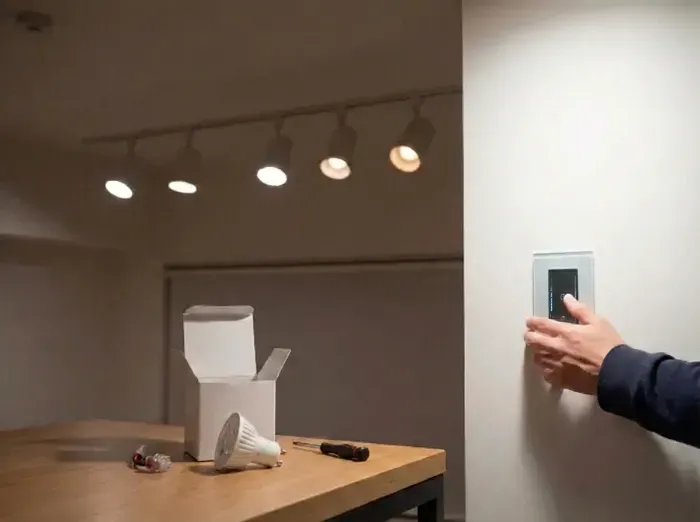
Ensuring compatibility between dimmer switches and LED drivers is crucial for smooth operation.
The Business Case: Why Quality GU10s Improve ROI
For a procurement manager, price is important, but Replacement Cost is critical.
1. Slash Maintenance Costs
A cheap GU10 bulb might save $0.50 upfront, but if it fails in a high-ceiling hotel lobby, the labor cost to bring in a lift and an electrician can exceed $100. Commercial-grade GU10s with isolated drivers and superior heat sinks ensure a lifespan of 25,000+ hours, reducing maintenance cycles and supporting strong lumen maintenance performance (L70)1.
2. Color Consistency (SDCM)
In a long corridor or retail shelf, nothing looks worse than unmatched shades of white—one bulb looking pinkish, the next greenish. This is defined by the MacAdam Ellipse (SDCM)2.
- Retail Grade: SDCM < 6 (Visible differences).
- Professional Grade: SDCM < 3 (Indistinguishable to the human eye).
Ensuring tight binning means your project looks professional from day one to year five.
Future Trends: Dim-to-Warm and Smart Integration
Static lighting is becoming obsolete in luxury hospitality. The trend is moving towards adaptive environments.

Smart integration allows for adaptive lighting environments in modern hospitality.
Dim-to-Warm Technology
Traditional LEDs simply get less bright when dimmed, often turning a dull gray. Dim-to-Warm GU10s mimic the behavior of halogens: as you dim them, the color temperature shifts from a crisp 3000K down to a cozy, candlelight-like 1800K.
Connected Lighting
Bluetooth Mesh and Zigbee-enabled GU10s allow facility managers to group lights and control scenes via a central tablet, eliminating the need for expensive rewiring.
Are GU10 bulbs being phased out?
A common concern among contractors is whether they are investing in obsolete technology.

Modern offices continue to utilize GU10s for their versatility and ease of retrofit.
The short answer is Nein. While regulations in the EU and US are banning inefficient halogen sources, the GU10 form factor remains the industry standard for mains-voltage spotlights. The technology inside is evolving, but the twist-and-lock base provides a secure, tool-free installation that integrated fixtures cannot match in terms of serviceability.
Common Installation Pitfalls to Avoid
Even the best products fail if installed incorrectly. Ensure your crew avoids these mistakes to protect your warranty and reputation.
1. Neglecting Socket Health (The "Arcing" Issue)
It’s not about "torque"; it’s about contact pressure. In retrofits, old ceramic GU10 sockets often have loose springs due to heat fatigue. A loose connection causes electrical arcing, which generates heat and melts the bulb base.
Action: Always inspect sockets during a retrofit. If they feel loose, replace the connector, not just the bulb.
2. Suffocating the Bulb
GU10 LEDs run cooler than halogens but still generate heat at the driver electronics. Placing high-power (7W+) LEDs into fully enclosed, unventilated cans drastically shortens their life.
Action: Ensure at least 10mm of airspace around the fixture or specify IC-rated bulbs designed for enclosed spaces.
| Mistake | Consequence | Professional Fix |
|---|---|---|
| Mixing Batches | Inconsistent color (SDCM variance) | Order spares from the same production "Bin" code. |
| Overloading Dimmers | Driver buzz / Breaker trips | Calculate max load using the LED rating, not the Incandescent rating. |
| Ignoring Voltage | Immediate failure | Verify 120V vs. 230V specs before bulk ordering. |
Conclusion: Partner with Technical Experts
Achieving a flicker-free, high-end atmosphere requires more than just a light bulb—it requires a lighting solution engineered for compatibility.
At Tecolite, we don’t just sell units; we provide the technical backing to ensure your project’s success. From verified compatibility lists to tight color binning, we protect your reputation.
Don’t let compatibility guesswork eat into your project margins.
Contact our Engineering Team today to request a Free Flicker-Free Sample Kit or a custom compatibility report for your next commercial project.
Footnotes:
Lumen Maintenance (L70): The point at which an LED maintains 70% of its initial light output, marking the end of its useful life according to IES LM-80 standards. ↩
SDCM (Standard Deviation of Colour Matching): A metric used to describe the color difference between light sources. Lower numbers indicate higher consistency. ↩