Büro-Schienenbeleuchtungsdesign: Flexible Beleuchtungslösungen für moderne Arbeitsumgebungen
Einführung
Office lighting failures rarely come from fixture output alone. In most projects, the real issue is that the lighting system cannot adapt to layout changes, workstation shifts, partition updates, and multi-use zones after handover. For contractors, specifiers, and facility managers, that creates a predictable chain of problems: dark desks, glare complaints, repeated aiming adjustments, ceiling rework, and unnecessary maintenance calls.
Office track lighting design addresses this as a system-level solution rather than a decorative choice. When properly planned, it gives commercial spaces the flexibility to support open-plan offices, focused task areas, meeting zones, circulation paths, and collaborative settings without rebuilding the ceiling each time the layout changes. That flexibility directly reduces site disruption, preserves lighting quality, and lowers long-term operational cost.
This guide is written for contractors, project buyers, lighting distributors, facility managers, and office fit-out teams evaluating LED track lighting systems for open offices, meeting areas, reception zones, and flexible commercial workspaces.
Executive Summary
Office track lighting improves flexibility, supports changing workspace layouts, and simplifies future lighting adjustments. When beam angle, illuminance1, fixture spacing, aiming, track compatibility, electrical loading, and control zoning are engineered correctly, track systems reduce rework, improve visual comfort, and provide a more maintainable lighting platform for modern offices.
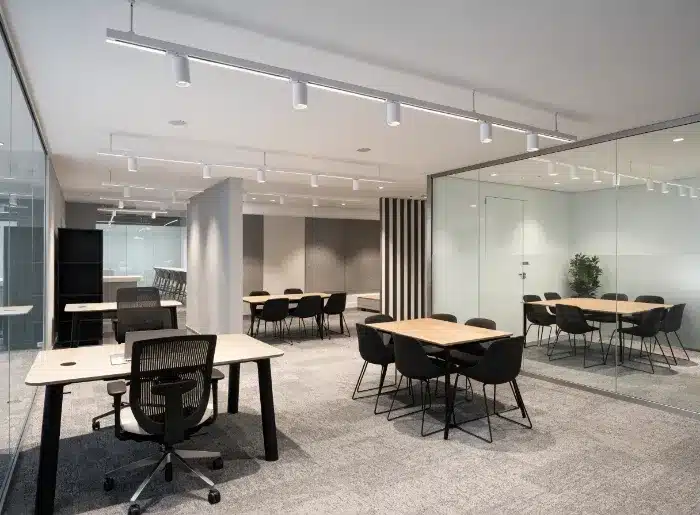
office track lighting design for modern workspace flexibility
Why Track Lighting Is Popular in Modern Office Design
On-Site / Commercial Reality
Modern offices no longer operate as fixed layouts. Open work areas become team zones, quiet rooms become video-call booths, and collaboration spaces are reconfigured after occupancy. With conventional recessed layouts, every change can mean uneven light distribution, additional fixtures, ceiling patching, or exposed coordination issues with HVAC and fire services. That increases labor cost and extends access time, especially in occupied offices where after-hours work is required.
Deep Dive & Engineering Solution
Track lighting is popular because it separates the electrical supply path from the final aiming position of the luminaire2. Instead of fixing light output at one permanent ceiling point, the system allows fixtures to be repositioned, added, removed, or re-aimed along the track.
For offices, this is valuable in several practical ways:
- open-office track layouts can be adjusted when desk clusters change
- spotlight heads can be repositioned to suit workstation density
- task lighting can be strengthened over focused work areas
- accent lighting can be directed toward meeting tables, breakout zones, and presentation walls
This makes LED track lighting particularly suitable for offices that evolve over time. The system supports a layered lighting strategy rather than a single uniform grid. General lighting can come from broader-beam track heads, while narrower and adjustable luminaires can support visual tasks or highlight collaborative areas.
| Merkmal | Fixed Recessed Layout | LED Track Lighting System | Impact on Maintenance / ROI |
|---|---|---|---|
| Post-install adjustment | Very limited | Hoch | Lower rework cost |
| Suitability for layout changes | Poor | Strong | Better long-term flexibility |
| Fixture replacement or relocation | Ceiling intervention often required | Usually track-based adjustment only | Reduced maintenance disruption |
| Zoning adaptability | Mittel | Hoch | Better use of installed infrastructure |
Factory Note
From a manufacturing perspective, the value of track lighting in offices is not only aesthetic flexibility. The real advantage is preserving compatibility between the installed power infrastructure and the changing lighting requirement. In commercial projects, that usually translates into fewer ceiling modifications over the life of the fit-out.
Key Advantages of Office Track Lighting Systems
On-Site / Commercial Reality
In office fit-outs, the most expensive lighting mistakes often appear after practical completion. Teams move in, furniture changes, meeting areas are redefined, and suddenly the original lighting no longer matches the actual use of space. If the system cannot adapt, facility teams are forced into temporary fixes or partial replacement.
Deep Dive & Engineering Solution
The main advantages of office track lighting systems are flexibility, zoning control, serviceability, and targeted illumination.
Key engineering benefits include:
- Adjustable fixture positioning for evolving office layouts
- Directional control for workstations, circulation routes, and collaboration zones
- Simplified adaptation without opening ceilings
- Better support for task lighting where desktop visual performance is critical
- Improved accent lighting for reception areas, informal meeting points, and feature walls
- Efficient integration with LED sources for lower connected load
A well-designed track system also helps avoid over-lighting. Instead of using a dense uniform grid to cover every possible arrangement, luminaires can be aimed where light is actually needed. That improves utilization efficiency and can reduce excess wattage.
| Merkmal | Conventional Downlight Grid | Track Lighting System | Impact on Maintenance / ROI |
|---|---|---|---|
| Lighting flexibility | Niedrig | Hoch | Longer usable life of installed system |
| Task-specific aiming | Begrenzt | Strong | Better workstation performance |
| Reconfiguration effort | Hoch | Low to moderate | Lower labor cost |
| Adaptation to mixed-use areas | Poor to moderate | Strong | Reduced need for additional fittings |
In commercial office fit-outs, flexibility matters most when it preserves operational continuity. If one lighting rail can support several future workstation arrangements without ceiling reconstruction, the project gains a measurable maintenance advantage. That flexibility still depends on track loading, circuit zoning, adapter compatibility, and the availability of matching replacement heads.
Types of Track Lighting Used in Offices
On-Site / Commercial Reality
Selecting the wrong track head type creates commissioning issues quickly. A narrow spotlight used for general office lighting leads to patchy illumination. A flood beam used over presentation surfaces may cause spill light and reduced contrast. Once installed in quantity, correction means re-aiming, replacing optics, or changing fixture types.
Deep Dive & Engineering Solution
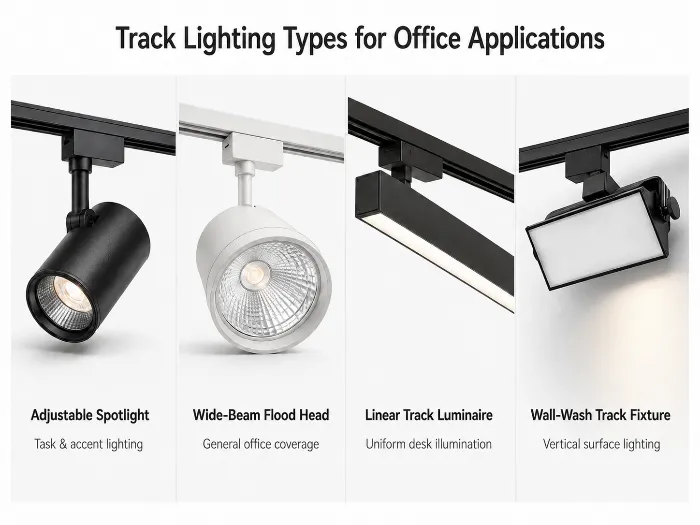
Office track lighting typically uses several fixture categories, each serving a different function:
Adjustable spotlights
Used for task lighting, highlighting work areas, or accenting presentation walls and collaborative zones.Wide-beam flood track heads
Suitable for general lighting in open office spaces where broader distribution is required.Linear track luminaires
Used where more uniform illumination is needed over desks, circulation paths, or shared work tables.Wall-wash track fixtures
Applied in offices with vertical display surfaces, branding walls, or visual presentation areas.
The most effective office systems usually combine more than one type. Open work areas may use linear or wide-beam heads for ambient lighting, while adjustable spotlights provide emphasis in lounges, touchdown spaces, or meeting corners.
The track system itself also requires careful selection. Commercial offices may use single-circuit or multi-circuit mains-voltage track, recessed or surface-mounted track, suspended track, or low-voltage magnetic systems. These categories should not be treated as interchangeable. Track dimensions, conductor arrangement, earthing, adapter geometry, circuit selection, control method, and permitted load vary by system and market.
Before specification, confirm whether future replacement heads must remain within one manufacturer’s system. A lamp or fitting that appears physically similar may not be electrically or mechanically compatible with another track. The number of heads that can be added is also limited by the track, feed connector, circuit protection, driver inrush current, and control-device rating.
| Merkmal | Spotlight Track Head | Linear Track Luminaire | Impact on Maintenance / ROI |
|---|---|---|---|
| Best use | Task or accent lighting | Allgemeine Bürobeleuchtung | Correct selection reduces retrofit risk |
| Beam control | Hoch | Moderate to broad | Better application matching |
| Visual uniformity | Lower unless carefully planned | Höher | Fewer user complaints |
| Re-aiming flexibility | Strong | Begrenzt | Useful in changing zones |
Factory Note
From a manufacturing perspective, office projects benefit when optical distribution is standardized early. Mixing too many beam types without a layout logic often creates site-level confusion, especially when replacement heads are ordered later and beam identification is no longer clear.
types of office track lighting spotlights linear track and flood beams
Office Track Lighting Buyer Checklist
For procurement, a track-lighting schedule should define the system and application requirements clearly enough to compare compatible products rather than wattage alone.
| Check Item | What to Confirm | Warum es wichtig ist |
|---|---|---|
| Schienensystem | Stromkreistyp, Spannung, Erdung, Abmessungen, Adapterstandard und Montagemethode | Verhindert mechanische oder elektrische Inkompatibilität |
| Elektrische Belastung | Schiene, Speisung, Verbinder, Schutzschalter, Steuergerät und Treiber-Einschaltstromgrenzen | Verhindert Überlastung und instabile Schaltvorgänge |
| Leuchtenfunktion | Umgebungs-, Arbeitsplatz-, Akzent-, Wandflut- oder vertikale Beleuchtung | Vermeidet die Verwendung schmaler Akzentleuchten als allgemeine Bürobeleuchtung |
| Strahl- und photometrische Daten | Strahlwinkel, Feldverteilung, IES- oder LDT-Datei, Abstand und Ausrichtung | Unterstützt Schreibtischgleichmäßigkeit und Blendungsprüfung |
| Visueller Komfort | Abschirmung, Sichtbarkeit der Lichtquelle, Bildschirmreflexionen und anwendbare Blendkriterien | Reduziert Beschwerden in bildschirmbasierten Arbeitsbereichen |
| Farbqualität | Farbtemperatur, Farbwiedergabeindex, Farbkonstanz und Toleranz bei Ersatzchargen | Erhält ein einheitliches Büroerscheinungsbild |
| Treiberleistung | Flackern, Dimmverfahren, Mindestlast, Steuerkompatibilität und Stromqualität | Verhindert sichtbare Instabilität und Inbetriebnahmeprobleme |
| Austauschplanung | Verfügbarkeit kompatibler Leuchtenköpfe, Optiken, Adapter und Treiber | Schützt die langfristige Flexibilität, die das System verspricht |
| Musterverifizierung | Vollständiger Test mit der vorgesehenen Schiene, Steuergerät, Deckenhöhe und Möblierung | Reduziert das Risiko vor Großbestellungen |
TECOs Produktpalette umfasst ausgewählte Schienenbeleuchtungsarmaturen und austauschbare LED-Spots für kompatible Büro- und Gewerbeanwendungen. Beispiele sind die TECO Stromschienenleuchte für PAR30-Strahler und ein kompatibles PAR30 E27 dimmbare LED-Spotlampe veröffentlicht mit 20° / 30° Strahloptionen. Die Eignung für ein Büroprojekt hängt weiterhin von der erforderlichen Beleuchtungsstärke, der Blendkontrolle, der Schienenkompatibilität, der Montagehöhe, der elektrischen Belastung und dem Steuerungsschema ab.
Büro-Schienenbeleuchtung Layout-Strategien
On-Site / Commercial Reality
Schlechte Layoutplanung führt zu Blendung, ungleichmäßiger Schreibtischbeleuchtung, dunklen Verkehrswegen und Konflikten zwischen Leuchten und Deckeneinrichtungen. Bei Büroausbauten werden diese Probleme nach Bezug schwieriger zu beheben, da Zugangsgeräte, Arbeitszeitbeschränkungen und Mieterkoordination die Korrekturkosten erhöhen.
Deep Dive & Engineering Solution
Die Büro-Schienenbeleuchtungsplanung sollte mit der Raumfunktion beginnen, nicht allein mit der Leuchtenanzahl.
Praktische Layoutstrategien umfassen:
- Verlegung von Schienenlinien parallel zu Arbeitsplatzreihen in Großraumbüros
- Verwendung verstellbarer Köpfe zur Feinabstimmung der Beleuchtung über Schreibtischgruppen
- Platzierung von dedizierter Arbeitsplatzbeleuchtung dort, wo fokussierte visuelle Arbeit erwartet wird
- Einbau von Akzentbeleuchtung in Kollaborationsbereichen zur Verbesserung der Raumidentität
- Trennung von Verkehrsbeleuchtung und Schreibtischbeleuchtung, wo möglich
- Koordinierung von Schienenpositionen mit Deckenelementen, HVAC-Luftauslässen, Sprinklern und akustischen Elementen
Für offene Büros funktionieren durchgehende oder segmentierte Schienenlinien normalerweise besser als verstreute kurze Abschnitte. Dies bietet eine stabile elektrische Rückgratstruktur und behält gleichzeitig Flexibilität für künftige Neuplatzierungen.
Eine geschichtete Strategie ist meist effektiver als gleichmäßige Ausrichtung:
- Umgebungsbeleuchtung für allgemeine Sichtbarkeit
- Arbeitsplatzbeleuchtung für Schreibtische und konzentrierte Arbeit
- Akzentbeleuchtung für Treffpunkte, Lounges und Gemeinschaftszonen
Während der Büroinbetriebnahme treten Ausrichtungs- und Zielungsfehler oft als ungleichmäßige Schreibtischhelligkeit, reflektierte Blendung auf Bildschirmen oder direkte Sichtbarkeit der Quelle aus normalen Sitzpositionen auf. Eine gute Layoutdisziplin vor der Installation verhindert später eine lange Reihe von Zielungsanpassungen nach Feierabend.
Den richtigen Strahlwinkel für Büro-Schienenbeleuchtung wählen
On-Site / Commercial Reality
Die Auswahl des Abstrahlwinkels ist eine der häufigsten Ursachen für Unzufriedenheit bei Büro-Schienenbeleuchtung. Ist der Strahl zu eng, erhalten Schreibtische helle Hotspots mit schlechter Gleichmäßigkeit. Ist er zu breit, fällt Licht auf Bildschirme, Verkehrsbereiche oder benachbarte Zonen, was den Kontrast verringert und Ausgangsleistung verschwendet.
Deep Dive & Engineering Solution
Abstrahlwinkel3 sollte Montagehöhe, Arbeitsgröße, Abstand und den Zweck der Zone entsprechen.
Allgemeine Richtlinie:
- Schmaler Strahl: geeignet zum Hervorheben spezifischer Punkte, Anzeigen oder kleiner Kollaborationsmerkmale
- Mittlerer Strahl: nützlich für Arbeitsplatzbeleuchtung über Schreibtischen oder kompakten Tischen
- Breiter Strahl: bevorzugt für breitere Umgebungsabdeckung in offenen Bürobereichen
Die richtige Wahl hängt ab von:
- Deckenhöhe
- Abstand von der Leuchte zur Arbeitsebene
- erforderliche Beleuchtungsstärke
- Abstand zwischen Leuchten
- gewünschte Überlappung für Gleichmäßigkeit4
Für den Büroeinsatz eignen sich breitere Strahlen oft besser für die Allgemeinbeleuchtung, während mittlere Strahlen praktisch für die Betonung von Arbeitsplätzen sind. Enge Strahlen sollten gezielt eingesetzt werden, nicht als Hauptlichtquelle für die allgemeine Bürobeleuchtung.
In bildschirmbasierten Büros müssen Strahlwinkel und Ausrichtungsrichtung gemeinsam geprüft werden. Ein technisch ausreichender Lux-Wert kann dennoch zu Beschwerden führen, wenn ein Strahler im normalen Blickfeld sichtbar ist oder reflektierte Blendung auf Monitoren, Glaswänden oder glänzenden Schreibtischen verursacht. UGR kann die Blendungsbewertung unterstützen, sollte jedoch nicht als vollständige Vorhersage für jede reale Strahleranordnung behandelt werden, insbesondere wenn kleine LED-Quellen eine hohe oder ungleichmäßige Leuchtdichte aufweisen.5
| Merkmal | Enger Strahl | Breiter Strahl | Impact on Maintenance / ROI |
|---|---|---|---|
| Lichtkonzentration | Hoch | Niedriger | Falsche Wahl erhöht Beschwerden |
| Gleichmäßigkeit über Schreibtischen | Niedriger | Höher | Besserer Komfort reduziert Anpassungsanfragen |
| Streulichtsteuerung | Besser | Reduziert | Muss zur Anwendung passen |
| Beste Büronutzung | Akzent- oder Fokuspunkte | Umgebungsbeleuchtung | Verbesserte Anwendungsgenauigkeit reduziert Nacharbeit |
Factory Note
Aus Herstellungssicht sollten Entscheidungen zum Abstrahlwinkel niemals nur aufgrund des Aussehens getroffen werden. In Büroprojekten können zwei optisch ähnliche Strahler auf der Arbeitsebene sehr unterschiedlich wirken. Verifizierte photometrische Daten6 ist weitaus zuverlässiger als das Vertrauen auf Nennleistung oder visuelle Eindrücke während des Mock-ups.
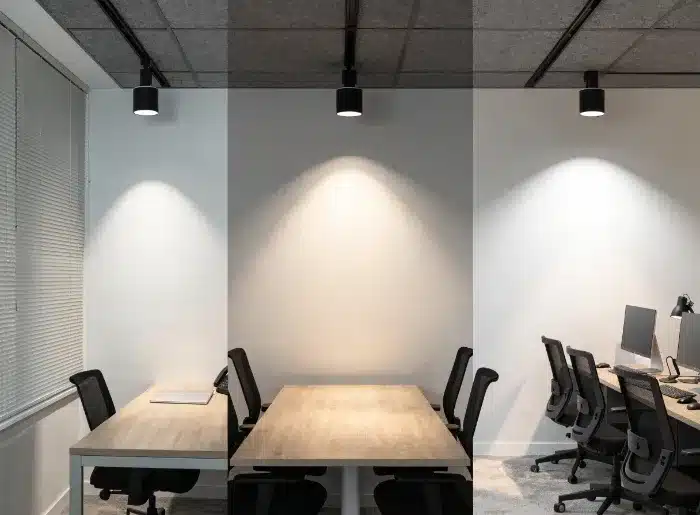
Büro-Strahlerbeleuchtung Abstrahlwinkelauswahl für Schreibtische und Kollaborationsbereiche
Empfohlene Helligkeitsstufen für Bürobeleuchtung
Unterbeleuchtung führt zu visueller Ermüdung und beschwerdegetriebenen Anpassungen. Überbeleuchtung erhöht die angeschlossene Last, erzeugt Blendungsrisiken und erzwingt oft Dimmen oder Neuausrichtung nach der Inbetriebnahme. Beide Ergebnisse bedeuten zusätzlichen Aufwand und Unzufriedenheit.
Die empfohlene Bürohelligkeit sollte auf den Aufgabenanforderungen basieren, nicht auf einem einzigen pauschalen Lux-Wert für alle Bereiche. Arbeitsplätze, Besprechungsbereiche, Flure, Empfangspunkte und Entspannungsbereiche haben unterschiedliche visuelle Anforderungen.
Als allgemeiner Ansatz:
- Büroarbeitsplätze benötigen eine stabile und komfortable Beleuchtungsstärke auf der Arbeitsebene
- Kollaborationsbereiche profitieren von ausgewogenem Umgebungslicht mit etwas fokaler Betonung
- Zirkulationsbereiche können mit niedrigeren Beleuchtungsstärken als aktive Arbeitszonen betrieben werden
- Präsentations- oder Anzeigeflächen erfordern möglicherweise vertikale Beleuchtung, nicht nur horizontale Helligkeit
Schienenbeleuchtung hilft, weil die Lichtleistung gezielt verteilt werden kann. Anstatt das gesamte Büro auf eine hohe Durchschnittshelligkeit zu bringen, kann der Designer Arbeitsplätze verstärken und unnötige Lichtabgabe anderswo reduzieren.
Die folgenden Werte sind vorläufige Referenzwerte für die Beibehaltung der Beleuchtungsstärke, keine allgemeinen Einhaltungsgrenzen. Endziele sollten anhand des aktuellen am Projektstandort geltenden Arbeitsplatzbeleuchtungsstandards, der visuellen Aufgabe, der Bedürfnisse der Nutzer, des Tageslichtanteils, der Steuerungsstrategie, der Gleichmäßigkeit und der Blendungsanforderungen bestätigt werden. ISO/CIE 8995-1:2025 ist der aktuelle internationale Standard, der Menge und Qualität der Beleuchtung für Innen-Arbeitsplätze abdeckt.7
| Bürobereich / Aufgabe | Häufige vorläufige Referenz | Designhinweis |
|---|---|---|
| Allgemeine Schreibtischarbeit, Schreiben, Tippen und Lesen | 300–500 Lux auf der Arbeitsebene | Viele Spezifikationen verwenden 500 Lux für reguläre Büroaufgaben; lokale Anforderungen und Aufgabenschwierigkeit bestätigen |
| Besprechungs- und Konferenztische | 300–500 lux | Provide dimming or scene control where presentations are common |
| Reception and waiting areas | 200–300 lux | Combine functional light with vertical and accent illumination |
| Corridors and internal circulation | 100–200 lux | Avoid excessive contrast at transitions into work areas |
| Breakout and informal collaboration zones | 150–300 lux | A softer level may be suitable if visual tasks are limited |
| Presentation walls and whiteboards | Project-specific vertical illuminance | Check visibility, contrast, reflections, and video-camera use |
Illuminance alone does not establish office-lighting quality. The design should also check task-area uniformity, surrounding-area brightness, direct and reflected glare, color quality, flicker, daylight interaction, and the visibility of track heads from seated positions.
In commercial office projects, excessive brightness is often mistaken for better lighting quality. In practice, offices perform better when maintained illuminance is matched to the task, glare is controlled, and beam distribution is properly overlapped. That approach is more stable for long-term user acceptance.
Office Track Lighting Design Example
Without a design logic tied to actual use, office track lighting becomes a collection of movable fixtures without performance consistency. This often causes late-stage site changes and repeated aiming visits.
Consider a mid-sized open office with:
- primary desk clusters in the central area
- collaborative seating near the perimeter
- circulation routes between departments
- a small presentation wall and reception corner
A practical track lighting design could use:
- linear or wide-beam track luminaires over the main desk area for ambient coverage
- adjustable medium-beam heads aimed at high-use workstation zones
- accent spotlights for collaboration areas to create visual hierarchy
- dedicated track heads for vertical illumination at the presentation wall
- separate switching or dimming groups for work zones and shared zones
This arrangement allows the office to evolve. If workstation density changes, fixture heads can be repositioned along the track without major infrastructure changes. If a collaborative corner becomes a focused work area, beam distribution can be adjusted rather than replacing the entire ceiling layout.
During tenant fit-out and post-occupancy adjustment, zones often change function after furniture and teams move in. A design example only works in practice if the track system allows operational changes without exceeding circuit loads, losing control zoning, or introducing new glare.
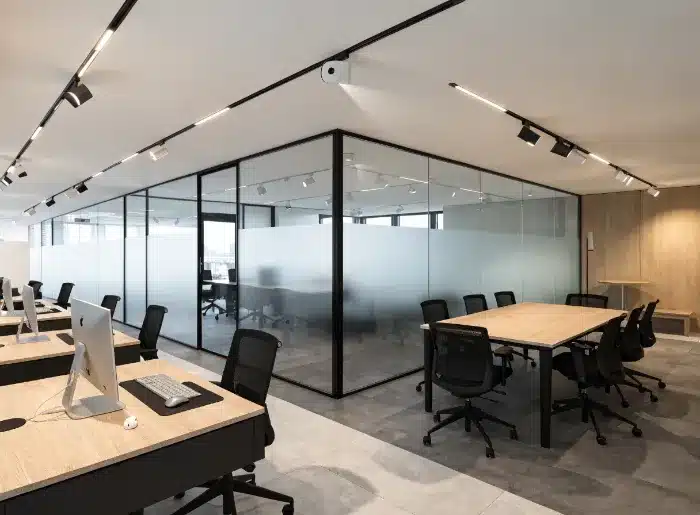
office track lighting design example for open plan workspace and collaboration zones
Energy Efficiency in Office Track Lighting
Energy claims are common, but poor system design can cancel the benefit. If track heads are over-specified, poorly aimed, or used to compensate for weak layout planning, the installation may still consume more power than necessary and create maintenance inefficiencies.
LED track lighting improves office energy efficiency primarily through three mechanisms:
- lower source power compared with legacy technologies
- better directional control, placing light only where needed
- adaptability, which reduces the need to over-light for future uncertainty
Because office environments change, fixed systems are often designed with excess coverage as a safety margin. Track lighting reduces that inefficiency by allowing later adjustment. Instead of installing permanent surplus light, the design can be tuned as space use becomes clear.
For best results, energy efficiency should be evaluated at system level:
- luminaire efficacy8
- optical control
- dimming compatibility
- zoning strategy
- actual usage profile
Factory Note
From a manufacturing perspective, the most efficient office lighting system is not necessarily the one with the lowest fixture wattage. It is the one that delivers the required task illumination with the least correction, least overspill, and least need for later fixture additions.
Common Office Track Lighting Mistakes
Most office track lighting failures are not caused by product defects. They come from planning shortcuts: poor aiming logic, wrong beam selection, ignoring task zones, or using accent fixtures as general lighting. These mistakes increase commissioning time and can damage confidence in the whole installation.
Common mistakes include:
- treating track lighting as decoration rather than a primary lighting system
- using narrow-beam spotlights for broad workstation coverage
- failing to provide separate task lighting for desks
- ignoring vertical illumination in meeting or presentation areas
- placing tracks without coordinating with furniture layout
- neglecting glare control for screen-based work
- over-lighting collaborative zones while under-lighting task areas
- assuming all track heads and adapters are cross-compatible
- adding fixtures without checking track load, inrush current, or control-device capacity
- relying on average lux while ignoring glare and monitor reflections
The correction is straightforward but must happen early:
- map real office functions first
- assign ambient, task, and accent roles clearly
- verify beam spread against ceiling height and task plane
- use track flexibility as part of the design strategy, not as a rescue method after poor planning
During commissioning, the most time-consuming adjustments usually come from systems that were expected to “be flexible later” without being engineered properly at the start. Flexibility works best when supported by a disciplined layout and a clear lighting hierarchy.
Future Trends in Office Lighting Design
Office environments are becoming more dynamic, with hybrid working, shared desks, modular furniture, and changing occupancy patterns. Lighting systems that cannot adapt will require more frequent modification and create higher life-cycle cost.
Future office lighting design is moving toward adaptable, layered, and data-supported systems. Track lighting is well aligned with this direction because it already supports physical flexibility at the luminaire level.
Key trends include:
- more reconfigurable office layouts requiring movable lighting points
- greater use of layered lighting instead of uniform blanket illumination
- increased focus on visual comfort for screen-intensive work
- wider use of dimmable LED systems for zone-based control
- stronger emphasis on maintainability and long-term adaptability
LED track systems are especially relevant because they allow offices to respond to space planning changes without discarding the installed lighting backbone. That makes them suitable for fit-outs where future change is expected rather than occasional.
In workplace renovation and tenant-improvement projects, the most resilient lighting systems are those that accept operational change without unnecessary hardware replacement. The commercial value is not only energy saving, but preserving usable infrastructure through multiple layout revisions while maintaining compatible fixtures, controls, and replacement parts.
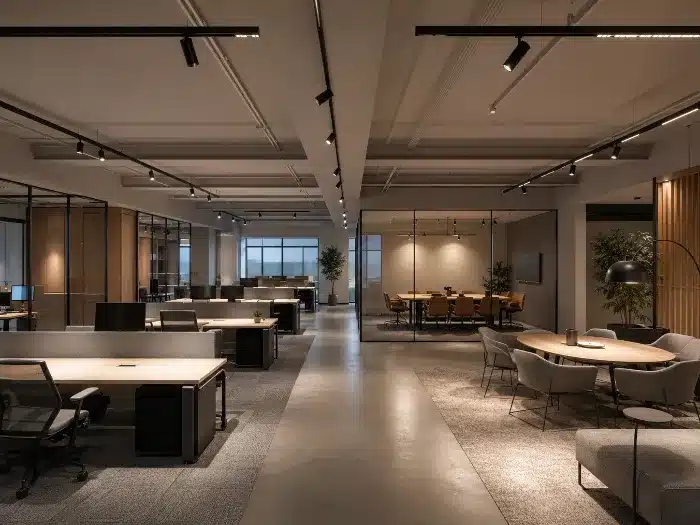
future trends in office lighting design with flexible LED track systems
Conclusion: Creating Flexible and Efficient Office Lighting
Office track lighting design gives modern workspaces a practical way to combine adaptability, visual performance, and maintainability. When fixture type, beam angle, layout, and task zoning are planned correctly, the system can support open offices, workstation lighting, and collaborative areas without repeated ceiling modification.
For commercial projects, that means better reliability, lower maintenance effort, and reduced lifetime system cost. The real strength of track lighting is not only adjustable fixtures, but the ability to keep the lighting infrastructure usable as the workplace evolves.
B2B Engineering Recommendation
For office track lighting projects, project buyers and contractors can send reflected ceiling plans, workstation layouts, proposed track types, circuit schedules, target illuminance, beam-angle requirements, and control information to the TECO engineering team for review before bulk ordering. Track and adapter compatibility, electrical loading, beam distribution, dimming behavior, sample performance, and replacement consistency should be verified before final approval.
Fußnoten
Illuminance is the amount of light falling on a surface, typically measured in lux. ↩
Luminaire is the complete lighting unit, including light source, optics, housing, and electrical components. ↩
Beam angle is the angle at which light is distributed from a luminaire. ↩
Uniformity refers to how evenly light is distributed across a task area or space. ↩
CIE 232:2019 discusses discomfort glare from luminaires with non-uniform source luminance and notes limitations in conventional UGR evaluation for some LED luminaire designs. ↩
Photometric data is measured performance data describing light output, distribution, and intensity. ↩
ISO/CIE 8995-1:2025, Light and lighting — Lighting of work places — Part 1: Indoor, specifies lighting requirements for visual comfort, performance, and safety in indoor workplaces. ↩
Luminaire efficacy is the ratio of useful light output to electrical power input, usually expressed in lumens per watt. ↩