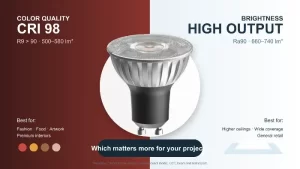
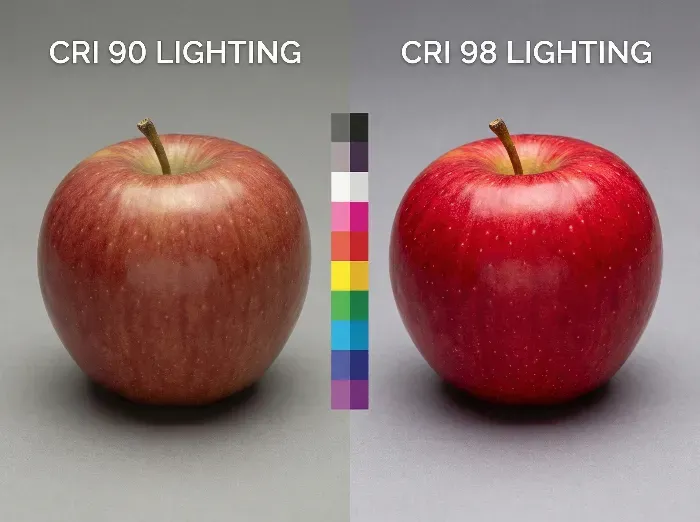
Vergleichsbild, das einen Apfel und eine Farbtafel unter CRI-90- gegenüber CRI-98-Beleuchtung zeigt und Unterschiede in der Farbwiedergabegenauigkeit hervorhebt.
Kurze Antwort: CRI 90 vs CRI 98 – Was sollten Sie wählen?
- CRI 90 ist für 80–90% der gewerblichen Beleuchtungsprojekte ausreichend
- CRI 98 ist nur für farbkritische Umgebungen notwendig
In den meisten realen Anwendungen ist der visuelle Unterschied minimal über 1–2 Meter hinaus
Fazit:
CRI 90 bietet die beste Balance aus Kosten, Effizienz und visuelle Leistung für die meisten B2B-Beleuchtungsprojekte.
Wesentliche Erkenntnisse
- CRI 90 = Industriestandard für gewerbliche Beleuchtung
- CRI 98 = Nischen-Upgrade für Premium-Umgebungen
- In vielen Fällen ist R9 wichtiger als CRI
- Höherer CRI verringert die Effizienz (lm/W)
- TM-30 bietet eine genauere Bewertung als CRI
Was ist CRI in LED-Beleuchtung?
CRI (Farbwiedergabeindex) misst, wie genau eine Lichtquelle Farben im Vergleich zu einer Referenzquelle wiedergibt.
- Skala: 0–100
Basierend auf 8 Standardtestfarben (R1–R8)
Referenz (CIE-Standard):
https://cie.co.at/publications/method-measuring-and-specifying-colour-rendering-properties-light-sources
Einschränkung des CRI
CRI tut schließt tiefes Rot (R9) nicht ein, was in kommerziellen Anwendungen wie: entscheidend ist
- Hauttöne
- Textilien
Lebensmittel- und Einzelhandelspräsentationen
Deshalb ist CRI allein nicht ausreichend für die Spezifikation.
CRI vs. R9: Warum die Rotwiedergabe wichtiger ist
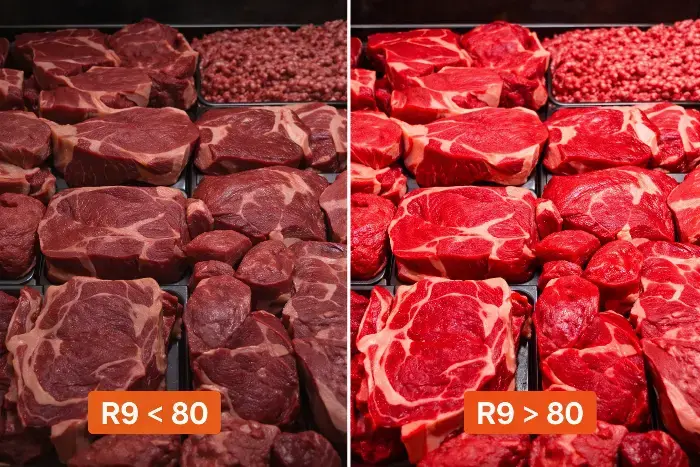
In praktischen Projekten:
- CRI 90 liefert typischerweise R9 > 50–80
- CRI 98 liefert typischerweise R9 > 90
Warum das wichtig ist:
- Hauttöne erscheinen natürlicher
- Produkte wirken reicher und gesättigter
Luxusumgebungen profitieren erheblich
Wesentliche Erkenntnis:
Eine CRI-90-Lampe mit hohem R9 kann eine CRI-98-Lampe mit schlechter spektraler Balance übertreffen.
CRI 90 vs. CRI 98: Direkter Vergleich
| Merkmal | CRI 90 | CRI 98 |
|---|---|---|
| Durchschnittliche Farbgenauigkeit | Hoch | Sehr hoch |
| R9 (Rotwiedergabe) | 50–80 | 90+ |
| Visueller Unterschied | Minimal | Leicht |
| Effizienz (lm/W) | Höher | Niedriger |
| Kosten | Niedriger | Höher |
| Anmeldung | Allgemeine gewerbliche | Premium |
Warum CRI 98 eine geringere Effizienz (lm/W) hat
Achieving CRI 98 requires broader spectral output, especially in red wavelengths.
Technical impact:
- 10%–15% reduction in luminous efficacy
- Increased energy consumption
- More complex phosphor design
Reference (DOE SSL research):
https://www.energy.gov/eere/ssl/solid-state-lighting
B2B implication:
- Harder to meet energy standards (ERP / DLC)
- Increased operational cost
- Reduced ROI in large-scale projects
Visual Difference: Can You Really See It?
Field tests and research show:
- Differences between CRI 90 and CRI 98 are hard to detect beyond 1–2 meters
- Under mixed lighting conditions, differences become negligible
Practical scenarios:
| Condition | Difference |
|---|---|
| Close-up (<1m) | Slightly visible |
| Normal viewing (2–5m) | Minimal |
| Mixed lighting | Nearly invisible |
Key takeaway:
In most commercial environments, CRI 98 does not provide noticeable visual improvement.
When CRI 90 Is Enough (Most Projects)
Geeignet für:
- Büros
- hotel corridors
- supermarkets
- general retail
Technical considerations:
- Stable spectral performance
- Better dimming compatibility
- Higher efficiency
Factory Direct Perspective
In large-scale hospitality projects:
- CRI 90 reduces cost by 15–25%
- Maintains visual consistency across batches
- Improves delivery lead times
When CRI 98 Is Worth It
Use CRI 98 only when color accuracy directly affects perception.
Recommended applications:
| Anmeldung | Recommended CRI |
|---|---|
| Jewelry retail | 98 |
| Art galleries | 98 |
| Medical lighting | 95+ |
| Luxury retail | 95–98 |
In these cases:
- small color differences matter
- premium experience is required
CRI vs TM-30: A More Accurate Evaluation Method
CRI is limited to 8 colors. TM-30 uses 99 color samples.
TM-30 key metrics:
- Rf (Fidelity Index) → similar to CRI
- Rg (Gamut Index) → color saturation
Typical values:
- CRI 90 → Rf ≈ 88–92
- CRI 98 → Rf ≈ 95+
- Ideal Rg → 95–105
Reference (IES TM-30):
https://www.ies.org/standards/tm-30-18/
Why TM-30 matters:
- More accurate color evaluation
- Detects oversaturation issues
- Better for high-end lighting design
Cost vs Benefit: Is CRI 98 Worth It?
| Faktor | CRI 90 | CRI 98 |
|---|---|---|
| Initial cost | Niedriger | Höher |
| Effizienz | Höher | Niedriger |
| ROI | Besser | Niedriger |
| Payback period | Faster | Slower |
Engineering insight:
- CRI 98 increases cost without proportional benefit
- Best used selectively
Practical Selection Guide
| Scenario | Recommendation |
|---|---|
| Standard commercial | CRI 90 |
| High-end retail | CRI 95+ |
| Galleries | CRI 98 |
| Gastgewerbe | CRI 90 |
Common Mistakes in CRI Selection
- Choosing CRI 98 for all areas
- Ignoring R9 values
- Assuming higher CRI = better quality
- Not testing lighting in real environments
FAQ: CRI 90 vs CRI 98
Is CRI 98 worth it?
Only for color-critical applications.
Is CRI 90 good enough?
Yes, for most commercial lighting projects.
Can people see the difference?
Usually not beyond 1–2 meters.
Is CRI enough for evaluation?
No — use TM-30 and R9 together.
Final Recommendation: How to Choose the Right CRI
Use this approach:
- Start with CRI 90 as baseline
- Upgrade to CRI 98 only if required
- Always verify R9 and TM-30 data
Ingenieurwissen
In real projects:
- Mixed CRI strategy reduces cost by 20%+
- Maintains visual performance
- Improves project ROI
Conclusion: Business Value
Choosing the correct CRI:
- reduces unnecessary cost
- improves lighting consistency
- minimizes project risk
- ensures better long-term performance
CRI 90 = industry standard baseline
CRI 98 = targeted upgrade solution
Planning a retail or hospitality project?
Our engineering team can support:
- CRI and R9 verification
- TM-30 reports
- lighting simulation (Dialux)
to ensure accurate performance before production.