Wie man eine differenzierte Produktlinie mit verschiedenen LED-Birnen aufbaut? Von ES111, AR111 bis GU10
Why LED Product Line Strategy Matters
In the lighting industry, a structured product line strategy for LED bulbs directly influences supply chain efficiency and market positioning. For project owners and procurement teams, this involves aligning bulb types like GU10, AR111, and ES111 with specific application needs, such as residential spots or commercial displays. Without a clear strategy, overlapping specifications can lead to inventory redundancies, increasing holding costs by complicating stock management across distributors. Conversely, a targeted approach ensures each bulb variant addresses distinct performance requirements, like beam angles or heat dissipation, allowing buyers to match products to project demands without excess options. This strategy also affects long-term supplier negotiations, as differentiated lines enable volume commitments on high-margin items while minimizing risks from commoditized low-end bulbs.
GU10’s Role in LED Product Portfolio
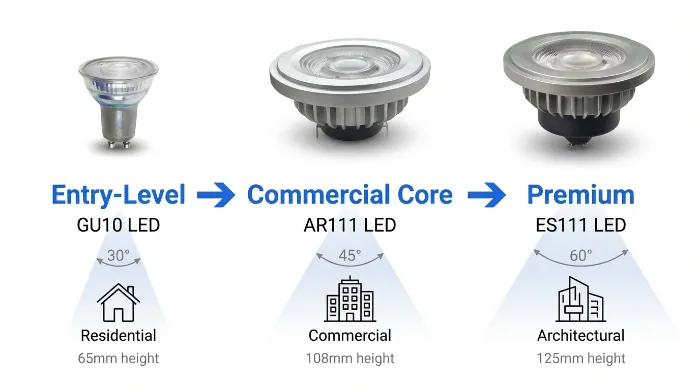
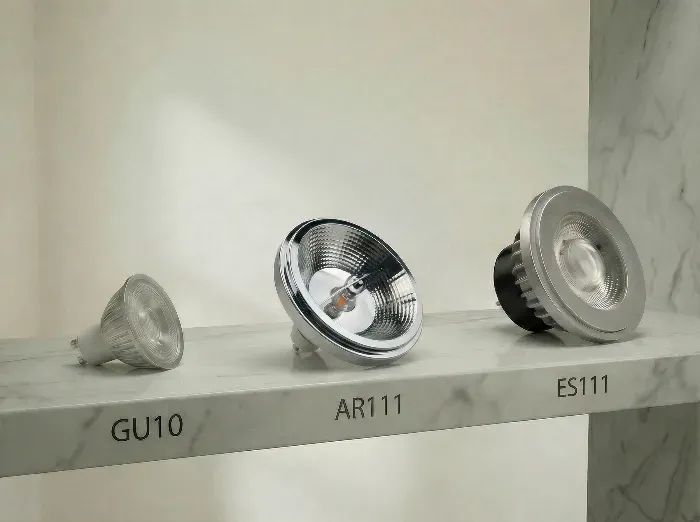
GU10 bulbs serve as an entry-level component in LED portfolios, primarily for low-voltage spot lighting in residential and hospitality settings. Their compact bi-pin base integrates easily into existing GU10 fixtures, making them suitable for retrofits where space constraints limit larger formats. In procurement, GU10’s role involves balancing cost with lumen output; while they offer quick installation, their lower wattage ceiling—typically under 5W for efficient models—restricts use in high-brightness applications, potentially requiring multiples for uniform coverage. This positions GU10 as a foundational portfolio element, supporting broader lines by handling volume sales in everyday projects, but it demands careful sourcing to avoid quality variances that could undermine reliability in moisture-prone environments like kitchens.
AR111: Core for Commercial LED Lighting
AR111 bulbs form the backbone of commercial LED installations, particularly in retail and office spaces requiring focused illumination. Their larger reflector design delivers wide beam spreads, up to 60 degrees, which suits track lighting and display cases where even light distribution is critical. For decision-makers, integrating AR111 involves evaluating compatibility with GU10 systems; while AR111 provides superior heat management through aluminum housings, its higher upfront cost necessitates assessing lifecycle savings from reduced energy use. Limitations include fixture size requirements, which can complicate retrofits in legacy setups, and potential glare issues if dimming controls are not specified upfront. In portfolios, AR111 anchors mid-tier commercial offerings, enabling scalable deployments but requiring validation of IP ratings for dust-exposed areas.
ES111 as Flagship LED Bulb Category
ES111 bulbs represent a premium category in LED lines, targeted at high-end architectural and hospitality projects demanding precise optics. Their E26/E27 base with integrated reflectors supports high CRI values above 90, essential for color-critical environments like galleries or luxury hotels. Procurement teams must consider ES111’s advanced drivers for flicker-free operation, which enhance user comfort but increase complexity in multi-bulb arrays, potentially raising maintenance needs if voltage fluctuations occur. As a flagship, ES111 differentiates portfolios by emphasizing durability—often with 50,000-hour lifespans—but trades off affordability, limiting adoption in budget-driven bids. This positions it as a strategic upsell option, where its superior beam control justifies premiums in specifications-heavy tenders.

Prevent Cannibalization in LED Bulbs
Cannibalization occurs when similar LED bulb variants, such as GU10 and AR111, compete internally by overlapping in features like lumen output or color temperature. To mitigate this, product managers segment lines by application: assign GU10 to compact residential spots and reserve AR111 for broader commercial beams, ensuring each fills a unique niche without diluting sales. In supply chains, this requires clear SKU differentiation through packaging and specs sheets, avoiding generic labeling that blurs boundaries. Trade-offs include higher development costs for distinct prototypes, but it preserves margins by directing buyers to purpose-built options. Monitoring distributor feedback helps identify overlaps early, adjusting assortments to maintain portfolio coherence without reducing overall inventory turnover.
Build Tiered LED Ladder for Upselling
A tiered structure in LED bulb lines creates a progression from basic to advanced models, facilitating upsell paths in procurement cycles. Start with GU10 as the base tier for standard efficacy, escalate to AR111 for enhanced optics in mid-tier commercial use, and culminate with ES111 for premium customization. This ladder guides project owners from cost-focused bids to value-driven selections, where each step adds features like tunable whites or smart connectivity. Responsibilities include educating sales teams on tier boundaries to prevent mis-selling, as pushing premium ES111 prematurely can erode trust if ROI is not demonstrated. Limitations involve inventory synchronization across tiers, risking stockouts in high-demand base levels, but it supports revenue growth by aligning with evolving project scopes.
Distributor Views on LED Product Lines
Distributors prioritize LED lines that minimize handling complexities, favoring portfolios with modular variants like GU10 for quick-turnover residential orders and AR111/ES111 for specialized commercial pulls. From their perspective, balanced assortments reduce return rates by matching bulb bases to common fixtures, but over-diversification strains warehouse space, prompting demands for consolidated shipping from suppliers. Key concerns include lead times for premium ES111, which can delay projects if not forecasted, versus the reliability of GU10 volumes. Distributors also value transparency in spec updates to avoid obsolescence risks, influencing their stocking decisions toward lines that offer predictable margins without excessive customization burdens.
Design Differentiated LED Bulb Portfolio
Designing a differentiated portfolio starts with mapping bulb types to market segments: GU10 for accessible entry points, AR111 for versatile commercial cores, and ES111 for specialized flagships. This involves specifying unique attributes, such as AR111’s reflector efficiency versus ES111’s optical precision, to avoid feature parity. Procurement implications include supplier audits for consistent quality across variants, ensuring compliance with standards like UL or CE without inflating costs. Trade-offs encompass R&D investments for differentiation, which yield competitive edges but require ongoing validation through field testing to confirm performance in real installations. The result is a portfolio that supports targeted bidding, where each bulb’s role enhances overall adaptability to diverse project requirements.
Schlussfolgerung
Building a differentiated LED product line with GU10, AR111, and ES111 involves weighing accessibility against specialization, where entry-level options drive volume but premium tiers capture margins in complex projects. Key trade-offs center on inventory management and application fit, emphasizing the need for segmentation to curb cannibalization and enable tiered progression. Decision-makers benefit from strategies that align portfolios with distributor needs and end-user demands, prioritizing operational reliability over expansive variety.
Sources
- Illuminating Engineering Society (IES) Handbook: Standards for LED bulb specifications and applications. Available at ies.org.
- International Electrotechnical Commission (IEC) 62612: Guidelines on performance criteria for LED lamps. Available at webstore.iec.ch.
- Lighting Research Center Reports: Analysis of reflector bulb efficiencies in commercial settings. Available at lrc.rpi.edu.
CTA
For further details on LED bulb procurement strategies, consult industry standards or supplier technical datasheets relevant to your project specifications.