Warum Projektkäufer zu ODM LED-Spots von chinesischen Herstellern wechseln
Commercial lighting procurement is undergoing a structural shift. For decades, project buyers relied on established lighting brands to minimize risk, ensure compliance, and simplify approvals. Today, that model is increasingly strained.
Rising customization demands, tighter project timelines, and pressure on lifecycle cost control are forcing buyers to reassess how lighting products are specified and sourced. As a result, ODM LED spotlights from Chinese manufacturers are becoming a practical alternative—not as a low-cost substitute, but as a different procurement strategy altogether.
This article examines why project buyers are making this shift, where ODM sourcing delivers real value, where it introduces new risks, and how experienced procurement teams evaluate whether ODM or branded solutions make sense for a given commercial project.
How Commercial Lighting Procurement Has Changed in Recent Years
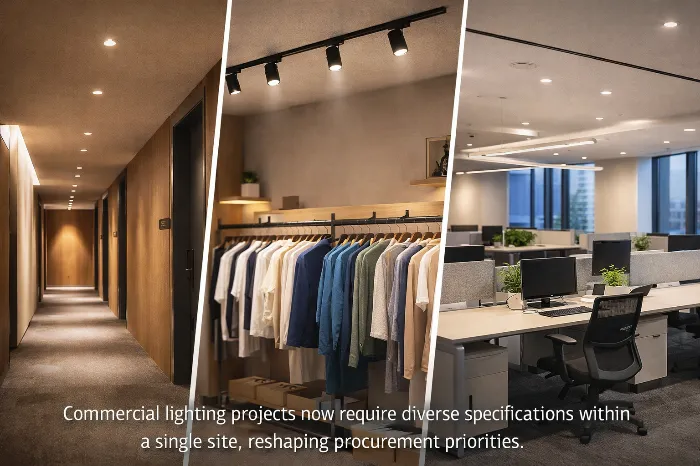
Image showing varied lighting applications in commercial spaces, including a paneled corridor, a retail clothing area with track spotlights, and an open office workspace with desks and plants.
Commercial lighting projects have become more fragmented and site-specific. Instead of deploying a single standardized luminaire across an entire development, projects increasingly involve multiple beam angles, lumen packages, color temperatures, control protocols, and mounting formats—often within the same site.
Hotels, retail chains, offices, and mixed-use developments now expect lighting to adapt to architectural intent rather than the other way around. This has altered procurement priorities in several ways:
- Flexibility now competes with brand stability
- Specification accuracy matters more than catalog availability
- Lifecycle cost and retrofit compatibility outweigh brand familiarity
Under these conditions, traditional branded procurement—designed around fixed SKUs and closed ecosystems—often struggles to keep pace with project realities.
Why Project Buyers Are Reconsidering Branded LED Spotlights
For many project teams, the question is no longer whether branded LED spotlights are technically sound, but whether they are operationally efficient in complex installations.
Several recurring challenges appear in large-scale projects:
Limited specification flexibility
Branded spotlights are typically optimized for broad market use. Adjusting beam angles, lumen output, housing depth, or driver behavior often requires switching SKUs—or entire product families.Control system integration issues
Proprietary drivers or control interfaces can complicate integration with third-party building management systems. In practice, this often leads to additional engineering work or compromise on control performance.Retrofit and expansion constraints
When future phases or refurbishments are planned, brand-specific accessories and discontinued models can create long-term maintenance risks.Cost structures disconnected from project reality
Marketing, distribution, and channel margins are embedded into branded pricing, even when buyers require only a subset of those value layers.
In projects where lighting must adapt over time, these constraints become increasingly visible.
Why China Has Become the Center of ODM LED Spotlight Manufacturing
China’s position in ODM LED spotlight manufacturing is not accidental. It is the result of an unusually dense and integrated lighting ecosystem.
Key structural advantages include:
Component proximity
LED packages, drivers, optics, housings, and finishing processes are sourced within tightly clustered regions, allowing rapid iteration without cross-border delays.Scalable customization
ODM factories routinely support small pilot runs (often 20–50 units) followed by volume production using the same bill of materials and processes.Shortened development cycles
For most commercial spotlight ODM projects, customized samples are delivered within 3–6 weeks, enabling early-stage validation before full rollout.Logistics maturity
Export-oriented manufacturing hubs, particularly in Guangdong, are optimized for project-based shipping schedules rather than consumer replenishment cycles.
That said, this concentration also introduces dependencies—on trade policy, currency stability, and supplier governance—that buyers must actively manage.
ODM vs Branded LED Spotlights: A Structural Comparison for Projects
Rather than viewing ODM and branded sourcing as competitors, experienced project buyers treat them as structurally different tools.
Branded LED Spotlights
- Strengths: standardization, simplified warranties, established certification pathways
- Limitations: limited customization, higher embedded costs, constrained retrofit flexibility
ODM LED Spotlights
- Strengths: specification control, cost transparency, adaptability across project phases
- Limitations: higher upfront coordination effort, greater responsibility for validation
The decision is not binary. Many large projects adopt a hybrid approach—using branded products in compliance-critical zones while deploying ODM solutions in areas requiring flexibility or cost optimization.
Cost Structure Transparency: How ODM Improves Budget Control

A professional reviewing a detailed cost structure sheet on a clipboard, displaying expenses such as materials and labor, with supporting digital financial symbols.
One of the most significant differences between ODM and branded procurement lies in cost visibility.
In ODM arrangements, buyers typically review:
- Material costs (LEDs, drivers, optics, housings)
- Assembly and testing labor
- Tooling amortization (where applicable)
- Packaging and logistics
This transparency allows procurement teams to make informed trade-offs. For example:
- Selecting alternative heat sink designs to reduce cost while maintaining thermal margins
- Adjusting optical materials where beam precision is less critical
- Aligning driver specifications precisely with project control requirements
As volumes scale, cost reductions are passed directly to the buyer rather than absorbed into brand margin structures. This makes ODM particularly effective for phased installations and multi-site rollouts.
Risk Control: How Project Buyers Manage ODM Sourcing Successfully
ODM sourcing does not eliminate risk—it reallocates it. Successful project buyers address this through structured processes rather than brand reliance.
Common risk-control measures include:
Early-stage pilot installations
Typically 20–50 fixtures installed across representative zones to validate performance, control compatibility, and installation tolerances.Third-party testing and inspection
Independent labs verify lumen output, color consistency, driver performance, and safety compliance before volume production.Clear contractual frameworks
Specifications, change controls, delivery milestones, and penalty clauses are defined upfront.Supply chain resilience planning
Approved alternative components and buffer inventories mitigate shortages.IP and design ownership protection
NDAs and tooling ownership clauses protect project-specific designs.
While these steps increase upfront workload, they reduce long-term dependency on single-brand ecosystems.
When ODM Is the Right Choice—and When It Is Not
ODM LED spotlights from Chinese manufacturers are most effective in projects that meet the following conditions:
ODM is well-suited when:
- Projects require multiple custom variants
- Long-term cost control outweighs short-term convenience
- Procurement teams have technical specification capability
- Future expansion or refurbishment is expected
ODM is less suitable when:
- Projects are small or time-critical
- Internal resources for supplier management are limited
- Regulatory traceability requirements dominate decision-making
- Standardized, off-the-shelf solutions fully meet requirements
Understanding these boundaries prevents ODM from being applied where it adds unnecessary complexity.
Decision Summary for Project Buyers
Before selecting ODM or branded LED spotlights, project teams should ask:
- Does this project benefit more from flexibility or from standardization?
- Are future phases or retrofits likely?
- Do we have internal or external resources to manage ODM validation?
- Where does brand-backed simplicity justify its premium?
There is no universal answer—only context-specific decisions.
Schlussfolgerung
The shift toward ODM LED spotlights from Chinese manufacturers reflects a broader transformation in commercial lighting procurement. Projects are becoming more customized, more cost-sensitive, and more operationally complex.
ODM sourcing offers transparency, adaptability, and long-term control—but demands disciplined risk management and technical engagement. Branded solutions remain valuable where speed, simplicity, and regulatory assurance dominate.
For project buyers, the real advantage lies not in choosing one model over the other, but in understanding when each model serves the project’s lifecycle best.
Quellen
- International Electrotechnical Commission (IEC) standards on LED lighting performance
- China Lighting Association reports on manufacturing and export trends
- Supply Chain Management Review on global sourcing strategies