
What Is the Difference Between Dim-to-Warm and Tunable White?
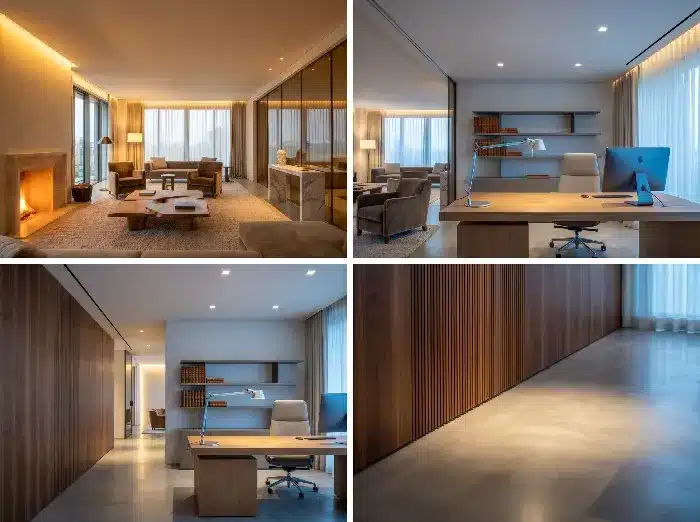
LED buyers often mix up dim-to-warm and tunable white. This mistake can cause wrong samples, wrong dimmers, and poor lighting results.
Dim-to-warm changes brightness and color temperature together. Tunable white changes color temperature and brightness separately. Dim-to-warm copies halogen dimming. Tunable white gives digital control over CCT and power.
I often explain this difference to buyers before they choose GU10 spotlights or LED bulbs. The two functions look similar on paper, but they serve very different lighting habits.
What Is Dim-to-Warm Lighting?
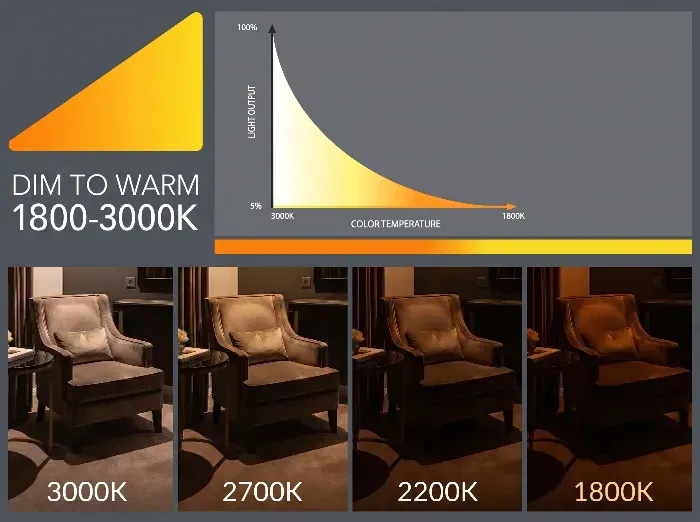
Dim-to-warm lighting is an LED function that makes the light warmer when the brightness goes down. It copies the feeling of incandescent and halogen dimming.
Dim-to-warm LED bulbs reduce wattage and color temperature at the same time. At full power, the light can be cooler and brighter. When dimmed down, the light becomes warmer and softer.
Why dim-to-warm exists
Dim-to-warm comes from an old lighting habit. In the incandescent and halogen age, people used front-edge dimmers to control current. The tungsten filament received more or less power. When the power was high, the filament temperature was high. The light looked whiter and brighter. When the power dropped, the filament temperature dropped too. The light became yellow, soft, and warm.
This was not a digital effect. It was a physical result. The filament acted like a black body. Different temperatures created different light colors.
Many users still like this feeling. They have used this lighting logic for many years. They do not only want lower brightness. They also expect a warmer mood when the room becomes darker.
How LED dim-to-warm copies halogen
LED does not naturally work like tungsten. LED chips need electronic design to copy this behavior. A dim-to-warm LED bulb usually uses two color channels. One channel is cooler. One channel is warmer. The driver changes the mixing ratio when the dimmer changes power.
For example, an 8W dim-to-warm GU10 can work at 6500K when it reaches full power. When the wall dimmer goes lower, the wattage drops. At the same time, the color temperature also drops. It may finally stop around 3000K.
| Dimming Level | Power Feeling | Color Temperature | User Feeling |
|---|---|---|---|
| 100% | Full 8W | 6500K | Bright and clear |
| 70% | Medium high | 5000K | Still active |
| 40% | Medium low | 4000K | Softer |
| 10% | Sehr niedrig | 3000K | Warm and relaxed |
The key point is simple. Dim-to-warm links brightness and color together. The user cannot keep 6500K at very low brightness. The user also cannot get 3000K at full 8W unless the product is designed that way.
Why buyers choose dim-to-warm
I usually suggest dim-to-warm for hotels, restaurants, villas, bedrooms, lounges, and retail spaces that want emotional lighting. It is not made for strict task lighting. It is made for atmosphere.
A good dim-to-warm product needs a smooth CCT curve. The change should not jump from cool to warm. It should feel soft. This is where factory design matters. Cheap products may change color too fast. Some products also flicker at low dimming levels. For B2B buyers, this creates complaints after installation.
What Is Tunable White Lighting?
Tunable white lighting is a digital LED control method that lets users adjust color temperature and brightness separately. It does not follow the old halogen dimming habit.
A tunable white LED bulb can stay at the same wattage while the color temperature changes. It can also dim brightness while keeping the selected CCT stable.
The basic logic of tunable white
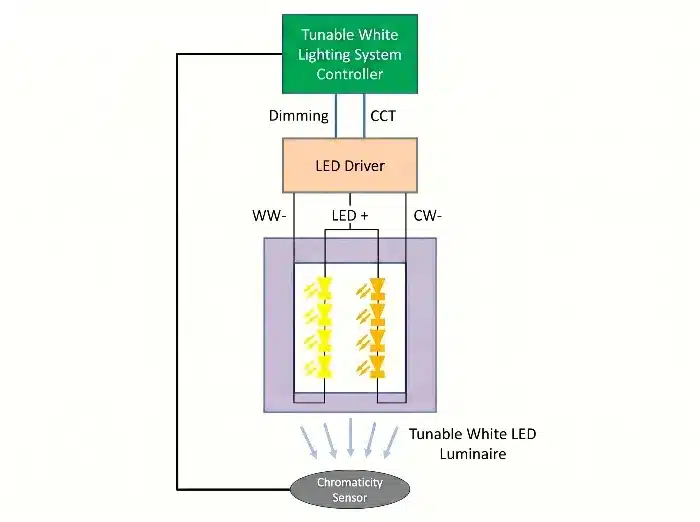
Tunable white usually uses warm white and cool white LED channels. The driver controls these channels through PWM or another digital control method. The system can change the ratio between the two channels without forcing the total power to drop.
For example, an 8W 3000K–6500K tunable white bulb can work at 3000K with full 8W output. It can also work at 6500K with full 8W output. When the user changes CCT, the brightness can stay almost the same.
| Function | 3000K | 4000K | 6500K |
|---|---|---|---|
| Tunable white at full power | 8W | 8W | 8W |
| Dim-to-warm behavior | Low power | Medium power | Full power |
This is the main difference. Tunable white separates color and power. Dim-to-warm ties them together.
Why tunable white feels more modern
Tunable white fits modern lighting control. It works well with smart systems, remote controls, wall panels, apps, DALI, Bluetooth, Zigbee, or other digital control methods. The user can choose a cool color for working, a neutral color for daily use, and a warm color for relaxing.
I see tunable white as a tool for flexible spaces. Offices, showrooms, classrooms, kitchens, conference rooms, and commercial areas often need this function. The same room may need different light at different times.
The buyer risk in tunable white
Tunable white sounds better because it gives more control. But it also needs better system matching. The control method must match the lamp. The dimmer or controller must support the function. A normal phase-cut dimmer usually cannot give full tunable white control.
This is a common sourcing mistake. A buyer may ask for “dimmable and CCT adjustable” but does not define the control method. The supplier may offer a product that needs a remote. The project may need wall control. Then the sample works in the office but fails in the real project.
For wholesale buyers, the question should not be only “Can it change color?” The better question is “How does the user control color and brightness separately?”
Which One Should You Choose for LED Spotlights?
You should choose dim-to-warm when you want a halogen-like mood. You should choose tunable white when you need separate control of brightness and color temperature.
Dim-to-warm is better for comfort and emotion. Tunable white is better for flexible function. The best choice depends on the project, control system, and user habit.

Choose dim-to-warm for familiar dimming
Dim-to-warm is the right choice when the user already understands traditional dimming. A hotel guest does not want to learn a control system. A restaurant owner may only want one rotary dimmer. A villa owner may want warm light at night without pressing many buttons.
In these cases, dim-to-warm gives a natural feeling. The light gets lower and warmer together. This matches old halogen logic. It also reduces user confusion.
| Project Type | Better Choice | Grund |
|---|---|---|
| Hotel room | Dim-to-warm | Simple and emotional |
| Restaurant | Dim-to-warm | Warm mood at low brightness |
| Schlafzimmer | Dim-to-warm | Comfortable night lighting |
| Office | Tunable white | Different tasks need different CCT |
| Showroom | Tunable white | Product display needs flexible color |
| Classroom | Tunable white | Activity and focus change during the day |
Choose tunable white for control freedom
Tunable white is better when the project needs flexible scenes. A showroom may need 3000K for a warm product area and 6500K for a technical display. A kitchen may need cool light for food preparation and warm light for dinner. An office may need neutral or cool light during working hours.
Tunable white also makes more sense in smart lighting. The user can set scenes. Morning can be 5000K. Evening can be 3000K. Meeting mode can be 4000K. Cleaning mode can be 6500K. Brightness can stay stable or change based on the scene.
My factory view for B2B buyers
From a factory view, dim-to-warm and tunable white should not be sold as the same upgrade. They need different drivers, different testing, and different quality control points.
For dim-to-warm, I care about the dimming curve. I test whether the CCT change is smooth. I also test whether the lamp flickers, buzzes, or shuts off too early. The feeling must be close to halogen.
For tunable white, I care about channel balance. I test whether 3000K and 6500K can both reach strong output. I also check whether the middle CCT looks clean. If the mixing is poor, 4000K may look strange or uneven.
A buyer should also ask for clear specifications:
| Item | Dim-to-Warm | Veränderbares Weiß |
|---|---|---|
| Control logic | Brightness and CCT together | Brightness and CCT separate |
| Typical control | Phase-cut dimmer | PWM, remote, smart control, DALI |
| Main feeling | Halogen-like | Digital and flexible |
| Best use | Mood lighting | Multi-scene lighting |
| Key risk | Flicker and rough CCT curve | Controller mismatch |
I usually ask buyers about the project before I recommend one. A product can be technically good but still wrong for the application. A restaurant does not always need tunable white. An office does not always need dim-to-warm. The best product is the one that matches the real user behavior.
Schlussfolgerung
Dim-to-warm copies the old halogen feeling. Tunable white gives separate digital control. Buyers should choose based on scene, control method, and user habit.
Recommended Products for Your Project
Based on the lighting principles discussed above, we have selected high-performance GU10 solutions to match different control systems and installation needs.
Top Dim-to-Warm Solutions (TRIAC Dimming)
Best for hotels, luxury villas, restaurants, and traditional wired dimming environments.
TECO Premium GU10 LED Bulb
Dim-to-Warm | Die-Cast Aluminum
- Fitting Type: GU10 LED Spotlight
- Dimming: Triac / Dim-to-Warm
- Color Temperature: 3000K → 1800K
- Luminous Flux: Up to 580lm
- Lifespan: 40,000 hours
- Compatibility: Works with 180+ dimmer brands
View Product Details → https://tecolite.com/product/gu10-dim-to-warm-led-spotlight-3000k-1800k/
TECO LED Essential GU10 Dimmable Bulb
5.5W | Plastic Body | High CRI
- CRI: >90
- Beam Angle: 38° / 60°
- Luminous Flux: 510lm
- Color Temperature: 2700K / 3000K / 4000K
- Lifespan: 25,000 hours
- Body: Thermoplastic, halogen-size replacement
View Product Details → https://tecolite.com/product/led-essential-plastic-gu10-dimmable-bulbs-5-5w/
Top Tunable White Solutions (Smart Wireless)
Best for smart homes, modern offices, apartments, and personalized lighting scenes.
Tuya Zigbee GU10 Smart LED Bulb
Smart CCT | RGBCW | Wireless Control
- Socket: GU10
- Control: WiFi / Zigbee / Bluetooth (Tuya ecosystem)
- Beam Angle: 38° / 60°
- Luminous Flux: 330–350lm
- Lifespan: 25,000 hours
- Smart Integration: Alexa / Google Home / SmartThings
- Equivalent: ~50W halogen lamp
View Product Details → https://tecolite.com/product/wireless-bluetooth-control-smart-tuya-cct-dimming-5w-glass-gu10-led-bulb/



 English
  French
  German
  Italian
  Spanish
  Portuguese
  Arabic
  Russian
  Japanese
  Chinese