Welches Licht lässt Diamanten funkeln? Beleuchtungsdesign-Leitfaden für Juweliergeschäfte
Zuletzt aktualisiert am 3. März 2026
Ein professioneller Leitfaden zur Beleuchtungsgestaltung für Juweliergeschäfte
Die Beleuchtung in einem Juweliergeschäft ist nicht nur dekorativ – sie bestimmt direkt, wie Diamanten funkeln, wie Edelsteine Tiefe offenbaren und wie Kunden den Wert wahrnehmen.
Im professionellen Einzelhandelslichtdesign wird die Beleuchtung von Schmuck als präzise optische Umgebung behandelt, nicht nur als allgemeine Beleuchtung.
Wenn Sie eine schnelle Antwort benötigen:
- Verwendung CRI ≥ 95 für hochwertige Diamantpräsentationen
- Auswählen 4000K–5000K um Brillanz und Kontrast zu verstärken
- Anwenden 15°–25° engen Strahlwinkels zur Betonung des Funkelns
- Beibehalten eines 3:1 Akzent-zu-Ambient-Licht-Verhältnis
- Blendung und Glasreflexion sorgfältig kontrollieren
Dieser Leitfaden erläutert die technischen Prinzipien hinter der Beleuchtung von Schmuck und wie sie in realen Einzelhandelsprojekten angewendet werden.
1. Warum Diamanten funkeln: Das optische Prinzip
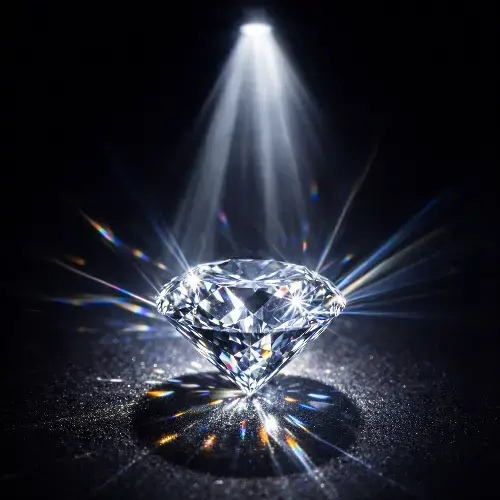
Klarer Diamant, beleuchtet von einem konzentrierten Lichtstrahl, der prismatische Funkeln und subtile Reflexionen auf einer dunklen Oberfläche darunter erzeugt.
Diamanten funkeln aufgrund von Brechung, Reflexion und Dispersion des Lichts durch ihre Facetten.
Damit Funkeln entsteht, muss die Beleuchtung Folgendes bieten:
- Hohe Intensität
- Starker Kontrast
- Richtiger Einfallswinkel
- Präzise Farbwiedergabe
In praktischen Einzelhandelsinstallationen wird Glitzern reduziert, wenn:
- Ambientbeleuchtung dominiert die Akzentbeleuchtung
- Farbtemperatur ist zu warm
- Strahlwinkel sind zu breit
- CRI ist unzureichend
Glitzern ist nicht zufällig – es ist konstruiert.
2. Farbtemperatur: Wie Kelvin die Brillanz beeinflusst
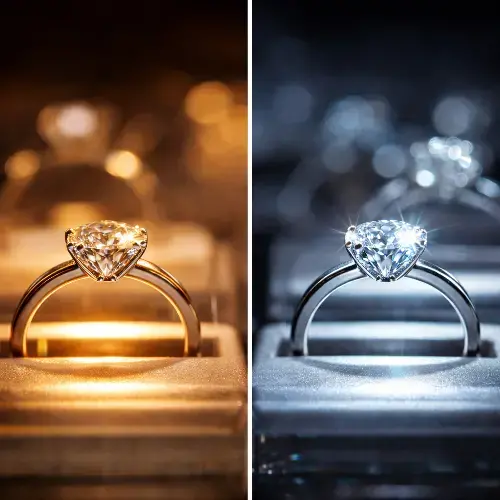
Vergleichsdarstellung eines Diamantrings in einer Schmuckumgebung, beleuchtet durch warmes gelbes Licht gegenüber kaltem weißem Licht, um zu zeigen, wie Lichtverhältnisse die wahrgenommene Brillanz und Farbe beeinflussen.
Die Farbtemperatur (CCT) beeinflusst die wahrgenommene Helligkeit und den Kontrast.
Empfohlene Farbtemperatur nach Schmucktyp
| Schmucktyp | Empfohlene CCT | Grund |
|---|---|---|
| Diamanten | 4000K–5000K | Steigert Brillanz und Feuer |
| Platin / Silber | 4000K | Klarer, scharfer Reflexion |
| Gemischte Edelsteine | 3500K–4000K | Ausgewogene Präsentation |
| Gelbgold | 2700K–3000K | Warmer tone enhances richness |
| Rose Gold | 2700K–3000K | Preserves warm hue |
In high-end boutique projects, designers often use 4000K accent lighting over diamond showcases while maintaining 3000K ambient lighting to preserve warmth in the store environment.
This layered approach increases visual hierarchy.
3. CRI and Spectral Quality: Why ≥95 Matters
Color Rendering Index (CRI) measures how accurately a light source reveals colors compared to a reference source.
For jewelry environments:
- CRI 90 is minimum acceptable
- CRI 95+ is recommended for premium retail
High CRI prevents gemstones from appearing flat or gray.
According to professional retail lighting practice guidelines from the Illuminating Engineering Society (IES), accurate color rendering is critical in merchandise evaluation environments.
Low CRI lighting can distort perceived gemstone saturation, reducing visual appeal.
In field experience, upgrading from CRI 80 to CRI 95 frequently produces noticeable improvement in diamond clarity perception.
4. Beam Angle: Controlling Focus and Contrast
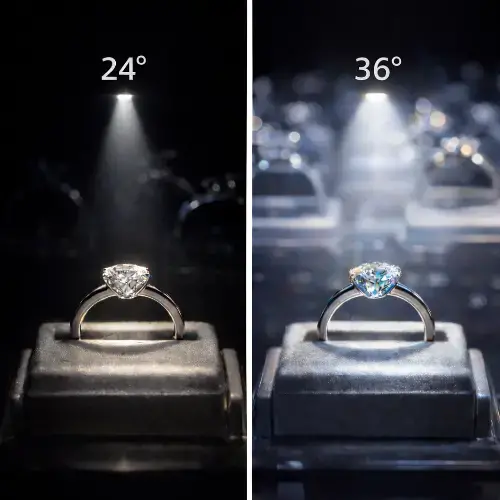
Beam angle determines light concentration.
Recommended Beam Angles
| Anmeldung | Strahlwinkel | Zweck |
|---|---|---|
| Diamond spotlighting | 15°–20° | Maximum sparkle contrast |
| Showcase trays | 20°–30° | Controlled highlight |
| General display | 30°–40° | Balanced coverage |
| Umgebungsbeleuchtung | 40°–60° | Background illumination |
In retail installations, changing from 36° to 20° beam angle often significantly increases perceived brilliance because narrower beams increase contrast across diamond facets.
However, overly narrow beams must be positioned carefully to avoid glare hotspots.
5. Light Layering Strategy (Professional Approach)
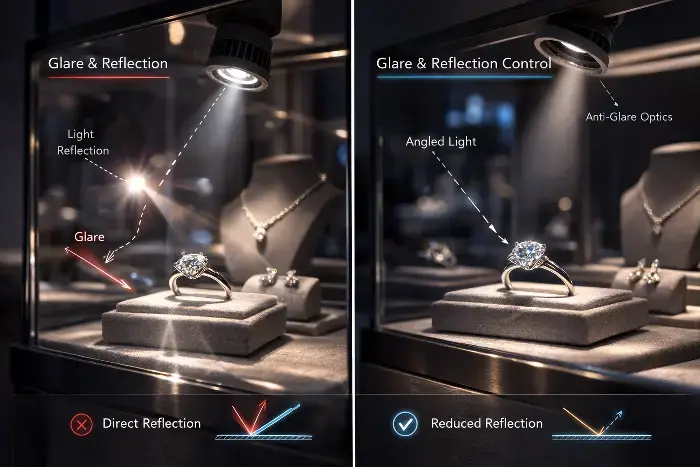
Visual comparison illustrating how specialized lighting and controlled beam angles help minimize glare and unwanted reflections in jewelry showcases for clearer product presentation.
Professional jewelry lighting follows a layered hierarchy.
1. Ambient Lighting
- Provides base illumination
- 3000K–4000K depending on brand identity
- Should not overpower displays
2. Accent Lighting
- 3:1 brightness ratio compared to ambient
- Narrow beam, high intensity
- Enhances sparkle and visual focus
3. Display Case Lighting
- Integrated mini spotlights or high-CRI strips
- Controlled angle to reduce reflection
- Even distribution across trays
Maintaining this hierarchy preserves contrast and luxury perception.
6. Glare and Reflection Control
Glass display cases introduce reflection challenges.
Professional mitigation techniques include:
- Positioning fixtures at 30°–35° angle relative to glass
- Avoiding direct vertical downlight reflection
- Using anti-glare optics
- Shielded trim or deep baffle design
Poor glare control reduces visual comfort and may discourage customer engagement.
7. LED Advantages in Jewelry Retail
LED lighting provides optical precision required in jewelry environments:
- High CRI availability
- Stable color consistency
- Precise beam control
- Minimal radiant heat
- Long operational life (25,000–50,000 hours)
Low heat emission protects delicate stones and prevents showcase overheating.
8. Common Jewelry Lighting Mistakes (Observed in Real Projects)
- Using 2700K spotlighting on diamonds
- Allowing ambient light to exceed accent intensity
- Mixing inconsistent color temperatures in one showcase
- Installing wide beam angles for sparkle applications
- Ignoring flicker performance in dimmable systems
Inconsistent lighting design often reduces perceived product value more than actual product quality.
9. Dimming and Scene Control
Luxury retail increasingly uses dimmable LED systems.
Vorteile umfassen:
- Scene-based display highlighting
- Time-based brightness adjustments
- Seasonal merchandising flexibility
- Enhanced luxury perception
Smooth, flicker-free dimming is essential.
Low-frequency modulation can reduce visual comfort.
10. Security and After-Hours Considerations
Security lighting should:
- Activate via motion sensor
- Maintain minimum illumination level
- Avoid excessive glare into storefront glass
Balanced security design protects merchandise without disrupting visual presentation.
11. Professional Design Summary
For optimal jewelry lighting performance:
- Verwendung CRI ≥ 95
- Auswählen 4000K–5000K for diamond sparkle
- Anwenden 15°–25° beam angles
- Beibehalten 3:1 accent-to-ambient ratio
- Control glare and reflection
- Keep color temperature consistent within showcases
Jewelry lighting is an engineered optical system — not simply a decorative choice.
When properly specified, lighting enhances brilliance, elevates perceived value, and strengthens customer confidence in purchase decisions.
Designing jewelry lighting requires careful coordination of:
Abstrahlwinkel
Farbtemperatur
CRI performance
Glare control
Dimming compatibility
If you are planning a jewelry retail project and need technical guidance on selecting optical LED solutions, professional evaluation before installation can significantly reduce redesign costs and performance inconsistencies.
Our engineering team supports retail lighting projects with:
High-CRI optical spotlight recommendations
Beam angle optimization guidance
Showcase lighting layout suggestions
Dimming and glare control consultation
For technical discussion or specification support, contact our team with your project details.