Where to Buy Dim-to-Warm LED Bulbs Online: A Complete Buyer’s Guide
People often discover dim-to-warm lighting by accident—usually in a hotel room, restaurant, or a well-designed living space. The light softens as it dims, shifting from a neutral white into a warm, candle-like glow around 1800–2200K. The effect is subtle but unmistakably human. Once people experience it, they want the same atmosphere at home or in a commercial project.
But searching online quickly reveals a problem: dim-to-warm bulbs are mixed together with tunable white, smart bulbs, “adjustable color temperature” bulbs, and basic dimmable LEDs. Many consumers buy a standard dimmable bulb thinking it will get warmer as it dims, only to discover nothing changes except brightness.
This guide explains where to buy real dim-to-warm bulbs online, how to avoid mislabeled listings, what price ranges to expect, regional differences in availability, and how to evaluate technical specs before purchasing. Whether buying for a residential project or hospitality chain, this guide helps buyers make informed decisions without guesswork.
1. What Dim-to-Warm Means—and Why It’s Different From “Adjustable” or “Tunable” LEDs
Dim-to-warm bulbs automatically lower color temperature as brightness decreases. The transition mimics halogen: bright at 3000K, gradually falling toward 2200K or even 1800K. The technology usually relies on two LED channels calibrated to follow a warm-dimming curve.
A tunable white bulb behaves differently. It lets users manually select color temperature—usually from 2700K to 6500K—through an app, remote, or switch. The key difference: tunable white does not warm automatically.
Online marketplaces often blur these categories.
Quick Reference: Dim-to-Warm vs Tunable White
| Característica | Dim-to-Warm LED | Tunable White LED |
|---|---|---|
| Color Shift | Automatic with dimmer | Manual (app/remote) |
| Typical Range | 3000K → 1800K | 2700K → 6500K |
| Mejor para | Relaxed mood, hospitality | Task areas, offices |
| User Effort | No settings needed | Requires control |
| Typical Confusion | Buyers think “dimmable” = dim-to-warm | Buyers think “adjustable” = warm-dimming |
The U.S. Department of Energy confirms that LEDs—including warm-dimming types—use up to 75% less energy and last up to 25 times longer than incandescent bulbs (Source: https://www.energy.gov/energysaver/led-lighting).
Understanding the difference is the first step to buying the right product.
2. Why Online Listings Cause So Much Confusion
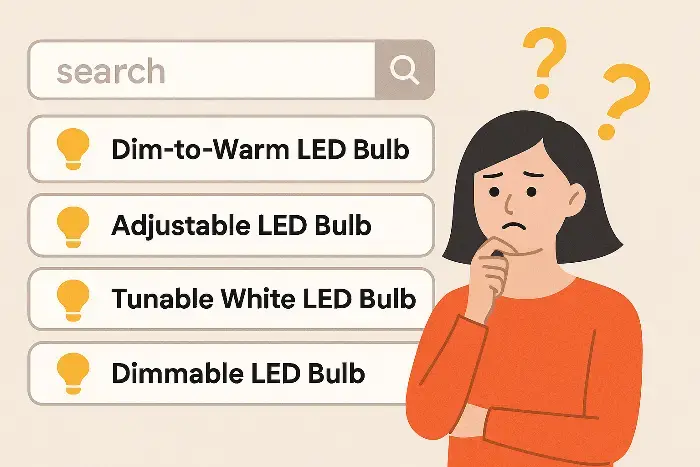
Online retailers use inconsistent terminology. Some sellers call warm-dimming bulbs “adjustable,” even though they do not support manual control. Others label tunable smart bulbs as “warm dim,” even though they do not warm automatically.
Common but misleading terms include:
- “Adjustable color temperature”
- “Warm glow”
- “Sunset dim”
- “Amber shift dimming”
- “Soft warm LED”
- “Color-change bulb”
Because search algorithms reward popular keywords, many unrelated smart bulbs appear when searching for dim-to-warm LEDs.
To find accurate listings, search using technical phrasing:
- “Dim-to-warm LED bulb”
- “Warm dim LED 3000K to 1800K”
- “GU10 sunset dim”
- “Warm dim LED spotlight”
- “Warm glow GU10”
These terms better reflect the underlying technology and help filter out unrelated products.
3. Where to Buy Dim-to-Warm Bulbs Online
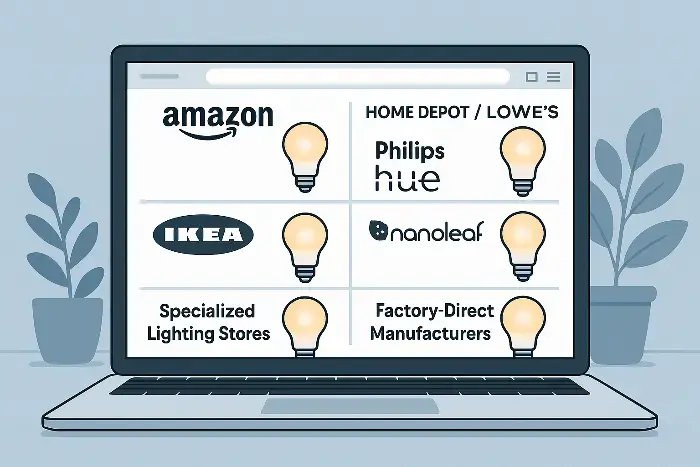
Although dim-to-warm is no longer niche, availability varies by country, platform, and bulb type. Below is a breakdown of the most reliable places to purchase.
3.1 Amazon (North America + Europe)
Amazon offers the broadest selection but also the most inconsistent labeling. Buyers can find everything from premium hospitality spotlights to generic bulbs with limited performance.
Pros:
- Large variety
- Fast shipping
- User reviews for reference
Cons:
- Many incorrectly labeled products
- Hard to verify CRI, dimming curves, or color shift quality
- Mixed tunable smart bulbs appear in results
Amazon works best for entry-level buyers but often frustrates professional users who require consistent technical parameters.
3.2 Home Depot / Lowe’s (U.S. + Canada)
Brick-and-mortar hardware stores offer fewer dim-to-warm SKUs but provide more reliable specifications.
Pros:
- Easy returns
- Trusted consumer brands
- Better product descriptions than Amazon
Cons:
- Limited socket types
- Fewer professional-grade GU10 or MR16 options
- Prices slightly higher
Home Depot and Lowe’s are ideal for homeowners seeking plug-and-play bulbs rather than project-based procurement.
3.3 IKEA (Global)
IKEA offers affordable LED bulbs with mild warm-dimming behavior, though the company rarely uses the term “dim-to-warm.” Many customers assume tunable control, which the bulbs do not provide.
Pros:
- Good color quality for the price
- Reliable manufacturing
Cons:
- Limited lumen output options
- Narrow socket selection
- Not suitable for high-end residential or hospitality spaces
IKEA works for simple ambient lighting but not for designer-level applications.
3.4 Philips Hue, Nanoleaf, and Smart Home Platforms
These platforms dominate search results for “adjustable lighting,” but they are typically tunable white, not dim-to-warm.
They appear attractive because of app interfaces, but anyone wanting incandescent-style warm dimming will be disappointed unless the product specifically states warm dimming behavior.
Pros:
- Flexible CCT control
- Integrates with Alexa, Google, and Apple Home
Cons:
- Does not warm automatically with dimming
- Higher prices
- Requires hubs or apps
Use these platforms only if manual control is the priority.
3.5 Specialized Lighting Stores (Architectural + Hospitality)
These online stores stock true dim-to-warm products with high CRI values, stable dimming curves, and accurate photometry.
Pros:
- Premium performance
- More beam angles (10°–60°)
- Better CRI (90–97)
- Suitable for hotels, restaurants, galleries
Cons:
- Higher price per bulb
- Requires more technical knowledge
This channel suits professional designers and contractors.
3.6 Factory-Direct Manufacturers (B2B Buyers)
Many dim-to-warm bulbs—especially GU10 and MR16 formats—are produced by OEM factories in China, Korea, and parts of Europe. The International Energy Agency reports that China supplies the majority of the global LED production base (Fuente: https://www.iea.org/reports/targeting-100-led-lighting-sales-by-2025).
Factories offer the widest technical customization:
- Exact CCT curve (3000→1800K or 2700→2000K)
- CRI 90–98 options
- Precise beam angles
- Dimmable driver tuning
- Voltage customization
- High-efficacy chips
Pros:
- Best pricing
- Engineering support
- Long-term supply stability
Cons:
- Some suppliers require MOQs
- Shipping times vary
- Requires spec clarification
This is the best channel for hospitality chains, lighting brands, and distributors.
4. Price Ranges: What Determines Cost?
Dim-to-warm bulbs are more expensive than standard LEDs because they require:
- Two LED channels
- Specialized drivers
- More precise thermal control
- Higher CRI bins
Typical price ranges:
| Tipo | Price (USD) |
|---|---|
| Entry-level dim-to-warm | $6–$12 |
| High-CRI warm-dim | $10–$18 |
| Hospitality GU10 warm-dim | $12–$28 |
| Smart tunable white | $15–$50 |
EnergyStar reports that while LED prices have dropped significantly over the last decade, specialty technologies continue to command a premium (Source: https://www.energystar.gov/products/light_fixtures).
5. Regional Differences in Availability
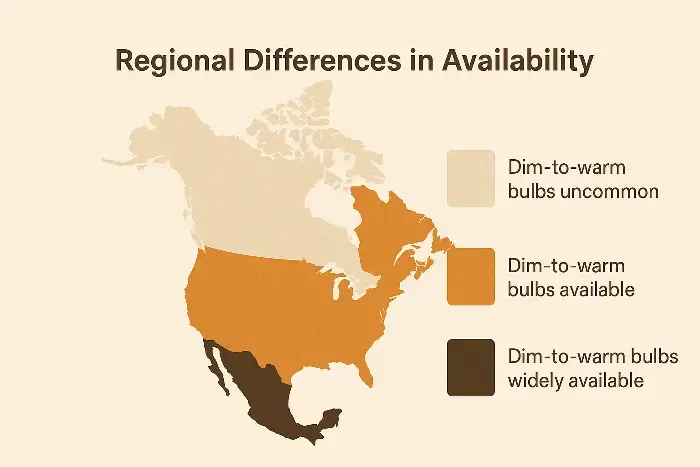
Europa
Highest awareness of dim-to-warm
GU10 dominates
Strong hospitality market demand
América del Norte
E26/E27 most common
Many consumers unaware of warm dimming until exposed in hotels
Growing interest in circadian lighting
Asia
High adoption in commercial spaces
Residential users still focus on low-cost LEDs
Japan shows strong demand for warm ambiance
6. What to Check Before Buying Dim-to-Warm Bulbs

Dim-to-warm is not only about color temperature range. Buyers should evaluate:
✔ Socket Type
GU10, MR16, E26, E27, G53, etc.
✔ Wattage & Brightness
Lumens matter more than watts.
✔ Beam Angle
Narrow for accent lighting; wide for general lighting.
✔ CRI Rating (Color Rendering Index)
The National Institute of Standards and Technology notes that high CRI improves skin tone and material accuracy (Source: https://www.nist.gov).
✔ Flicker & Dimming Curve
Poor dimmers lead to flicker or early shutoff.
✔ Dimmer Compatibility
Many legacy dimmers expect incandescent loads.
These factors influence overall performance far more than branding.
7. Using Dimmers With Dim-to-Warm Bulbs
Common dimming issues include:
- Flicker at low levels
- Ruido de zumbido
- Flashing on startup
- Sudden dropout below 20%
Buyers should pair bulbs with LED-compatible dimmers, especially when installing multiple fixtures.
8. Brands Offering Reliable Dim-to-Warm Bulbs
- Philips
- GE
- Osram
- Cree
- Soraa
- TCP
- Various OEM suppliers
Premium brands emphasize color accuracy, smoother dimming curves, and better heat management.
9. Matching Bulbs to Applications
Residential
Ideal for bedrooms, living rooms, and relaxation areas.
Hospitalidad
Restaurants, lounges, and hotel guestrooms rely heavily on warm dimming for atmosphere.
Restaurantes
Narrow-beam dim-to-warm bulbs highlight table settings and improve visual depth.
Commercial Projects (B2B)
Case-pack purchasing ensures consistency across large installations.
10. Why Many People Cannot Find Dim-to-Warm Bulbs Easily
Search algorithms prioritize:
- Smart bulbs
- High-lumen bulbs
- Sponsored listings
- Low-cost high-volume sellers
Dim-to-warm bulbs are more specialized, so they appear further down the results unless the search terms are precise.
11. What Buyers Expect From Online Platforms
Most buyers prefer:
- Clear technical specs
- Real images
- Accurate descriptions
- Fast delivery
- Dimmer compatibility assurance
They do not want jargon or misleading claims.
Poor communication leads to returns and negative reviews.
Conclusión
Dim-to-warm bulbs provide a uniquely natural lighting experience, shifting smoothly into warm, amber tones as they dim. They differ substantially from tunable white bulbs, and this distinction matters when purchasing online.
Buyers can find warm-dimming bulbs across marketplaces, hardware stores, specialized lighting retailers, and factory-direct manufacturers—each offering different advantages in price, performance, and technical consistency.
For best results, buyers should review:
- Socket type
- Salida de lúmenes
- CRI rating
- Compatibilidad de regulación
- Actual warm-dimming range
As demand grows for human-centric lighting, dim-to-warm technology is becoming more accessible, though still less common than traditional LEDs or smart bulbs.
If you need dim-to-warm bulbs for homes, hotels, or commercial spaces—and want reliable performance with real engineering support—you can share your required socket type, wattage, CCT range, and application scenario. We can help you select stable, high-quality products without guesswork.