Ámbar vs Rojo vs Blanco Cálido: ¿Qué Luz Debe Usarse por la Noche?
Artificial lighting plays a critical role in how the human body prepares for rest. In bedrooms, hotels, healthcare facilities, and residential environments, the wrong light spectrum at night can delay sleep onset, reduce melatonin production, and disrupt circadian rhythms.
Among the most discussed options for night-time lighting are red light, amber light, and warm white light. Each has different spectral characteristics and physiological effects. This article provides a structured, evidence-based comparison to help lighting designers, engineers, and informed users choose the most appropriate light for night-time use.
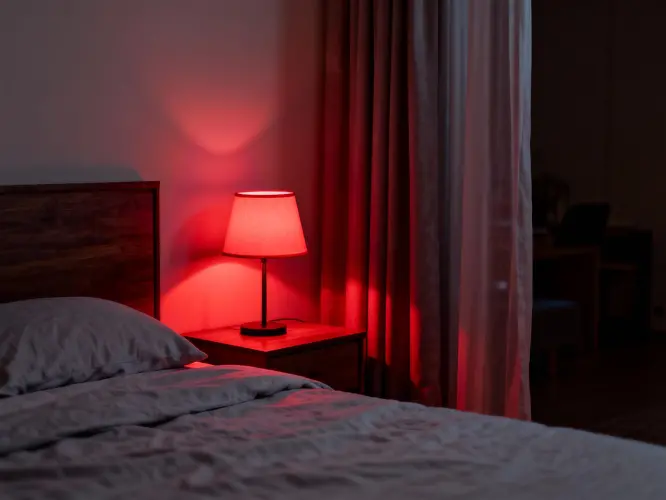
Amber vs red vs warm white light at night – spectrum and sleep impact comparison
Why Night-Time Lighting Matters for Sleep
Human circadian rhythms are regulated by light exposure, particularly by short-wavelength blue light. In the evening, exposure to blue-enriched light signals the brain to remain alert, suppressing melatonin—the hormone responsible for initiating sleep.
Research from Harvard Medical School and the National Institutes of Health confirms that even low-intensity blue light at night can significantly delay melatonin release and shift circadian timing. This effect is especially relevant in environments such as hotels, apartments, and healthcare facilities where occupants may already experience sleep disruption due to travel or stress.
For lighting professionals, night-time illumination must therefore balance visual safety, comfort, y biological impact—not simply brightness or aesthetics.
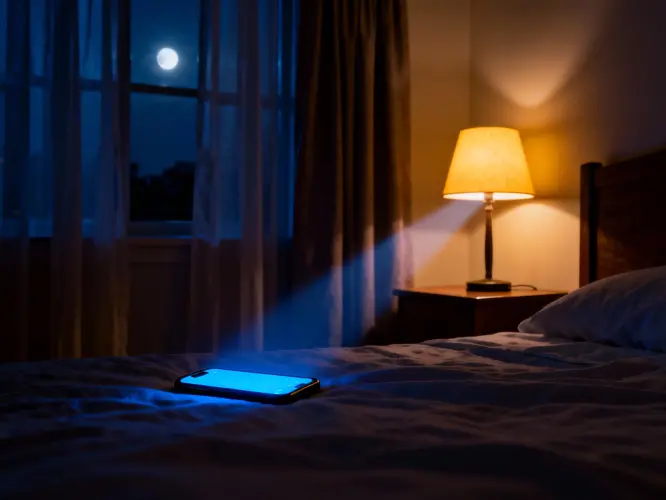
Blue light exposure at night interferes with natural melatonin production
Spectral Differences: Red vs Amber vs Warm White
The key difference between these light types lies in their spectral power distribution, not just their perceived color.
| Tipo de luz | Typical Wavelength / CCT | Blue Light Content | Circadian Impact |
|---|---|---|---|
| Rojo | 620–700 nm (monochromatic) | Ninguno | Mínima |
| Amber | ~2000–2500K | Muy baja | Bajo |
| Warm White | ~2700K | Moderado | Medio |
Red light emits long wavelengths only and does not stimulate melanopsin-sensitive retinal cells. Amber light significantly reduces blue wavelengths while maintaining better visual usability. Warm white light, although softer than cool white, still contains enough blue energy to affect circadian signaling when used at night.
This distinction is critical for lighting specifications intended for sleep-supportive environments.
Which Light Best Supports Melatonin Production?
From a physiological standpoint, red light offers the highest level of melatonin preservation, followed closely by amber light. Warm white light, even at low brightness, continues to suppress melatonin to a measurable degree.
Controlled studies published in the Journal of Biological Rhythms demonstrate that exposure to red light in the evening preserves over 90% of natural melatonin levels, while amber light preserves approximately 80–90%. Warm white lighting typically reduces melatonin more significantly due to residual blue content.
| Tipo de luz | Melatonin Preservation | Recommended Night Use |
|---|---|---|
| Rojo | Muy alta | Bedrooms, sleep zones |
| Amber | Alta | Reading, circulation areas |
| Warm White | Moderado | Transitional or early evening only |
For sleep-focused applications, especially in hospitality or residential bedrooms, this distinction directly affects occupant rest quality and next-day alertness.

Melatonin response under different night-time light spectra
Practical Night-Time Lighting Hierarchy
Based on biological impact and functional usability, a clear hierarchy emerges:
1. Red Light – Maximum Circadian Protection
Red light is the preferred option for areas where sleep is the priority. It offers the least circadian disruption and is ideal for bedside lamps, nightlights, and low-level pathway lighting in bedrooms or hotel suites.
2. Amber Light – Balanced Function and Comfort
Amber light provides a practical compromise where some visual clarity is required. It is well suited for living spaces, hotel corridors at night, and reading areas where complete darkness or red-only lighting may be impractical.
3. Warm White Light – Limited Night Use
Warm white lighting should be reserved for early evening or transitional periods and used at very low illuminance levels when applied at night.
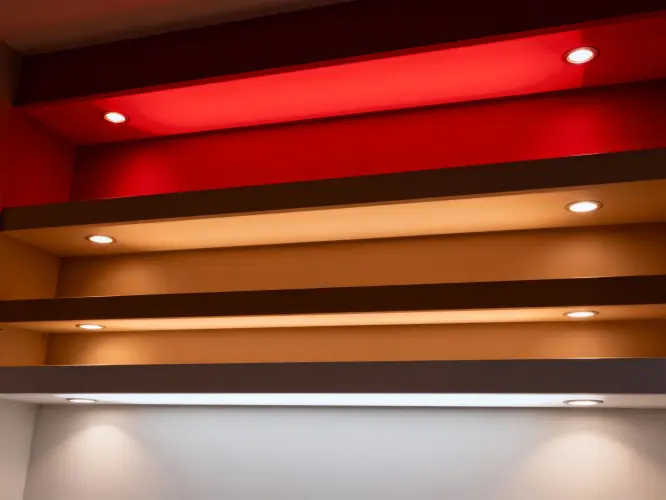
Recommended hierarchy for low blue light night lighting
Choosing the Right Light for Different Scenarios
| Space | Recommended Light | Target Illuminance | Design Rationale |
|---|---|---|---|
| Dormitorio | Red / Amber | <5 lux | Preserve melatonin |
| Living Room (night) | Amber | 10–20 lux | Comfort without alertness |
| Hallways / Hotels | Amber / Warm White (dimmed) | 5–10 lux | Safety + circadian care |
| Late-night task use | Amber | 20–50 lux | Visual clarity with reduced blue |
Designers should also consider beam control, glare reduction, and dimming compatibility. In professional applications, combining spectral control with automated dimming schedules provides the most reliable circadian-friendly solution.
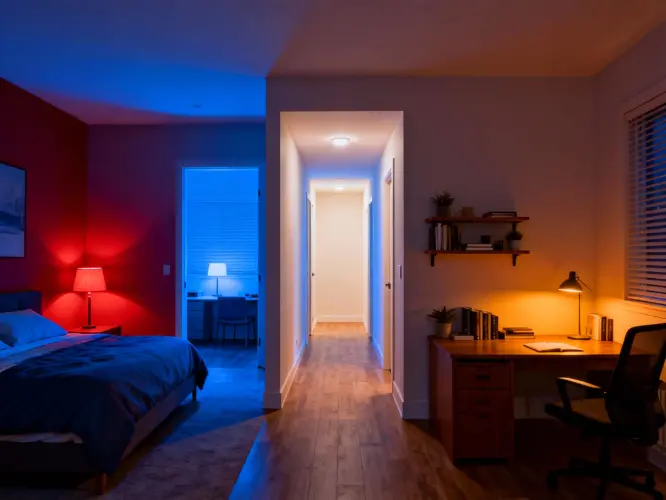
Selecting night lighting based on space function
Key Limitations and Design Trade-Offs
While red and amber lighting offer strong biological advantages, they are not universal solutions. Red light has limited color rendering and may not be suitable for detailed tasks. Amber light improves usability but still requires careful intensity control.
Effective night-time lighting design is therefore not about choosing a single “perfect” color, but about layering light, controlling brightness, and matching spectrum to activity.
Recognizing these trade-offs is essential for credible, real-world lighting design.
Recomendaciones finales
- Uso red light in sleep-critical environments where circadian protection is the priority.
- Apply amber light in semi-active night-time spaces requiring usability without excessive stimulation.
- Limit warm white light to early evening or transitional periods and always pair it with dimming.
- Prioritize low illuminance, controlled beam angles, and consistent spectral performance over brightness alone.
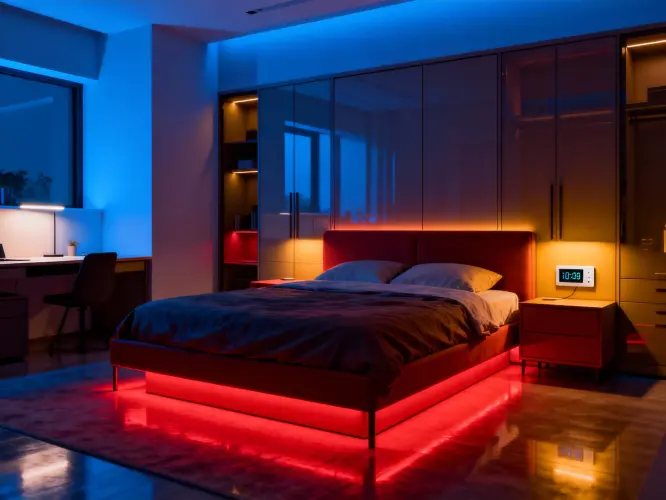
Practical strategies for circadian-friendly night lighting
Conclusión
When comparing amber vs red vs warm white light at night, the evidence is clear: red light offers the least circadian disruption, amber provides a balanced alternative, and warm white should be used cautiously after dark. Thoughtful spectral selection, combined with appropriate brightness control, can significantly improve sleep quality and night-time comfort in both residential and commercial settings.
If you are designing, specifying, or sourcing night-time lighting solutions for residential, hospitality, or healthcare projects, reviewing spectral data—not just color temperature—is essential.
Consider evaluating your current lighting against circadian-friendly criteria, testing low-blue alternatives in key spaces, or consulting with lighting suppliers who provide verified spectral performance data rather than generic “warm light” claims.
Making informed lighting choices at night is a small design decision with long-term human impact.
Notas al pie