Respuesta rápida: Explicación de las clasificaciones IP
- IP20 → uso en interiores secos
- IP44 → resistente a salpicaduras en interiores
- IP65 → impermeable (chorros)
- IP66 → protección exterior de alta resistencia
Conclusión:
- IP20 = rentable para interiores
- IP44 = solución equilibrada
- IP65 = estándar para áreas húmedas
- IP66 = entornos exteriores de alto riesgo
Comparación rápida de clasificaciones IP
| Clasificación | Protección contra polvo | Protección contra agua | Uso típico |
|---|---|---|---|
| IP20 | Objetos >12,5 mm | Ninguno | Oficinas, comercios |
| IP44 | Polvo limitado | Resistente a salpicaduras | Baños, pasillos |
| IP65 | A prueba de polvo | Chorros de agua | Exterior, zonas húmedas |
| IP66 | A prueba de polvo | Chorros de agua fuertes | Fachadas, exteriores severos |
¿Qué es una clasificación IP?
La clasificación IP (IEC 60529) define la protección contra:
- sólidos (polvo)
- líquidos (agua)
Más información sobre cumplimiento internacional de iluminación
→ Más información sobre estándares internacionales de seguridad en iluminación (certificación CE vs CB)
→ certificación-e-vs-cb-bombillas-led
IP20: Estándar para interiores

Ideal para:
- oficinas
- tiendas minoristas
- salas de reuniones
Limitación:
Sin protección contra agua
Mecanismo de fallo
Causas de humedad:
→ Migración electroquímica (ECM)
Resultado:
- Cortocircuitos micro en PCB
- driver instability
- long-term failure
IP44: The Cost-Effective Middle Option

Where IP44 Fits:
- bathroom zone 2
- corridors
- semi-humid indoor areas
Why choose IP44:
- lower cost than IP65
- sufficient splash protection
- better thermal performance
Best choice when IP20 is risky, but IP65 is overkill
IP65: Commercial Standard for Wet Areas
Ideal para:
- bathrooms
- outdoor areas
- cleaning-exposed environments
Key advantage:
- dust-tight
- water jet resistant
Learn how beam angle affects outdoor lighting
→ how-to-choose-beam-angle-led-spotlights
IP66: High-Risk Outdoor Solution
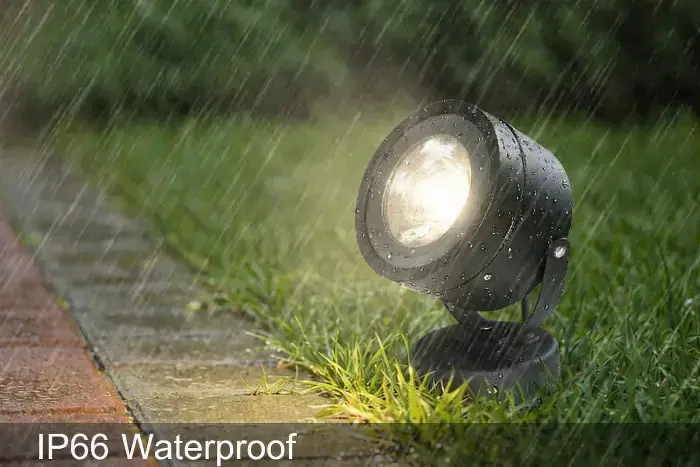
Robust outdoor spotlight illuminating a wet garden lawn and brick path during heavy rainfall, showcasing reliable waterproof performance in harsh weather conditions.
When IP65 is not enough:
- coastal areas
- heavy rain exposure
- pressure cleaning environments
Perspectiva de Ingeniería
IP66 provides:
- stronger sealing
- higher resistance to water pressure
- long-term outdoor reliability
Product Application
For high-end outdoor lighting:
IP66 AR111 spotlight offers:
- high-intensity beam control
- superior waterproof design
- suitable for facade & landscape lighting* suitable for facade & landscape lighting
Ideal para:
- hotels
- commercial buildings
- outdoor retail
How IP Ratings Are Tested (IEC 60529)
IP ratings are verified according to the IEC 60529 standard using controlled laboratory testing methods.
Dust Protection Test (IP6X)
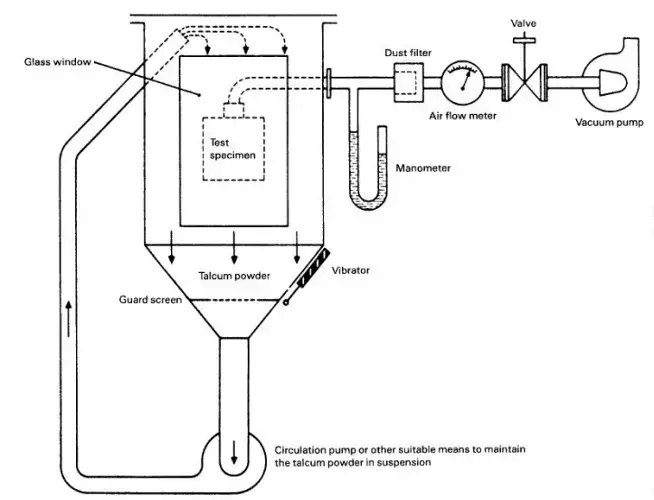
Schematic illustrating a talc powder suspension system, including components such as a guard screen, flow meter, manometer, valve, and equipment for maintaining controlled dust circulation during testing.
- The fixture is placed inside a sealed dust chamber
- Fine particles (typically talcum powder) are circulated continuously for 8 hours
- Requirement: no dust ingress is allowed inside the fixture
Purpose:
- Prevent dust accumulation on internal components
- Maintain heat dissipation performance
- Protect LED driver from contamination
Water Protection Test (IPX5 / IPX6)

High-pressure water jet test conducted in a controlled laboratory environment, demonstrating equipment used for durability and ingress protection testing.
- Water is sprayed using a calibrated nozzle
- Flow rate: approximately 12.5 L/min
- Distance: around 3 meters
- Spray direction: multiple angles
- Test duration: several minutes
Protection levels:
- IPX5 → resistant to low-pressure water jets
- IPX6 → resistant to high-pressure water jets
Purpose:
- Simulate rain exposure
- Simulate cleaning processes
- Ensure outdoor reliability
Perspectiva de Ingeniería
In real-world applications:
- IP65 is suitable for rain and routine cleaning
- IP66 is required for heavy rain and high-pressure washing
This is why IP66 fixtures are recommended for:
- building facades
- coastal environments
- exposed outdoor installations
Factory Validation
In production, each batch undergoes:
- random sampling IP testing
- sealing integrity inspection
- humidity and temperature cycling tests
to ensure consistent waterproof performance in large-scale commercial projects.
How to Choose the Right IP Rating
Decision Logic
Indoor?
 ├── Yes → Dry? → Yes → IP20
 │             └ No → IP44
 └── No → Cleaning / rain?
               ├ Yes → IP65
               └ Heavy exposure → IP66
Cost vs Risk
| Clasificación | Cost | Riesgo | Best Strategy |
|---|---|---|---|
| IP20 | Bajo | High (wrong use) | Dry only |
| IP44 | Medio | Equilibrado | Transitional zones |
| IP65 | Más alto | Bajo | Standard wet areas |
| IP66 | Highest | Mínima | Harsh outdoor |
Key insight:
Choosing the wrong IP rating costs more than choosing a higher one.
Real Project Case
The Economic Reality: Retail Case
- 22% failure rate (IP20 in humid zones)
- replacement cost = 3.5× product cost
After switching to IP65:
- failure <1%
- maintenance reduced by 90%
Engineering Verdict:
Most failures happen in “in-between environments”
Procurement Strategy
Recommended stock mix:
- 50–60% IP20
- 20–30% IP44
- 15–25% IP65
- 5–10% IP66
Common Mistakes
- ignoring transition zones
- overusing IP65 indoors
- underestimating humidity
PREGUNTAS FRECUENTES
Is IP44 enough for bathrooms?
Yes (zone 2), but IP65 is safer.
Is IP65 waterproof?
Water-resistant, not submersible.
When do I need IP66?
Heavy rain or high-pressure environments.
Get Your IP Rating Selection Plan
Submit your project details to receive:
- IP rating recommendation per zone
- beam angle layout
fixture quantity estimation
Request your free lighting plan
→ https://teco-lighting.com/contact