Introducción
In hospitality environments such as hotels, restaurants, and bars, lighting is not just functional—it directly affects atmosphere, guest experience, and brand perception.
Among various lighting options, dimmable PAR38 LED bulbs are widely used for:
- accent lighting in lobbies and dining areas
- spotlighting artwork and architectural features
- creating layered lighting scenes in bars and lounges
However, selecting the wrong PAR38 LED can lead to:
- flicker during dimming
- unstable brightness
- poor ambiance due to incorrect beam or color
Esta guía se centra en how to choose the right dimmable PAR38 LED bulbs, using a practical decision-making framework based on real project requirements.
Quick Selection Checklist
If you need a quick answer, use this baseline:
- Atenuación: TRIAC compatible, 1–100% range
- Parpadeo: <5% (flicker-free)
- Ángulo del haz: 25°–40° (most common)
- Luminosidad: 900–1200 lumens
- Temperatura de Color: 2700K–3000K
- CRI: ≥90, R9 >80
- Vida útil: ≥50,000 hours
- Environment: IP65 (for outdoor or damp areas)
This specification covers 80–90% of hospitality projects.
Dimming Compatibility (The Most Critical Factor)
Por qué es importante
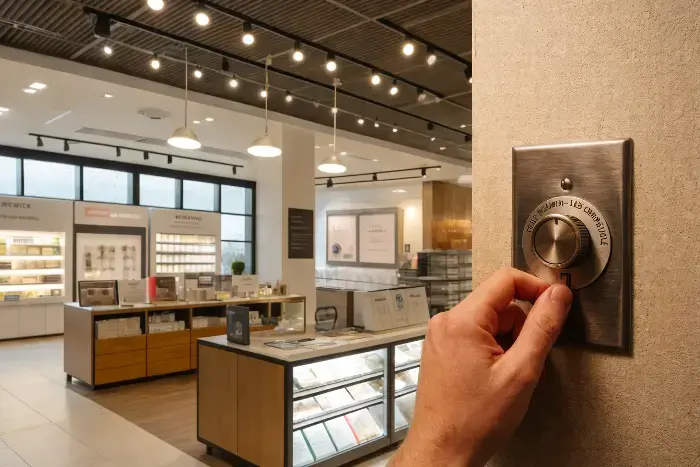
In many hotel projects, existing dimmers are TRIAC (phase-cut) systems designed for halogen lamps.
LED bulbs behave differently. If incompatible, you will see:
- flicker at low brightness
- delayed turn-on (pop-on)
- sudden shut-off (drop-out)
What to Choose
- TRIAC-compatible PAR38 LED
- Built-in load stabilization (bleeder circuit)
- Smooth dimming from 1% to 100%
Practical Tip
If you are working on retrofit projects:
Always prioritize compatibility over price
Dimming Performance (Smoothness & Flicker)
What Defines Good Dimming
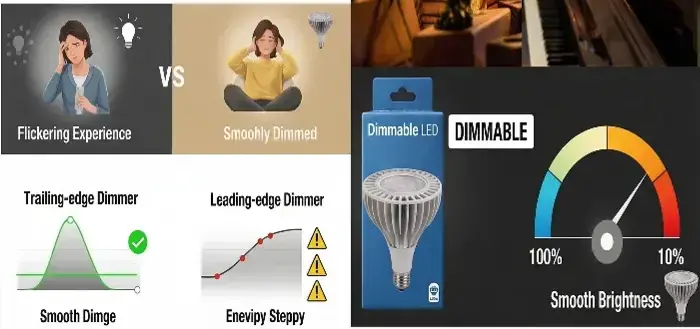
- No visible flicker
- No brightness jumping
- Smooth transition at low levels
Engineering Insight (Simplified)
Cheap LEDs use linear dimming → poor low-light control
Better LEDs use logarithmic dimming curves → natural visual experience
What to Specify
- Flicker <5%
- High-frequency driver
- Stable dimming curve
Beam Angle Selection
How Beam Angle Affects Design
| Ángulo del haz | Effect | Aplicación |
|---|---|---|
| 15°–25° | Narrow, high intensity | Artwork, feature walls |
| 30°–40° | Equilibrado | Dining, lobby |
| 60°+ | Wide coverage | Iluminación general |
Decision Logic
- Want focus → narrow beam
Want uniform light → wider beam
In most hospitality projects, 30°–40° is the safest choice
Brillo (Salida de Lúmenes)
Typical Range
- 900–1200 lumens for PAR38
How to Choose
| Scenario | Recomendación |
|---|---|
| Mesas de restaurante | Medium brightness |
| Hotel lobby | Higher brightness |
| Bar / lounge | Lower + dimmable |
Perspectiva Clave
Brightness should always be combined with dimming capability, not used alone.
Color Temperature & CRI (Atmosphere Control)
Temperatura de Color
| CCT | Effect | Aplicación |
|---|---|---|
| 2700K | Warm, cozy | Restaurants, bars |
| 3000K | Equilibrado | Hotels, retail |
| 4000K | Neutral | Functional spaces |
CRI & R9 (Critical but often ignored)
- CRI ≥90 → overall color accuracy
R9 >80 → red tones (food, wood, fabric)
In dining areas:
Higher R9 makes food and materials look more appealing
Outdoor & Environmental Requirements

PAR38 bulbs are often used in:
- hotel entrances
- outdoor facade lighting
- semi-exposed areas
What to Choose
- IP65 or Wet Location Rated
- Sealed driver design
Por qué es importante
Moisture can cause:
- parpadeo
- driver instability
- early failure
Thermal Design (Often Overlooked)
Many PAR38 bulbs are installed in:
- recessed fixtures
- enclosed housings
Riesgo
- heat buildup
- driver degradation
- unstable dimming
What to Look For
- aluminum heat sink
high-temperature driver
Good thermal design = stable performance + longer lifespan
Common Problems & How to Fix Them
| Problema | Causa | Solution |
|---|---|---|
| Parpadeo | Incompatibilidad del regulador | Use compatible LED |
| Zumbido | Driver instability | Better driver design |
| Drop-out | Low load | Add compatible bulb |
| Uneven dimming | Poor batch consistency | Use quality supplier |
Application-Based Selection Logic
Hotel Lobby
- 3000K
- 30°–40°
- smooth dimming
Restaurante
- 2700K
- CRI ≥90, R9 >80
- low flicker
Bar / Lounge
- deep dimming (1–10%)
- warm tone
- stable low brightness
Final Selection Checklist
Before purchasing, confirm:
- TRIAC compatible
- flicker-free (<5%)
- correct beam angle (25°–40°)
- 900–1200 lumens
- 2700K–3000K
- CRI ≥90, R9 >80
- IP65 (if needed)
- ≥50,000 hours lifespan
Conclusión
Choosing the right dimmable PAR38 LED bulb is a balance between:
- compatibility
- visual performance
- reliability
In hospitality lighting, the goal is not just illumination—but creating a controlled, comfortable, and consistent lighting experience.
- Download: PAR38 Dimmer Compatibility List
- Request: Free Project Lighting Advice
- Get: Dialux Lighting Simulation Support