Diseño de Iluminación para Galerías: Estrategias Profesionales para Iluminar Arte y Espacios de Exposición
Introducción
Gallery lighting is not a decorative afterthought. It is a control system for visibility, color fidelity, visitor focus, and artwork protection. When the lighting is poorly designed, the result is immediate: uneven presentation, reflected glare, washed-out colors, visitor discomfort, and repeated on-site adjustment after installation.
For importers, project contractors, and exhibition lighting specifiers, the issue is larger than aesthetics. Incorrect beam selection, poor aiming geometry, or unstable dimming behavior can lead to commissioning delays, fixture replacement, ceiling rework, and dissatisfaction from curators or end clients. In gallery, museum, and retail exhibition projects, lighting must be treated as a technical layer of the display system, not simply a luminaire schedule.
Resumen Ejecutivo
Effective gallery lighting depends on controlled beam angles, high color rendering, glare management, correct aiming geometry, and application-based lux levels. A successful design improves artwork visibility, protects visual comfort, reduces adjustment work on site, and supports long-term exhibition flexibility.
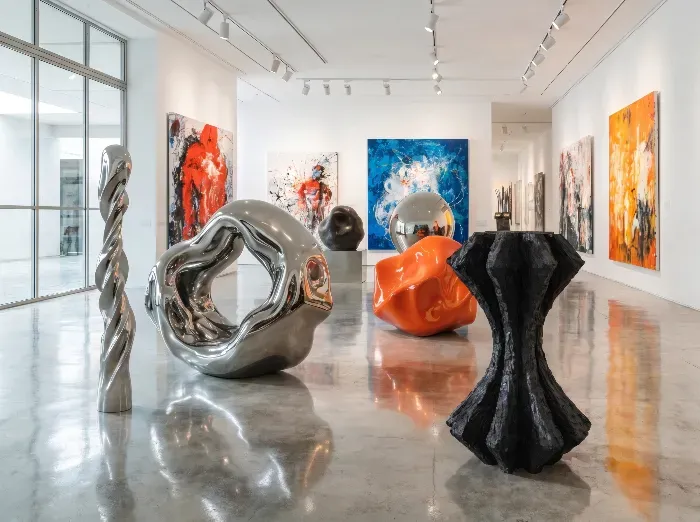
gallery lighting design for art exhibition spaces
Understanding the Lighting Challenges in Art Galleries
Realidad en el sitio / comercial
Art galleries present a more demanding environment than standard retail or hospitality spaces. The ceiling may be clean and minimal, but commissioning is often complex. Different artwork sizes, changing exhibitions, reflective glass frames, textured canvases, and variable wall finishes all affect the final lighting result.
If these factors are not considered at design stage, installers spend extra hours re-aiming luminaires, replacing beam optics, or relocating track heads after mock-up review. In premium projects, each access cycle may require lifts, after-hours labor, or coordination with curators, which directly increases project cost.
Análisis Profundo y Solución de Ingeniería
Gallery lighting must balance several technical objectives at the same time:
- highlight the artwork without over-lighting the wall
- preserve accurate color appearance through high color rendering index (CRI)1
- control glare for standing and moving visitors
- avoid harsh shadows and scalloping
- maintain flexibility for exhibition rotation
Unlike general architectural lighting, gallery lighting is usually based on layered illumination. Accent lighting directs attention to the artwork, while ambient lighting supports circulation and spatial comfort. This means the luminaire selection cannot rely on wattage alone. Beam angle, center beam candlepower, mounting distance, aiming angle, and dimming behavior all affect the final visual outcome.
In practice, artwork lighting should be treated as a precision optical task. A narrow beam may create dramatic focus for small pieces, while a wider beam may be required for large canvases or grouped displays. The correct result is not just “bright enough,” but visually balanced across the exhibition wall.
Nota de Fábrica
From a manufacturing perspective, the most common problem in gallery projects is not insufficient lumen output. It is incorrect optical selection during specification. Once the fixtures arrive on site, replacing lenses or changing beam distribution becomes far more expensive than validating the layout before production.
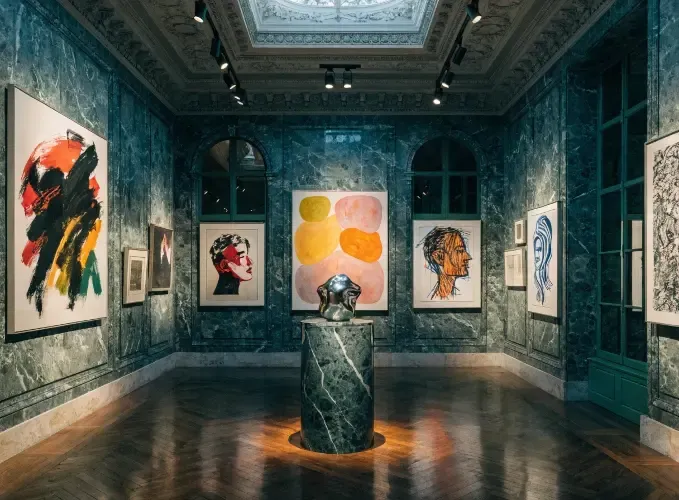
art gallery spotlight planning and glare control
Why High CRI Lighting Is Essential for Art Galleries
Realidad en el sitio / comercial
When artwork colors appear dull, shifted, or unnatural under artificial light, the problem is usually identified immediately by curators, artists, or brand stakeholders. This often triggers fixture comparisons, site complaints, or re-specification pressure, even when the installation is already complete.
In commercial terms, this is a high-risk issue. A lighting system that fails to reproduce color accurately undermines the exhibition itself and creates reputation risk for both contractor and supplier.
Análisis Profundo y Solución de Ingeniería
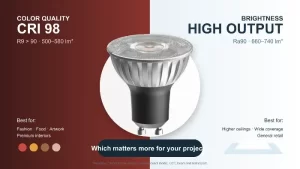
High CRI lighting is critical because artwork depends on subtle color differentiation, tonal depth, and surface nuance. A luminaire with inadequate spectral quality can distort reds, flatten blues, or reduce contrast in mixed pigments. This is especially problematic for oil paintings, textile works, photography, and premium retail displays where color judgment matters.
For gallery use, specifiers commonly target CRI 90 or above, with stronger attention to red rendering performance, often evaluated through R92. In practical terms, high CRI helps preserve:
- skin tones in portraiture
- warm pigments in classical paintings
- material perception in sculpture and textiles
- brand color consistency in exhibition retail environments
It is also important to distinguish between color temperature and color rendering. A suitable correlated color temperature (CCT)3 sets the mood of the space, but it does not guarantee faithful color appearance. A 3000K luminaire with poor spectral balance may look warm yet still render artwork inaccurately.
| Característica | Standard Commercial LED | High CRI Gallery LED | Impact on Maintenance / ROI |
|---|---|---|---|
| CRI performance | Typically lower | Typically 90+ | Fewer client complaints and reduced rework |
| R9 red rendering | Often weak | Stronger red reproduction | Better artwork fidelity and visual approval |
| Suitability for art display | Limitado | Preferred | Higher specification confidence |
| Exhibition consistency | Variable | More controlled | Better batch continuity across projects |
Nota de Fábrica
From a manufacturing perspective, achieving high CRI is not only a matter of selecting a better LED package. Batch consistency must also be controlled. In gallery projects, visible variation between fixtures on the same wall is unacceptable, so binning discipline and outgoing batch verification are as important as nominal CRI values.
The 30° Lighting Rule in Gallery Design
Realidad en el sitio / comercial
Incorrect aiming angles are a major source of reflected glare on framed artwork, especially when glass or protective acrylic is used. Visitors may see the luminaire reflection instead of the artwork, which immediately reduces viewing quality. On site, correcting this often means repeated aiming adjustments and inconsistent visual results across the gallery.
Análisis Profundo y Solución de Ingeniería
The 30° lighting rule is a widely used gallery lighting guideline. It refers to aiming the light at the artwork from approximately 30 degrees relative to the vertical plane of the wall. This geometry helps balance three critical factors:
- reduced reflected glare toward the viewer
- improved modeling and texture visibility
- more even illumination across the artwork surface
If the angle is too steep, the upper portion may be over-emphasized and the lower area may fall off excessively. If the angle is too shallow, glare and shadow problems become more likely, particularly for framed or glazed works.
This rule is not absolute, but it is a strong starting point for track-mounted spotlights in gallery and museum settings. Final adjustment should still consider artwork height, frame finish, protective cover material, and visitor viewing distance.
| Característica | Too Shallow Angle | Around 30° | Too Steep Angle | Impact on Maintenance / ROI |
|---|---|---|---|---|
| Reflection control | Deficiente | Bueno | Moderado | Less re-aiming on site |
| Texture visibility | Weak | Equilibrado | Strong but uneven | Better presentation quality |
| Uniformity on artwork | Inconsistent | Controlled | Top-heavy | Fewer curator complaints |
| Commissioning time | Longer | More efficient | Longer | Menor costo de mano de obra |
Nota de Fábrica
During hotel commissioning and gallery installations, the 30° rule usually works well as an optical baseline, but fixture positioning must still match the real mounting height. A good design on paper can fail on site if the track location does not support the intended aiming geometry.
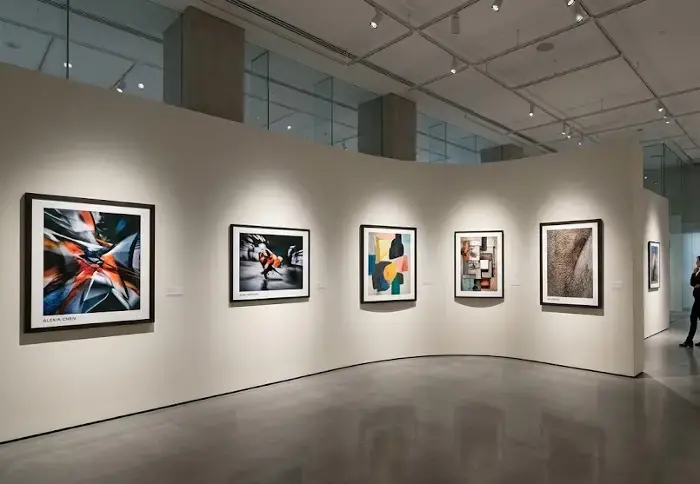
30 degree artwork lighting rule in gallery design
Choosing the Right Beam Angle for Artwork Lighting
Realidad en el sitio / comercial
Beam angle errors are one of the most expensive avoidable issues in exhibition lighting. If the beam is too narrow, the artwork is hot-spotted and the edges fall dark. If the beam is too wide, light spills onto adjacent walls and weakens visual focus. On site, this often leads to changing optics, replacing luminaires, or accepting compromised results.
Análisis Profundo y Solución de Ingeniería
Ángulo del haz4 should be selected according to artwork size, mounting distance, and required visual emphasis. There is no universal beam for all exhibitions.
Typical application logic:
- narrow beam: small paintings, sculptures, or strong focal accents
- medium beam: standard framed works at common viewing distances
- wide beam: larger canvases, wall graphics, or grouped display areas
The key is matching the beam spread to the illuminated target at the actual aiming distance. Optical control is more important than nominal lumen output. A lower-wattage spotlight with the correct beam often performs better than a higher-wattage unit with poor optical fit.
For changing exhibitions, interchangeable optics or multiple beam options within the same fixture family can significantly reduce long-term operating friction.
| Característica | Haz Estrecho | Haz medio | Haz ancho | Impact on Maintenance / ROI |
|---|---|---|---|---|
| Best for | Small artworks | General gallery use | Large artworks or wall washing | |
| Visual effect | Strong focus | Balanced coverage | Broad illumination | |
| Riesgo de luz derramada | Bajo | Moderado | Más alto | |
| Re-aiming sensitivity | Alta | Moderado | Inferior | |
| Flexibility across exhibitions | Limitado | Bueno | Good with careful spacing |
Nota de Fábrica
From a manufacturing perspective, beam angle tolerance matters more in gallery projects than in many commercial jobs. Even small optical deviations between fixtures become visible on a clean exhibition wall. Lens quality, reflector alignment, and final photometric validation should be treated as production control items, not catalogue assumptions.
Museum Lighting Standards and Recommended Lux Levels
Realidad en el sitio / comercial
Over-lighting can damage sensitive exhibits over time, while under-lighting reduces visibility and visitor engagement. If lux levels5 are not defined clearly during specification, site teams often compensate by subjective dimming or arbitrary aiming changes, which creates inconsistency across exhibition rooms.
Análisis Profundo y Solución de Ingeniería
Museum and gallery lighting levels should be based on both visual needs and conservation sensitivity. Different exhibit materials tolerate light exposure differently. Paper, textiles, and other delicate objects generally require lower illuminance than oil paintings, sculpture, or durable display elements.
Typical ranges used in professional practice include:
- around 50 lux for highly sensitive materials
- around 150 to 200 lux for moderately sensitive exhibits
- around 200 to 300 lux or higher for less sensitive display elements, depending on curatorial intent
These are not universal values, but practical reference points. The lighting designer must also consider cumulative exposure, beam concentration, ambient contribution, and daylight interaction where present.
In exhibition retail spaces, the lux target may be intentionally higher to support visual merchandising, but this should still be controlled to avoid excessive contrast and visitor discomfort.
| Exhibit Type | Rango típico de lux | Lighting Priority | Impact on Maintenance / ROI |
|---|---|---|---|
| Light-sensitive artifacts | Around 50 lux | Preservation | Lower risk of exhibit damage |
| Paintings and mixed media | Around 150–200 lux | Balance of visibility and protection | Stable curatorial acceptance |
| Sculpture and durable displays | Around 200–300+ lux | Form and presence | Strong visual impact with controlled energy use |
| Retail exhibition displays | Often higher | Brand visibility | Better commercial presentation with careful glare control |
Nota de Fábrica
In large hospitality and exhibition projects, lux problems often come from uncontrolled layering rather than one fixture being too powerful. Accent lighting, ambient lighting, and decorative lighting must be calculated together. Otherwise, final levels on the artwork can exceed target values even when each fixture seems acceptable by itself.
Track Lighting Systems for Flexible Exhibition Lighting
Realidad en el sitio / comercial
Exhibition layouts change. Artwork sizes change. Curatorial priorities change. A fixed downlight layout may look clean at handover, but it can become restrictive after the first exhibition rotation. This creates a maintenance burden because any major adjustment may require ceiling work instead of simple fixture repositioning.
Análisis Profundo y Solución de Ingeniería
Track lighting systems are widely used in galleries because they allow repositioning, re-aiming, and fixture replacement without modifying the ceiling infrastructure. For project operators, this is a practical way to preserve flexibility over the life of the space.
A well-designed track system supports:
- movement of spotlights along the rail
- fast aiming changes for new artwork positions
- beam angle variation within the same system family
- phased upgrades without replacing the entire ceiling layout
For B2B projects, compatibility within the track ecosystem is critical. Mechanical fit, driver dimensions, dimming protocol6, and thermal design all affect long-term serviceability. The best result is a standardized family of luminaires with consistent photometric and electrical performance.
| Característica | Fixed Downlight Layout | Track Lighting System | Impact on Maintenance / ROI |
|---|---|---|---|
| Exhibition flexibility | Bajo | Alta | Lower future modification cost |
| Re-aiming capability | Limitado | Excelente | Faster exhibition turnover |
| Ceiling rework risk | Más alto | Inferior | Reduced site disruption |
| Fixture replacement flexibility | Restricted | Easier | Better lifecycle value |
Nota de Fábrica
From a manufacturing perspective, gallery track lighting should be validated as a system, not as isolated luminaires. Mechanical locking reliability, conductor contact stability, dimming compatibility, and thermal performance must all be tested together, especially in projects with long daily operating hours.
Real Gallery Lighting Layout Example
Realidad en el sitio / comercial
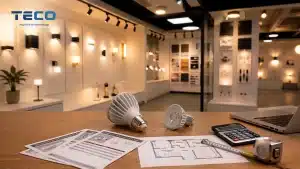
Without a layout strategy, even good fixtures can produce poor exhibition results. The common failure is to place track lines or spotlight positions according to ceiling symmetry rather than artwork presentation. This leads to compromised aiming angles, inconsistent beam coverage, and visible rework during commissioning.
Análisis Profundo y Solución de Ingeniería
Consider a typical gallery room with a 3.2 m ceiling height, white walls, and framed artworks mounted at standard viewing height. A practical approach may include:
- track installed parallel to the display wall
- offset from the wall to support an aiming angle close to 30 degrees
- mixed beam spotlights for different artwork sizes
- dimmable control for scene adjustment during exhibition setup
Por ejemplo:
- small framed works: narrow to medium beam spotlights
- medium paintings: medium beam with careful center spacing
- large artworks: wide beam or overlapping medium beams for uniformity
- sculpture zones: controlled accent from multiple directions to shape volume
The layout should prioritize viewing conditions rather than geometric neatness on reflected ceiling plans. Photometric review is strongly recommended before ordering, especially where glazing, dark wall finishes, or premium artworks are involved.
Nota de Fábrica
During gallery mock-ups, the most effective way to avoid site correction is to test one representative wall condition in advance. This should include real mounting height, actual beam options, dimming level, and frame reflectance. A half-day pre-install verification can prevent weeks of adjustment later.
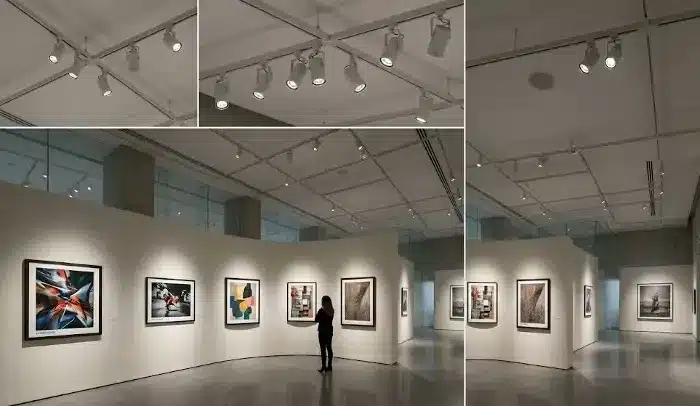
real gallery lighting layout example with track spotlights
Common Gallery Lighting Design Mistakes
Realidad en el sitio / comercial
Most gallery lighting failures are not caused by one major defect. They come from several small specification errors that combine during commissioning. The result is a space that technically functions but does not present the artwork properly, forcing additional labor and client negotiation.
Análisis Profundo y Solución de Ingeniería
Los errores comunes incluyen:
- selecting luminaires by wattage instead of optical distribution
- ignoring glare from glazed frames
- using low CRI fixtures in color-critical spaces
- placing tracks too close or too far from the display wall
- applying one beam angle to all artwork types
- omitting dimming and scene adjustment capability
- failing to verify target lux levels on sensitive exhibits
- overlooking consistency between fixture batches
Another frequent issue is over-lighting. Brighter is not always better in galleries. Excessive contrast can fatigue visitors and reduce appreciation of nearby works. Controlled hierarchy is more effective than maximum intensity.
| Error | Immediate Result | Long-Term Impact | Impact on Maintenance / ROI |
|---|---|---|---|
| Ángulo de haz incorrecto | Hot spots or spill light | Re-aiming and fixture change | Higher labor cost |
| Low CRI selection | Poor color appearance | Client dissatisfaction | Possible re-specification |
| Poor aiming geometry | Reflected glare | Reduced viewing quality | Longer commissioning |
| No dimming flexibility | Inflexible exhibitions | Operational constraints | Lower lifecycle value |
| No batch consistency control | Visible variation | Uneven presentation | Higher replacement risk |
Nota de Fábrica
From a manufacturing perspective, one of the most preventable mistakes is assuming all gallery spotlights within the same nominal specification will perform identically. Optical precision, LED bin consistency, driver stability, and finish quality all affect the final installation. In visual-critical projects, sample validation should never be skipped.
Conclusion: Business Value
A well-executed gallery lighting design improves more than visual presentation. It reduces commissioning time, limits post-install adjustment, supports exhibition flexibility, and lowers long-term maintenance effort. For B2B projects, the real value lies in predictable optical performance, stable color quality, and a system structure that can adapt without repeated ceiling intervention.
Effective gallery lighting depends on disciplined control of beam angle, CRI, aiming geometry, glare, lux levels, and track system flexibility. When these factors are coordinated properly, the result is a more reliable installation and a lower lifetime system cost.
B2B Engineering Recommendation
For large projects with specific dimming requirements, request the load schedule. The Teco engineering team will simulate the system in-lab to verify compatibility before mass production.
Notas al pie
CRI, or Color Rendering Index, is a metric that indicates how accurately a light source reveals colors compared with a reference source. ↩
R9 is a supplemental color rendering value representing strong red reproduction, which is especially important in artwork, textiles, and skin tones. ↩
CCT, or Correlated Color Temperature, describes whether the light appears warm, neutral, or cool in visual tone. ↩
Beam angle is the angle at which light intensity is distributed from a luminaire, affecting coverage size and visual focus. ↩
Lux is the unit of illuminance, measuring how much light falls onto a surface. ↩
Dimming protocol refers to the control method used to regulate light output, such as phase-cut, 0/1–10V, DALI, or other control systems. ↩