Why Does Your Hotel Lighting Look Dim After 3 Years?
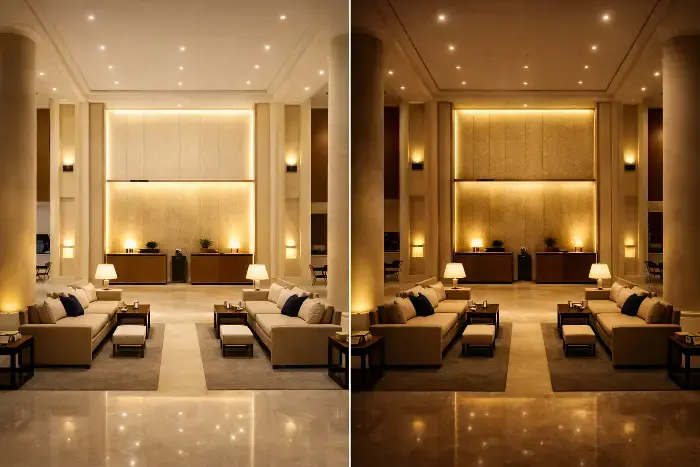
Modern hotel lobby shown under two lighting conditions, contrasting cool daylight illumination with a warm, inviting glow to highlight architectural details and interior furnishings.
In many hospitality and commercial lighting projects, the issue is not product failure—it is incorrect lifetime specification.
Common real-world problems include:
- corridors falling below required lux levels
- uneven brightness across zones
- expensive group relamping in high ceilings
- increasing maintenance costs after only 2–4 years
The root cause is often simple:
Choosing the wrong L-value (L70, L80, or L90)
Quick Answer: Which Should You Choose?
| Scenario | Recommended | Why |
|---|---|---|
| Hotels / corridors / high ceilings | L70 | Lowest maintenance cost, longest usable life |
| Restaurants / hospitality | L80 | Better visual consistency |
| Retail / luxury display | L90 | Maximum brightness accuracy |
Conclusión:
For over 80% of commercial projects, L70 is the most practical choice.
What Do L70, L80, and L90 Mean?
LED lifetime is defined by lumen maintenance, not failure.
- L70 → 70% brightness remaining
- L80 → 80% brightness remaining
- L90 → 90% brightness remaining
This means the light is still working—but gradually dimming.
How Lumen Maintenance Actually Looks Over Time

Perspectiva Clave
- L90 drops faster → shorter rated life
- L70 drops slower → longer usable life
Does 70% Brightness Look “Dim”?
Important Insight
Human eyes perceive brightness logarithmically.
70% brightness does NOT look like 30% darker
This is why:
L70 became the global industry standard
The Real Difference: L70 vs L80 vs L90
| Métrica | Brightness Retention | Typical Lifetime | Cost Impact |
|---|---|---|---|
| L90 | 90% | Shortest | Alta |
| L80 | 80% | Medio | Medio |
| L70 | 70% | Longest | Lowest |
The Hidden Cost: Why L90 Is Not Always Better
Over-Specification Problem
Choosing L90 often leads to:
- higher fixture cost
- lower drive current (to reduce heat)
- more fixtures needed to meet lux levels
Lifecycle Cost Comparison (10-Year)
| Métrica | Coste inicial | Maintenance Cost | Total Cost |
|---|---|---|---|
| L90 | Alta | Medio | Highest |
| L80 | Medio | Medio | Equilibrado |
| L70 | Bajo | Bajo | Lowest |
Key B2B Insight
In high-ceiling projects, labor cost exceeds fixture cost.
This makes L70 the most economical choice.
3-Step Decision Tree (Fast Selection)
Step 1: Is visual perfection critical?
→ Yes → Choose L90
Step 2: Is maintenance difficult (high ceiling / large scale)?
→ Yes → Choose L70
Step 3: Need balance between cost and performance?
→ Choose L80
Why L70 Is the Industry Standard
1. Matches Real Maintenance Cycles
- hotels: 5–10 years
- offices: 3–7 years
2. Aligns with Lighting Standards
- EN / IES lux requirements
- ENERGY STAR baseline
3. More Realistic in Real Conditions
Real installations include:
- higher ambient temperatures
- enclosed fixtures
- dimming usage
LM-80 and TM-21: How Lifetime Is Calculated

Chart illustrating lumen maintenance curves for LED light output normalized to 1 at zero hours, showing how performance degrades at different operating temperatures over time.
Core Concept
- LM-80 = measurement (real test data)
- TM-21 = projection (mathematical model)
The Rule of Six
Lifetime ≤ 6 × test duration
Ejemplo:
- 10,000h test → max claim = 60,000h
- 6,000h test → max claim = 36,000h
Why Temperature (Ta) Matters More Than You Think

Key Rule
Every +10°C → lifetime drops ~50%
Critical Engineering Insight
All lifetime claims depend on ambient temperature (Ta).
If real installation temperature exceeds test conditions:
actual lifetime will drop significantly
Advanced Engineering Note
What Is L70B50?
- L70 = lumen level
B50 = 50% of samples meet the level
Industry standard = L70B50
Important Distinction
- LM-80 → LED package
- Real project → luminaire system
Includes:
- driver
- heatsink
- housing
Manufacturer Insight
As a manufacturer, we validate:
- LED package (LM-80)
- complete luminaire performance
- thermal + driver integration
Common Mistakes to Avoid
❌ L90 is always better
→ Not true (higher cost, shorter life)
❌ L70 means low quality
→ Not true (industry standard)
❌ Lifetime = working hours
→ Not true (it means brightness drop)
Final Selection Checklist
✔ What is the maintenance cycle?
✔ Is visual accuracy critical?
✔ What is the installation height?
✔ What is the ambient temperature (Ta)?
✔ Is dimming used?
✔ Is LM-80 ≥10,000h?
✔ Is TM-21 within 6× rule?
FAQ (Featured Snippet Ready)
What is L70 in LED lighting?
L70 means the LED produces 70% of its initial brightness and is the most common lifetime standard.
Is L90 better than L70?
Not necessarily. L90 provides higher brightness retention but shorter lifetime and higher cost.
Which LED lifetime is best for hotels?
L70 is typically the best choice for hotels due to lower maintenance and longer usable life.
Can I trust a 100,000-hour LED claim?
Only if LM-80 test data exceeds ~16,000 hours. Otherwise, it likely violates the Rule of Six.
Conclusión
Choosing L70, L80, or L90 is not about selecting the highest number.
It is about selecting the right balance between performance, cost, and maintenance.
For most commercial and hospitality projects, L70 delivers the best long-term value.
For large-scale projects, we provide:
- LM-80 / TM-21 report verification
- thermal simulation
lifetime optimization recommendations
Send your project details to get a free lifetime evaluation report