
Introduction: Why LED Flicker Is a Real Project Risk
LED flicker is one of the most common issues in commercial lighting projects.
It can lead to:
- visible light instability
- camera interference in retail environments
- discomfort in offices and hospitality spaces
- safety risks in environments with moving machinery
In many cases, what appears as flicker is actually a stroboscopic effect—a different phenomenon that can distort motion perception.
Understanding the difference is essential for:
- selecting compatible LED drivers
- meeting international compliance standards
- avoiding costly commissioning delays
Understanding the difference is critical for selecting compatible LED drivers and dimming systems.For a deeper understanding of dimming compatibility, refer to our guide on dimmable LED lighting systems.
Flicker vs Stroboscopic Effect
| Característica | Parpadeo | Stroboscopic Effect |
|---|---|---|
| Cause | Light intensity fluctuation | Interaction with motion |
| Perception | Visible instability (static) | Motion illusion |
| Key Metrics | PF / FI / Pst LM | SVM |
| Risk | Eye strain, discomfort | Safety hazard |
What Is LED Flicker?
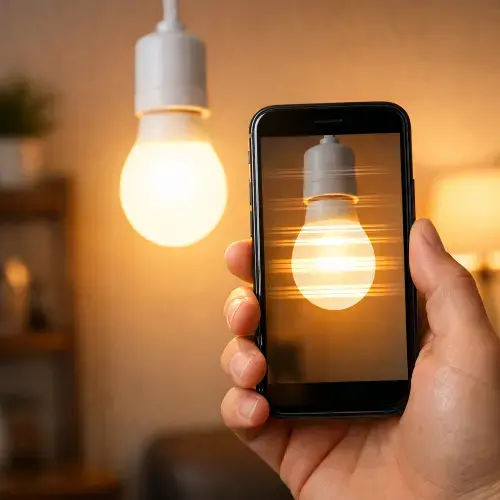
In a warmly lit interior, a smartphone screen reflects the glow of an LED bulb from nearby hanging lamps, surrounded by houseplants and wooden shelving.
LED flicker refers to temporal light modulation, where light output varies over time due to electrical ripple or driver instability.
According to IEEE, flicker risk depends on frequency and modulation depth (see IEEE 1789-2015).
Key Flicker Metrics
- Percent Flicker (PF)
- Flicker Index (FI)
Percent Flicker = (L_max − L_min) / (L_max + L_min) × 100%
IEEE recommendation:
- Low risk: <10% modulation (100–2000 Hz)
- Preferred: <5% in sensitive environments
Perspectiva de Ingeniería
In real commercial GU10 installations, over 80% of flicker issues are caused by dimmer-driver incompatibility rather than LED chip quality.
What Is the Stroboscopic Effect?
El stroboscopic effect occurs when modulated light interacts with moving objects, creating visual illusions.
Examples:
- rotating fans appearing stationary
- conveyor belts appearing slower or reversed
- machinery motion being misinterpreted
Defined by the International Electrotechnical Commission (IEC) in IEC TR 63158:2018
(https://webstore.iec.ch/publication/29994)
Key Metric: SVM (Stroboscopic Visibility Measure)
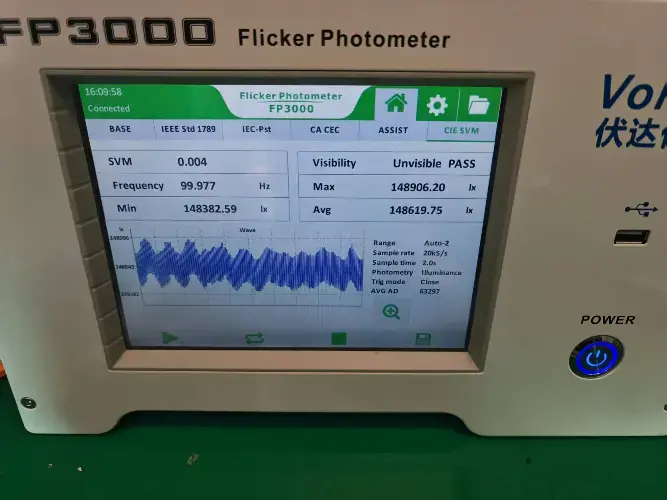
FP3000 Flicker Photometer interface showing real-time measurement data, including waveform graphs, frequency range from 95.77 Hz to 148.60 Hz, and controls for visible and invisible flicker testing.
- SVM ≤ 0.4 → acceptable (EU ErP requirement)
-
SVM < 0.2 → recommended low-risk level
In modern EU regulations (Commission Regulation (EU) 2019/2020),
SVM ≤ 0.4 is the key compliance threshold for LED products.
Short-Term Flicker (Pst LM) in LED Systems
In addition to PF and SVM, commercial lighting systems must consider:
Pst LM (short-term flicker severity)
Defined in IEC 61000-3-3
What Pst LM Measures
- Evaluates voltage fluctuation impact on light stability
- Reflects system-level performance, not just driver design
Key Threshold
- Pst LM = 1.0 → perceptibility limit
- Pst LM < 1.0 → acceptable for public lighting systems
Por qué es importante
High Pst values often result from:
- unstable power supply
- incompatible dimmers
- large load variation
Engineering Recommendation
- Ensure Pst LM < 1.0
- Validate dimming compatibility
- Use drivers with stable input regulation
Why Do LED Lights Flicker in Commercial Installations?
In real-world projects, flicker is usually caused by system mismatch rather than product failure.
Common Causes
-
Dimmer incompatibility
- TRIAC mismatch
-
Driver ripple current
- insufficient filtering
-
Voltage instability
- common in large buildings
-
Low-end dimming instability
- below 20–30% brightness
How to Fix LED Flicker and Stroboscopic Issues
1. Driver Selection
- Use constant current drivers
- Ripple current <5% recommended
- Use capacitors rated ≥105°C for stability
2. Dimming System Matching
- Verify minimum load of dimmer
- Prefer trailing-edge dimmers for LED systems
3. Increase PWM Frequency
- Recommended: >20 kHz
- Eliminates visible flicker
4. System-Level Validation
- Verify Pst LM < 1.0
- Check voltage fluctuation behavior
5. Specify Compliance Metrics
- PF < 10%
- FI < 0.08
- SVM ≤ 0.4
Many flicker issues originate from incompatible dimming systems.
You can learn more in our guide on LED dimmer compatibility and common mistakes
LED Flicker Troubleshooting Checklist
- Check dimmer compatibility (TRIAC vs LED driver)
- Verify driver ripple current (<5%)
- Measure Pst LM (<1.0)
- Confirm SVM value (≤0.4 for EU compliance)
-
Test across full dimming range (10–100%)
This checklist helps reduce commissioning issues and field failures.
Risks in Industrial and Commercial Environments
In environments with motion:
- flicker → fatigue and discomfort
- stroboscopic effect → safety hazards
According to World Health Organization, low-frequency flicker may contribute to headaches and visual strain.
Example Risk Scenario
- 10 Hz modulation
-
600 RPM machinery
Can appear stationary → serious safety risk
Referenced in EU Machinery Directive 2006/42/EC
Testing Methods and Standards
Key standards include:
- IEEE 1789-2015
- IEC 61000-3-3
- IEC TR 63158
* CIE TN 006:2016
Typical Testing Methods
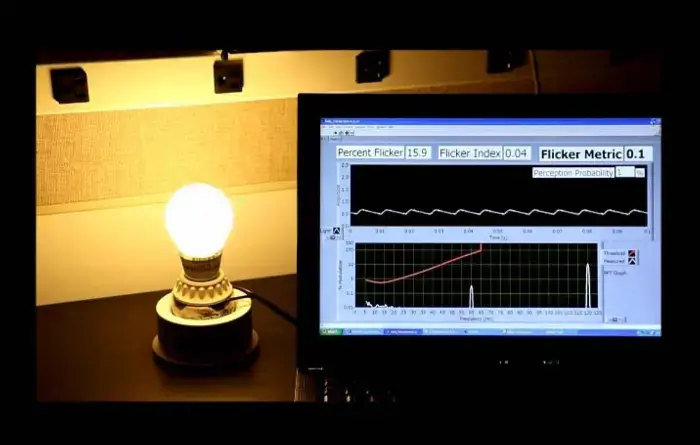
Illuminated incandescent bulb setup with an adjacent screen showing waveform graphs used to analyze light flicker index and related performance metrics in a laboratory environment.
- Oscilloscope waveform analysis
- FFT frequency analysis
- High-speed camera motion testing
Why It Matters in Retail and Hospitality
In commercial spaces:
- flicker → reduces visual comfort
- stroboscopic → disrupts perception
According to Illuminating Engineering Society (see IES RP-29-16):
lighting quality directly affects customer experience and dwell time
Cost Consideration in Commercial Projects
Flicker-free drivers may increase upfront cost by approximately 5–10%, but can significantly reduce:
- maintenance frequency
- replacement costs
- customer complaints
Quick Answers for Specifiers
Q: What is the difference between flicker and stroboscopic effect?
A: Flicker is brightness variation; stroboscopic effect is motion illusion.
Q: What is the key EU requirement?
A: SVM ≤ 0.4 (ErP regulation)
Q: What is acceptable flicker level?
A:
- PF < 10%
- FI < 0.08
- Pst LM < 1.0
Q: How to verify supplier claims?
A:
- Request third-party reports (UL / ETL)
- Verify PF / SVM / Pst LM data
Conclusion: Engineering Value
Flicker and stroboscopic effects directly impact:
- safety
- comfort
- system reliability
A properly specified system ensures:
- compliance
- stable performance
- reduced lifecycle cost
B2B Engineering Recommendation
For commercial lighting projects:
- verify PF / FI / SVM / Pst LM
- ensure driver-dimmer compatibility
- validate system performance before installation
Early validation helps avoid:
- commissioning delays
- warranty claims
- rework costs


 English
  French
  German
  Italian
  Spanish
  Portuguese
  Arabic
  Russian
  Japanese
  Chinese