Mini GU10 para aplicaciones de iluminación compacta: Cómo elegir, usar y optimizar el rendimiento
Introducción
As commercial lighting design continues to evolve, space constraints have become a critical challenge across retail, hospitality, and architectural projects. From narrow display cabinets and compact shelving systems to shallow ceiling installations and decorative niches, many environments simply do not allow the use of standard-sized lighting fixtures.
In these situations, selecting the right light source is not just a technical decision—it directly affects installation feasibility, visual performance, and long-term maintenance.
This is where Mini GU10 LED bulbs provide a highly practical solution.
Unlike standard GU10 lamps, Mini GU10 bulbs are specifically engineered for compact lighting applications, offering a reduced form factor while maintaining the same base compatibility. More importantly, they enable precise beam control in confined spaces, making them ideal for applications that require both accuracy and flexibility.
For lighting designers, contractors, and B2B buyers, understanding how to properly apply Mini GU10 lighting can significantly improve project outcomes while reducing installation complexity and cost.
What Is a Mini GU10 Bulb?
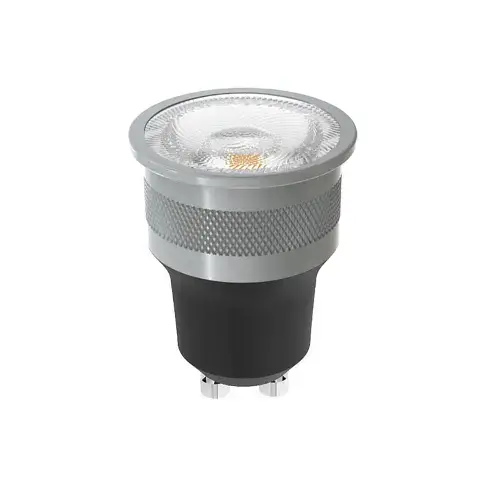
Detailed view of a GU10 LED spotlight bulb featuring a reflective silver lens, ridged collar design, black base, and dual pin connectors for easy installation.
A Mini GU10 bulb is a compact version of a standard GU10 LED lamp, designed for installations where space is limited but performance requirements remain high.
While it uses the same GU10 twist-lock base and operates on standard mains voltage (typically 220–240V), its smaller physical size allows it to fit into fixtures that would otherwise be incompatible with standard GU10 lamps.
Características clave
- Compact dimensions for tight installations
- Standard GU10 base for easy replacement
- Available in multiple beam angles
- Designed for precision lighting
Mini GU10 vs Standard GU10
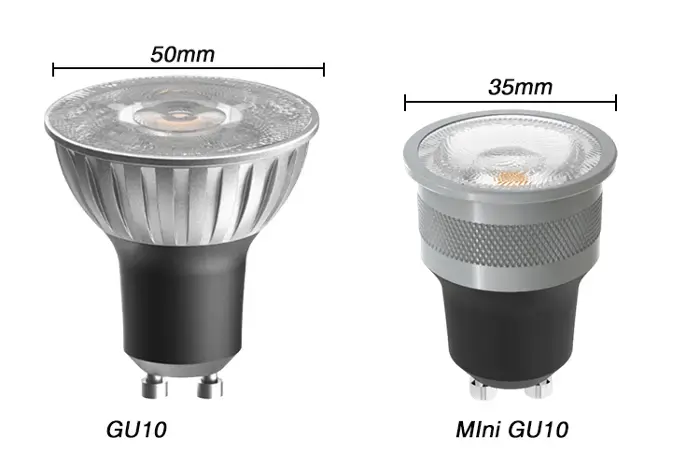
| Característica | Mini GU10 | Standard GU10 |
|---|---|---|
| Talla | Smaller and shorter | Standard size |
| Aplicación | Compact environments | Iluminación general |
| Installation | Flexible | Estándar |
| Thermal performance | More sensitive | More stable |
The reduced size is the defining advantage—but it also introduces new considerations, particularly in heat management and layout planning.
Where Mini GU10 Works Best
Mini GU10 is not intended as a universal replacement for all GU10 lamps. Its value lies in solving specific spatial and functional challenges.
1. Display Cabinet Lighting
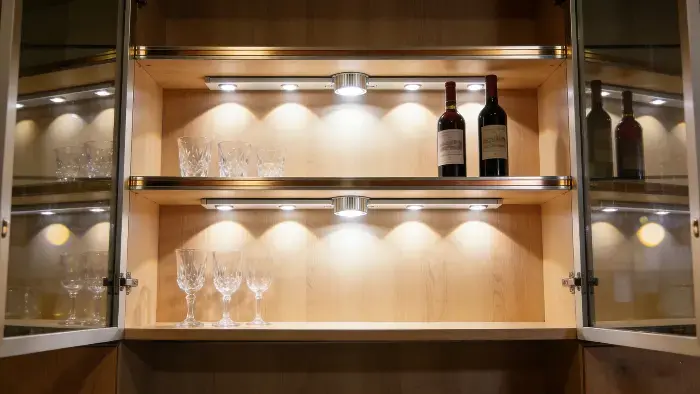
In jewelry stores, museums, and luxury retail environments, lighting must be both precise and discreet.
Standard GU10 bulbs are often too large for display cabinets and can create excessive heat in enclosed spaces. Mini GU10 solves both problems.
By using a narrow beam angle (typically 10°–24°), Mini GU10 allows designers to:
- Highlight small objects such as rings, watches, or artifacts
- Avoid light spill onto adjacent items
- Maintain clean and unobtrusive fixture integration
In practice, this results in stronger visual focus and higher perceived product value, which is critical in high-end retail.
2. Retail Shelving Lighting
Retail shelves often require localized lighting to highlight individual product sections without affecting surrounding areas.
Mini GU10 is particularly effective here because:
- It fits into compact shelf-mounted fixtures
- It allows precise beam targeting
- It reduces the need for custom fixture redesign
In one typical retail project, switching from standard GU10 to Mini GU10 reduced fixture depth requirements by over 30%, allowing slimmer shelving systems and improving overall store aesthetics.
3. Architectural Niche Lighting
Modern interior design frequently incorporates recessed niches and decorative cavities. These spaces require lighting that is both subtle and controlled.
Mini GU10 enables:
- Hidden installation within narrow recesses
- Controlled accent lighting without glare
- Clean visual integration with architectural elements
Because of its small size, it becomes possible to illuminate design features without exposing the light source.
4. Low Ceiling or Limited Depth Installations
In many commercial projects, ceiling depth is restricted due to structural or design limitations.
Standard GU10 lamps often cannot be installed because:
- The lamp body is too long
- Heat accumulation becomes problematic
Mini GU10 provides a direct solution:
- Shorter body fits shallow ceiling cavities
- Reduced installation complexity
- No need for major fixture modification
For contractors, this can significantly reduce both labor time and installation risk.
Why Standard GU10 Often Fails in Compact Spaces
Many projects initially attempt to use standard GU10 lamps, only to encounter practical limitations.
Common Issues
Lamp cannot physically fit into fixture
Overheating in enclosed or tight spaces
Excessive light spill in small areas
Difficult installation requiring modification
These issues are not related to product quality—they are simply a mismatch between lamp size and application requirements.
How Mini GU10 Solves This
Mini GU10 addresses these problems through:
- Reduced dimensions for easier installation
- Better suitability for focused lighting
- Lower need for structural changes
This makes it a more efficient solution for compact lighting applications.
Key Advantages of Mini GU10
1. Space Efficiency
Mini GU10 is specifically designed for environments where space is limited. This allows designers to use standard GU10 infrastructure without compromising on fixture size.
2. Precise Beam Control
Mini GU10 lamps are commonly available in beam angles such as:
- 10° for tight spotlighting
- 24° for focused accents
- 36° for general accent lighting
This flexibility allows for diseño de iluminación por capas, even in compact spaces.
3. Easy Installation and Retrofit
Because Mini GU10 uses the same base as standard GU10:
- No transformer is required
- Installation is straightforward
- Existing fixtures can often be reused
This significantly reduces retrofit complexity.
4. Improved Aesthetic Integration
Mini GU10 fixtures are less visible, making them ideal for:
- Minimalist interior designs
- High-end retail environments
- Architectural lighting applications
Design Considerations for Mini GU10
Although Mini GU10 offers flexibility, its compact size requires careful planning.
Beam Angle Selection
Choosing the correct beam angle is critical.
| Aplicación | Recommended Beam |
|---|---|
| Iluminación de exposición | 10°–24° |
| Retail shelving | 24°–36° |
| Iluminación de acento | 36° |
A narrower beam provides stronger focus but requires more precise placement.
Fixture Spacing
In compact lighting environments, spacing must be tighter than in general lighting.
Spacing ≈ 0.5–0.8 × mounting heightThis ensures consistent illumination without dark gaps.
Heat Management (Critical Factor)
Because Mini GU10 has a smaller heat dissipation surface, thermal management becomes more important.
Poor ventilation can lead to:
- Reduced lifespan
- Performance degradation
Las mejores prácticas incluyen:
Use aluminum housing
Avoid sealed fixtures
Ensure adequate airflow
Select high-quality drivers
Reproducción de Color (CRI)
For commercial lighting, especially retail:
CRI ≥ 90 is recommendedThis ensures accurate color presentation and improves product appeal.
Common Problems and Practical Solutions
Problem 1: Light Output Is Insufficient
Cause:
- Beam angle too wide
- Insufficient number of fixtures
Solution:
- Use narrower beam angles
- Increase fixture density
Problem 2: Overheating
Cause:
- Poor airflow in compact fixtures
Solution:
- Use thermally optimized products
- Avoid enclosed installations
Problem 3: Uneven Lighting
Cause:
- Incorrect spacing
- Inconsistent beam angles
Solution:
- Recalculate layout
- Use uniform beam angles
Mini GU10 vs GU10 vs MR16
| Característica | Mini GU10 | GU10 | MR16 |
|---|---|---|---|
| Tensión | 220V | 220V | 12V |
| Talla | Smallest | Medio | Pequeño |
| Installation | Fácil | Fácil | Requires transformer |
| Mejor Uso | Compact spaces | Iluminación general | Technical applications |
How to Choose Mini GU10 for Your Project
When selecting Mini GU10 lighting, consider:
Is space limited?
Is precise lighting required?
Is ventilation sufficient?
Is high CRI needed?
Is dimming compatibility required?
Choosing the right specification ensures both performance and reliability.
Commercial Value for B2B Buyers
Mini GU10 offers clear advantages for commercial projects:
Reduces fixture modification requirements
Simplifies installation in tight spaces
Improves lighting flexibility
Enhances product presentation
For contractors and distributors, this translates to:
- Lower labor costs
- Faster project execution
- Reduced risk of installation issues
Conclusión
Mini GU10 is not simply a smaller alternative to standard GU10—it is a specialized lighting solution designed for compact environments where precision and flexibility are essential.
By selecting the appropriate beam angle, optimizing spacing, and ensuring proper thermal management, Mini GU10 can deliver high-performance lighting even in the most constrained spaces.
For modern commercial lighting projects, it provides a practical and efficient way to overcome spatial limitations while maintaining high visual quality.