How to Choose Beam Angle for LED Spotlights (Narrow vs Wide Explained by Ceiling Height)
Narrow vs Wide Beam: Quick Answer
Narrow beam (15°–30°) → high intensity, small coverage → best for high ceilings & accent lighting
Wide beam (60°–90°) → lower intensity, large coverage → best for low ceilings & general lighting
Rule of thumb:
Ceiling higher than 4m → use narrow beam
Ceiling lower than 3m → use wide beam
Narrow vs Wide Beam: Side-by-Side Comparison
| Característica | Narrow Beam (15°–30°) | Wide Beam (60°–90°) |
|---|---|---|
| Light distribution | Focused | Wide spread |
| Intensidad de lux | Alta | Inferior |
| Área de cobertura | Pequeño | Grande |
| Best application | Iluminación de acento | Iluminación general |
| Altura del techo | High ceilings | Low ceilings |
| Glare control | Better | More glare risk |
When to Use Narrow vs Wide Beam

Use Narrow Beam (15°–30°) when:
- Altura del techo > 4m
- Need to highlight products or objects
- Require high lux on a specific area
Applications:
- retail displays
- hotel lobbies
- galleries
Use Wide Beam (60°–90°) when:
- Altura del techo < 3m
- Need uniform ambient lighting
- Reduce fixture quantity
Applications:
- oficinas
- supermarkets
- residential lighting
Why Narrow Beam Produces Higher Lux

Comparative chart of light beam spreads for 10° spot and 60° flood angles, showing resulting coverage diameters at different installation heights.
The difference between narrow and wide beams comes from light concentration.
Illuminance follows the inverse square law:
E = I / d²- E = illuminance (lux)
- I = luminous intensity
d = distance
Referencia:
https://en.wikipedia.org/wiki/Inverse-square_lawKey insight:
A narrow beam concentrates light into a smaller area, producing 2–4× higher lux than a wide beam at the same height.
Beam Coverage Formula (Practical Calculation)
To compare narrow vs wide beam in real projects:
D ≈ 2 × H × tan(θ/2)- D = beam diameter
- H = mounting height
θ = beam angle
Ejemplo:
At 3m height:
- 30° beam → ~1.6m coverage
60° beam → ~3.5m coverage
Referencia:
https://www.mathsisfun.com/algebra/trig-tangent.html
Narrow vs Wide Beam by Ceiling Height
| Ceiling Height | Recommended Beam | Razón |
|---|---|---|
| <3m | 60°–90° (Wide) | Better coverage |
| 3–4m | 40°–60° | Equilibrado |
| 4–6m | 20°–40° (Narrow) | Higher lux |
| >6m | 10°–25° (Narrow) | Deep penetration |
Based on practical IES lighting design principles:
https://www.ies.org/standards/
Manufacturer Insight
In commercial lighting projects:
- Over 60% of lighting complaints are caused by incorrect beam angle selection
- Not by lumen output
For ceilings above 5m:
Using 60° wide beam often results in:
- flat lighting
- insufficient brightness
Recommended solution:
Uso 24°–36° narrow beam
Improves contrast and visual impact
Beam Angle vs Fixture Spacing
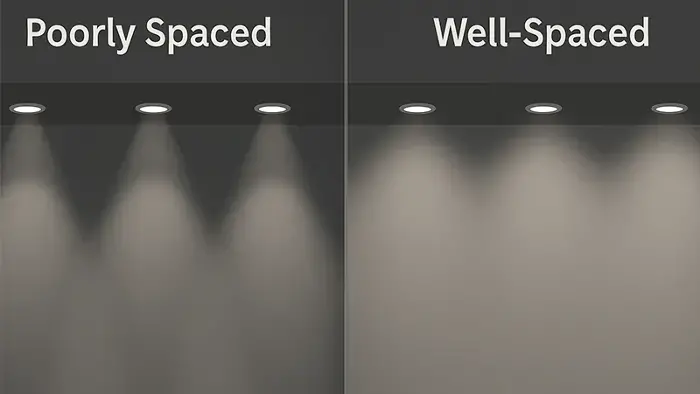
Even with correct beam type, spacing matters.
Spacing ≈ Height × (2 / tan(θ/2))Ejemplo:
3m + 30° → spacing ≈ 3.5m
Referencia:
https://www.ies.org/store/lighting-handbook/
Real Commercial Applications
Iluminación minorista
- 3m ceiling
- 40° beam
- Balanced visibility and coverage
Hotel Lobby
- 5m ceiling
Combine:
- narrow beam (accent)
- wide beam (ambient)
Art Gallery
- 4m ceiling
- 15° narrow beam
High contrast lighting
Reference (retail lighting guide):
https://www.ies.org/store/ies-lighting-for-retail-applications-rp-29-16/
Common Mistakes When Choosing Beam Angle
- Using wide beam for high ceilings
- Using one beam angle everywhere
- Ignoring spacing rules
- Focusing only on lumens
Troubleshooting: Narrow vs Wide Beam Problems
- Too dark → beam too wide
- Too bright spot → beam too narrow
- Uneven lighting → spacing issue
- Flat lighting → no beam layering
Before Buying LED Spotlights (Checklist)
- Ceiling > 4m? → choose narrow beam
- Need accent lighting? → choose narrow
- Need uniform lighting? → choose wide
- CRI ≥ 90? → better visual quality
How Professionals Combine Multiple Beam Angles
In high-end commercial projects, using a single beam angle across the entire space is a common mistake that leads to "flat" and uninspiring environments. Professional designers use Layered Lighting to create depth, focus, and visual comfort.
1.The "Accent + Ambient" Combo
This is the most standard professional setup for retail and hospitality.
The Strategy: Use 15°–24° narrow beams to highlight specific products or features (Accent), and 60° wide beams for general circulation areas (Ambient).
The Benefit: It creates a 3:1 contrast ratio, which naturally draws the customer’s eye to the merchandise while ensuring the space feels bright and safe.
2.The "Wall Washing + Task" Combo
Common in art galleries and modern offices.
The Strategy: Use 36°–45° beams pointed at walls (Wall Washing) to make the space feel larger, combined with 24° beams over desks or exhibits (Task).
The Benefit: It reduces eye strain by providing vertical brightness while maintaining high-intensity light where work is being done.
3.Avoiding "Hot Spots" with Overlapping Beams
When spacing fixtures, professionals aim for a 20%–30% beam overlap.
If beams don’t overlap: You get dark "scallops" on the walls and uneven light on the floor.
If overlap is too high: You waste energy and create "hot spots" that cause glare.
Conclusion: Narrow vs Wide Beam — Which One Is Better?
Neither is “better” — it depends on application
Narrow beam = precision + high intensity
Wide beam = coverage + uniformity
The correct choice depends on:
ceiling height
lighting purpose
spacing design
B2B Engineering Recommendation
For commercial projects:
- Request beam angle simulation
- Verify spacing and lux distribution
Use mixed beam strategies
Our engineering team can support Dialux simulation and beam angle optimization before production.