¿Puede una Bombilla Foco Funcionar tanto para Aplicaciones Residenciales como Minoristas? Consejo de Compra Experto para Compradores al por Mayor
Bulk buyers and project procurement teams often ask a deceptively simple question:
Can one spotlight bulb realistically serve both residential and retail applications?
The short answer is yes—but only in limited, well-defined scenarios.
In most commercial projects, attempting to use a single “universal” spotlight bulb introduces performance compromises that surface later as maintenance issues, visual inconsistency, or shortened lifespan.
This article explains where overlap is feasible, where it breaks down, and how bulk buyers should structure SKU decisions when residential and retail use cases intersect.
Short Answer for Bulk Buyers
Before diving into specifications, it helps to set clear expectations.
One spotlight bulb can work for both residential and retail
when operating hours are moderate, visual demands are not critical, and flexibility is prioritized over optimization.One spotlight bulb usually does not work well
when retail environments require long daily operation, precise beam control, or high color fidelity.The factor that most often breaks universality is usage intensity, not lumen output.
Understanding this early prevents over-reliance on specification averages that look acceptable on paper but fail in real-world deployment.
What Truly Differentiates Residential and Retail Lighting Needs

Comparative image illustrating a residential living area with warm downlights alongside a retail boutique featuring adjustable track lighting for garment racks and accessories.
Although residential and retail lighting often use similar spotlight formats, their functional priorities differ significantly.
Iluminación residencial focuses on:
- Visual comfort and even illumination
- Moderate brightness (typically 500–1000 lumens per spotlight)
- Wider beam angles (30–60°) to avoid harsh contrast
- Dimming compatibility for ambiance control
- Intermittent daily use, often under 4–6 hours
Retail lighting, by contrast, prioritizes:
- Visual emphasis and contrast
- Higher illuminance on merchandise (often 50–100 footcandles)
- Narrower, controlled beams (10–25°) for accent lighting
- High CRI (90+ or 95+) for accurate color presentation
- Extended daily operation, frequently 10–14 hours or more
From a procurement perspective, the most important distinction is not brightness, but operating profile. A lamp that performs well intermittently may degrade faster under continuous retail use, even if specifications appear similar.
Can One Spotlight Bulb Meet Both Residential and Retail Requirements?
A single spotlight bulb can meet overlapping baseline requirements, but only within a narrow performance window.
For example, an LED spotlight with:
- Around 800–900 lumens
- A 30–40° beam angle
- 3000K color temperature
- CRI around 85–90
may function adequately in:
- Home offices
- Small boutiques
- Low-traffic hospitality spaces
- Mixed-use residential-commercial properties
However, compromises quickly emerge:
- In retail settings, color saturation and contrast may be insufficient for merchandise presentation.
- In residential settings, beam focus may feel too directional, creating visual discomfort.
- Thermal margins designed for intermittent use may erode under extended daily operation.
Procurement teams should therefore view “dual-use” not as full equivalence, but as acceptable overlap under controlled conditions.
Key Technical Criteria That Determine Cross-Scenario Suitability

Visual comparison of advanced LED lighting features, including beam angle distribution, CRI performance on produce, thermal management design, and dimmer compatibility.
When evaluating whether one spotlight bulb can serve both applications, bulk buyers should prioritize specifications differently than they would for single-use projects.
1. Operating Hours (Most Critical)
Operating time is often the decisive factor. A lamp rated for 50,000 hours does not behave identically when used 3 hours per day versus 12 hours per day, especially in enclosed retail fixtures.
2. Beam Control
Retail environments demand precise beam shaping. Residential spaces tolerate—and often prefer—broader distribution. Adjustable optics or mid-range beams (30–45°) offer limited compromise.
3. Color Rendering
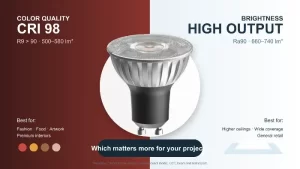
CRI above 85 may suffice for residential use, but retail—especially fashion or premium goods—frequently requires CRI 90–95+. This requirement alone often disqualifies universal bulbs.
4. Thermal Design
Retail installations stress thermal systems more consistently. Universal bulbs often sacrifice heat dissipation to reduce cost or size, increasing long-term failure risk.
5. Dimming and Control Compatibility
Residential systems often rely on TRIAC dimming, while retail projects may use 0–10V or centralized control systems. A mismatch here introduces hidden integration costs.
These criteria are interdependent. Improving one often raises cost or complexity elsewhere, which is why true universality is rare.
Practical Scenarios Where One Bulb Can Serve Both Uses
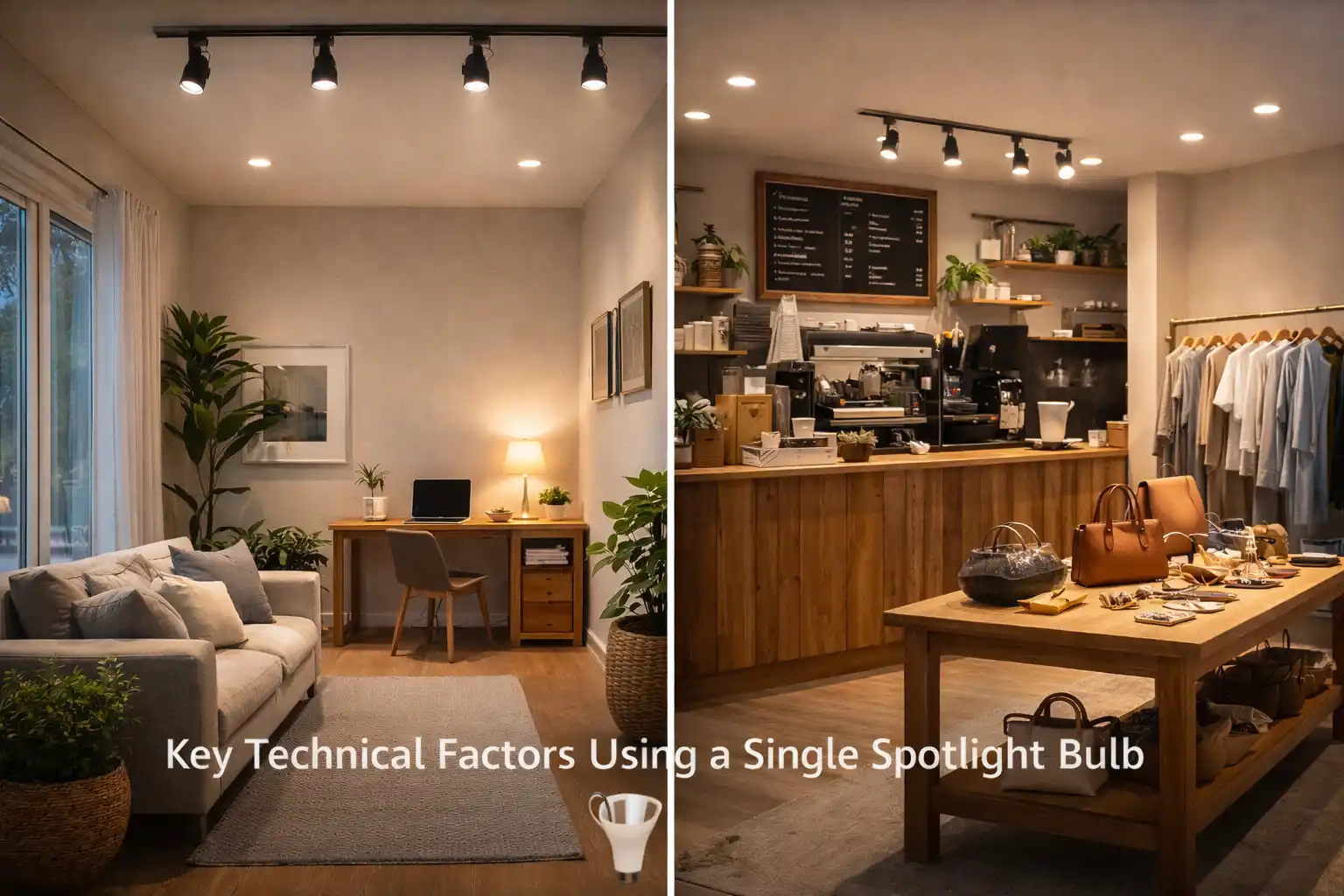
Comparative scenes of a residential living room and a café interior illuminated by a single spotlight bulb, demonstrating how key technical lighting factors influence interior design outcomes.
Despite limitations, some real-world scenarios benefit from a shared spotlight specification.
Small mixed-use businesses
Home-based studios, cafés with retail corners, or boutique offices can successfully deploy a single spotlight type when daily operating hours remain moderate and visual demands are balanced.
Vacation rentals with retail elements
Property managers sometimes standardize on one spotlight model for guest rooms and adjacent gift shops, reducing SKU variety and simplifying maintenance.
Low-traffic hospitality spaces
Lounge areas or secondary retail zones in hotels often tolerate mid-range specifications without visual compromise.
In these cases, buyers typically accept minor performance trade-offs in exchange for simplified procurement and inventory control.
When Specialized Bulbs Are the Better Choice
In many scenarios, attempting to force universality introduces more risk than savings.
High-traffic retail environments
Apparel stores, supermarkets, and flagship shops require:
- Narrow beams
- High CRI
- Continuous operation
Universal bulbs often fail prematurely or underperform visually.
Performance-driven residential installations
High-end homes, galleries, or art-focused interiors demand precise color and beam quality that general-purpose spotlights cannot deliver.
Projects with strict control integration
Smart homes or commercial lighting systems expose limitations in dimming and driver compatibility.
In these contexts, the cost of early replacement, customer dissatisfaction, or retrofit work quickly outweighs SKU consolidation benefits.
How Bulk Buyers Should Build a Practical SKU Strategy
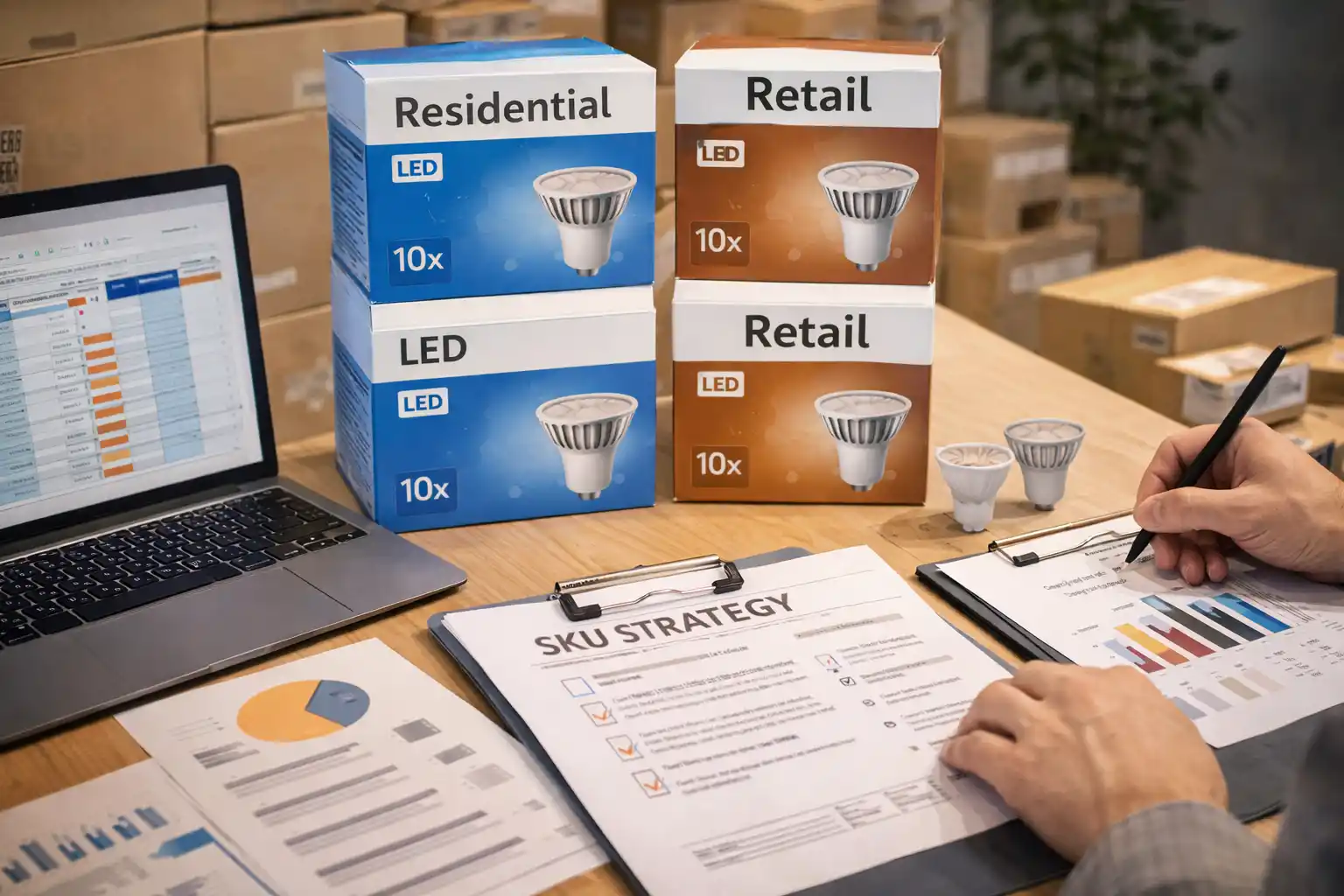
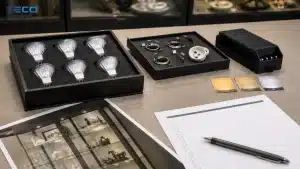
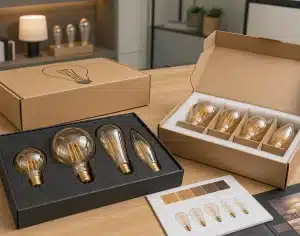
A professional workspace showing LED lighting product boxes for residential and retail markets alongside SKU planning documents, charts, and analytical tools.
Rather than searching for a single universal solution, experienced procurement teams adopt a controlled overlap strategy.
- Identify 2–3 core spotlight specifications that cover the majority of use cases.
- Use a shared platform or housing where possible, with limited variation in optics or CRI.
- Validate candidates through pilot installations before scaling.
- Track failure rates and visual feedback separately for residential and retail deployments.
This approach typically reduces SKU count by 20–30% without sacrificing performance where it matters most.
Decision Summary: Can One Spotlight Bulb Work for Both?
Works best when:
mixed-use, moderate operating hours, low visual criticalityHigh risk when:
long retail operating hours, premium merchandise, strict control systemsRarely advisable when:
high-end retail or performance-driven residential projects
The key is not universality, but knowing where compromise is acceptable.
Conclusión
Using one spotlight bulb for both residential and retail applications is possible—but only within carefully defined boundaries. The more a project values visual precision, durability, and long operating hours, the faster universality breaks down.
Bulk buyers achieve the best outcomes by focusing on operating profiles and decision hierarchies rather than specification averages. A structured SKU strategy, supported by testing and real usage data, delivers far more value than chasing a one-size-fits-all solution.
Sources
- Illuminating Engineering Society (IES) Handbook: Residential and Commercial Lighting Guidelines
- U.S. Department of Energy Solid-State Lighting Program
- IEC 60598: Luminaire Safety and Performance Standards
For bulk projects involving mixed residential and retail applications, procurement teams should evaluate spotlight choices based on operating hours, beam control, and acceptable performance trade-offs rather than nominal specifications alone.