Why 4000K Is Ideal for Work, but 1000K Is Better for Sleep: A Practical Guide for Lighting Designers and Procurement Teams
Lighting affects far more than visibility—it directly influences alertness, cognitive performance, mood, and sleep quality. In commercial, hospitality, and residential environments, choosing the correct color temperature is essential for supporting daytime productivity and nighttime recovery.
For work-focused environments such as offices, retail back-of-house areas, design studios, and task-oriented home workspaces, 4000K neutral white remains the most widely adopted specification. It provides balanced brightness, accurate color rendering, and consistent visual performance across long working hours.
For evening and night-time environments, particularly bedrooms, hotels, wellness spaces, and assisted-living facilities, 1000K deep-red light delivers the opposite effect—minimal biological activation, reduced eye strain, and improved sleep readiness. With the growing industry interest in circadian-supportive lighting, low-Kelvin red illumination has become a preferred solution to reduce melatonin suppression while maintaining safe, low-level visibility.
Este artículo explica why 4000K enhances daytime alertness, why 1000K supports sleep, y how lighting designers and procurement teams can deploy both effectively using practical, engineering-focused guidelines.
1. Daytime vs. Nighttime Lighting Needs
Human visual performance and biological responses vary significantly between daytime tasks and nighttime rest. Even without going deep into chronobiology, the lighting industry recognizes two fundamental requirements:
- Daytime: High visual accuracy, blue-enriched light, adequate contrast, and elevated alertness.
- Nighttime: Minimal biological stimulation, warm/red tones, low intensity, and reduced glare.
This creates a clear division:
| Lighting Need | Ideal Kelvin | Application Focus |
|---|---|---|
| Productivity / Work | 4000K | Offices, retail, studios, task lighting |
| Sleep / Relaxation | 1000K | Bedrooms, hotels, corridors, baby rooms |
Lighting cannot be evaluated solely on brightness—spectral distribution y visual comfort matter equally.
2. Why 4000K Neutral White Enhances Work Performance
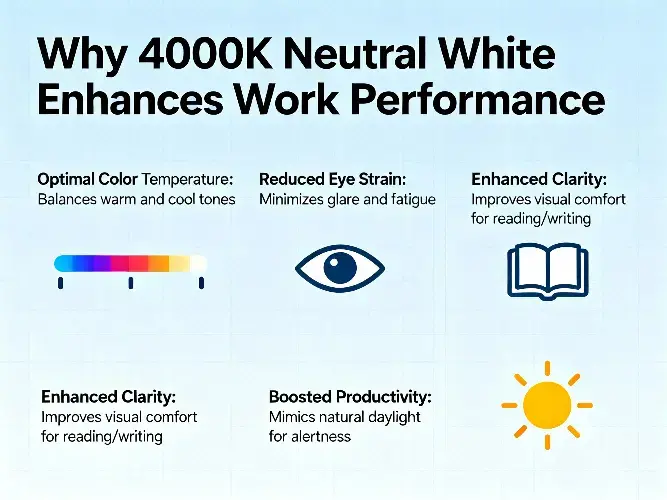
4000K has become a near-universal recommendation for professional working environments due to its balanced spectrum and practical benefits in long-duration tasks.
2.1 Supports Visual Accuracy and Contrast
4000K delivers a clean, neutral tone that improves the visibility of printed materials, digital screens, textiles, product samples, and architectural surfaces. Unlike warmer 2700K light, it does not create a yellow shift in materials, which is essential for:
- Quality control areas
- Packing/inspection lines
- Retail back rooms
- Engineering workstations
- Design studios
Industry standards such as IES recommendations for offices note that neutral white in the 3500–4100K range offers better task efficiency due to its higher perceived brightness at identical lux levels.
2.2 Balanced Blue Content Without Harshness
4000K contains blue wavelengths that support alertness, but without the glare or strain often associated with 5000–6500K. In practice, it offers:
- Increased attention stability
- Better reaction times
- Lower eye fatigue across an 8–10 hour workday
This makes 4000K suitable for environments where workers need to remain alert but comfortable.
2.3 Ideal for Long Exposure Durations
Studies on workplace ergonomics indicate that overly warm light can lower cognitive engagement, while very cool light can cause discomfort. 4000K is the midpoint, making it suitable for:
- Administrative offices
- Shared workspaces
- Salas de reuniones
- Laboratories with moderate color-rendering needs
- Hotel back-office areas
It is also the most compatible with GU10, MR16, and panel-light configurations widely used in commercial ceilings.
3. Why Warm White (2700K) Is Not Optimal for Work

While warm white lighting creates hospitality-style ambience, it has limitations in work settings.
3.1 Reduced Visual Precision
2700K reduces blue light emission, which in turn reduces alertness and can lead to:
- Slower task completion
- Reduced accuracy
- Poorer perception of small details
This is why warm light is often reserved for restaurants, lounges, hotel lobbies, and residential living areas—not offices or workshops.
3.2 Color Distortion Risks
Warm light skews product and material colors, which can affect:
- Packaging inspection
- Printing processes
- Textile review
- Retail visual merchandising
These tasks require neutral color conditions that warm light cannot provide.
4. Why 1000K Red Light Is Superior for Nighttime and Sleep Environments
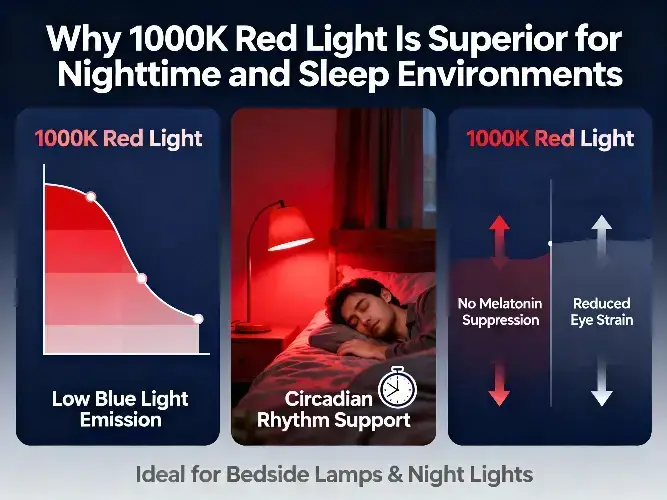
At night, lighting requirements completely invert. Instead of supporting cognitive performance, the goal becomes protecting melatonin levels, maintaining visual comfort, and enabling safe nighttime navigation.
1000K deep-red lighting is increasingly used in:
- Dormitorios
- Hotels and resorts
- Elder-care facilities
- Children’s rooms
- Pre-sleep reading lights
- Wellness and meditation spaces
4.1 Extremely Low Biological Activation
Unlike warm white bulbs (2200–2700K), which still contain measurable blue wavelengths, 1000K red light emits almost no blue or cyan light, making it ideal for:
- Maintaining melatonin release
- Avoiding circadian disruption
- Reducing nighttime alertness
This is why many modern circadian systems—such as those used in wellness centers and aviation—include a “deep-red mode” for transition to sleep.
4.2 Comfortable for Eyes in Dark Environments
1000K red light provides a soft glow that:
- Reduces glare
- Minimizes pupil contraction
- Supports night vision adaptation
- Avoids overstimulation
This makes it especially useful for:
- Night-time feeding or childcare
- Hotel guest rooms (ease of movement without waking fully)
- Senior living facilities where fall prevention is important
4.3 Ideal Spectrum for Sleep Preparation
Users typically report:
- Easier sleep onset
- Less nighttime awakening
- Calmer evening routine
In lighting applications, the benefit is clear: red light prepares the mind and body for rest without eliminating all visibility.
5. GU10 as the Ideal Format for Both 4000K Work Lighting and 1000K Sleep Lighting
Your product category—GU10—plays a central role in both daytime and nighttime applications due to its optical control and practical installation advantages.
5.1 Precision Beam Control
A GU10 spotlight naturally creates a controlled beam angle (10°, 24°, 36°, 60° options). This is valuable for both use-cases:
For 4000K work lighting:
- Illuminates task areas precisely
- Prevents spill light
- Enhances contrast on work surfaces
For 1000K nighttime lighting:
- Avoids flooding the entire room
- Provides gentle, targeted illumination
- Reduces disturbance to partners or family members
5.2 Easy Integration in Existing Fixtures
GU10 is widely used in:
- Recessed ceiling lights
- Track lights
- Adjustable downlights
- Wall-mounted fixtures
This allows users to upgrade to 1000K or 4000K without rewiring.
5.3 Technical Performance (Your Product)
Your GU10 1000K product specifications:
- Power: 7W
- Brightness: approx. 80 lumens
- Color Temperature: 1000K deep red
- Dimming: Triac dimmable
- Use Case: sleep, bedroom, wellness, hotels
These parameters are important because:
- 80 lm is intentionally low to protect night vision and melatonin
- Regulable allows further reduction to <5 lux for pre-sleep
- 1000K ensures no blue-light leakage, unlike filter red bulbs
- 7W LED offers stability and long lifespan
For B2B buyers, these provide a clear engineering rationale—not marketing language.
6. Day–Evening–Night Lighting Transition Strategy
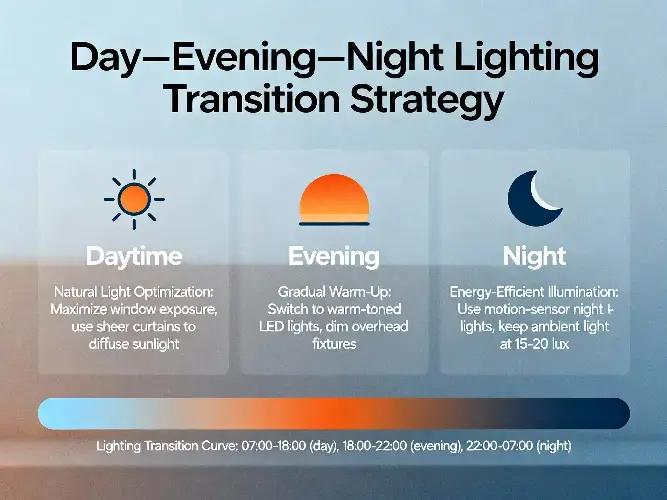
Proper lighting is not only about picking the correct Kelvin—it’s about using the right temperature at the right time. A practical, designer-friendly schedule looks like this:
| Time | Recommended Kelvin | Propósito |
|---|---|---|
| Morning (8:00–12:00) | 4000K | Build alertness |
| Afternoon (12:00–18:00) | 3500–4000K | Maintain focus |
| Evening (18:00–22:00) | 2200–2700K | Transition to relaxation |
| Night (22:00+) | 1000K | Proteger el sueño |
The goal is to progressively reduce stimulation, not abruptly shift from "office light" to "sleep light.”
7. Practical Implementation for Residential, Hospitality, and Commercial Use

Hogares
- Uso 4000K in study rooms, kitchens, and home offices
- Install 1000K GU10 in bedrooms, bedside lamps, and corridors
- Combine dimming + timers for automatic transitions
Hoteles
- Replace traditional warm whites in guest rooms with 1000K night mode
- Use 4000K for housekeeping areas
- Offer dual-mode lighting (4000K task, 1000K nightlight)
Oficinas
- Use 4000K as standard
- Provide personal task lights for flexibility
- Reduce CCT after 18:00 to avoid overstimulation for overtime workers
Healthcare / Elder Care
- Nighttime 1000K lights minimize fall risks and prevent sleep disruption
8. Common Mistakes to Avoid
Lighting planning often fails due to these misconceptions:
Mistake 1: Using 2700K in bedrooms as “sleep lighting”
→ Still contains blue light; disrupts melatonin.
Mistake 2: Using RGB red mode instead of true 1000K LED
→ RGB red light can still contain secondary peaks; not suitable for sleep.
Mistake 3: Using bright lights in night corridors
→ Leads to nighttime awakenings.
Mistake 4: Using 5000K+ in offices without reason
→ Causes glare, eye fatigue, and discomfort.
Mistake 5: Assuming brightness = effectiveness
→ At night, less is more.
Conclusión
4000K and 1000K serve distinct biological and visual needs.
- 4000K is the optimal choice for focus, productivity, and visual accuracy in work environments.
- 1000K is the most effective for nighttime use, supporting melatonin preservation and enhancing sleep quality.
With precise beam control, easy installation, and flexible dimming, Focos GU10 are ideal for deploying both solutions across homes, hotels, offices, and wellness facilities.
By aligning lighting with human behavior and daily rhythms, designers and procurement teams can improve comfort, efficiency, and long-term well-being across diverse environments.