Éclairage de cabine de yacht 24V : comment spécifier les LED GU10 pour les intérieurs marins
Yacht lighting is not the same as ordinary residential lighting. Space is compact, surfaces are reflective, and the lighting has to support both function and atmosphere.
This is where a 24V GU10 LED bulb can make sense. In a yacht refit or new-build interior, the question is not simply "which bulb is brighter?" It is whether the lamp can support the vessel’s low-voltage architecture, limited ceiling depth, reflective materials, dimming scenes, and long-term service access.
The TECO 24V GU10 PWM dimmable LED spotlight is designed around 24V DC constant-voltage input, PWM dimming, Ra98 color rendering, 2700K / 3000K / 4000K CCT options, and 24° / 36° / 60° beam angle options. For yacht projects, the key is whether the complete fixture, wiring, control system, and installation environment are suitable.
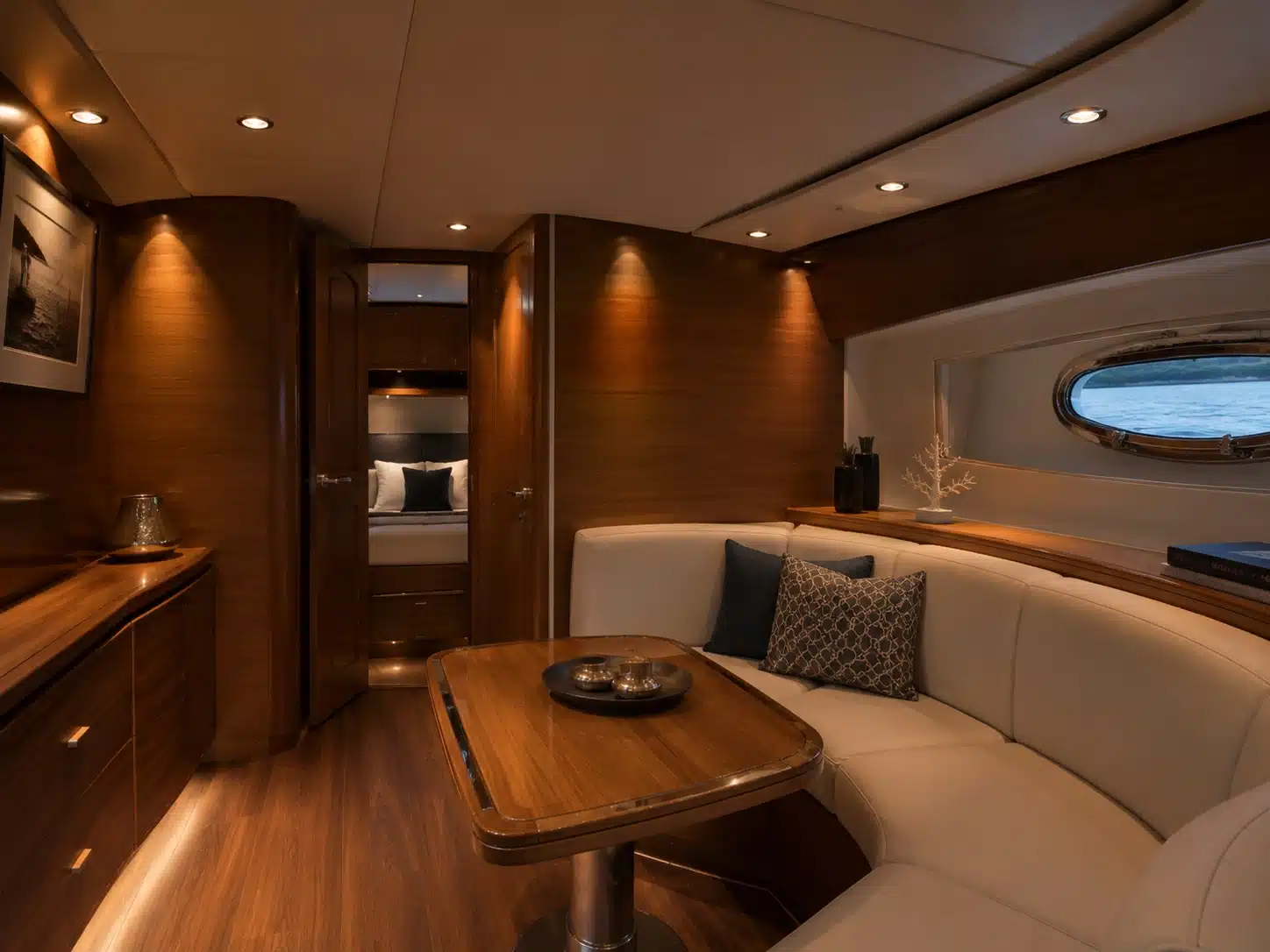
24V GU10 LED bulbs in a modern yacht cabin interior
Where GU10 LEDs Fit in Yacht Cabin Lighting
Many yacht interiors use compact ceiling cavities, curved joinery, narrow corridors, and small task areas. A replaceable GU10 spotlight can be useful when designers want a clean architectural look and engineers need a lamp that fits a compatible 24V DC circuit.
Typical locations include owner cabins, guest cabins, saloons, vanity corners, display shelves, stair zones, and decorative ceiling spots. These are protected interior areas where accent lighting, color quality, and dimming control matter more than raw brightness.
This product should be understood as an interior accent-lighting component. It should not be specified as a navigation light, emergency light, exterior deck light, engine-room light, or hazardous-area luminaire unless the complete product and installation have the required approvals.
For yacht builders and refit contractors, the GU10 format is practical because it keeps a familiar replaceable spotlight style while supporting low-voltage DC distribution.
It should not be treated as a direct replacement for a standard mains-voltage GU10 lamp. It should only be used with a compatible 24V DC constant-voltage power supply and suitable PWM dimming control.
The lamp should also not be connected directly to an unregulated yacht battery bus unless its accepted input-voltage range and transient tolerance have been confirmed. A regulated 24V DC output may be required where charging or load changes cause voltage fluctuation.
The fixture matters as much as the lamp. A 24V GU10 bulb may be suitable for protected indoor cabin areas, but waterproof rating, salt-air exposure, corrosion resistance, vibration, ventilation, wiring method, and local compliance should still be reviewed at the project level.
Cabin Ambience, High CRI and Beam Angle Selection
Yacht interiors combine functional lighting and mood lighting in tight spaces. A cabin may need reading light, soft evening ambience, accent lighting on wood panels, and focused illumination around storage or vanity areas. Poor color quality can make timber, leather, fabric, stone, and metal trim look flat.
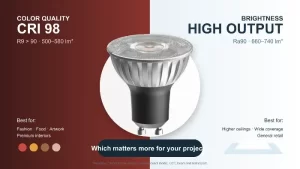
High color rendering is therefore important. The TECO 24V GU10 option lists Ra98, which is useful where natural material appearance matters.
CCT selection should follow the space. For cabins, lounges, dining corners, and warm hospitality-style interiors, 2700K or 3000K is usually easier to live with. For galley, service, storage, or task areas, 4000K may be more practical.
Beam angle matters because yacht interiors are small and reflective. A narrow beam can create a focused accent, but too many narrow beams may create harsh hot spots. A wider beam can soften the space, but it may lose contrast.
| Yacht Area | Suggested Lighting Approach | Practical Note |
|---|---|---|
| Owner cabin | 2700K / 3000K, soft accent lighting | Avoid harsh light directly over pillows or mirrors |
| Lounge / saloon | 2700K / 3000K with dimming scenes | Use beam angle to highlight panels, tables, or art |
| Galley | 3000K / 4000K task-oriented lighting | Check glare on metal and stone surfaces |
| Corridor / stair zone | Stable low-level guidance lighting | Avoid strong contrast between steps and walls |
| Display shelf | High CRI with controlled beam | Prevent hot spots on glass and polished surfaces |
For most yacht accent lighting, 36° is a balanced starting point. A 24° beam can work for artwork and small feature points. A 60° beam may suit lower ceilings or softer ambient zones.
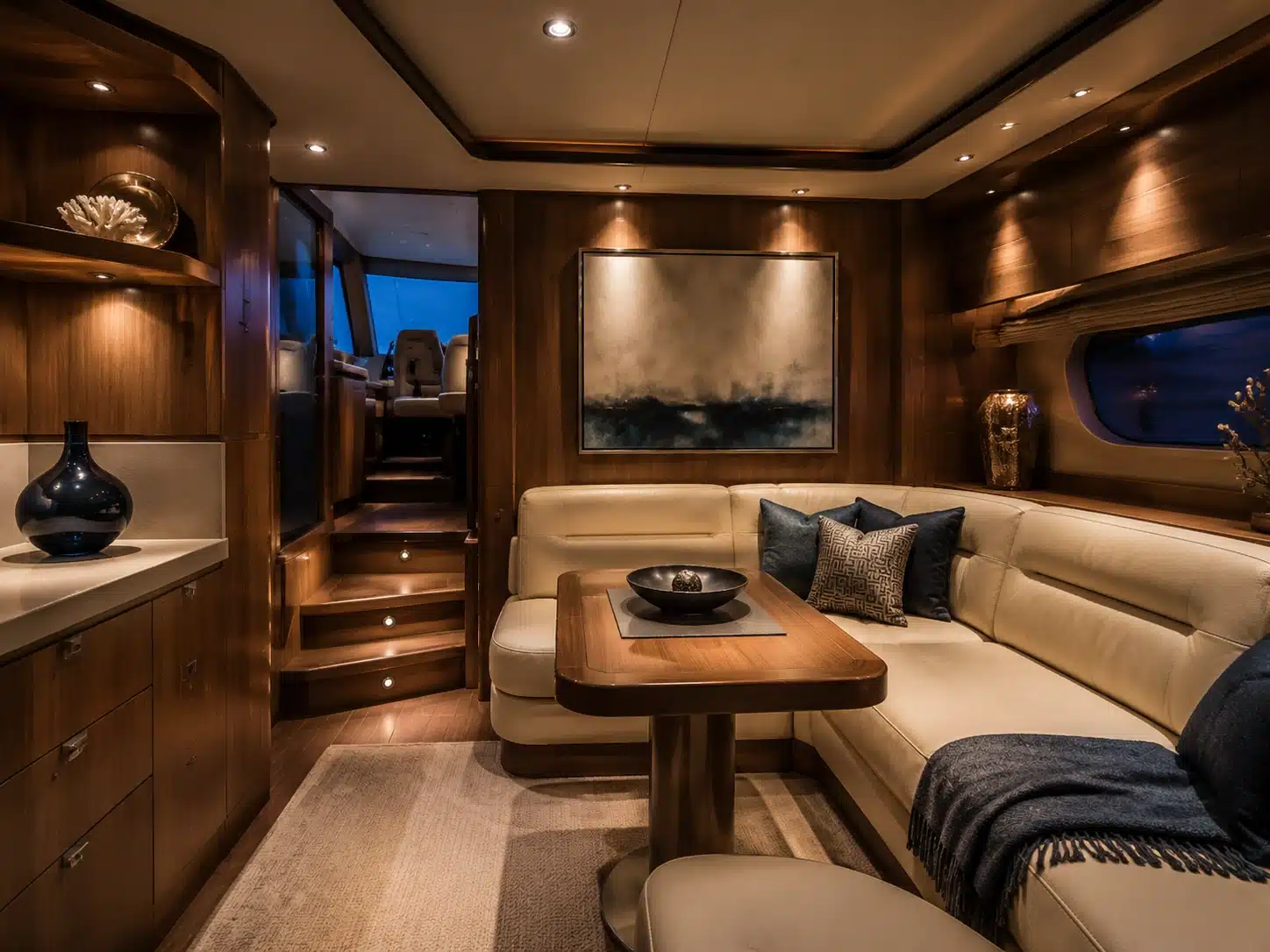
Warm yacht saloon lighting with GU10 accent spotlights
Dimming Scenes and Low-Voltage Control on Yachts
Yacht lighting often needs scene control. The same saloon may need practical brightness during service work and soft lighting during evening use.
PWM dimming can support smooth brightness control when the lamp, controller, power supply, cable layout, and load are compatible. For yacht interiors, this helps create quieter lighting scenes without changing the physical lamp style.
But PWM should not be oversold. It does not automatically mean every controller will work perfectly, and it does not automatically mean flicker-free in every camera or viewing condition. Real performance depends on PWM frequency, controller quality, power supply stability, cable length, connected load, and the lamp’s internal design.
Cable runs may pass through compact service spaces, cabinets, ceiling voids, or curved interior structures. If one end of a cabin circuit looks dimmer than another, the cause may be cable length, wire gauge, controller output, or load design rather than the lamp itself.
Before bulk procurement, test the complete dimming channel rather than only one loose sample lamp. Include the actual power supply, PWM controller, representative cable length, fixture, lamp quantity, and expected cabin scenes.
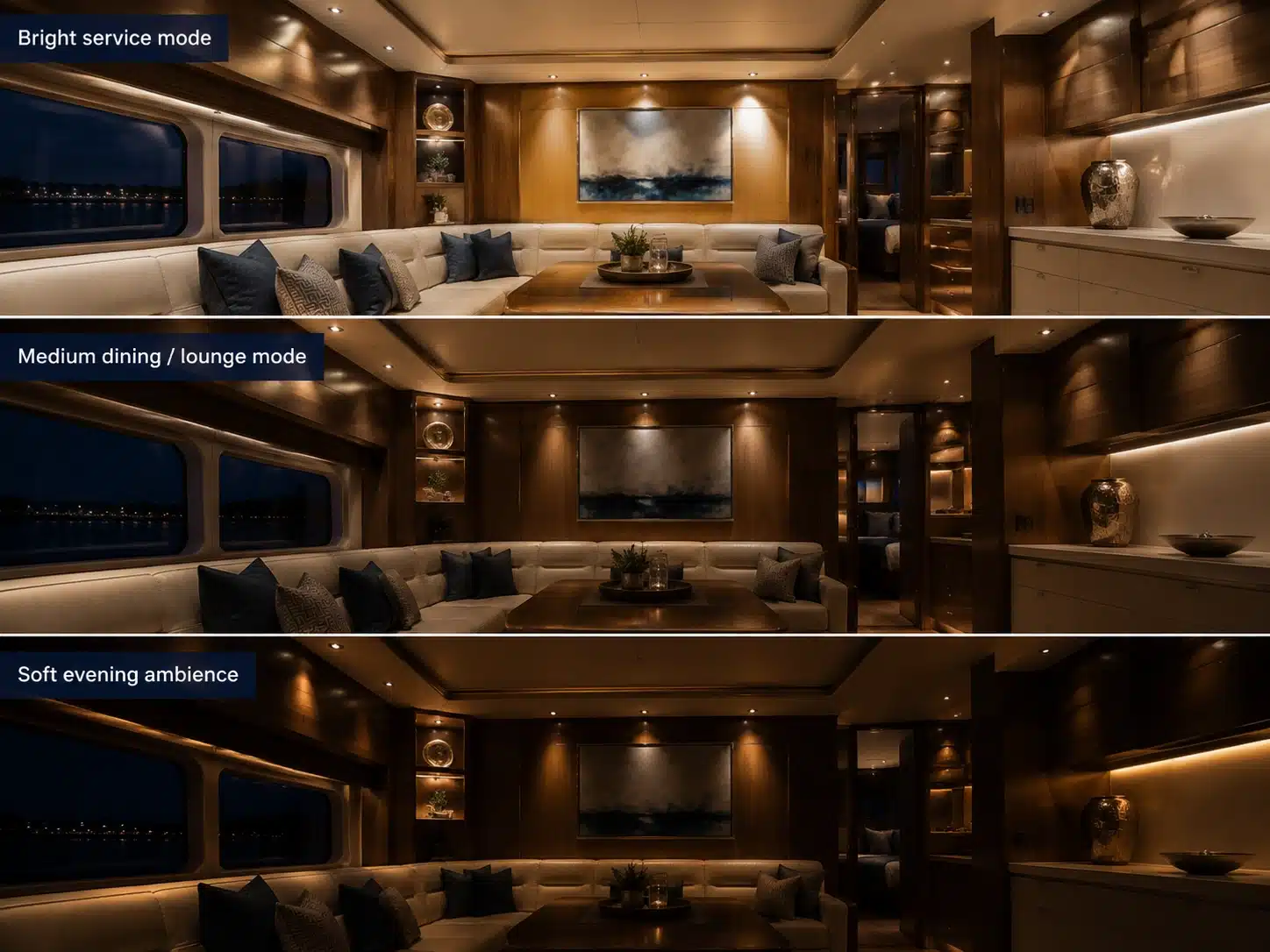
Yacht saloon lighting scenes from bright service mode to soft evening ambience
Marine Installation Risks Buyers Should Check
A yacht interior may face vibration, limited ventilation, humidity, salt-air exposure, maintenance access restrictions, and mixed electrical zones.
A bulb may be used in a protected indoor fixture, but that does not make the complete luminaire suitable for damp, wet, or exposed marine areas. For heads, exterior decks, or humid service areas, the fixture IP rating, gasket design, cable entry, corrosion resistance, and installation method must be checked separately.
Compact yacht ceilings and recessed housings may restrict airflow. Even efficient LED bulbs still generate heat, and driver components can age faster if the fixture traps heat behind wood panels or upholstered ceiling sections.
Lamp holders, retaining rings, spring clips, wiring terminals, and connectors should be secure enough for the installation environment. A replaceable GU10 format helps only if the fixture gives reasonable access after panels or trim rings are installed.
A 24V GU10 spotlight is useful for accent and localized lighting, but linear lighting, reading lights, step lights, waterproof deck lights, and emergency lighting may require different products.
For B2B buyers, the safest approach is to treat the 24V GU10 bulb as one component in a complete marine interior lighting system.
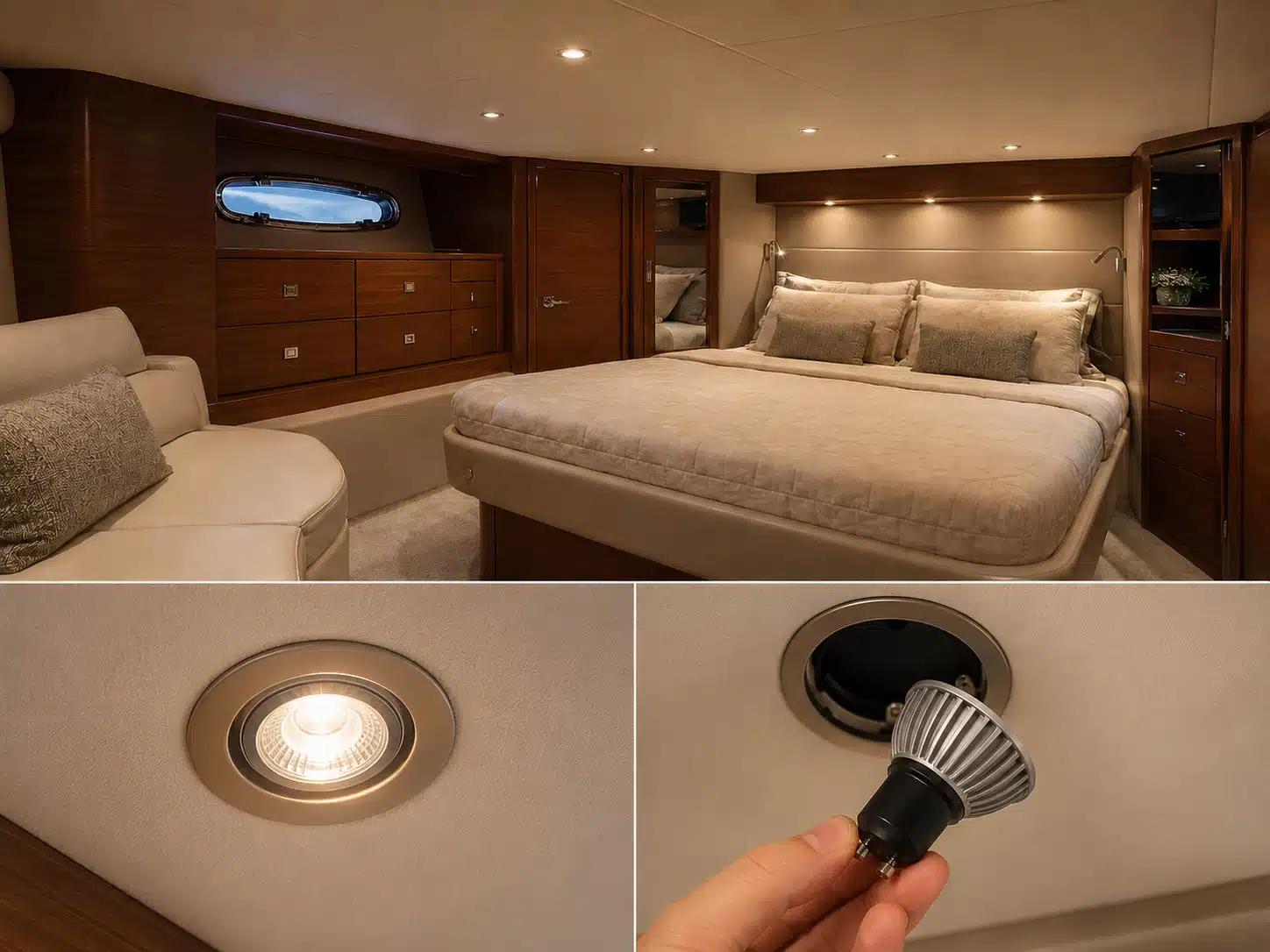
Yacht cabin lighting installation detail with recessed GU10 fixtures
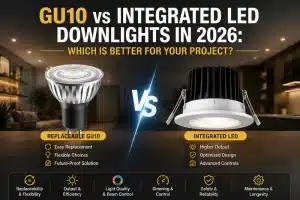
Replaceable 24V GU10 Bulbs vs Integrated Marine Downlights
Yacht builders and refit teams often need to decide whether to use replaceable GU10 lamps or integrated marine downlights. Neither choice is automatically better.
Replaceable 24V GU10 bulbs are useful when the project already uses compatible GU10 fittings and the buyer wants flexible lamp replacement, beam angle options, and easier sample comparison.
Integrated marine downlights may be better when the project needs a complete certified luminaire with defined IP rating, marine-grade housing, sealed construction, and one supplier responsible for the whole fixture.
| Decision Point | Replaceable 24V GU10 Bulb | Integrated Marine Downlight |
|---|---|---|
| Maintenance | Lamp can be replaced if fixture access is good | Often replaced as a full fitting |
| Moisture protection | Depends on the complete fixture | Can be selected as a sealed marine/IP luminaire |
| Beam flexibility | 24° / 36° / 60° options support adjustment | Usually fixed by fixture design |
| Refit suitability | Useful where GU10 fittings already exist | Useful when replacing the full lighting package |
| Main risk | Wrong voltage, holder, heat, or control compatibility | Higher replacement cost if the integrated unit fails |
For protected yacht cabin accent lighting, a replaceable 24V GU10 can be practical. For exterior, wet, engine-adjacent, or safety-critical zones, an integrated marine luminaire is usually the better starting point.
Specification Checklist for Yacht Projects
When selecting 24V GU10 bulbs for yacht interiors, product data should be checked together with installation details. Based on the TECO product page, key specifications include 24V DC constant-voltage input, 7.5W power, 550 lm / 590 lm / 620 lm luminous flux options, Ra98 CRI, 2700K / 3000K / 4000K CCT, PWM dimming, 3-step MacAdam color consistency, 24° / 36° / 60° beam angles, 40,000-hour listed lifespan, and 50 mm x 57 mm dimensions.1
For yacht use, those specifications should be reviewed through the project context:
| Checkpoint | What to Confirm |
|---|---|
| Electrical system | The yacht lighting zone is confirmed as 24V DC constant voltage |
| Battery bus | Regulated 24V DC output confirmed if battery voltage may fluctuate |
| Controller | PWM controller is compatible with the lamp and load |
| Fixture | GU10 holder, ventilation, retention, IP rating, vibration resistance, and access are suitable |
| Environnement | Indoor, protected, damp, humid, or exposed zone is clearly defined |
| Angle du faisceau | 24° / 36° / 60° selected according to mounting height and target area |
| TDC | 2700K / 3000K / 4000K matched to cabin ambience and task needs |
| Rendu des couleurs | Ra98 used where material color and premium interior appearance matter |
| Cable layout | Voltage drop and channel load checked through real cabin routing |
| Maintenance | Lamp can be accessed after panels and trim are installed |
| Sample test | Complete yacht lighting channel tested before bulk procurement |
For yacht builders, refit contractors, distributors, and marine interior suppliers, this checklist is more useful than choosing by wattage alone.
Why Yacht Project Buyers Work with TECO
For yacht cabin lighting projects, TECO’s value is not only the lamp specification itself. The company can support buyers with 24V DC product options, PWM dimming review, Ra98 color rendering, 3-step MacAdam color consistency, and 24° / 36° / 60° beam choices for different cabin effects.
For refit contractors, distributors, and marine interior suppliers, sample review is especially important before bulk order. Buyers can share the fixture type, controller model, wiring layout, installation zone, CCT preference, beam angle, and target quantity so TECO can help check whether the 24V GU10 PWM dimmable LED spotlight fits the intended protected yacht interior application.
FAQ
Can 24V GU10 bulbs be used in yacht cabins?
Yes, when the cabin lighting circuit is designed for compatible 24V DC constant-voltage operation and the fixture is suitable for the interior environment.
Can a 24V GU10 bulb connect directly to a yacht battery system?
Not automatically. The accepted input-voltage range and transient tolerance must be confirmed first. In many projects, a regulated 24V DC output is the safer specification.
Are 24V GU10 bulbs suitable for exterior yacht lighting?
Not by default. Exterior decks, wet areas, engine rooms, emergency lighting, navigation lighting, and hazardous areas require complete luminaires with the right approvals and environmental protection.
What CCT is best for yacht cabin lighting?
2700K or 3000K is usually suitable for warm cabin and lounge ambience. 4000K can be considered for galley, storage, service, or task-oriented areas.
Conclusion
A 24V GU10 LED bulb can be a practical solution for yacht cabin lighting when the project is designed around compatible 24V DC power and PWM dimming control.
It should not be treated as a universal marine lighting product. Yacht environments require review of fixture protection, wiring, corrosion resistance, heat, vibration, maintenance access, and control compatibility.
For yacht and marine interior projects, buyers should share the fixture type, wiring layout, controller model, installation zone, CCT preference, beam angle, and order quantity before procurement. TECO can help review whether the 24V GU10 PWM dimmable LED spotlight is suitable for the intended low-voltage yacht lighting application.
Notes de bas de page
Product specifications and application notes are based on TECO’s product page for the 24V GU10 PWM Dimmable LED Spotlight 7.5W Ra98. ↩