Sourcing 24V DC LED Bulbs: A B2B Checklist for Samples, Compatibility and Replacement Supply
A 24V GU10 sample works perfectly on your test bench. The bulk order arrives a few months later, and some of the lamps behave differently on the project’s dimming system. Or the original installation works well, but matching replacement bulbs become difficult to source two years later.
These are the kinds of problems that a purchasing specification should address before an order is placed.
Choosing a 24V LED bulb supplier involves more than comparing wattage, lumen output and unit price. For importers, lighting brands and luminaire manufacturers, the product needs to work with the intended electrical system, fit the fixture, deliver consistent lighting performance and remain replaceable throughout the project’s service life.
A useful RFQ starts with the application rather than a product photo or a target price.
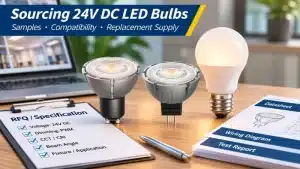
Write the Application and Electrical Specification
A request for a 24V LED bulb quotation often begins with a few basic details: base type, wattage, colour temperature and quantity. That is enough for an initial price indication, but not enough to establish product compatibility.
Start by identifying the lamp format. For an OEM 24V GU10 project, specify the GU10 base, overall diameter, length and required beam angle. For MR16 bulbs, confirm the actual base, commonly GU5.3, together with the available installation depth and retaining structure. For A60 bulbs, specify whether the fitting uses E26 or E27 and check the maximum bulb dimensions against the shade or enclosure.
The same lamp shape does not guarantee the same electrical or mechanical characteristics.
The electrical specification should state that the system uses 24V DC and identify the required input voltage range. A regulated 24V power supply and a nominal 24V battery system do not necessarily present the same operating conditions. If the supply voltage varies during normal operation, give the supplier the expected minimum and maximum values rather than specifying only the nominal voltage.
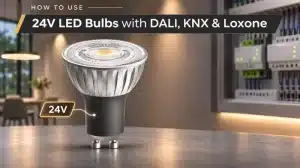
Dimming needs its own description. State whether the bulbs will operate at fixed output, through a PWM controller or as part of a DALI, KNX or Loxone installation. Where a building control system uses a separate PWM output stage, provide the actual controller model and output characteristics. The name of the control protocol alone does not establish lamp compatibility.
Our guide to [using 24V LED bulbs with DALI, KNX and Loxone](http://https://tecolite.com/24v-led-bulbs-dali-knx-loxone/ "using 24V LED bulbs with DALI, KNX and Loxone") explains the relationship between the control system, power supply and lamp in more detail.
The optical specification should cover lumen output, beam angle or light distribution, CCT, CRI and any application-specific requirements for R9 or colour consistency. A retail display project may need a narrow beam and accurate colour rendering, while an A60 pendant installation may require broad light distribution through a decorative shade.
Include the target market and installation environment in the RFQ. An indoor hotel project, a compact enclosed luminaire and an outdoor lighting installation have different requirements. Tell the supplier where the lamps will be sold, how they will be installed and what environmental conditions they will face.
A well-defined RFQ gives different suppliers the same technical starting point. Without it, two quotations for a nominally identical 24V bulb may represent quite different products.
Ask for Model-Specific Evidence
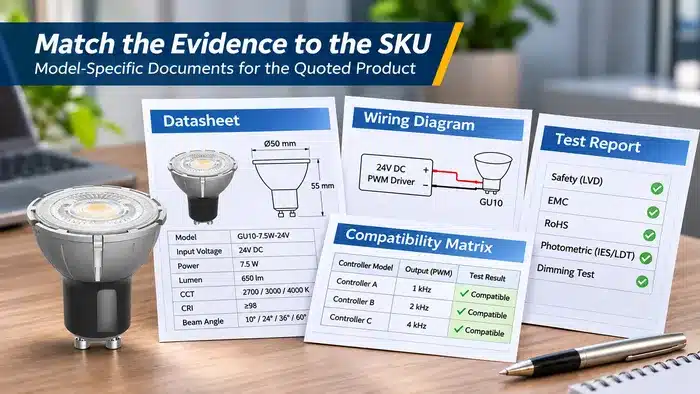
A product catalogue tells you what a supplier offers. Model-specific documentation tells you what you are actually buying.
Ask for a datasheet covering the exact SKU being quoted, including its input voltage range, power consumption, dimensions, optical performance, operating temperature and installation restrictions. For dimmable products, request the wiring information and available controller compatibility data.
A compatibility matrix should identify the actual controller models, PWM output characteristics and load configurations tested, rather than simply listing supported control protocols. If the intended controller has not been tested, include that combination in the sample acceptance plan.
Our guide to why 24V LED bulbs won’t dim properly explains why bulbs with the same nominal voltage and dimming description can behave differently on different controllers.
Where beam distribution matters, request available IES or LDT files for the actual optical version. A 24° GU10 and a 60° GU10 from the same product family should not be treated as interchangeable simply because their wattage and nominal lumen output are similar.
Compliance documentation also needs to match the product and destination market. Ask which declarations, certificates or test reports are available for the quoted SKU and check their scope, model coverage and applicable standards.
A report for a conventional mains-voltage GU10 does not automatically cover a 24V DC version. Likewise, a report for a non-dimmable product does not establish coverage for a dimmable version with different electronics. A certificate for the external power supply alone does not establish compliance for the complete lighting product or installation.
The applicable requirements depend on the destination market, product classification and whether the bulb is supplied separately or as part of a complete luminaire. Confirm these requirements before committing to a production order.
When comparing a 24V DC LED manufacturer with a trading supplier, ask who controls the product specification, production changes and technical documentation. The distinction matters less than whether the supplier can provide reliable information for the exact product and maintain traceability when questions arise.
Agree on a Sample Acceptance Plan
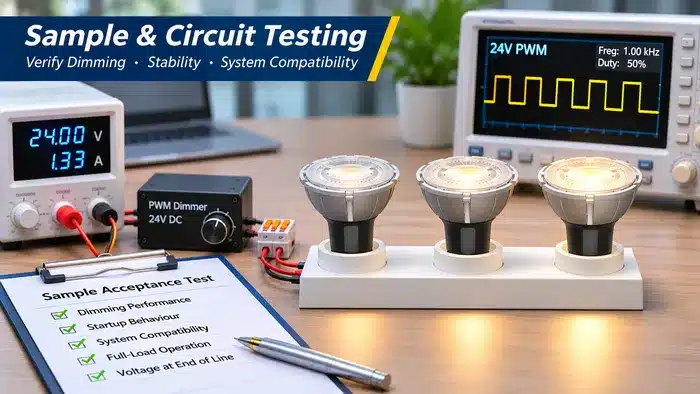
A sample that switches on is not an approved product.
Before requesting samples, agree with the supplier on what will be tested and what constitutes an acceptable result. Define measurable acceptance limits where applicable, including input power tolerance, light output, minimum usable brightness, colour consistency and maximum permitted operating temperatures. These limits should reflect the product specification and project requirements, rather than a generic set of values applied to every lamp.
Start with the individual lamp. Check its dimensions, base fit, input power, light output and colour appearance against the agreed specification. Use the intended supply voltage and, where applicable, the actual dimming controller.
Then test the lamp as part of the intended circuit. A single 24V GU10 operating correctly does not establish that a full channel of lamps will behave in the same way. Startup current, total connected load, wiring length and controller limits become relevant when several lamps operate together.
Reproduce the expected number of lamps per channel and the intended wiring arrangement. Check startup behaviour, stable operation at full output and the voltage available at the furthest lamp. Our articles on sizing a 24V DC power supply for LED bulbs et 24V LED voltage drop and cable sizing explain the electrical checks behind this part of the acceptance test.
For dimmable products, test the complete dimming range, paying attention to the lowest brightness levels intended for normal use. Check for flickering, sudden brightness changes, unexpected switch-off and visible differences between lamps on the same circuit.
Recovery behaviour deserves attention as well. Switch the system off and back on, including from a low dimming setting, and observe whether the lamps restart correctly. If the controller is expected to restore the previous brightness setting after a power interruption, confirm that behaviour with the actual system.
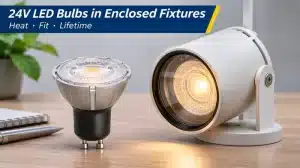
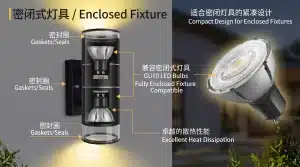
Thermal testing should use the intended fixture, installation orientation and environmental conditions. A sample tested in open air does not establish suitability for a compact or enclosed luminaire. Allow the lamp to reach a stable operating temperature and compare the relevant readings with the manufacturer’s specified limits.
Our guide to [using 24V LED bulbs with DALI, KNX and Loxone](http://https://tecolite.com/24v-led-bulbs-dali-knx-loxone/ "using 24V LED bulbs with DALI, KNX and Loxone") covers fixture clearance, temperature measurements and installation restrictions.
Light quality should also be checked in the actual application. A retail spotlight needs to illuminate the intended products, not simply produce an acceptable lumen reading. A pendant bulb should be evaluated inside its intended shade. For installations with multiple lamps, compare colour consistency and light distribution across the group.
There is no universal sample quantity that guarantees a successful bulk order. The number of samples and the extent of testing should reflect the project size, product variations, installation conditions and consequences of failure.
Record the approved sample model, revision, electrical configuration, test conditions, acceptance limits and measured results. This gives both parties a reference when production begins and provides a basis for investigating differences in later deliveries.
Control Changes Between Samples and Production
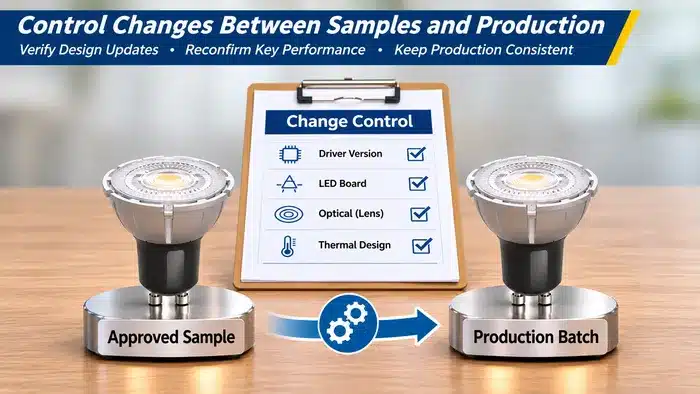
Approving a sample is only useful if the production lamps continue to meet the approved specification.
A change to the internal driver can affect PWM dimming behaviour. A different LED package can change colour rendering, lumen output or operating temperature. Replacing a lens or reflector can alter the beam distribution even when the nominal beam angle remains unchanged.
Some component changes are necessary because of material availability, product development or discontinued parts. The purchasing agreement should establish how changes affecting the approved specification will be handled.
For an OEM or private-label order, ask the supplier how product revisions are identified and how production batches are linked to the applicable specification. Agree on which changes require advance notification, updated documentation or buyer approval.
Changes to the driver, LED package, optical components, housing or thermal design deserve attention when they affect electrical compatibility, light quality, mechanical fit, reliability or compliance.
The need for retesting should depend on the change. A different driver design may require renewed dimming and startup tests. An optical change may require updated photometric measurements. A change affecting the thermal path or operating limits may require another test in the intended luminaire.
Where a component or design change affects the scope of existing compliance documentation, check whether updated evidence is required for the target market.
The approved sample, current datasheet and production revision should be identifiable throughout the order. For repeat orders, confirm whether the product specification remains unchanged rather than relying on the original model name alone.
Incoming inspection should also be agreed before shipment. The buyer and supplier need a common understanding of which characteristics will be checked, the permitted tolerances, the sampling method and how nonconforming products will be handled.
This does not mean every order requires a complete laboratory evaluation. Routine inspection and more extensive retesting serve different purposes. Establish which checks apply to each delivery and which product changes trigger additional evaluation.
For a project using hundreds of dimmable MR16 lamps, maintaining consistent electrical behaviour between batches may be just as valuable as achieving a slightly lower unit price.
Plan Spare Stock, Lead Times and Total Project Cost
The cheapest bulb quotation is not always the lowest-cost lighting solution.
A 24V lighting installation includes the lamps, power supplies, controllers, wiring, installation labour and commissioning. Future maintenance adds replacement lamps, service labour and, in some cases, access equipment or temporary disruption to the space.
A bulb that requires a different controller, additional wiring or repeated commissioning can increase the installed cost even if its purchase price is lower. In a hotel or retail project, the cost of accessing and replacing a failed lamp may exceed the price of the lamp itself.
Compare quotations on the basis of the complete installation and the agreed performance requirements.
Supply arrangements deserve the same attention. When sourcing wholesale 24V MR16 bulbs or working with a 24V A60 supplier, ask about minimum order quantities, sample lead times, production lead times and the conditions for repeat orders.
A manufacturer producing customised lamps to order may not hold finished products in stock. A small replacement order placed two years later may therefore have a different MOQ or lead time from the original project order. Establish these conditions early rather than assuming replacement lamps will always be available for immediate delivery.
For projects with a long expected service period, agree on an initial spare-stock quantity based on the installed population, maintenance requirements, replenishment lead time and consequences of a shortage. There is no single spare-stock percentage suitable for every project.
A Replacement Matrix for the Next Maintenance Team
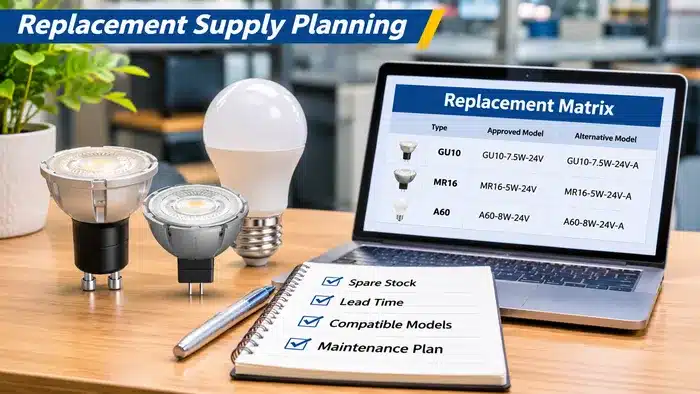
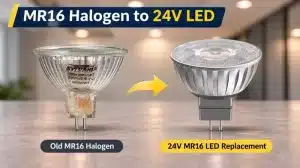
Keep low-voltage replacements clearly identifiable. A 24V GU10 can resemble a mains-voltage GU10, while a 24V MR16 may look almost identical to a conventional 12V MR16. A 24V A60 with an E26 or E27 base can also be mistaken for a conventional mains-voltage bulb.
Separate spare lamps by voltage, base type and approved model. Packaging and maintenance records should clearly identify the electrical specification and dimming requirements. Physical fit is not proof of electrical compatibility.
Our guide to 24V DC A60 bulbs for pendant and table lamps discusses replacement identification and base compatibility in more detail.
Keep a replacement matrix alongside the original purchasing records. Each installed lamp type should be linked to its approved SKU, any approved alternative, input voltage range, base type, dimming method, beam angle or light distribution, colour temperature and installation restrictions.
Ask how the supplier handles discontinuation: what notice is given, whether an alternative is offered, and which characteristics must be checked before approving it.
A proposed substitute should match more than the original base and wattage. Its electrical behaviour, dimensions, optical performance and thermal suitability need to be confirmed against the existing installation. Add an alternative to the replacement matrix only after the relevant compatibility checks have been completed.
Keep batch information, sample acceptance records and warranty arrangements with the replacement specification. When a lamp fails, record its installation location, operating conditions and failure symptoms so the supplier has useful information for investigation.
This gives the next maintenance team a clear reference instead of leaving them to select replacements based on appearance or socket fit.
A reliable purchasing arrangement addresses both the initial installation and the next replacement order.
Request a Quotation for Your 24V LED Bulb Project
If you are sourcing 24V GU10, MR16 or A60 bulbs for an OEM product, distribution programme or commercial lighting project, send Tecolite your application details before confirming the product specification.
Use our 24V LED Bulb RFQ Template to provide the required lamp format, electrical specifications, dimming system, optical requirements, fixture dimensions, target market and estimated order quantity.
If the project uses an existing power supply or controller, include its model and technical information. Fixture drawings, lighting layouts and details of the intended operating environment are also useful.
We can review the requirements, discuss available product options and establish what needs to be confirmed through sample testing before a production order is placed.
The aim is to approve a lamp that works in your application, with a documented specification that can also serve as the reference for future orders.