Top Dim-to-Warm LED Bulbs for Cozy Bedrooms and Living Rooms
Harsh, flat overhead light can destroy the mood in a bedroom or living room. It makes a “home” feel like a waiting room: too bright, too white, and not relaxing at all.
Dim-to-warm LED bulbs are designed to fix exactly that problem.
Instead of staying the same cold white when you dim them, dim-to-warm LEDs shift from a comfortable neutral white down to a soft amber glow—very similar to halogen or candlelight. The result is simple: cozier rooms, calmer evenings, and light that feels natural instead of clinical.
In this guide, we’ll walk through:
- What dim-to-warm LED bulbs are and how they work
- Why they’re ideal for bedrooms, living rooms, and other cozy spaces
- How to choose the best dim-to-warm LED bulbs (CRI, CCT range, wattage, dimmer compatibility)
- Practical, room-by-room tips and example products
- How to get started with a real upgrade, not another disappointing bulb
1. What Are Dim-to-Warm LED Bulbs?

Most standard LED bulbs behave like this:
You dim them → the light gets darker → the color stays basically the same.
That’s fine for offices or task lighting, but it feels wrong in a bedroom or living room. Traditional incandescent and halogen bulbs didn’t work like that. When you dimmed them, they naturally turned warmer and more amber.
Dim-to-warm LED bulbs are designed to copy that behavior.
At full brightness, they might sit around 2700–3000K (a soft, pleasant white). As you dim them, they smoothly slide down to 1800–2200K, which looks more like candlelight or a fireplace glow.
So instead of “less of the same white,” you get:
Brighter = clearer, more neutral light
Dimmer = softer, warmer, more relaxing light
Perfect for bedrooms, living rooms, and any space where you want a cozy vibe instead of a spotlight.
1.1 How Dim-to-Warm Technology Works
Inside a dim-to-warm LED bulb, you don’t just have one type of LED. You typically have two LED channels:
- A higher-CCT (cooler/neutral) channel
- A warmer, amber-biased channel
When the bulb is at full power, the neutral channel dominates. As you dim the lamp, the driver electronics shift more current into the warm channel and reduce the neutral one.
The result to your eye:
- At 100% → ~2700–3000K (neutral-warm white)
- At 50% → ~2300–2500K (warm, cozy)
- At 10–20% → ~1800–2000K (candle-like amber)
All of this happens automatically through the dimmer, without an app, remote, or separate CCT switch.
1.2 Dim-to-Warm vs Tunable White vs Standard LEDs
A lot of product listings mix up these terms. Quick comparison:
| Fonctionnalité | Standard LED Bulb | Dim-to-Warm LED Bulb | Tunable White / Smart CCT Bulb |
|---|---|---|---|
| Color temperature change | Fixed (e.g. always 2700K) | Automatic when dimming | Manual via app, remote, or wall control |
| Behavior on dimming | Just darker | Darker et noticeably warmer | Stays whatever CCT you’ve set |
| Typical CCT range | Single CCT (e.g. 2700K) | ~3000K → 1800K | ~2700K → 6500K or wider |
| Best for | General low-cost lighting | Bedrooms, living rooms, cozy hospitality | Offices, multi-use rooms, tech-heavy homes |
| Control complexity | Very simple | Simple (just a dimmer) | Higher (app, hub, settings, scenes, etc.) |
If the goal is “warm and cozy when dimmed, without thinking about it”, dim-to-warm is almost always a better match than tunable white.
2. Why Dim-to-Warm Works So Well in Bedrooms and Living Rooms
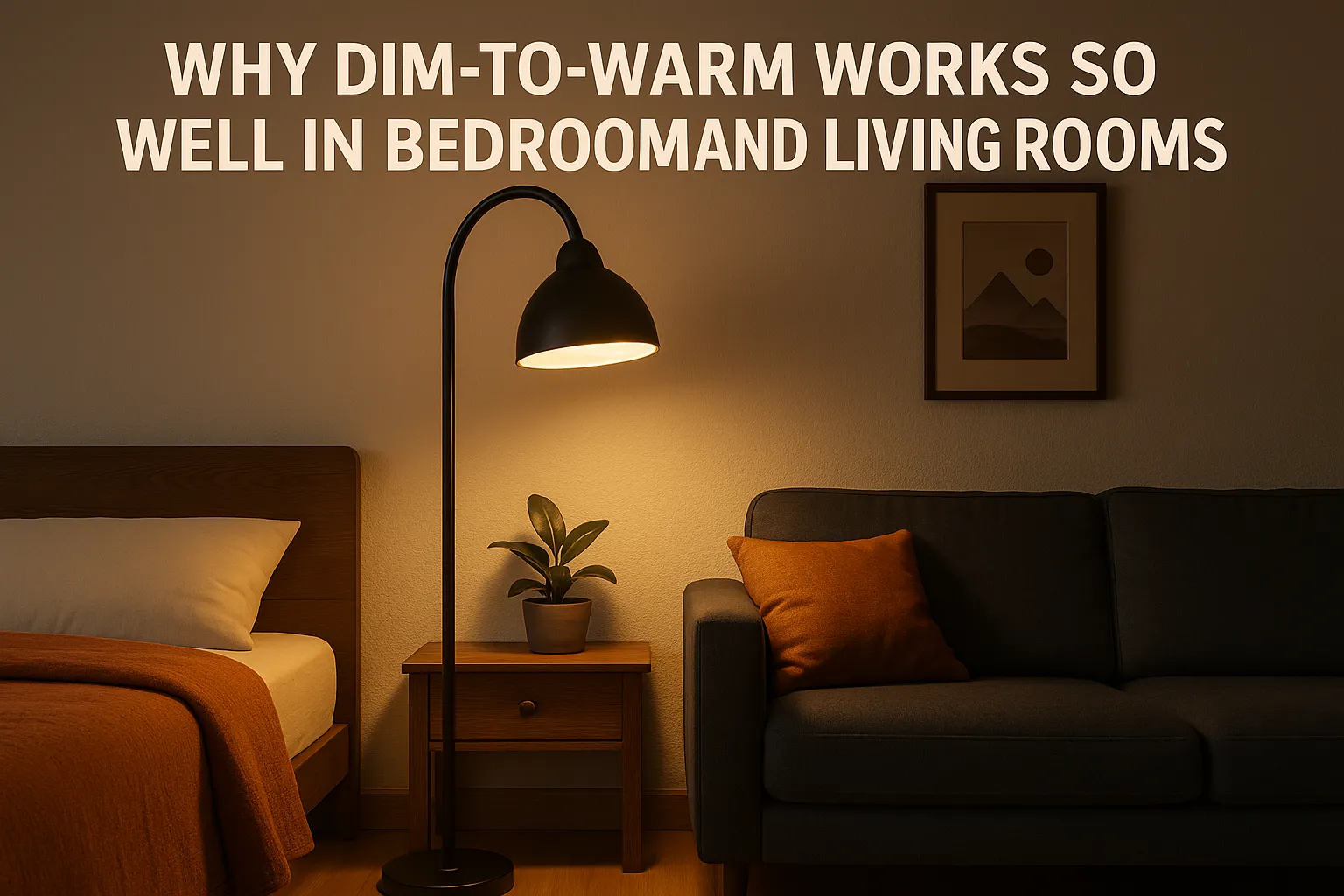
Bedrooms and living rooms are not just “illumination zones.” They’re relaxation zones:
- Winding down after work
- Watching a movie
- Reading or scrolling before bed
- Talking with family or guests
Bright, cool-white light can easily:
- Kill the mood
- Make faces look washed out
- Keep your brain too alert late in the evening
Dim-to-warm LED bulbs attack all three problems at once.
2.1 Biological and Psychological Benefits
Human biology treats light as a timing signal:
- Cooler, blue-rich light (like midday sunlight) tells the brain: be awake and alert
- Warm, low-blue light (sunset, firelight, candles) tells the brain: it’s safe to slow down and prepare for sleep
Dim-to-warm LEDs play into this:
- At higher brightness, a neutral 2700–3000K gives enough clarity for tasks
- As you dim, the CCT slides down to 1800–2200K, with much less blue content
Warm, low-blue light in the evening:
- Feels more comfortable and less harsh
- Supports melatonin production and better sleep
- Makes the whole room visually “softer”
You don’t have to lecture your guests on circadian lighting. They’ll just say:
“Wow, the room feels really comfortable.”
2.2 Bedroom Use: Wind-Down Instead of Wake-Up
In the bedroom, dim-to-warm bulbs help with:
- Bedside lamps that are bright enough for reading at higher levels, then glide into soft amber when you’re done
- Ceiling or recessed lights that don’t feel like an exam room at 10pm
- Nighttime navigation with ultra-low, ultra-warm levels that won’t fully wake you
Compared with fixed 3000K LEDs, dim-to-warm is simply more forgiving and more sleep-friendly.
2.3 Living Room Use: Flexible but Always Cozy
The living room has many “modes”:
- Game night
- TV/movie night
- Conversation with guests
- Quiet evening alone
Dim-to-warm LEDs let one set of fixtures cover all those modes:
- Full brightness for cleaning or kids playing
- Medium brightness for social time
- Low, amber levels for TV or late-night conversation
You don’t have to change bulbs or grab your phone every time. Turn the dimmer, and the room changes “temperature” with you.
3. How to Choose the Best Dim-to-Warm Bulbs (CRI, Dimming, CCT Range)

Not all dim-to-warm bulbs are equal. If you want “just works, looks great, doesn’t flicker,” focus on four key specs:
- CRI (Color Rendering Index)
- Dimming performance and compatibility
- Gamme de CCT
- Wattage and lumens
3.1 CRI: Make Colors (and People) Look Right
CRI (Color Rendering Index) measures how accurately colors appear under a light source.
- For cozy spaces, aim for IRC 90+
- Under CRI < 80, skin tones can look greyish, food looks dull, wood loses richness
In bedrooms and living rooms, you’re looking at:
- Faces
- Furniture
- Art
- Textiles
High-CRI dim-to-warm bulbs make all of them look better, especially as the light warms up.
Règle générale :
For any room where people relax or socialize, treat CRI 90+ as standard, not a luxury.
3.2 Dimming Performance and Dimmer Compatibility
This part is critical and often ignored.
Dim-to-warm bulbs depend heavily on driver quality et compatibilité variateur. If the pairing is bad, you get:
- Flicker at low levels
- Buzzing noises
- Sudden shut-off below a certain point
- Color jumps instead of smooth shifts
Look for:
- “LED / TRIAC dimmable” or “trailing-edge compatible” on the packaging
- Compatibility charts from the manufacturer (lists of tested dimmer models)
In practice:
- Trailing-edge (electronic) dimmers usually work better with modern dim-to-warm LEDs
- Older leading-edge dimmers were designed for halogen loads and can struggle with low-watt LED circuits
If you’re planning a bigger upgrade (multiple fixtures in living room + bedrooms), it’s often worth:
- Replacing old dimmers with modern LED-rated dimmerset
- Keeping all bulbs on each dimmer the same type and brand
3.3 CCT Range: How Warm Do You Want to Go?
For cozy spaces, you don’t need 6500K “daylight” at home. You’re not in a lab.
A good range for dim-to-warm bulbs in bedrooms and living rooms is typically:
- 2700–3000K at full brightness (soft white)
- 1800–2200K at low dim levels (candle / firelight feel)
Look for spec sheets that clearly show:
- “CCT: 3000K → 1800K (dim-to-warm)” or similar language
More extreme ranges (like 6500K → 1800K) make sense for tunable white in multipurpose spaces, but for pure cozy lighting, a 3000K→1800K dim-to-warm profile is usually perfect.
3.4 Wattage and Lumens: Matching Brightness to Room Size
Wattage is only a rough proxy. Lumens tell you how much light you really get.
Rough guidelines for dim-to-warm bulbs:
Small bedrooms (8–12 m² / 80–130 ft²)
- 5–7W per bulb (~400–600 lm) for table lamps or small ceiling fixtures
- Use 1–3 sources rather than a single big one
Medium bedrooms or living rooms (12–20 m² / 130–215 ft²)
- 7–9W per bulb (~600–800 lm) in ceiling or main fixtures
- Supplement with 5–7W lamps for layering
Larger living rooms (20+ m² / 215+ ft²)
- Multiple 8–10W dim-to-warm bulbs (~800–1000 lm) across several fixtures
- Combine with floor lamps and wall lights for deeper layering
Always check lumens first, then wattage. Two 7W bulbs from different brands can differ a lot in actual brightness.
4. Room-by-Room Ideas: Using Dim-to-Warm in Real Spaces

4.1 Bedrooms: Calm by Design
Goal: Soft, flexible light that supports both function and sleep.
Ideas:
Bedside lamps:
- Use 5–7W dim-to-warm A-type bulbs or small decorative lamps
- Set higher when reading, then dim to ~20% for wind-down
Ceiling/recessed lights:
- Use 7–9W dim-to-warm bulbs on a dedicated dimmer
- Keep them at 30–50% in the evening so the room doesn’t feel like a studio
Accent lights:
- Consider a strip or indirect light with very warm dim-to-warm behavior to act as a “night glow”
4.2 Living Rooms: One Space, Many Modes
Goal: A living room that can jump from “bright and social” to “cinematic and cozy” without changing fixtures.
Ideas:
Main ceiling lights / downlights:
- Use GU10 dim-to-warm spotlights or A-type bulbs in semi-flush fixtures
- Run them bright for cleaning or kids playing; dim for evenings
Floor and table lamps:
- Equip with high-CRI dim-to-warm bulbs to act as your “evening layer”
- Turn off harsh overheads and let the warm pools of lamp light define the space
Wall lights / sconces:
- Great for soft, indirect light at 1800–2200K when dimmed
- Ideal for conversation or movie nights
4.3 Other Cozy Zones: Reading Corners, Hallways, Home Offices
Reading corner:
- 5–7W dim-to-warm bulb in a directional lamp; bright for reading, warm and low after
Hallway/landing:
- Dim-to-warm spots can be practical while still feeling soft at night
Home office / multipurpose room:
- If it doubles as a guest room or lounge, dim-to-warm can still be useful when you’re not “on duty”
5. Example Products and Brand Tiers
(These are conceptual tiers—you can plug in your own catalog or preferred brands.)
5.1 Budget-Friendly Options
- Basic A19 or GU10 dim-to-warm bulbs
- CRI around 80–90
- Good for non-critical spaces or tight budgets
5.2 Mid-Range “Safe Choices”
Well-known brands offering:
- IRC 90+
- 2700–3000K → 2000K dim-to-warm range
- Reasonable compatibility with modern LED dimmers
- Suitable for most bedrooms and living rooms
5.3 Premium / Professional Options
- High-CRI (95+) dim-to-warm GU10 or MR16 spotlights
- Very smooth dimming curves down to 1–5%
- Excellent color consistency from lamp to lamp
- Ideal for design-driven homes, hospitality, and high-end residential projects
If you’re looking for a premium GU10 dim-to-warm solution with high lumen output and stable dimming performance, you can explore products like:
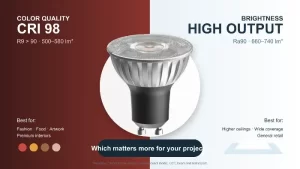
Tecolite Premium GU10 Pro 7.5W High Lumen Dimmable LED Lamp (Dim-to-Warm) – designed for cozy yet professional-grade lighting in living rooms, bedrooms, and hospitality projects.
6. Practical Tips: Dimmers, Installation, and Maintenance

6.1 Choose the Right Dimmer
- Utiliser LED-rated dimmers (often trailing-edge)
- Check the minimum and maximum load
- Avoid mixing bulb types (don’t put standard LEDs and dim-to-warm LEDs on the same dimmer circuit)
If you’re planning a renovation or new project, it’s worth standardizing:
- One dimmer model per area
- One family of dim-to-warm bulbs for easier troubleshooting
6.2 Install and Test Before You Commit
Before you buy 20 pieces:
- Test 1–2 bulbs with your existing dimmers
Check for:
- Flicker at low levels
- Buzzing sounds
- Smoothness of the color shift
- Walk around the room and see how faces, furniture, and colors look
If the test passes, then scale up.
6.3 Basic Maintenance
- Dust and clean fixtures and bulbs occasionally—dust can kill the cozy effect by dulling light
- Avoid fully enclosed fixtures if the bulb is not rated for it (excess heat shortens LED life)
- If a bulb starts flickering suddenly, check the dimmer and connections, not just the bulb
7. Quick FAQs About Dim-to-Warm LEDs for Cozy Spaces
Q1: Are dim-to-warm LED bulbs bad for energy savings because they go so warm?
No. The CCT change doesn’t increase power use—it’s still an efficient LED driver reallocating current between channels.
Q2: Can I use dim-to-warm bulbs in rooms that also need bright light sometimes?
Yes. At full brightness, they still deliver clear, usable light (2700–3000K). The magic happens when you dim them.
Q3: Do I need a smart home system to use dim-to-warm?
No. Most dim-to-warm bulbs work with standard wall dimmers (ideally LED-compatible ones). No apps required.
Q4: Are dim-to-warm and tunable white the same?
No. Dim-to-warm = automatic warm-up while dimming.
Tunable white = manual adjustment of color temperature via app/remote/controls.
If your bedroom or living room still feels too bright, too flat, or too “office-like” at night, lighting is probably the missing piece—not your furniture.
Dim-to-warm LED bulbs give you:
- Bright, functional light when you need it
- Soft, amber, cozy light when you don’t
- Better-looking spaces, more relaxing evenings, and a smoother path toward sleep
If you’re planning to upgrade:
- Start with one room (often the living room or master bedroom)
- Pick high-CRI dim-to-warm bulbs
- Pair them with a modern LED dimmer
- Test, adjust, then roll out to the rest of the home
And if you want a shortcut instead of trial-and-error:
Looking for reliable, high-performance dim-to-warm LED spotlights for bedrooms, living rooms, or hospitality projects?
Share your fixture type (GU10, MR16, etc.), wattage, and room layout, and we can recommend a dim-to-warm configuration that delivers stable dimming, warm cozy light, and long-term performance—without guesswork.