Ampoules LED MR16 : Comment choisir l'angle du faisceau, l'IRC et la CCT pour l'éclairage des vitrines commerciales
Retail display lighting is not only about making products bright. A good display spotlight should create contrast, guide attention, show product color accurately, and avoid making shelves, cabinets, fabrics, cosmetics, jewelry, or artwork look flat. This is why MR16 LED bulbs are still widely used in compact retail and showcase lighting.
Compared with broad ambient lighting, MR16 spotlights give buyers a small, directional light source that can be aimed at specific products or display zones. For retail chains, shopfitters, lighting distributors, and fixture manufacturers, the challenge is choosing an MR16 LED bulb that works with the display design, not just one that fits the socket.
This guide focuses on MR16 LED bulbs for retail display lighting: where they fit, how beam angle affects product presentation, why CRI and CCT matter, and what B2B buyers should test before ordering.
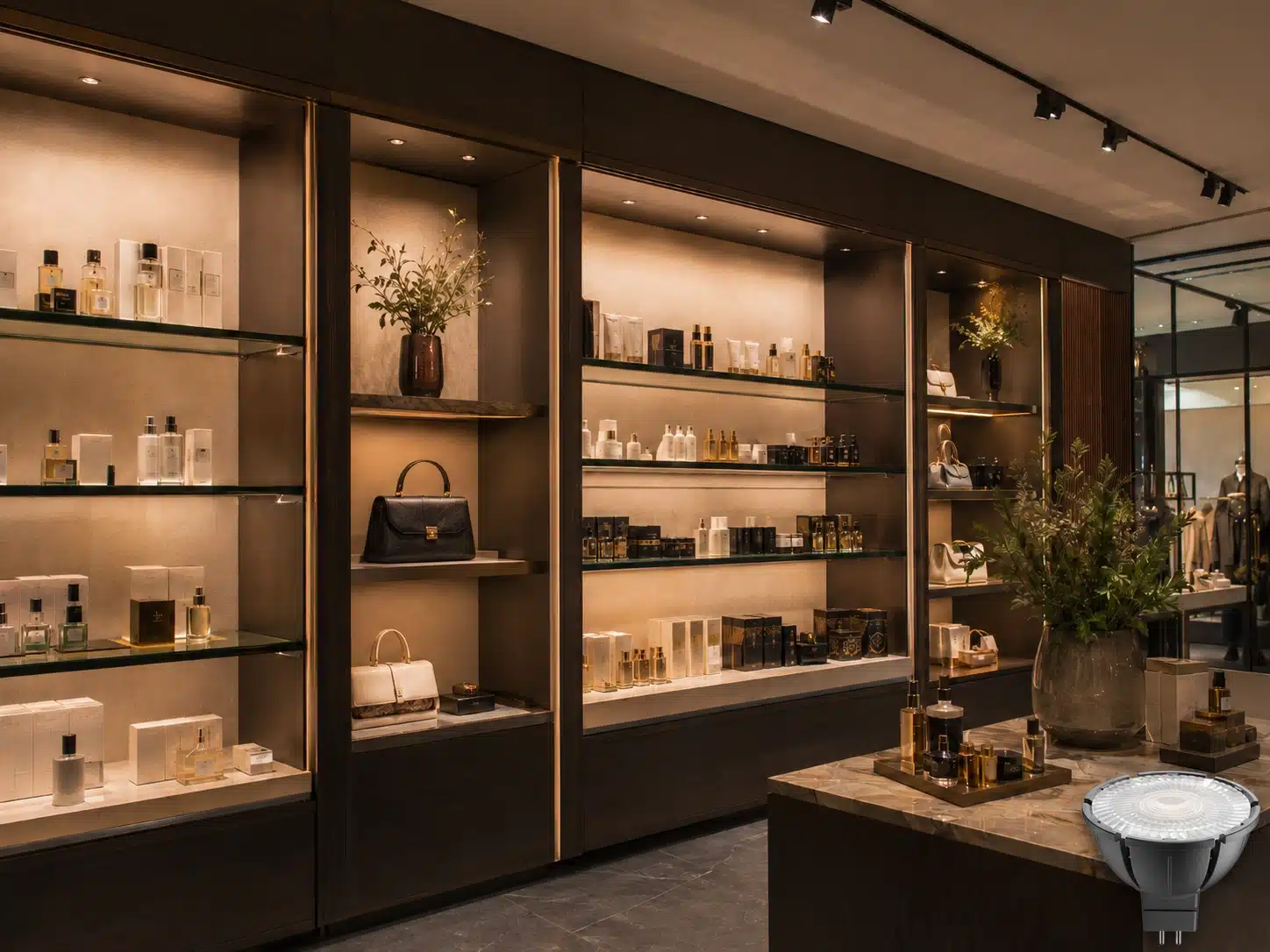
MR16 LED bulbs for retail display lighting and showcase shelves
What Is an MR16 LED Bulb in Retail Display Lighting?
MR16 is a compact directional spotlight format commonly used where controlled accent lighting is needed. In many projects, an MR16 LED bulb is around 50 mm in diameter and uses a GU5.3 bi-pin base with 12V low-voltage operation, although buyers should always confirm the actual product specification before ordering.
In retail display lighting, MR16 is valued because it can create focused light on shelves, cabinets, counters, and small product zones without using a large fixture. It is not simply a "small bulb"; it is part of the optical design of the display.
| Fonctionnalité | Typical MR16 LED Bulb |
|---|---|
| Diamètre | About 50 mm |
| Base | GU5.3 bi-pin |
| Tension | Commonly 12V low voltage |
| Lighting role | Accent and display spotlighting |
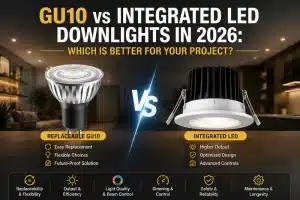
MR16 vs GU10: Avoid Choosing the Wrong Spotlight Base
MR16 and GU10 lamps can look similar from the front because both are compact spotlights, but they are usually not interchangeable. In most retail projects, MR16 commonly refers to a 12V low-voltage lamp with a GU5.3 bi-pin base, while GU10 usually refers to a mains-voltage twist-lock spotlight.
This matters when buyers order lamps for display cabinets, ceiling spotlights, or track fixtures. A lamp may have the right diameter but the wrong base or voltage. Before approving samples, confirm the fixture holder, input voltage, transformer or driver condition, and dimming requirement. For a fuller comparison, see TECO’s guide to MR16 vs GU10 bulbs.
Why MR16 LEDs Are Used in Retail Display Lighting
MR16 LED bulbs are popular in retail because they are compact, directional, and easy to integrate into small spotlight fixtures. They are often used in display cabinets, shelving systems, ceiling spotlights, track heads, wall niches, and boutique interiors where a narrow or medium beam is needed.
In many retail spaces, the goal is not maximum lumen output. The goal is product visibility and controlled contrast. A bright but poorly aimed lamp can create glare, hot spots, or reflections on glass. A lower-output lamp with the right beam angle can sometimes produce a better display effect.
MR16 LED bulbs are especially useful for:
- jewelry and watch displays
- cosmetics counters
- fashion and footwear shelves
- museum shop displays
- wine, food, and specialty retail
- hotel boutique corners
- cabinet and showcase lighting
For buyers, the main advantage is flexibility. MR16 lamps can be selected with different beam angles, CCTs, CRI levels, and dimming options. This allows project teams to fine-tune the display effect without changing the entire fixture design.
The limitation is that MR16 is not a one-size-fits-all product. Many MR16 LEDs are 12V GU5.3 low-voltage lamps, so transformer, dimmer, fixture, and thermal conditions still matter. If the project involves retrofit work, buyers should review compatibility separately instead of assuming every MR16 lamp will behave the same.
Beam Angle Selection for Shelves, Cabinets and Accent Displays
Beam angle is one of the most important decisions in retail display lighting. It determines how the light lands on the product, how much contrast the display has, and whether the customer sees the product or the glare.1
| Angle du faisceau | Retail Display Use |
|---|---|
| 10° / 15° | Jewelry, watches, small luxury items, artwork details |
| 24° | Focused display shelves, single product groups, high-contrast accents |
| 36° | General retail spotlighting, fashion shelves, boutique interiors |
| 60° | Wider cabinet lighting, lower mounting heights, softer product zones |
A narrow beam can make a product feel more premium because it creates stronger focus. But if the beam is too narrow, the display may have bright centers and dark edges. This is common in glass cabinets, jewelry trays, or shallow shelves where the lamp is close to the product.
A 24° beam is often useful when the display needs clear product focus. A 36° beam is usually more forgiving and can work well for fashion, accessories, and hospitality retail areas. A 60° beam may be better when the fixture is close to the shelf or when the buyer wants broader coverage with less contrast.
The right beam angle should be checked together with fixture depth, aiming direction, shelf height, product size, and surface reflectance. Black shelves, glass cases, polished metal, mirrors, and light-colored packaging all react differently. For retail projects, a small mockup is often more useful than choosing from a catalog table.
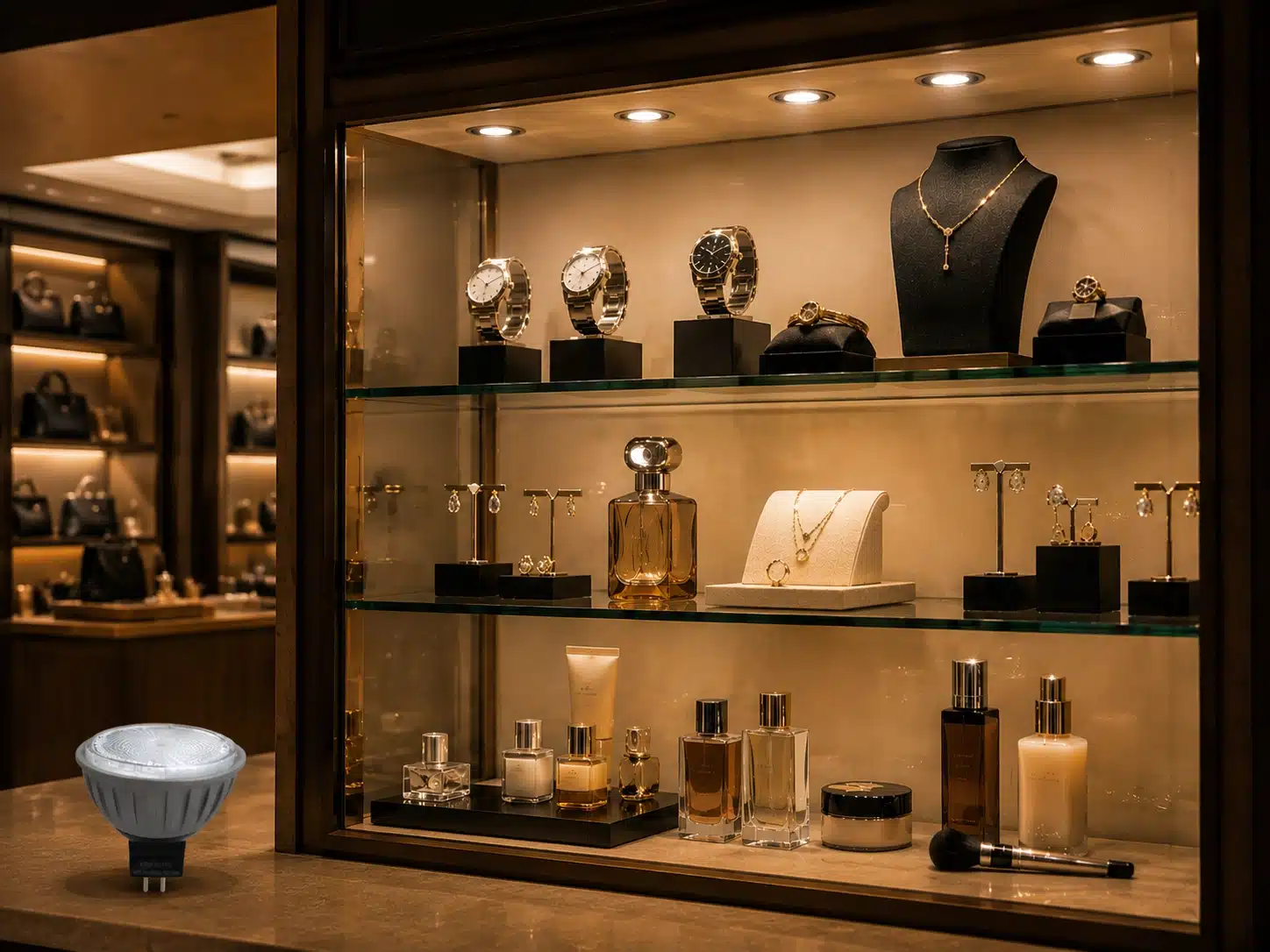
MR16 spotlight beam angle effect on retail shelves and display cabinets
CRI, R9 and CCT: Why Product Color Can Change Under MR16 Lighting
Color quality is a commercial issue in retail. If lighting makes a fabric look dull, a cosmetic shade look wrong, or a wood finish look muddy, the product presentation suffers even when the illuminance is high.
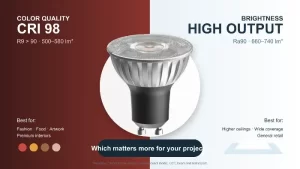
CRI is the first number many buyers check. For general retail, CRI90 can be acceptable. For premium retail, cosmetics, galleries, jewelry, and high-end displays, CRI95 or Ra98 is often a better target. CRI is useful, but it should not be treated as the only color-quality indicator because Ra values do not always predict how solid-state light sources will look in real visual evaluation.2 TECO’s MR16 range includes high-CRI options such as the MR16 12V dimmable LED bulb with CRI95/98 options and the MR16 Pro dimmable LED spotlight bulb 7W CRI98.
R9 should also be considered when red tones matter. Skin tones, cosmetics, food, leather, red fabrics, wine labels, and warm wood finishes can all look different if saturated red rendering is weak. A high general CRI value does not always guarantee strong red rendering, so premium retail buyers should ask for more color-quality data when the product category is color-sensitive.
CCT selection should follow the brand atmosphere and product type:
| TDC | Retail Use |
|---|---|
| 2700K | Warm luxury displays, hospitality retail, wood and leather |
| 3000K | Fashion, boutique retail, jewelry, warm premium interiors |
| 4000K | Cosmetics, galleries, cleaner display zones, task-focused counters |
One common mistake is mixing CCTs across the same display wall or store chain. A shelf lit by 3000K and another shelf lit by 4000K may make identical products look different. For chain stores and distributors, CCT binning and batch consistency should be checked before bulk orders.
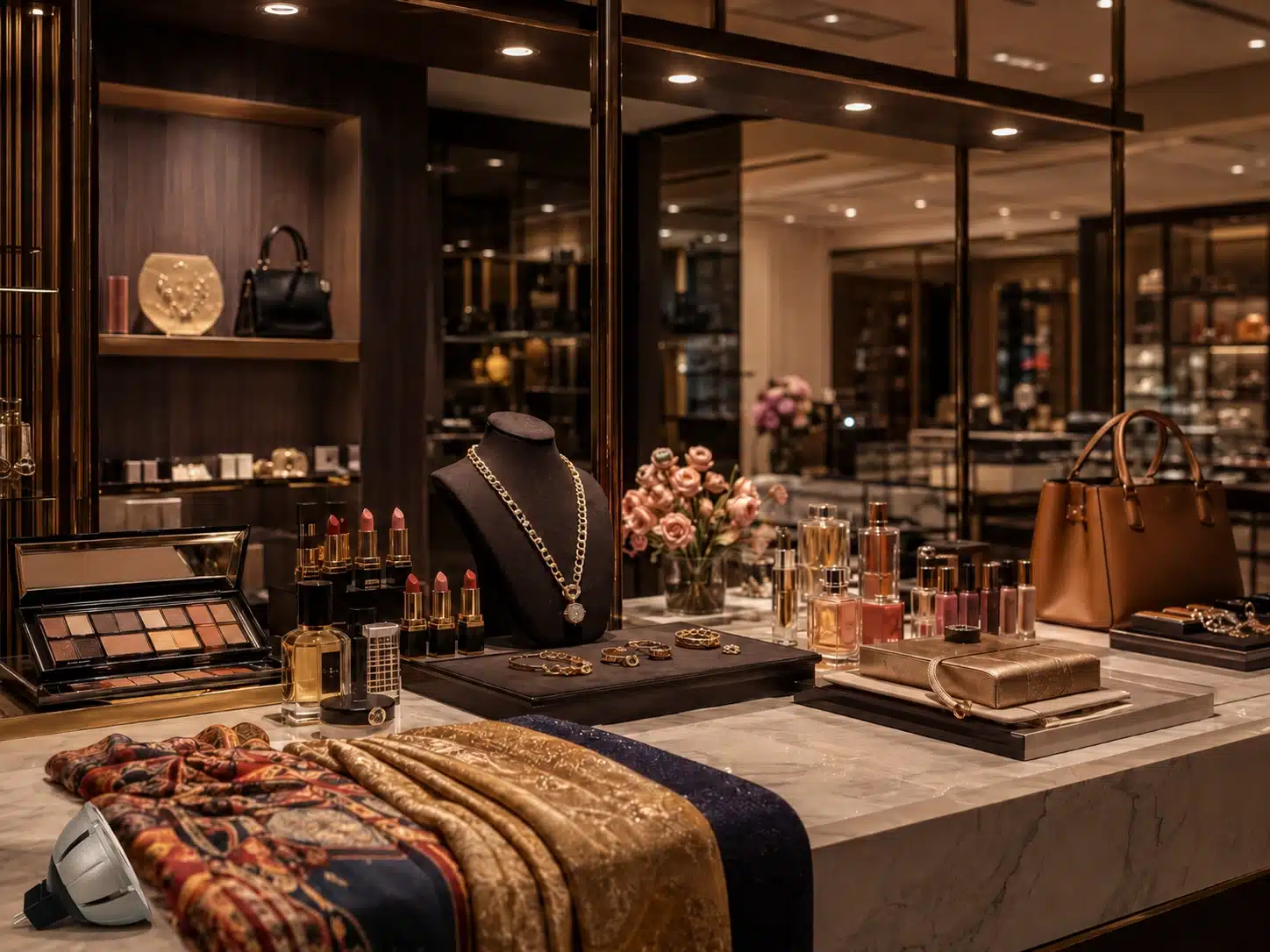
High CRI MR16 LED lighting for cosmetics jewelry and fashion display
Heat, Glare and Fixture Placement in Retail Displays
MR16 LEDs produce much less heat than halogen MR16 lamps, but they are not heat-free. In small display cabinets, recessed shelves, and compact spot fixtures, trapped heat can still affect driver life, LED performance, and long-term reliability.3
Fixture placement matters. If the MR16 lamp is too close to glass, polished metal, or glossy packaging, the customer may see reflection instead of product detail. If the lamp is aimed directly toward eye level, it may create uncomfortable glare. If too many spotlights overlap on one shelf, the center can look overlit while nearby products look dull.
In retail projects, the best lighting effect usually comes from balancing three things:
- enough contrast to make the product stand out
- controlled glare so customers can view the display comfortably
- enough thermal space so the lamp and driver can operate reliably
For enclosed or semi-enclosed display fixtures, buyers should ask whether the MR16 lamp is suitable for the thermal condition. A high-CRI product with a stable driver and proper heat dissipation will usually perform better than a low-cost lamp that looks bright during a short sample test but ages quickly in a cabinet.
Glare control is also part of product quality. A precise beam, stable optics, and correct fixture shielding can improve the display without increasing wattage. For some retail shelves, reducing glare and improving beam placement is more effective than simply choosing a higher-lumen bulb.
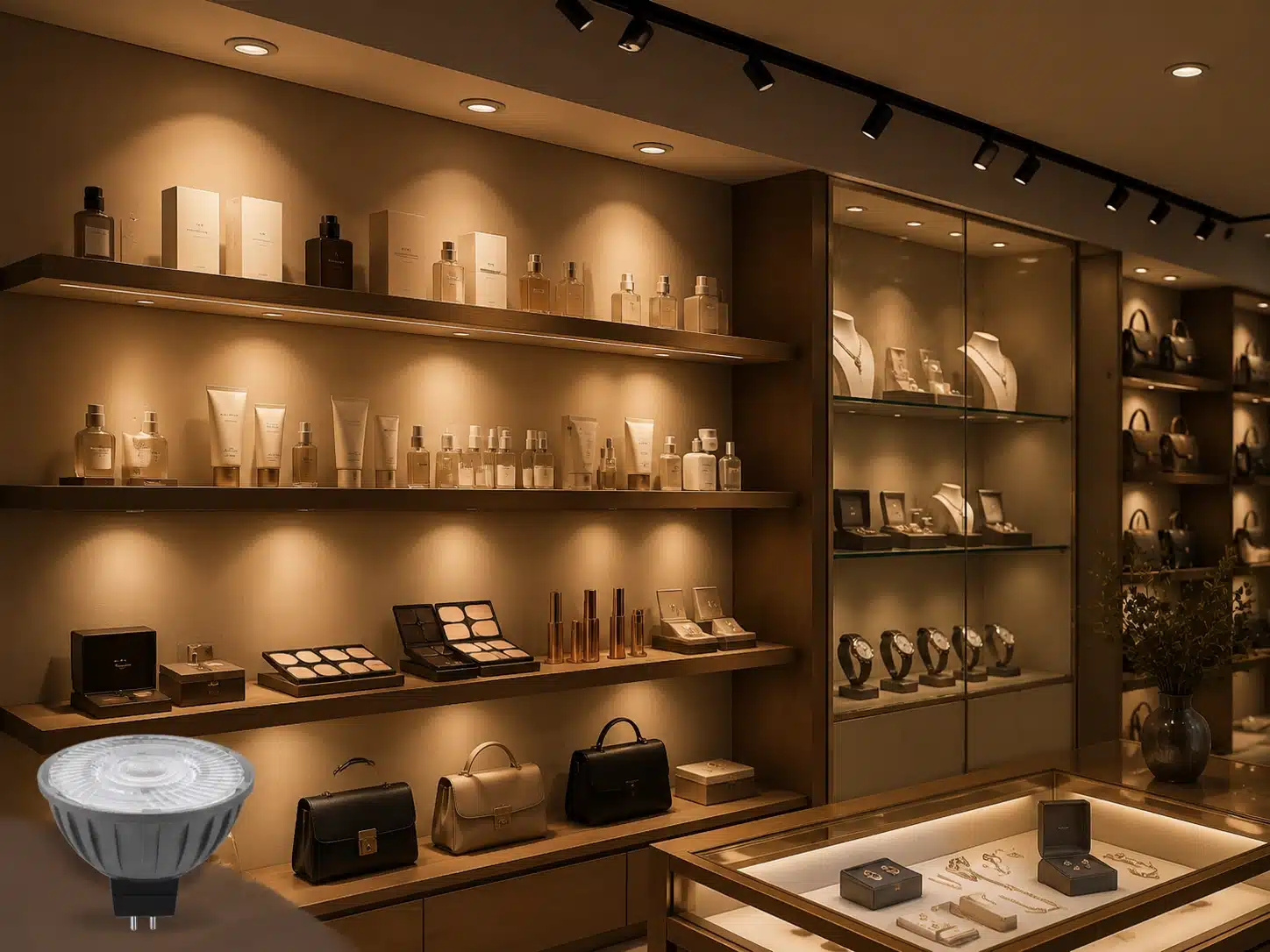
MR16 LED display cabinet lighting with controlled glare and heat
What Buyers Should Test Before Bulk MR16 Orders
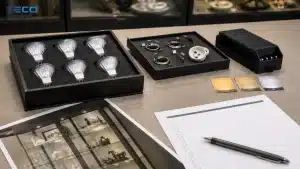
Retail display lighting should be tested under realistic conditions before bulk procurement. A loose lamp on a desk does not show how the beam will behave in a glass cabinet, on a black shelf, above cosmetics, or across repeated store locations.
Before ordering, buyers should check:
| Checkpoint | What to Review |
|---|---|
| Voltage and base | Confirm 12V GU5.3 system compatibility |
| Angle du faisceau | Test 10° / 24° / 36° / 60° on the actual display |
| TDC | Confirm 2700K / 3000K / 4000K with store design |
| CRI / R9 | Check product color accuracy under real merchandise |
| Lumen output | Compare visual effect, not wattage alone |
| Gradation | Test with actual dimmer, transformer, and load |
| Thermal condition | Check cabinet, shelf, or fixture ventilation |
| Batch consistency | Confirm CCT, beam, driver, and BOM control |
| Certification | Match destination market requirements |
For dimmable retail projects, do not rely only on a "dimmable" label. MR16 dimming depends on the LED driver, transformer, dimmer type, and load condition. TECO has a dedicated MR16 LED dimming guide and a separate article on MR16 LED compatibility issues for buyers who need deeper troubleshooting information.
For buyers comparing products, TECO’s MR16 LED bulb category is a good starting point for reviewing beam options, dimming choices, CRI levels, and product styles before requesting samples.4
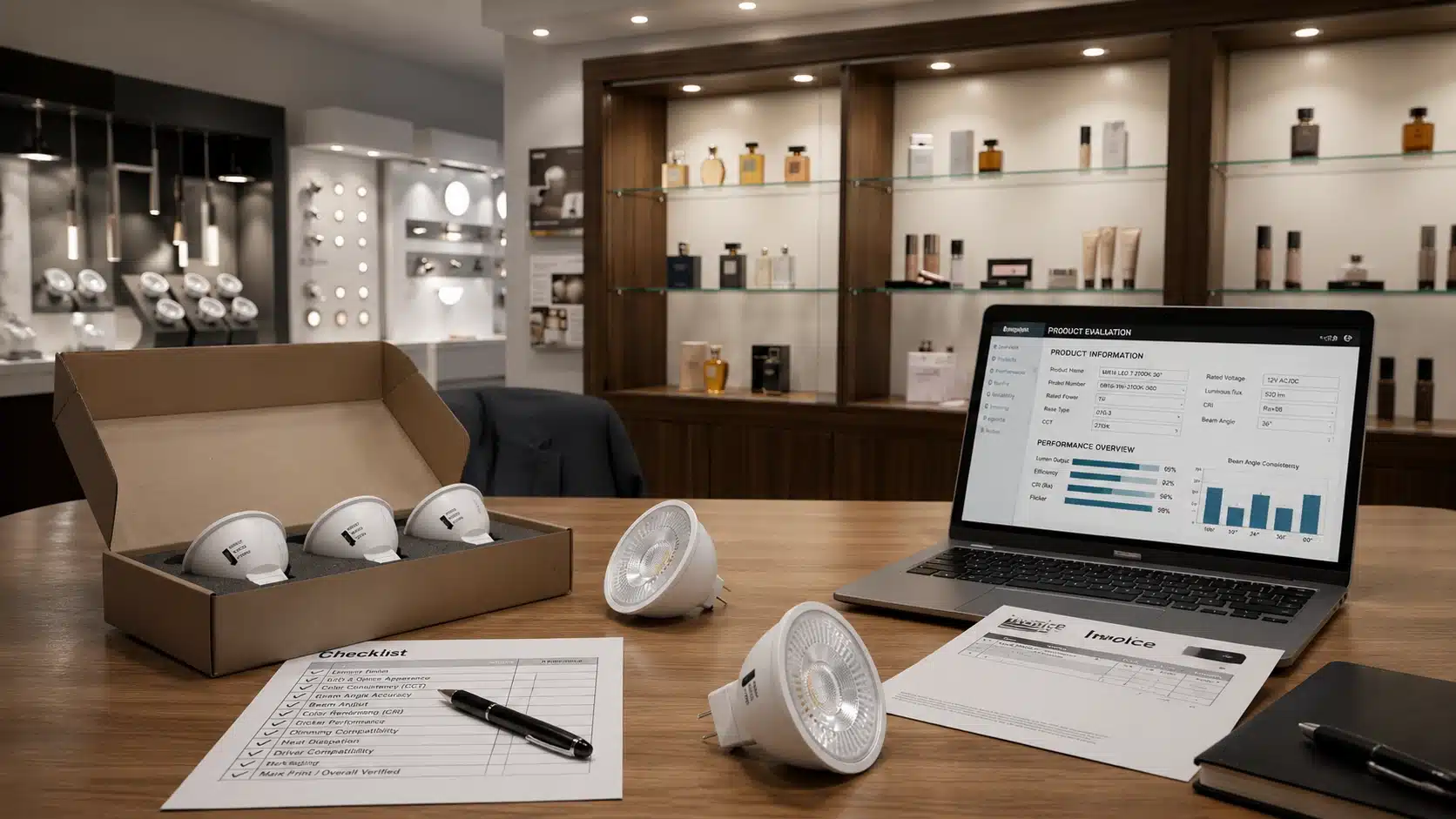
MR16 LED bulb sample testing for retail display projects
Need Custom MR16 LED Bulbs for Retail Display Projects?
Retail display projects often need more than a standard catalog lamp. Different store types may require specific beam angles, CRI targets, CCT choices, dimming behavior, packaging, certification documents, or batch consistency controls.
For B2B orders, TECO can support MR16 sample review, beam angle selection, high-CRI options, OEM/ODM requirements, and bulk production discussion before final procurement. Buyers can share the fixture type, display layout, target merchandise, dimming system, CCT, CRI requirement, beam angle, and order quantity so the product choice can be reviewed against the real application.
Conclusion
MR16 LED bulbs can be very effective for retail display lighting when they are selected for the actual display condition. The right product depends on beam angle, CCT, CRI, R9, lumen output, fixture placement, heat, glare control, dimming behavior, and batch consistency.
For jewelry, cosmetics, fashion, galleries, and premium display cabinets, buyers should not choose MR16 lamps by wattage alone. The real test is how the product looks under the lamp, how stable the beam and color remain across batches, and whether the lamp performs reliably inside the intended fixture.
For retail chains, distributors, shopfitters, and lighting brands, the safest process is to approve samples in a real display mockup before bulk orders. Share the display type, mounting height, beam angle target, CCT, CRI requirement, dimming system, and order quantity so TECO can help review suitable MR16 LED options for the project.
Notes de bas de page
IES lighting terminology defines beam-angle-related concepts used in illumination engineering. See ANSI/IES LS-1-25 Lighting Science: Nomenclature and Definitions. ↩
CIE notes that the CIE Colour Rendering Index, especially general Ra, is widely used but has known limitations for solid-state light sources. See CIE Colour Fidelity Index for accurate scientific use. ↩
The U.S. Department of Energy notes that fully enclosed fixtures can trap heat and increase operating temperatures, which can affect LED product performance and life expectancy. See DOE Purchasing Energy-Efficient Light Bulbs. ↩
Product examples and specifications are based on TECO’s current MR16 product range. See TECO MR16 LED bulbs. ↩