Conception de l'éclairage des musées : Normes, techniques et meilleures pratiques pour l'illumination des artefacts
Introduction
Lighting for museums is not simply a visual design task. It is a controlled engineering balance between visibility, conservation, visitor comfort, and long-term operating risk. If the system is specified incorrectly, the result is not limited to poor presentation. It can lead to irreversible material degradation, exhibition rework, difficult recommissioning, uneven color appearance between galleries, and higher maintenance costs in spaces where fixture access is often restricted.
For museums, galleries, and heritage exhibition projects, lighting decisions must satisfy two competing requirements at the same time: reveal the object clearly and protect it from light-induced damage. That is why the design must be approached as a system-level discipline involving illuminance limits, spectral control, beam management, glare suppression, color rendering, fixture adjustability, and stable dimming performance.12
Résumé Exécutif
The exhibition lighting system must balance artifact visibility with conservation. The correct solution combines controlled lux levels, minimal UV and infrared exposure, high CRI light sources, accurate beam aiming, and stable adjustable fixtures to reduce damage risk, improve presentation, and lower maintenance over the exhibition lifecycle.

museum lighting design for artifacts and exhibitions
Why Lighting Is Critical in Museums
Réalité sur site / commerciale
In museum projects, lighting quality directly affects both curatorial acceptance and visitor experience. If artifacts appear flat, distorted, overlit, or difficult to view because of reflections, the exhibition often requires fixture re-aiming, lens changes, dimming adjustments, or even replacement of luminaires after installation. In display cases, vaulted galleries, or high ceilings, every correction adds access cost and risks disruption to opening schedules.
Plongée approfondie & Solution d'ingénierie
Exhibition lighting has two primary functions: presentation and preservation. Presentation requires sufficient vertical and object-focused illumination so viewers can perceive texture, material, form, and color accurately. Preservation requires strict limitation of cumulative light exposure, especially for sensitive materials such as paper, textiles, dyes, manuscripts, and organic objects.
Unlike retail or hospitality spaces where brightness is often used to create impact, museums must work with controlled and often intentionally restrained illuminance. The objective is not maximum brightness but optimum visibility under conservation constraints. This requires careful coordination of:
- illuminance level by artifact sensitivity
- beam angle according to object size and distance
- spectral quality for color fidelity
- glare and reflection control for framed works and display vitrines
- dimming precision for scene tuning and rotating exhibitions
From a manufacturing perspective, museum projects demand tighter optical consistency than general commercial lighting. Small variations in beam shape, color temperature, or dimming response become visible immediately when fixtures are installed in parallel rows or focused on high-value artifacts.
In real projects, the first conflict is often not technical but curatorial: visitors need enough light to read form and detail, while the conservation team needs exposure to remain low over the full exhibition period. A strong gallery scheme does not "win" this conflict by making everything brighter. It solves it through better beam control, cleaner contrast, tighter dimming, and more disciplined scene setting.
Museum Lighting Conservation Principles
Réalité sur site / commerciale
The conservation team and the lighting team often work under different priorities. One focuses on protecting collections; the other focuses on visibility. If the specification does not define exposure limits early, the project may face redesign during commissioning, especially when objects are changed late in the exhibition schedule.
Plongée approfondie & Solution d'ingénierie
The first conservation principle is that light exposure is cumulative. Damage to sensitive materials is generally irreversible, which means the design must consider not only the instantaneous lux level but also the duration of exposure over time.
A practical conservation strategy is based on three control layers:
- Limit illuminance Keep object lighting within recommended lux thresholds based on material sensitivity.
- Control spectrum Minimize ultraviolet and unnecessary infrared energy to reduce photochemical and thermal stress.
- Control exposure duration Use zoning, dimming, occupancy response, and programmed scenes so light is present only when needed.
Typical conservation-sensitive categories include:
- paper documents
- watercolor works
- dyed textiles
- photographs
- manuscripts
- natural history specimens with delicate pigments
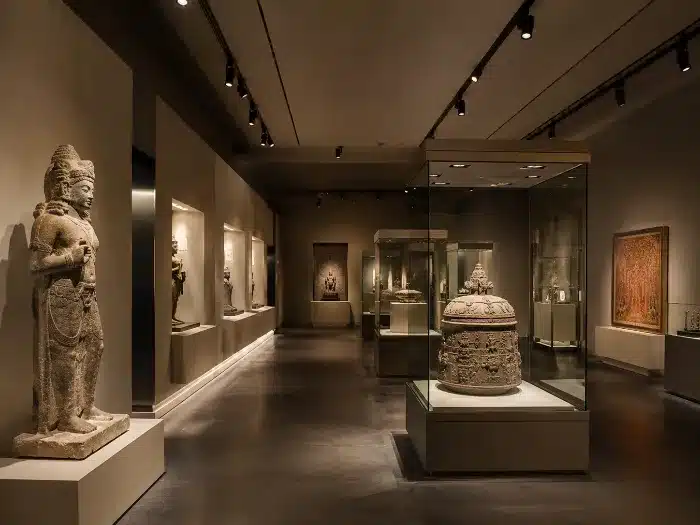
Less sensitive objects such as stone, metal, ceramics, and some glass can tolerate higher illuminance, but they still benefit from disciplined optical control to avoid overheating, reflections, and uneven presentation.
In large exhibition projects, the most reliable approach is to define a conservation matrix before luminaire selection. This matrix links object type, maximum lux, target CRI, beam spread, mounting height, and control method. It reduces late-stage adjustment and helps standardize gallery performance.
museum artifact conservation lighting and lux control
Recommended Lux Levels for Different Museum Artifacts
Réalité sur site / commerciale
Incorrect lux levels are one of the most common causes of curator rejection during mock-up review. Overlighting creates conservation risk, while underlighting reduces legibility and visitor satisfaction. If fixture output is not adjustable with enough precision, contractors are forced to compensate by changing aiming positions or adding filters on site.
Plongée approfondie & Solution d'ingénierie
Recommended illuminance levels vary according to artifact sensitivity. The figures below are traditional project reference values used in many conservation discussions, not universal legal limits. They should always be aligned with the museum’s own conservation policy, loan agreements, object condition, exhibition duration, and any applicable CIE or local guidance.34
| Artifact Type | Typical Recommended Lux Level | Relative Sensitivity | Impact on Maintenance / ROI |
|---|---|---|---|
| Highly light-sensitive artifacts such as paper, textiles, manuscripts | 50 lux | Haut | Lower damage risk, but requires accurate dimming and tighter commissioning |
| Moderately sensitive artifacts such as oil paintings, wood, lacquered objects | 150 lux as a common reference; sometimes adjusted by policy | Moyen | Good visibility with controlled exposure and reduced re-aiming |
| Low-sensitivity artifacts such as stone, metal, ceramics, glass | 300 lux as a common upper reference | Faible | Easier presentation, but glare and reflection still require control |
Lux targets alone are not enough. Uniformity across the object surface, beam edge quality, and contrast ratio with background surfaces also influence visibility. A 50 lux object can still be legible if the optical distribution is clean and the background is controlled. Conversely, a brighter object can appear uncomfortable if glare is present or if the beam creates hard hotspots.
During public cultural projects with mixed-use circulation areas, a common mistake is to apply corridor lighting logic to gallery objects. Artifact displays require object-based illumination, not general ambient brightness.
These values should also be treated as operating targets, not only design targets. A gallery can be commissioned correctly on opening day and drift later if scenes are overwritten, dimming curves are changed, or replacement fixtures do not match the original beam and color specification. For sensitive collections, the real risk is cumulative exposure: illuminance multiplied by time. A 50 lux display left on unnecessarily can create more annual exposure than a higher-lux scene used only for controlled viewing periods.
UV and Infrared Control in Museum Lighting
Réalité sur site / commerciale
When spectrum control is overlooked, artifact damage risk increases even if the measured lux appears acceptable. This is especially critical in heritage displays, temporary loan exhibitions, and enclosed cases where thermal buildup may go unnoticed until after installation.
Plongée approfondie & Solution d'ingénierie
Ultraviolet radiation and infrared energy must be controlled because both can contribute to material degradation, though in different ways.
- UV is associated with photochemical deterioration, fading, and embrittlement in sensitive materials.
- Infrared contributes primarily to heating, which can stress objects and microclimates inside display enclosures.
Modern exhibition projects increasingly rely on LED sources because they can significantly reduce UV and infrared output compared with legacy technologies.56 However, specifying LED alone is not sufficient. The full optical and thermal system still matters:
- driver stability
- junction temperature control
- beam concentration
- case ventilation
- casework integration
For vitrines and enclosed showcases, narrow-beam luminaires must be selected carefully. A high center-beam intensity in a small case can create localized heating or excessive highlight contrast even if total wattage is low.
As a practical reference, traditional museum guidance has often treated UV below 75 microwatts per lumen as an acceptable upper limit, with many conservation teams preferring levels as close to zero as practical for sensitive materials.3 This should be verified with a museum UV meter or supplier spectral data rather than assumed from the word "LED" alone.
From a manufacturing perspective, spectral control must be supported by thermal verification, not only source claims. In compact spotlights, poor thermal management can shift color performance over time and reduce output consistency between fixtures in the same gallery.
High CRI Lighting for Accurate Artifact Color
Réalité sur site / commerciale
If artifact colors appear dull, shifted, or inconsistent from one gallery to another, the exhibition team will usually identify it immediately. Correcting this after installation may involve replacing entire fixture batches, especially when color rendering issues are tied to the LED package rather than optics.
Plongée approfondie & Solution d'ingénierie
High CRI7 lighting is essential in museums because visitors, curators, and conservation teams must perceive the object as faithfully as possible. This is particularly important for paintings, dyed fabrics, historical surfaces, and mixed-material artifacts where subtle chromatic variation carries interpretive value.
In practical specification terms, museum projects typically prioritize:
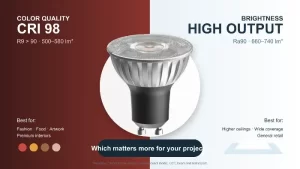
- high CRI, often 90 or above
- strong red rendering where skin tones, pigments, wood finishes, or warm historical materials are present
- consistent correlated color temperature across fixture batches
- low color variation between luminaires
For expert review, CRI should be treated as a starting point rather than a complete color-quality specification. Where pigment accuracy is critical, the project team should also review spectral power distribution, red rendering performance, color consistency tolerance, and sample approval under the actual object and wall finishes.
The purpose of high color rendering is not visual richness for marketing effect. It is accurate material reading. A source with poor spectral balance may make pigments appear muted or distort the relationship between adjacent colors.
| Fonctionnalité | Standard Commercial Lighting | Museum-Oriented High CRI Lighting | Impact on Maintenance / ROI |
|---|---|---|---|
| Rendu des couleurs | Acceptable for general spaces | Accurate for pigments and historical surfaces | Reduces curator dissatisfaction and fixture replacement |
| Batch consistency | Often broader tolerance | Tighter color consistency required | Fewer visual mismatches across galleries |
| Exhibition flexibility | Limited for sensitive objects | Better for rotating collections | Reduces need for repeated re-specification |
In large hospitality projects, visual inconsistency often goes unnoticed in circulation spaces. In museums, it is immediately visible on white plinths, neutral walls, and focused artifact illumination. That is why batch verification for CCT and output consistency should be treated as a procurement requirement, not an optional quality check.
Lighting Angles and Glare Control in Exhibitions
Réalité sur site / commerciale
Glare is one of the fastest ways to compromise an otherwise well-specified exhibition. Visitors may struggle to view objects through glass, framed works may reflect the luminaire directly, and polished artifacts can produce distracting highlights. These problems often trigger on-site re-aiming work and repeated viewing tests.
Plongée approfondie & Solution d'ingénierie
Lighting angle and glare control are central to museum performance. The common objective is to reveal the object without exposing the source to direct view or producing reflected images in the viewing direction.
Key methods include:
- using appropriate incidence angles for framed works
- selecting accessories such as snoots, louvers, and honeycomb screens
- controlling beam spread to keep light off surrounding reflective surfaces
- balancing ambient and accent levels to reduce excessive contrast
- placing luminaires outside critical reflection zones for display glass
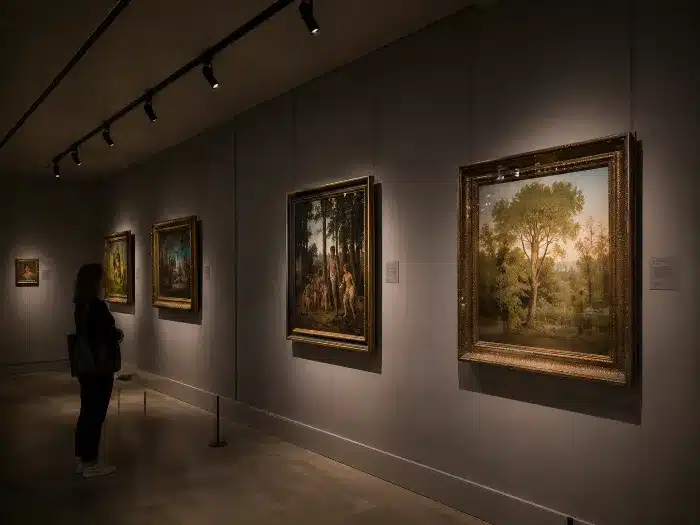
For two-dimensional works, a commonly used starting angle is around 30 degrees from vertical, though actual conditions depend on glass type, viewer distance, mounting height, artwork size, and surface finish.8 For sculptures and three-dimensional objects, multiple controlled beams may be required to reveal form while preventing harsh shadow buildup.
During exhibition commissioning, glare must be checked from the real visitor perspective, not only from the ladder or aiming position. A fixture that looks correct from ceiling level may produce reflections at eye level once the public route is established.
This is where many otherwise good museum projects lose quality. The measured lux may be correct, the CRI may be high, and the fixture may be premium, but a framed work under glass can still reflect the luminaire directly into the visitor’s sightline. In practice, the aiming review should include a normal visitor height, the expected walking route, and the final glass or acrylic surface, not a temporary mock-up surface.
museum lighting angle and glare control for framed artwork
Museum Lighting Systems and Fixtures
Réalité sur site / commerciale
Museums rarely operate with one fixed display condition. Exhibitions rotate, object sizes vary, curatorial priorities change, and lighting must adapt without major ceiling reconstruction. If the fixture system lacks flexibility, every exhibition changeover becomes slower and more expensive.
Plongée approfondie & Solution d'ingénierie
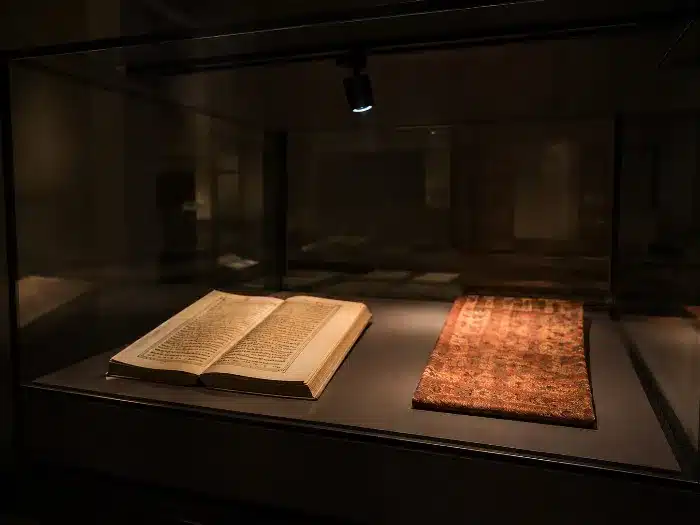
Modern gallery systems typically combine adjustable track-mounted luminaires, accent spotlights, wall washers, case lighting, and centralized or zoned control. LED track lighting and adjustable spotlights are widely used because they provide flexibility in aiming, beam selection, dimming, and maintenance access.
A practical fixture strategy may include:
- Track-mounted spotlights for paintings, sculptures, and rotating displays
- Adjustable beam luminaires for varied object sizes and mounting distances
- Wall washers for graphic panels and uniform vertical illumination
- Miniature case lights for vitrines and enclosed displays
- Dimming and scene control systems for exhibition changes and conservation management
| Fonctionnalité | LED Track Lighting | Fixed Downlights | Impact on Maintenance / ROI |
|---|---|---|---|
| Aiming flexibility | Haut | Faible | Better for rotating exhibitions |
| Beam adaptability | Haut | Limitée | Fewer fixture changes during re-curation |
| Maintenance access | Generally easier | Often ceiling-dependent | Lower labor cost in exhibition updates |
| Object-focused lighting | Forte | Weak | Better artifact presentation and lower spill light |
From a manufacturing perspective, museum fixtures should be evaluated not only for optical performance but also for dimming stability at low output, accessory retention, aiming lock reliability, and thermal behavior in long operating hours. These factors affect whether the installation remains stable six months after opening, not just on handover day.
For example, a track spotlight may perform beautifully at full output but become uneven or slightly unstable at low dimming levels often used for sensitive artifacts. In a retail store, this may pass unnoticed. In a quiet gallery with neutral walls and low ambient light, small dimming differences between adjacent fixtures can become very visible. If a project expects operation below about 20% output, low-end dimming should be validated with the actual driver, control protocol, fixture batch, and target scene setting rather than assumed from the catalogue dimming range.
museum LED track lighting and display case lighting system
Museum Exhibition Lighting Layout Example
Réalité sur site / commerciale
Layout errors usually show up during the final aiming phase: beams overlap unevenly, labels are too bright, case fronts reflect the source, or key objects sit outside the optical centerline. Correcting this late can consume significant labor, especially when scaffolding or after-hours access is required.
Plongée approfondie & Solution d'ingénierie
A typical museum exhibition lighting layout starts with the viewing sequence, not the ceiling plan. The designer should first identify:
- primary artifacts
- visitor approach direction
- display case positions
- label and graphic panel locations
- ceiling track or fixture mounting constraints
A simple gallery strategy may look like this:
- low ambient background lighting for spatial orientation
- focused accent lighting for primary artifacts
- controlled vertical illumination for wall-mounted works
- separate low-level lighting for interpretive graphics and labels
- independent dimming zones for curatorial tuning
For example, in a rectangular gallery with framed works on both sides and a sculpture in the center:
- track spotlights with narrow-to-medium beams illuminate each wall piece
- the sculpture receives two or three carefully crossed beams to reveal form
- circulation lighting remains subdued to preserve contrast
- labels are lit separately at readable but non-dominant levels
- display cases use internal or concealed lighting with screened optics
During hotel commissioning-style workflows, teams sometimes prioritize overall brightness first and detail tuning later. In museum projects, the sequence should be reversed: establish object lighting correctly, then build background light around it.
Common Museum Lighting Design Mistakes
Réalité sur site / commerciale
Most gallery lighting failures are not caused by one major defect. They come from small specification shortcuts that multiply during installation: wrong beam angles, poor dimming range, inconsistent CCT, uncontrolled reflections, or excessive general ambient light. The result is rework, delayed opening, and unnecessary fixture replacement.
Plongée approfondie & Solution d'ingénierie
Common mistakes include:
- Applying uniform commercial lighting logic Museums need selective, object-based illumination, not flat general lighting.
- Ignoring artifact sensitivity Lux levels must be matched to material type and conservation policy.
- Using poor color rendering sources This reduces the accuracy of object presentation.
- Overlooking glare and reflections Glass-covered works and polished artifacts require viewing-angle analysis.
- Insufficient dimming precision Fine adjustment is essential for conservation and exhibition balance.
- Choosing inflexible fixtures Rotating exhibitions need adjustable systems.
- Neglecting batch consistency Color and output mismatch between fixture lots can disrupt gallery uniformity.
| Mistake | Immediate Effect | Long-Term Impact on Maintenance / ROI |
|---|---|---|
| Excessive lux levels | Conservation risk | Reduced artifact protection and policy non-compliance |
| Low CRI source | Inaccurate appearance | Curatorial dissatisfaction and retrofit cost |
| Poor glare control | Visitor discomfort | Re-aiming labor and reduced exhibition quality |
| Inflexible fixture system | Difficult exhibition updates | Higher recurring labor cost |
| Unstable dimming | Visible inconsistency | Control complaints and replacement risk |
From a manufacturing perspective, one overlooked issue is low-end dimming behavior. A fixture may look acceptable at full output but become unstable, non-linear, or visibly inconsistent at museum operating levels. This is why low-output validation should be part of pre-delivery testing.
Other field issues are less visible during specification but very real after opening: accessories can be misplaced during re-aiming, aiming locks can loosen after repeated exhibition changeovers, and replacement fixtures from a later batch may not visually match the original installation. These are not dramatic problems, but they are exactly the details that separate a stable museum system from a system that requires constant correction.
Future Trends in Museum Lighting Technology
Réalité sur site / commerciale
Museums increasingly expect lighting systems to support changing exhibitions, energy targets, digital controls, and stricter conservation monitoring. If the system is designed only for current displays, it may become operationally inefficient within a short upgrade cycle.
Plongée approfondie & Solution d'ingénierie
Future exhibition lighting development is moving toward greater precision, adaptability, and data integration. Key trends include:
- finer dimming resolution for conservation-sensitive displays
- tunable spectral strategies for different artifact categories
- improved optical accessories for glare suppression
- smarter controls linked to occupancy and exhibition schedules
- remote monitoring of drivers and lighting scenes
- modular fixture families that simplify future upgrades
LED technology remains the primary platform because it supports compact optics, lower UV and infrared output, better control integration, and lower maintenance frequency than legacy sources. However, performance still depends on engineering discipline in drivers, thermal paths, optics, and consistency control.
In large public projects, the most useful innovations are not always the most complex. Stable dimming, repeatable beam control, easy field adjustment, and verified batch consistency often deliver more operational value than feature-heavy systems that are difficult to commission or maintain.
FAQ
What lux level is recommended for museum lighting?
Common project references are around 50 lux for highly sensitive materials such as paper, textiles, and manuscripts, around 150 lux for moderately sensitive objects, and up to about 300 lux for less sensitive materials such as stone, metal, ceramics, and glass. Final targets should follow the museum’s conservation policy, loan conditions, object condition, and exhibition duration.
What CRI is best for museum lighting?
Museum projects commonly use high CRI sources, often CRI 90 or above, because accurate color perception is important for paintings, textiles, historical surfaces, and mixed-material artifacts. Strong red rendering and tight color consistency between fixtures may also matter.
Are LED lights safe for museum artifacts?
LED lighting can be suitable for museums because it can reduce UV and infrared exposure compared with many legacy sources. However, LED alone does not make a system safe. Lux level, spectrum, exposure time, thermal behavior, beam concentration, and controls must still be managed.
What angle should museum lights use for artwork?
For framed two-dimensional works, around 30 degrees from vertical is often used as a starting point. The final angle depends on mounting height, viewer position, glass reflectance, artwork texture, and glare control accessories.
How do museums reduce glare on glass display cases?
They reduce glare by controlling fixture position, beam angle, beam spread, accessory selection, background brightness, and visitor viewing routes. Glare should always be checked from real visitor eye level, not only during ceiling-level aiming.
Conclusion: Balancing Visibility and Conservation in Museum Lighting
This type of lighting works best when it is treated as a conservation-controlled presentation system rather than a decorative layer. The correct design combines appropriate lux levels, careful spectral management, high color rendering, controlled beam angles, and flexible fixture systems that support exhibition change without repeated infrastructure work.
For museums and exhibition projects, the business value is clear: higher reliability, reduced maintenance intervention, lower risk of installation rework, and better protection of valuable collections over time.
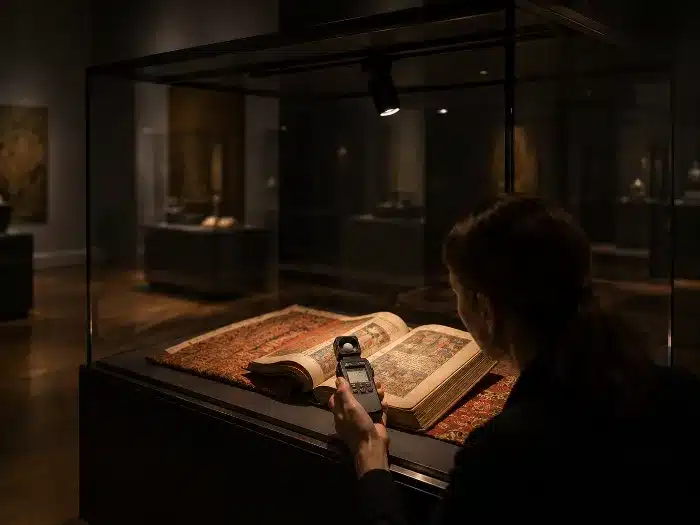
museum lighting engineering review for exhibition projects
Recommandation d'ingénierie B2B
For museum and heritage exhibition projects, share the artifact sensitivity list, gallery layout, mounting height, target lux range, beam angle requirements, dimming protocol, and control schedule before mass production. The Teco engineering team can review optical risk, simulate electrical load, verify low-end dimming behavior, check fixture and accessory compatibility, and support sample testing before rollout.
Notes de bas de page
Illuminance is the amount of light falling on a surface, commonly measured in lux. ↩
Dimming performance refers to how smoothly and consistently a luminaire reduces light output across its control range. ↩
The 50 / 150 / 300 lux references and the 75 µW/lm UV reference are widely cited traditional conservation guidelines; the Canadian Conservation Institute notes that object sensitivity, visibility, and exposure duration should be assessed together rather than treated as a simple universal rule. ↩ ↩
CIE 157:2004, Control of Damage to Museum Objects by Optical Radiation, provides a risk-based procedure for setting up and monitoring lighting during the life of a display. ↩
Ultraviolet (UV) radiation is short-wavelength energy that can accelerate fading and material degradation. ↩
Infrared (IR) radiation is longer-wavelength energy associated mainly with heat transfer. ↩
CRI, or Color Rendering Index, is a measure of how accurately a light source reveals object colors compared with a reference source. ↩
Getty Conservation Institute guidance for solid-state lighting includes gallery track examples where beams strike painting centers at approximately 30 degrees to the vertical; this is a starting point, not a substitute for glare checks from the actual visitor route. ↩