Come funzionano le lampadine LED a dimmerazione a 3 step con un normale interruttore della luce?
Introduzione
In many retrofit projects, the request is simple: add dimming without replacing the existing wall switch or opening the wiring. On site, however, this becomes a system-level problem rather than a bulb-only decision. If the control method is not clearly understood, the result can be inconsistent user experience, complaints after handover, and unnecessary maintenance visits.
Three-step dimming LED bulbs are designed to work from a standard on/off wall switch by changing brightness in fixed steps. This can be useful in selected applications, especially where rewiring is not practical. But in shared spaces, circulation areas, and commercial projects with frequent switching, the same feature can create confusion because the lamp changes output based on the timing of power interruptions rather than a dedicated control signal.
For importers, distributors, and project buyers, the real question is not whether the lamp can dim. The real question is whether this control logic matches the operating behavior of the space.
Sintesi Esecutiva
3-step dimming LED bulbs use rapid power cycling from a normal switch to move between preset brightness levels. They are suitable for simple retrofit use, but they are not ideal for spaces requiring predictable user control, scene consistency, or commercial-grade dimming performance.
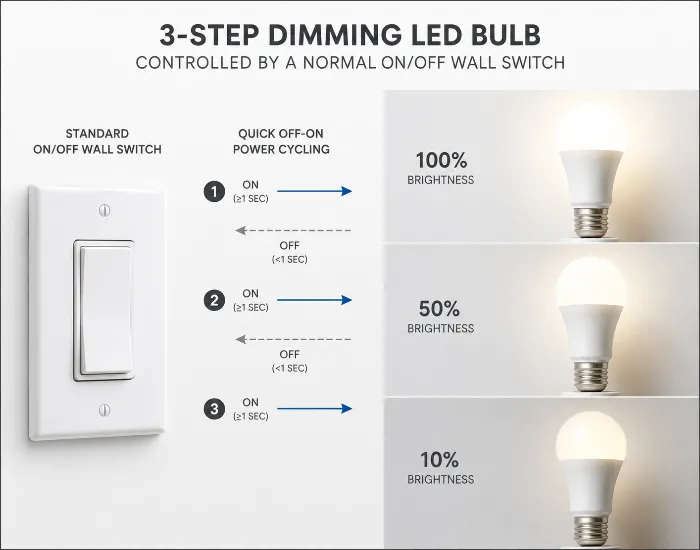
3-step dimming LED bulb controlled by normal light switch
What Does 3-Step Dimming Mean?
Realtà in Cantiere / Commerciale
Buyers often assume “dimmable” means smooth adjustment. In practice, 3-step dimming means the lamp only offers a few fixed output levels, typically low, medium, and high. If this is not clarified before procurement, end users may expect full-range dimming and reject the product after installation.
Approfondimento e Soluzione Ingegneristica
A 3-step dimming LED bulb contains an internal driver1 programmed to switch between preset power levels. Instead of receiving a phase-cut2 dimming signal from a wall dimmer, it monitors the mains power interruption pattern from a standard switch.
Each rapid off-on cycle tells the internal control circuit to advance to the next brightness level. In most designs, the sequence repeats in a loop, such as:
| Caratteristica | 3-Step Dimming Bulb | Full Range Triac Dimming Bulb | Impatto sulla Manutenzione / ROI |
|---|---|---|---|
| Output control | Fixed preset levels | Continuous dimming range | Preset levels reduce wiring changes, but limit user flexibility |
| User interface | Standard switch | Dedicated dimmer required | Easier retrofit, but more user confusion |
| Brightness accuracy | Fixed by internal driver | Depends on dimmer-driver matching | Fewer compatibility variables in simple installations |
Nota di Fabbrica
From a manufacturing perspective, the main issue is not whether the stepping function works in the lab. The real issue is whether the switching window is calibrated tightly enough to avoid accidental step changes during normal use, while still remaining responsive across production batches.
How Does a Normal Light Switch Dim an LED Bulb?
Realtà in Cantiere / Commerciale
Installers may believe the wall switch is “dimming” the lamp. It is not. The switch is only cutting and restoring power. If facility managers do not understand this, they may misdiagnose user complaints as lamp failure or wiring instability.
Approfondimento e Soluzione Ingegneristica
The internal electronics detect short power interruptions and interpret them as a control command. If the switch is turned off and back on within a defined time window, the bulb advances from one preset output level to the next.
This means the dimming action depends on timing, not analog control. The bulb effectively counts rapid power cuts and uses that timing logic to select brightness. That is why different users can produce different results from the same switch.
A simplified operating logic looks like this:
| Caratteristica | Normal Switch 3-Step Control | Conventional Wall Dimmer Control | Impatto sulla Manutenzione / ROI |
|---|---|---|---|
| Control signal | Timed power interruption | Phase-angle power modulation | Simpler installation, less predictable operation |
| Wiring changes | None in most retrofits | Usually requires dimmer replacement | Lower upfront labor cost |
| User consistency | Depends on switching rhythm | More direct control | More complaints in shared spaces if behavior is misunderstood |
Nota di Fabbrica
During hotel commissioning, timing-based switching logic often performs acceptably in mock-up rooms but becomes less predictable in real operation once multiple users interact with the switch differently. This is where functional acceptance can diverge from laboratory validation.
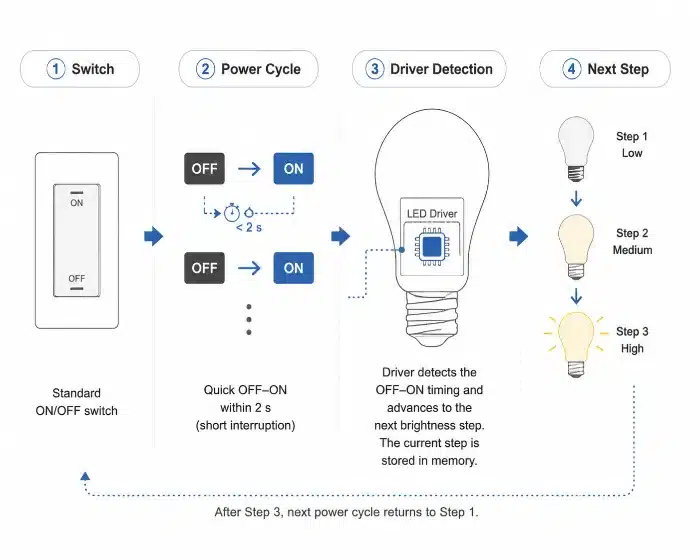
3-step dimming LED bulb controlled by standard on-off switch
Why Do 3-Step Dimming Bulbs Not Need a Wall Dimmer?
Realtà in Cantiere / Commerciale
This is the main commercial attraction. In retrofit work, replacing hundreds of wall dimmers can add material cost, electrician time, and coordination risk. A lamp that offers basic brightness adjustment from an existing switch can reduce initial installation scope.
Approfondimento e Soluzione Ingegneristica
The dimming intelligence is built into the lamp driver, not the wall device. Because the bulb interprets on-off timing internally, the switch only needs to provide stable mains isolation and reconnection.
This avoids a common LED retrofit issue: incompatibility between legacy halogen dimmers and low-wattage LED loads. DOE testing notes that LED lamp performance with phase-cut dimmers can depend on the selected dimmer and other circuit components, so compatibility should not be assumed from the word "dimmable" alone.3 With 3-step dimming, that compatibility problem is bypassed because no phase-cut dimmer is used.
However, the tradeoff is that control remains crude. There is no smooth dimming curve, no precise scene setting, and no guaranteed recall of a preferred brightness level after switching.
What Brightness Levels Do 3-Step Dimming LED Bulbs Usually Have?
Realtà in Cantiere / Commerciale
Procurement teams often specify only wattage and CCT4, but not the actual lumen output5 at each dimming step. This creates mismatch between user expectation and installed performance, especially in guest rooms and bedside applications.
Approfondimento e Soluzione Ingegneristica
Most 3-step dimming bulbs use three fixed output bands, commonly around:
- 100% output
- 50% to 60% output
- 10% to 25% output
The exact levels vary by driver design, thermal limit, LED efficacy, and product positioning. Some suppliers market the steps as low / medium / high, but without providing measured lumen maintenance at each level. For B2B purchasing, this is not sufficient.
Buyers should request the actual electrical and photometric data for each step, because light output, flicker, audible noise, and minimum-output behavior are all relevant when evaluating dimming performance in LED lamps.6
| Caratteristica | Typical 3-Step Dimming Levels | What Buyers Should Request | Impatto sulla Manutenzione / ROI |
|---|---|---|---|
| Brightness steps | Low / medium / high | Measured lumen output at each step | Avoids under-lighting complaints |
| Power draw | Reduced by step | Wattage at each level | Supports energy calculations |
| CCT stability | May shift slightly | CCT data across all steps | Prevents visual inconsistency in projects |
Nota di Fabbrica
In large hospitality projects, the low-level step often matters more than the full-output step. If the lowest setting is still too bright for bedside or nighttime use, the product may be technically functional but commercially unsuitable.
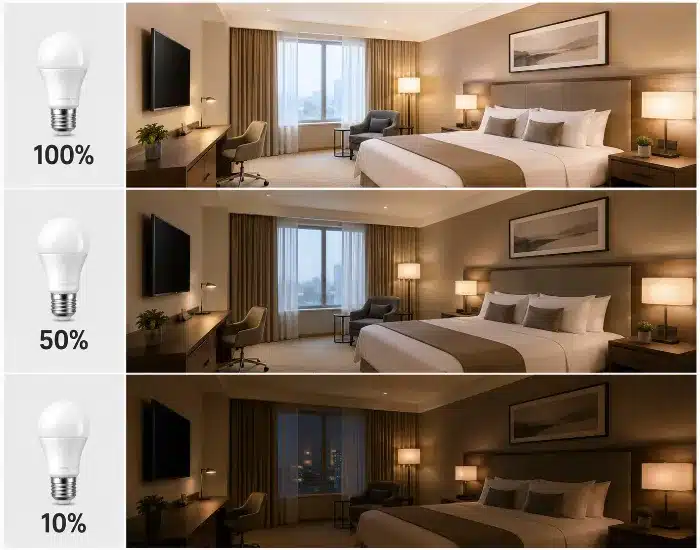
3-step dimming LED bulb brightness levels
Where Are 3-Step Dimming Bulbs Most Useful?
Realtà in Cantiere / Commerciale
The best applications are spaces with one primary user, simple lighting expectations, and limited need for precise scene control. The worst applications are shared-use or high-traffic areas where switch behavior is inconsistent.
Approfondimento e Soluzione Ingegneristica
Three-step dimming bulbs are most useful when rewiring is undesirable and the user only needs basic brightness selection. Suitable examples may include:
- Guest room bedside lamps
- Table lamps in serviced apartments
- Small retrofit hospitality rooms
- Temporary renovation phases
- Decorative fixtures with difficult wiring access
They are less suitable for:
- Corridors
- Shared rooms
- Stairwells
- Public lobbies
- Sale riunioni
- Any area needing predictable scene recall
This is because different users operate the same switch with different timing. The resulting brightness level can become random from the occupant’s perspective.
What Are the Advantages of 3-Step Dimming LED Bulbs?
Realtà in Cantiere / Commerciale
For certain retrofit jobs, the value is straightforward: no wall dimmer replacement, reduced electrician time, and quick functional upgrade. This can be attractive where access to existing controls is costly or disruptive.
Approfondimento e Soluzione Ingegneristica
The main advantages are practical rather than advanced:
| Caratteristica | 3-Step Dimming Bulb | Lampadina standard non regolabile | Impatto sulla Manutenzione / ROI |
|---|---|---|---|
| Flessibilità della luminosità | Sì, a passi fissi | No | Migliore usabilità senza importanti rifacimenti elettrici |
| Complessità di installazione | Basso | Basso | Interruzione minima di retrofit |
| Problema di compatibilità del dimmer | Non applicabile nella maggior parte dei casi | Non applicabile | Evita l'incompatibilità con dimmer obsoleti se è necessaria la regolazione |
| Costo di controllo iniziale | Inferiore al retrofit basato su dimmer | Minimo | Utile quando una regolazione di base è sufficiente |
I vantaggi principali includono:
- Utilizza un normale interruttore a muro
- Evita la sostituzione dei controlli tradizionali on/off
- Riduce la manodopera iniziale di installazione
- Fornisce una regolazione semplice bassa / media / alta
- Evita molti problemi di compatibilità con i dimmer da parete
Quali sono i limiti delle lampadine LED a regolazione a 3 livelli?
Realtà in Cantiere / Commerciale
È qui che hanno origine molte lamentele post-installazione. Se gli occupanti si aspettano memoria stabile, selezione di scene ripetibili o funzionamento intuitivo in spazi condivisi, il prodotto potrebbe generare chiamate di assistenza anche quando non vi è alcun difetto hardware.
Approfondimento e Soluzione Ingegneristica
Le principali limitazioni sono legate al metodo di controllo stesso:
- Sono disponibili solo livelli di luminosità fissi
- Nessuna regolazione fluida
- La selezione della luminosità dipende dal ritmo di commutazione
- Una doppia commutazione accidentale può portare la lampada al livello sbagliato
- Il comportamento della memoria potrebbe non corrispondere alle aspettative dell'utente
- Le prestazioni in spazi multi-utente sono spesso incoerenti
| Caratteristica | 3-Step Dimming Bulb | Sistema di Dimmeraggio Dedicato | Impatto sulla Manutenzione / ROI |
|---|---|---|---|
| Precisione di controllo | Basso | Alto | Più reclami degli utenti se le aspettative sono alte |
| Ripetibilità della scena | Limitata | Forte | Meglio per la coerenza commerciale con controlli dedicati |
| Idoneità per uso condiviso | Debole | Migliore | Tasso di reclami inferiore in ambienti commerciali |
Dimmeraggio a 3 Step vs Dimmeraggio Triac: Qual è la Differenza?
Realtà in Cantiere / Commerciale
Questi due prodotti sono spesso raggruppati sotto la parola “dimmable”, ma risolvono problemi diversi. Selezionare quello sbagliato può portare a incompatibilità, scarsa esperienza utente o costi hardware di controllo non necessari.
Approfondimento e Soluzione Ingegneristica
Dimmerazione a triac7 utilizza un dimmer da parete che modifica la forma d'onda CA per ridurre la potenza fornita al driver della lampada. Un driver LED compatibile interpreta quindi quella forma d'onda e regola l'uscita in modo continuo.
La regolazione a tre livelli non legge una forma d'onda a taglio di fase. Monitora semplicemente i rapidi reset di alimentazione da un interruttore standard e cambia tra livelli preimpostati.
| Caratteristica | Regolazione a 3 livelli | Dimmerazione a triac | Impatto sulla Manutenzione / ROI |
|---|---|---|---|
| Dispositivo di controllo | Interruttore standard on/off | Dimmer a triac da parete | I 3 livelli riducono le modifiche hardware per retrofit |
| Gamma di dimmeraggio | Passi fissi | Di solito continuo | Triac migliore per il controllo delle scene |
| Rischio di compatibilità | Più basso con interruttori semplici | Più alto se si verifica un disallineamento tra dimmer e driver | Il triac necessita di pre-validazione |
| Precisione dell'utente | Basso | Più alto | Triac migliore per la ripetibilità commerciale |
| Caso d'uso migliore | Retrofit semplice | Applicazione di regolazione progettata | Una selezione corretta riduce i reclami |
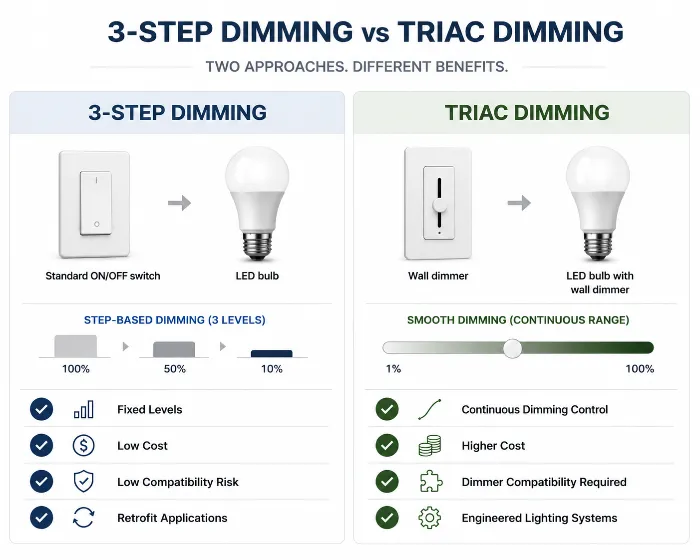
Confronto tra lampadina LED a regolazione in 3 step e regolazione Triac
Cosa dovrebbero verificare gli acquirenti prima di ordinare lampadine a regolazione in 3 step?
Realtà in Cantiere / Commerciale
Ordinare basandosi solo sull'aspetto, il wattaggio e il prezzo è rischioso. Il comportamento di controllo deve essere esaminato nel contesto dell'applicazione, altrimenti i tassi di reso e l'insoddisfazione sul campo possono aumentare dopo il dispiegamento.
Approfondimento e Soluzione Ingegneristica
Prima di effettuare un ordine, gli acquirenti dovrebbero confermare:
- Sequenza di luminosità esatta
- Comportamento di memoria o riavvio
- Finestra temporale di commutazione richiesta
- Output di lumen ad ogni passo
- Consumo energetico ad ogni step
- Consistenza della CCT tra i passi
- Affidabilità del driver con ripetuti commutazioni
- Idoneità per apparecchi chiusi se pertinente
- Coerenza di lotto nei tempi di controllo
Di seguito è riportata una lista di controllo pratica:
| Elemento da controllare | Perché è importante | Impatto B2B |
|---|---|---|
| Livello predefinito di riavvio | Influisce sull'accettazione dell'utente | Riduce i reclami dopo la consegna |
| Tempistica di transizione tra step | Determina la facilità d'uso | Previene cambiamenti accidentali di luminosità |
| Lumen misurati per fase | Conferma l'effetto di illuminazione reale | Evita dichiarazioni di sottoperformance |
| Resistenza alla commutazione ripetitiva | Riflette le condizioni d'uso effettive | Riduce l'esposizione a RMA |
| Idoneità dell'applicazione | Previene l'uso improprio in spazi condivisi | Protegge la reputazione del progetto |
Nota di Fabbrica
Da una prospettiva di produzione, la resistenza alla commutazione ripetuta non dovrebbe essere trattata come un test minore. In questa categoria, il comportamento di controllo sotto interruzione ripetuta della rete è centrale per l'affidabilità del prodotto, non una caratteristica secondaria.
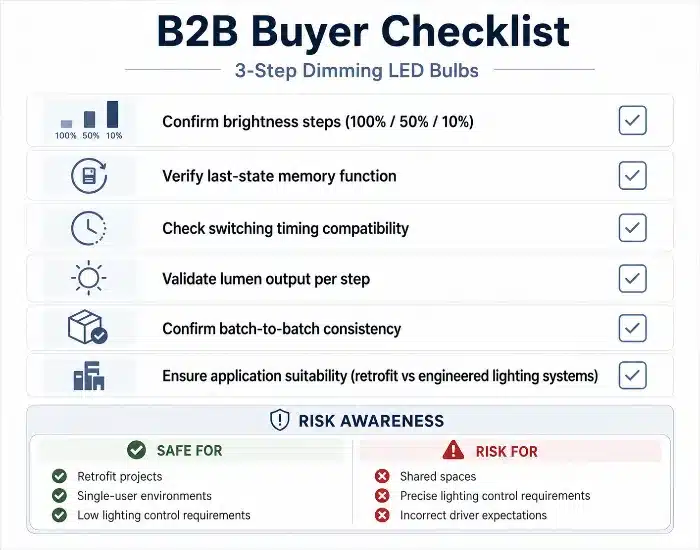
Lista di controllo per l'acquirente B2B di lampadine LED a regolazione in tre fasi
Le lampadine a regolazione in 3 step sono adatte per progetti commerciali?
Realtà in Cantiere / Commerciale
La risposta breve è: solo in scenari limitati. I progetti commerciali di solito richiedono un funzionamento prevedibile, un'esperienza utente ripetibile e bassi tassi di reclamo tra molte stanze o utenti.
Approfondimento e Soluzione Ingegneristica
Le lampadine a regolazione in tre fasi possono essere adatte in applicazioni commerciali strettamente definite:
- Le modifiche al cablaggio di retrofit non sono pratiche
- Di solito una persona controlla la lampada
- Il richiamo esatto della scena non è richiesto
- L'output preimpostato basso / medio / alto è accettabile
They are generally weak choices for:
- Shared controls
- Repeatable lighting scenes
- Centralized control systems
- Public or staff-operated areas
Nota di Fabbrica
During hotel commissioning, shared-use areas quickly reveal the weakness of timing-based control. A product may satisfy the specification sheet yet still create operational friction if brightness changes depend on how different people tap the switch.
Final Thoughts: When Should You Choose 3-Step Dimming LED Bulbs?
Realtà in Cantiere / Commerciale
This product category should be selected as a control compromise, not as a universal dimming solution.
Approfondimento e Soluzione Ingegneristica
Choose 3-step dimming LED bulbs when the project mainly needs a simple retrofit upgrade:
- Existing on/off switches must stay
- Basic stepped output is enough
- A dedicated wall dimmer is not justified
Choose a dedicated dimming system instead when user consistency, scene control, or low complaint tolerance matters.
| Caratteristica | Choose 3-Step Dimming | Choose Dedicated Dimming | Impatto sulla Manutenzione / ROI |
|---|---|---|---|
| Retrofit simplicity | Forte | Moderato | 3-step lowers initial installation cost |
| User predictability | Debole | Forte | Dedicated dimming reduces callbacks |
| Commercial scalability | Limitata | Migliore | Better long-term control consistency |
Conclusion: Business Value
Three-step dimming LED bulbs can reduce retrofit complexity and avoid the cost of replacing wall controls, but their value depends heavily on the application. In the right setting, they offer acceptable flexibility with low installation disruption. In the wrong setting, they increase user confusion, service calls, and dissatisfaction after handover.
For B2B buyers, the key business value is not the dimming feature itself. It is selecting a control method that reduces maintenance effort, limits post-installation complaints, and keeps lifetime system cost under control.
Raccomandazione di Ingegneria B2B
For 3-step dimming bulb projects, buyers should confirm the switching sequence, restart behavior, memory logic, minimum brightness level, lumen output at each step, and batch consistency before mass production. TECO’s 3-step dimming GU10 LED bulb can be considered for selected retrofit applications where normal-switch control is acceptable. The team di ingegneria TECO can support sample testing and project-specific evaluation to confirm whether this control logic is suitable for the intended application.
Note a piè di pagina
Driver: the electronic circuit inside an LED lamp that regulates current and power supplied to the LEDs. ↩
Phase-cut dimming: a mains dimming method that changes lamp power by cutting part of each AC waveform. See the DOE/PNNL report Dimming LEDs with Phase-Cut Dimmers. ↩
The U.S. DOE CALiPER report notes that LED lamp dimming performance can depend on the control device and other circuit components, especially with phase-cut dimmers. See DOE CALiPER Retail Lamps Study 3.1. ↩
CCT: correlated color temperature, the perceived warmth or coolness of white light. See IES CCT Definition. ↩
Lumen output: the total visible light emitted by a lamp. See IES Lumen Definition. For project purchasing, measured lumen output at each step is more useful than nominal wattage alone. ↩
ENERGY STAR dimming guidance discusses light output, minimum output, flicker metrics, and audible noise as dimming-performance considerations for LED lamps. See ENERGY STAR Dimming LED Lights. ↩
Triac dimming: a common phase-cut dimming method using a triac-based wall dimmer to control AC power delivery. See the DOE/PNNL report Dimming LEDs with Phase-Cut Dimmers. ↩