Perché 5000K ti aiuta a concentrarti ma 1700K ti aiuta a dormire: GU10 centrato sull'umano spiegato
Introduzione
Lighting is no longer just about brightness.
In modern homes, hotels, and hospitality spaces, people expect lighting to adapt to different moments of the day—not remain fixed from morning to night.
Yet most interiors still rely on a single GU10 color temperature:
3000K all day
4000K all day
5000K all day
The problem?
A lighting setup that works for productivity may feel uncomfortable at night. Likewise, cozy warm lighting may look relaxing in the evening but insufficient during focused daytime activities.
This creates a common frustration:
One lighting tone rarely fits every moment of daily life.
That is why Human-Centric Lighting (HCL) is becoming increasingly relevant.
Inspired by the changing rhythm of daylight, Human-Centric Lighting aims to support how people naturally live, work, relax, and sleep throughout the day.
For GU10 users, this no longer requires expensive smart systems or complex automation.
A 1700K–2600K–5000K Human-Centric GU10 bulb provides a practical alternative by allowing users to switch between different lighting experiences using a standard wall switch—while still maintaining dimming flexibility through compatible dimmers.
In this guide, we explore:
- Why 5000K helps focus
- Why 2600K supports comfort
- Why 1700K feels more sleep-friendly
- And how a Human-Centric GU10 bulb solves the limitations of traditional lighting
What Is Human-Centric Lighting?
Human-Centric Lighting refers to lighting designed to better support comfort, mood, and daily rhythms.
Rather than treating lighting purely as illumination, Human-Centric Lighting considers how light affects different activities and environments throughout the day.
In simple terms:
Cooler light → supports focus and activity
Warmer light → supports comfort and relaxation
Ultra warm light → supports evening ambience
This idea comes directly from nature.
Throughout the day, natural daylight changes continuously:
- Morning daylight feels fresh and energizing
- Midday light is bright and productive
- Evening light becomes warmer and softer
Traditional indoor lighting does not follow this rhythm.
Most GU10 bulbs provide only one fixed color temperature, forcing people to use the same lighting environment from morning until bedtime.
That may be functional.
But it is rarely ideal.
[ Circadian Lighting Explained]
Why Traditional Single-CCT GU10 Lighting Falls Short
Traditional GU10 lighting typically offers:
One bulb
One color temperature
One lighting experience
That creates limitations.
Ad esempio:
A 5000K GU10 may feel productive during daytime—but too harsh in the evening.
A 2700K GU10 may feel cozy at night—but too dim or relaxing for focused tasks.
The challenge is simple:
Daily life changes, but traditional lighting does not.
For homes and hospitality environments, this often results in compromises.
Users either:
- sacrifice comfort at night, or
- sacrifice visibility during the day.
Why Our 1700K–2600K–5000K Human-Centric GU10 Is Different
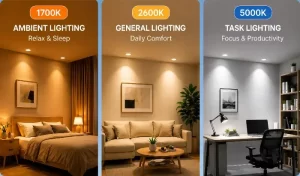
Unlike standard GU10 bulbs, a 1700K–2600K–5000K Human-Centric GU10 is designed to adapt to different moments of the day.
Instead of relying on a fixed color temperature, users can switch between:
5000K → Focus Mode
Ideale per:
✔ Work
✔ Reading
✔ Kitchens
✔ Productivity
2600K → Comfort Mode
Ideale per:
✔ Living rooms
✔ Hospitality ambience
✔ Relaxation
1700K → Sleep Mode
Ideale per:
✔ Bedrooms
✔ Evening wind-down
✔ Hotel guestrooms
Most importantly:
No smart hub, app, or complicated setup is required.
Users can simply:
✔ Switch color temperature through a regular wall switch
✔ Enjoy dimming flexibility using compatible TRIAC dimmers
✔ Retrofit directly into standard GU10 fixtures
This makes Human-Centric GU10 lighting significantly easier to adopt than many smart lighting systems.
Why 5000K Helps You Focus
During daytime hours, spaces often require lighting that feels brighter, cleaner, and more energizing.
This is where 5000K lighting becomes useful.
5000K appears closer to daylight and generally feels more visually active.
Best Applications for 5000K
- Home office
- Kitchen preparation areas
- Reading corners
- Hotel workspaces
- Vendita al dettaglio boutique
Benefits of 5000K
✔ Better visual clarity
✔ Improved concentration
✔ Cleaner visual appearance
✔ More productive atmosphere
For hospitality projects, 5000K can also enhance the perception of cleanliness and professionalism.

Why 2600K Helps You Relax
After work, people naturally shift into a more relaxed environment.
This is where 2600K lighting creates a better atmosphere.
Compared to daylight-style lighting, 2600K feels noticeably warmer and softer.
Best Applications
- Soggiorni
- Dining areas
- Camere d'albergo
- Lounge spaces
2600K helps create spaces that feel:
Warm
Comfortable
Relaxing
Inviting
For hotels and hospitality environments, this contributes to a more welcoming guest experience.

Why 1700K Supports Better Sleep
At night, harsh bright lighting often feels uncomfortable.
This is where 1700K ultra warm lighting becomes unique.
1700K creates a soft amber-like atmosphere that feels significantly gentler than standard warm white lighting.
Compared with:
5000K → bright daylight
3000K → warm white
2600K → comfort warm
1700K → ultra warm / candle-like
1700K feels:
✔ Softer
✔ More relaxing
✔ Less visually stimulating
Best Applications
- Camere da letto
- Bedside lighting
- Night lighting
- Camere d'albergo
- Wellness spaces
Instead of bright white light before sleep, 1700K creates a calmer nighttime atmosphere.

Standard GU10 vs Human-Centric GU10
| Caratteristica | Standard GU10 | Human-Centric GU10 |
|---|---|---|
| Fixed color temperature | ✔ | ❌ |
| Multiple lighting moods | ❌ | ✔ |
| Sleep-friendly lighting | Limitata | ✔ 1700K |
| Productivity lighting | Limitata | ✔ 5000K |
| Standard GU10 retrofit | ✔ | ✔ |
| Compatibilità con la regolazione | Dipende | ✔ |
Human-Centric GU10 adapts to your day—rather than forcing your day to adapt to lighting.
Best Applications for Human-Centric GU10
Residential Homes
Perfect for:
- Camere da letto
- Soggiorni
- Reading areas
Hotels & Hospitality
Supports:
- Guestroom ambience
- Wellness-focused experiences
- Flexible lighting scenes
Wellness Spaces
Ideale per:
- Boutique hotels
- Spas
- Relaxation areas
[TM-30 vs CRI Color Rendering Guide]
How to Choose the Right Human-Centric GU10
Before choosing, consider:
✔ 1700K–2600K–5000K switching options
✔ High CRI (Ra90+) for visual comfort
✔ TRIAC dimming compatibility
✔ Beam angle selection
✔ Consistent color quality
[ GU10 Dimming Compatibility Guide]
FAQ
Does Human-Centric GU10 require smart systems?
No. Color temperature can be switched using a standard wall switch.
Can Human-Centric GU10 be dimmed?
Yes, compatible TRIAC dimmers allow brightness adjustment.
Is 1700K too orange?
1700K is intentionally ultra warm and designed for relaxing environments.
Is 5000K too bright for bedrooms?
5000K is better for daytime use rather than nighttime ambience.
Conclusione
Lighting should change as daily life changes.
5000K supports focus and visibility.
2600K creates comfort.
1700K helps create a softer nighttime atmosphere.
A 1700K–2600K–5000K Human-Centric GU10 bulb provides an easy way to experience multiple lighting moods—without changing fixtures or installing complicated smart systems.
For homes, hotels, and wellness spaces, it offers a more flexible and thoughtful lighting experience.
Informazioni su Teco
Teco Lighting develops practical GU10 lighting solutions focused on comfort, dimming compatibility, and real-world usability for residential and hospitality projects.
Looking for Human-Centric GU10 lighting?
Tell us your application requirements.
We can help you with:
✔ 1700K–2600K–5000K recommendations
✔ Beam angle selection
✔ TRIAC dimming compatibility
✔ Hospitality and residential lighting solutions
Contact: [email protected]