Metriche dell'illuminazione circadiana spiegate: Lux melanopico, CS e MR
Molti progetti di illuminazione circadiana appaiono di successo sulla carta. I rapporti mostrano lux melanopici accettabili, i valori di CS rientrano negli intervalli raccomandati e le specifiche fanno riferimento agli ultimi standard.
Tuttavia, gli occupanti segnalano ancora sonno scarso, irrequietezza serale e affaticamento diurno.
Il problema raramente è il corpo illuminante stesso.
È come le metriche dell'illuminazione circadiana sono interpretate, applicate e—più spesso—abuse.
Le metriche di illuminazione circadiana descrivono il potenziale della luce biologica. Non garantiscono l'efficacia circadiana.
Questo articolo spiega quali sono le principali metriche dell'illuminazione circadiana—lux melanopici, Stimolo Circadiano (CS) e Rapporto Melanopico (MR)—misurano effettivamente, dove sono utili, dove fuorviano e come acquirenti e progettisti dovrebbero applicarle responsabilmente in progetti reali.
Perché l'illuminazione circadiana ha bisogno di metriche—ma non dovrebbe dipenderne

Confronto affiancato delle metriche tradizionali di illuminazione per il comfort visivo rispetto alle metriche di risposta circadiana, con icone di occhi e termini chiave di misurazione.
L'illuminazione circadiana è radicata nella biologia, non nel comfort visivo. Le metriche esistono perché i valori tradizionali dell'illuminazione non possono descrivere la risposta biologica.
Le metriche dell'illuminazione circadiana aiutano a quantificare l'influenza della luce biologica, ma non possono sostituire la progettazione basata sul tempo, la pianificazione spaziale o il controllo comportamentale.
Perché sono emerse le metriche circadiane
Le metriche convenzionali dell'illuminazione si concentrano sulla visione:
- lux
- lumen
- CCT
- CRI
Questi descrivono come appare la luce, non come influisce sul sistema circadiano.
La ricerca che identifica cellule gangliari retiniche intrinsecamente fotosensibili (ipRGC) ha rivelato che la risposta circadiana è particolarmente sensibile alle lunghezze d'onda corte e ai tempi.
Ciò ha creato la necessità di metriche ponderate biologicamente.
Quali metriche sono destinate a rispondere
Le metriche circadiane tentano di quantificare:
- quanto biologicamente stimolante è una sorgente luminosa
- se la luce è probabile che attivi o sopprima i segnali circadiani
- come lo spettro conta oltre la luminosità visiva
Sono strumenti analitici—non garanzie di risultato.
Perché le metriche da sole falliscono nella pratica
Le metriche fanno non tenere conto di:
- tempo di esposizione
- durata e ripetizione
- direzione di visualizzazione
- comportamento dell'utente e sovrascritture
Una luce che “soddisfa le metriche” durante il giorno può comunque disturbare il sonno se usata di notte.
Ecco perché la misurazione dell'illuminazione circadiana senza contesto temporale porta a falsa sicurezza.
Le metriche indicano potenziale, non successo
L'illuminazione circadiana funziona solo quando:
- le metriche si allineano con il tempo
- il tempo si allinea con la biologia
- il comportamento rafforza il sistema
Le metriche da sole non possono imporre quella catena.
Cos'è il Lux Melanopico—e Come Dovrebbe Essere Interpretato
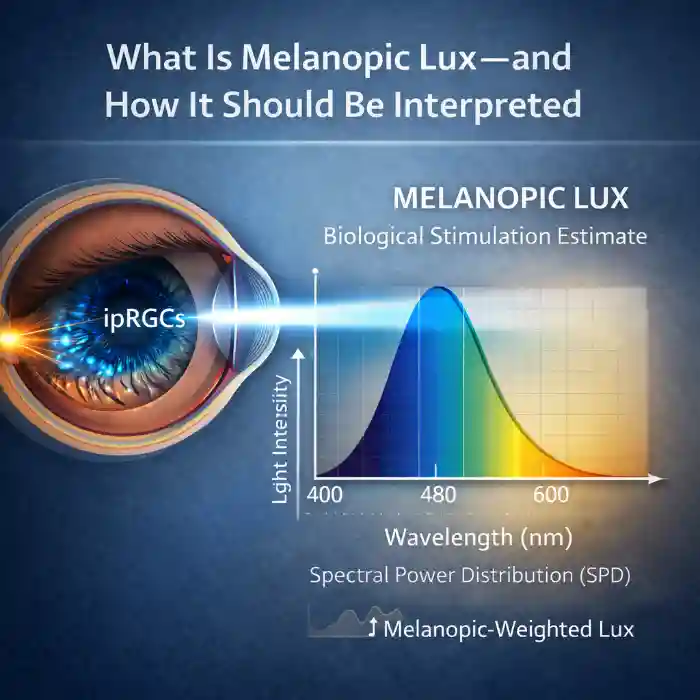
Diagramma educativo che spiega il lux melanopico, con un modello di occhio con ipRGC e un grafico di distribuzione spettrale di potenza per l'interpretazione della luce biologica.
Il lux melanopico è ampiamente citato, spesso frainteso e frequentemente applicato in modo errato.
Il lux melanopico misura la stimolazione biologica delle cellule retiniche contenenti melanopsina, non la luminosità visiva o il comfort.
Cosa misura effettivamente il lux melanopico
Melanopic lux is calculated by weighting light intensity according to the melanopsin action spectrum, based on the spectral power distribution (SPD) of the source.
It estimates potential circadian activation strength.
Where melanopic lux is useful
Melanopic lux is best used for:
- daytime circadian stimulation assessment
- comparing biological impact between spectra
- evaluating morning and workday lighting strategies
In these contexts, higher melanopic values often support alertness and circadian entrainment.
What melanopic lux does not tell you
Melanopic lux does non indicate:
- whether light is appropriate at night
- whether exposure duration is sufficient
- whether light reaches the eyes vertically
A high melanopic lux value at 22:00 is not beneficial—it is biologically disruptive.
The most common misuse
Many projects chase melanopic targets without asking a simple question:
When will this light be used?
Melanopic lux has no built-in time logic.
Time determines whether the signal helps or harms.
Proper interpretation boundary
- Daytime: melanopic lux can be a design target
- Nighttime: melanopic lux is a warning indicator
Used outside its intended time window, melanopic lux becomes misleading.
Circadian Stimulus (CS): Strengths and Practical Limitations
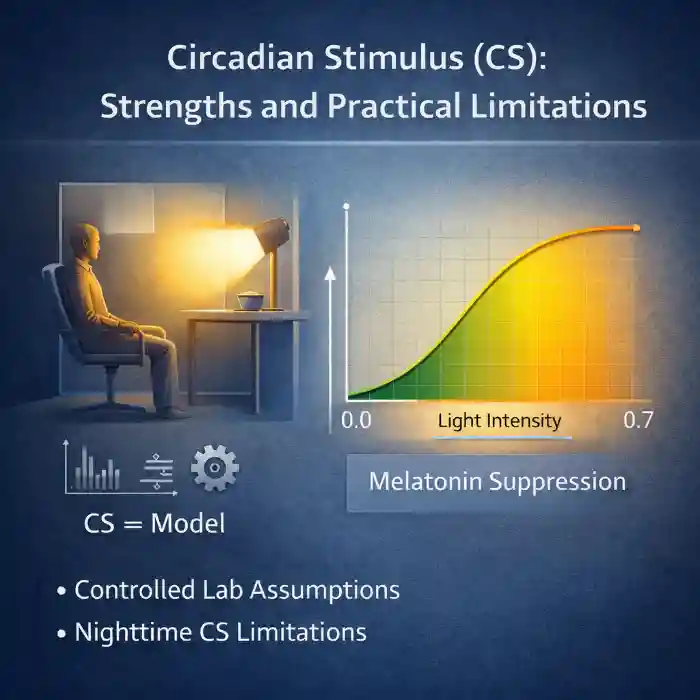
Presentation slide illustrating the strengths and limitations of the Circadian Stimulus (CS) model, featuring a melatonin suppression graph and a controlled nighttime laboratory lighting scenario.
Circadian Stimulus (CS) was developed to link light exposure more directly to melatonin suppression.
CS attempts to model circadian effectiveness, but only under specific assumptions.
What CS represents
CS estimates the likelihood of melatonin suppression based on:
- spectrum
- intensity
- retinal response modeling
It is expressed on a relative scale (approximately 0.0–0.7).
Where CS performs well
CS is useful for:
- comparative daytime lighting evaluation
- office and educational environments
- research-aligned design validation
It offers a biologically anchored framework when assumptions are respected.
Key limitations of CS
CS is derived from controlled laboratory conditions and assumes:
- fixed exposure duration
- frontal eye exposure
- stable viewing geometry
Real environments rarely meet these conditions.
CS and nighttime misapplication
CS was not designed as a nighttime safety metric.
Low CS values do not guarantee:
- sleep protection
- melatonin preservation
At night, even low-CS white light can still disrupt circadian rhythm.
Responsible CS use
CS should be treated as:
- a relative daytime comparison tool
- not a universal pass/fail threshold
It supports analysis—it does not replace design judgment.
Melanopic Ratio (MR): What It Tells You—and What It Cannot
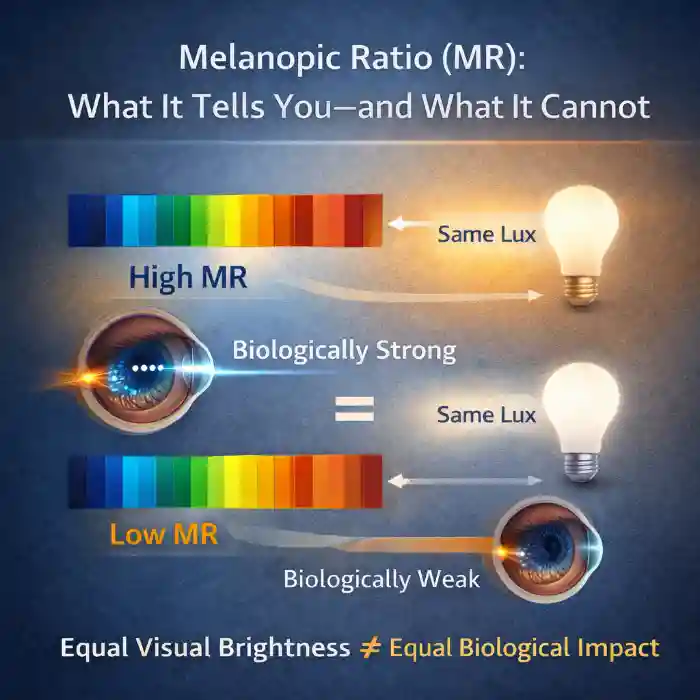
Visual explanation of melanopic ratio (MR), illustrating how light with a higher MR delivers stronger biological stimulation while lower MR light remains biologically weaker, even at the same visual lux level.
Melanopic Ratio (MR) compares biological stimulation to visual brightness.
MR describes how melanopically active a spectrum is per unit of visual lux.
Why MR is useful
MR helps designers:
- compare spectra independently of brightness
- identify blue-heavy or biologically intense white light
- evaluate reduction strategies in evening lighting
What MR cannot determine
MR does non indicate:
- correct timing
- safe nighttime use
- adequate or excessive intensity
A low MR light at high lux can still overstimulate the circadian system.
Common MR misunderstanding
Marketing claims often imply:
“Low MR = circadian safe.”
This ignores timing.
At night, the issue is not MR—it is white light itself.
Correct MR boundary
MR is meaningful when:
- comparing spectra within the same time phase
- supporting evening reduction strategies
It does not replace night-safe spectral selection.
Why Time Changes the Meaning of Every Metric

Graphic illustrating how time of day affects lighting metrics for circadian health, highlighting higher stimulation benefits during daytime hours and reduced biological risk during nighttime with color-coded evaluations.
Circadian lighting metrics change meaning entirely depending on when light is used.
The same metric value can represent success during the day and failure at night.
Daytime interpretation
During the day:
- higher melanopic stimulation supports alertness
- CS can guide activation strategies
- MR helps compare biological efficiency
Metrics act as targets.
Nighttime interpretation
At night:
- any melanopic stimulation is undesirable
- CS should approach zero
- MR becomes irrelevant if white light is avoided
Metrics act as risk indicators, not goals.
A clear design rule
| Time Phase | Metric Role |
|---|---|
| Mattina | Target stimulation |
| Pomeriggio | Maintain stability |
| Sera | Reduce stimulation |
| Notte | Avoid stimulation entirely |
Applying daytime targets at night is the most common cause of circadian failure.
Common Metric Misuses in Real Projects
Most circadian failures come from predictable mistakes.
Circadian lighting metrics fail when treated as certifications instead of analytical tools.
Common misuses include:
- relying on a single number for validation
- ignoring vertical eye exposure
- applying lab thresholds to living spaces
- optimizing daytime metrics without a night strategy
- assuming automation replaces biology
Metrics without behavioral control remain theoretical.
How Buyers and Designers Should Use Circadian Metrics Responsibly
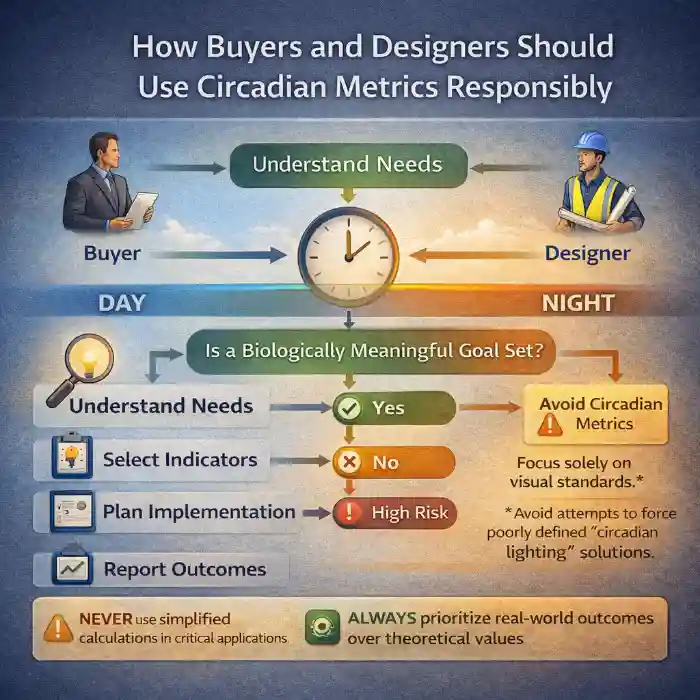
Visual guide showing a decision flowchart for buyers and designers to use circadian metrics responsibly, focusing on needs assessment and risk avoidance in lighting design.
Metrics should support decisions—not replace them.
Responsible circadian lighting design integrates metrics, timing logic, spatial design, and user behavior.
Practical guidance
- Use metrics comparatively, not absolutely
- Always define time context
- Combine metrics with design intent
- Treat metrics as risk-management tools
Better buyer questions include:
- When is this light used?
- How long is exposure?
- Where does the light reach the eye?
- What happens at night?
Metrics inform. Design decides. Behavior completes.
Conclusione
Circadian lighting metrics—melanopic lux, CS, and MR—are valuable analytical tools, but only when applied with time awareness, biological understanding, and realistic project context.
Used without these constraints, metrics create false confidence and real-world failure.
Teco supports B2B buyers and designers applying circadian lighting metrics responsibly in hospitality, residential, and commercial projects.
We help with:
- interpreting melanopic lux, CS, and MR in real environments
- aligning biological metrics with practical fixture choices
- avoiding metric-driven but biologically weak designs
Our focus is not selling numbers, but delivering lighting that works in real life.
Email: [email protected]
Sito web: www.tecolite.com
Tell us which metrics you are evaluating and in what context.
We help you understand what they mean—and what they do not.