COB vs. SMD LEDs Explained: Which Is Right for Your Lighting Business?
Введение
In the lighting and LED component world, two terms come up again and again: COB (Chip-on-Board) и SMD (Surface-Mounted Device). For manufacturers, system integrators, lighting-OEMs and large-scale specifiers, the choice between them isn’t just academic — it influences cost, reliability, optical quality, supply-chain risk and ultimately customer satisfaction.
Over the years, both technologies have matured, yet each has distinct strengths and operational trade-offs. In this article we’ll dig beyond the buzzwords, compare technical and business-critical parameters side by side, and show how you might choose the right technology for your specific lighting or display application.
What exactly are “SMD” and “COB”?
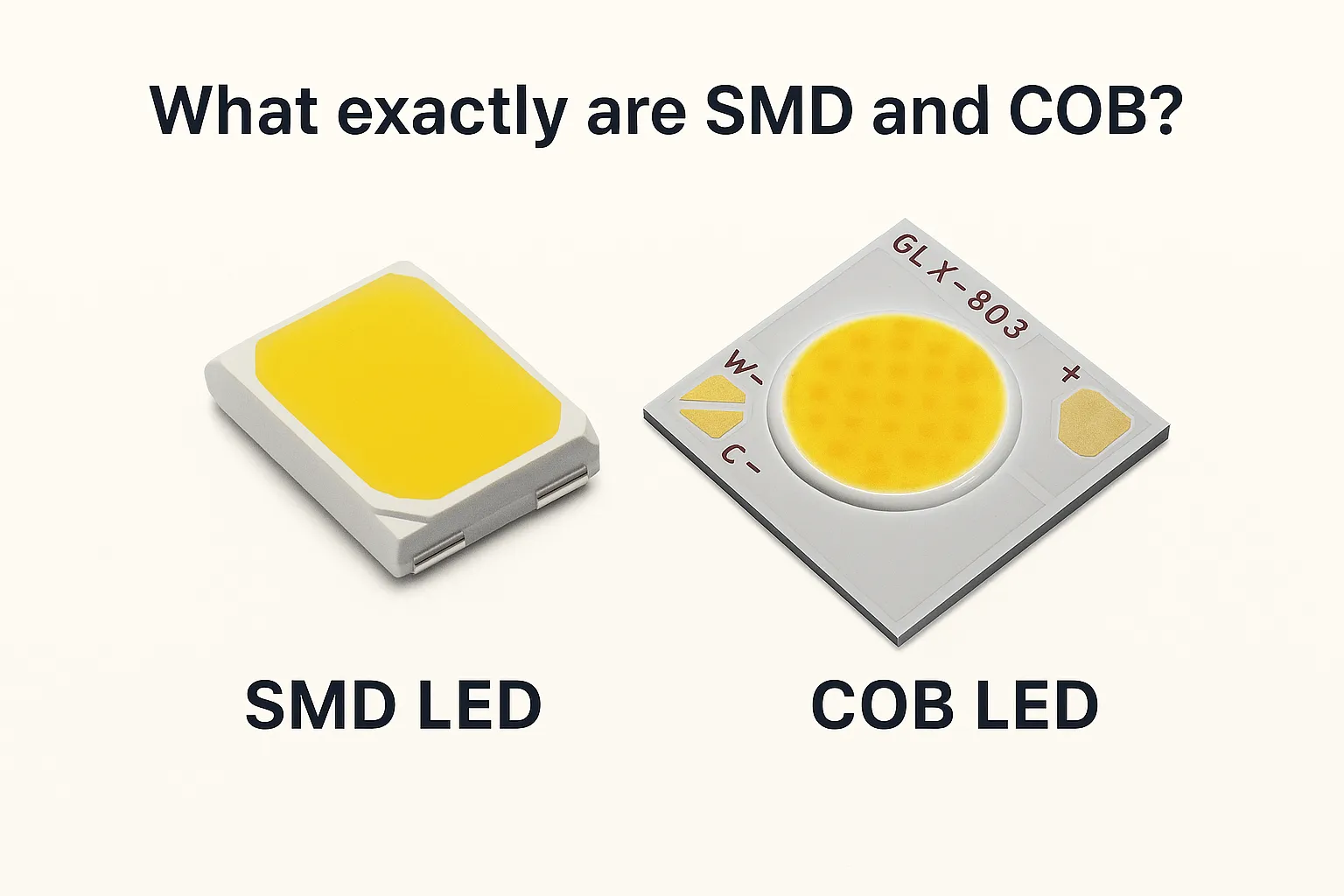
Before diving into comparisons, it helps to clarify the definitions.
- SMD (Surface-Mounted Device): In this design, individual LED chips (die) are packaged (typically with lens or epoxy), then mounted via surface-mount technology on a printed circuit board (PCB). Each LED or group of LEDs is fairly independent. ([Encore Lighting][1])
- COB (Chip-on-Board): Multiple bare LED die are directly attached (die-bonded) onto a single substrate (often aluminium or ceramic), covered with a phosphor or resin, forming a unified “light-emitting surface”. The term emphasises integration of many chips in one module. ([维基百科][2])
In plainer terms: imagine SMD as many “point-lights” placed on a board, whereas COB is more like a “flat panel” of light built from many chips tightly integrated. That structural difference leads to many downstream performance, manufacturing and cost impacts.
Key Technical & Business Metrics – Side-by-Side

Here’s a table summarising how SMD and COB compare on important metrics from both engineering and business viewpoints:
| Метрика | SMD LED | COB LED |
|---|---|---|
| Source architecture | Individual packaged LEDs mounted on board | Many bare chips bonded on substrate as one module |
| Light-emitting appearance | Many discrete points of light; may require diffuser for uniformity ([reversepcb.com][3]) | A continuous surface of light with minimal visible separation between chips ([dicolorled.com][4]) |
| Thermal path / heat dissipation | Heat must travel from each chip via package, solder, PCB trace → higher thermal resistance in some cases ([ledsino.com][5]) | Shorter heat path: chip to substrate, fewer interconnect layers → better thermal efficiency ([ledialighting.com][6]) |
| Uniformity of light / visual effect | Potential for “dot-effect” (visible LED points) especially in lower-cost designs or close-view applications ([Linsn LED][7]) | Better uniformity, fewer visual discontinuities, more suitable for premium or near-view applications ([onedisplaygroup.com][8]) |
| Flexibility / modularity | Highly modular: since each LED is discrete, repairs or replacements can be done at component level | Less modular: the module is highly integrated so if part fails replacement may require the entire module rather than individual chips ([en.kinglight.com][9]) |
| Cost structure (initial + lifecycle) | Typically lower initial component cost; mature supply chain; easy to scale volumes | Higher upfront cost (materials + integration) but may yield lower lifecycle cost (maintenance, reliability) in high-demand applications ([besenledlight.com][10]) |
| Typical applications | Decorative lighting, LED strips, general illumination, longer viewing-distance displays | High-power downlights, track lights, architectural lighting, fine-pitch displays, high-end installations |
| Suitability for fine pitch displays | Recent SMD variants support very fine pitches, but historically less suited for ultra-close-view ultra-fine pixel spacing ([OBOdisplay][11]) | Excellent for ultra-fine pitches, seamless surface, premium indoor display installations ([dicolorled.com][4]) |
Why these differences matter – from a B2B perspective

Let’s break down how the differences translate into decision-making criteria for business customers and project planners.
Longevity, serviceability and total cost of ownership (TCO)
From a B2B viewpoint, it’s rarely just about upfront cost. Maintenance intervals, failure rates, serviceability and lifetime energy use matter.
- COB’s tighter integration and superior thermal path often mean less thermal stress and potentially longer life under high-power or continuous-use conditions. ([Encore Lighting][1])
- On the flip side, SMD’s modularity means when a component fails, replacement might cost less (you may replace a board or even one LED) rather than the whole module — important in environments where service accessibility is key.
Performance and visual quality
In many applications (retail showrooms, architectural lighting, control-rooms, high-end displays) visual quality is a differentiator: uniformity, colour rendering, absence of “spots” or shadows, minimal glare.
- COB excels for “premium look” use-cases.
- SMD remains highly capable, especially when cost and flexibility are key.
Manufacturing, supply chain and scalability
If you’re specifying for a product you’ll manufacture or source at scale:
- SMD technology enjoys a large mature ecosystem: many suppliers, standard packages, high automation.
- COB may require more specialised materials, die-bonding processes, tighter tolerances — which may impact lead-times, minimum orders or cost flexibility.
Matching technology to the application
Choosing the wrong technology can lead to compromises: e.g., using SMD in an ultra-fine pitch display and finding visible LED dots, or using COB in a low-budget decorative strip and paying a price premium for no added value. So aligning technology to application context matters.
Deeper Dive: Technical Considerations Worth Knowing

Thermal management and impact on reliability
Heat remains the enemy of long-life LEDs. As one article notes: “COB LEDs … excel in heat dissipation because their chips share a single, larger thermal base.” ([ledialighting.com][6]) From a project risk standpoint: if you’re designing high-power luminaires (e.g., > 30 W, downlights, floodlights) where ambient temperature is elevated or ventilation limited, COB may reduce thermal risk and hence service calls / failures.
Uniformity, viewing distance & pixel pitch
In display / signage applications, pixel pitch (distance between LED centres) and viewing distance matter greatly. COB technology’s capability for ultra-fine pitch (< P1.0 mm) makes it well-suited for close-view high-resolution installations. ([dicolorled.com][4]) By contrast, SMD is often perfectly adequate for general-purpose signage where viewing distance is more forgiving — and with cost+maintenance advantages.
Optical design & visual experience
From colour rendering, glare control and aesthetic quality:
- With SMD, because each LED is discrete, you may need additional diffusers or optics to smooth light output and avoid visible “spots”. ([ledialighting.com][6])
- COB by contrast produces more continuous light surfaces, which helps applications like cove lighting, architectural lighting, studio lighting or premium retail environments.
Cost – not just upfront but lifecycle
One often-ignored dimension: although COB modules may cost more upfront, their longer life, fewer maintenance interventions and potentially lower warranty exposure may yield better total cost of ownership. Conversely, SMD’s lower cost and greater flexibility in repair might make it better for large-volume general lighting where service access is easier and cost pressure is high.
Flexibility, colour control and design freedom
SMD really shines when you need dynamic lighting: RGB, individually addressable LEDs, complex shapes or strips, retrofit modules. Because you’re working with discrete LEDs mounted on a board, there is design freedom. COB tends to focus on single white light (or simpler colour mixing) in a dense module — less flexibility but higher integrated performance in its niche.
Application-focused decision guide
Here’s a handy guide for B2B decision-makers and specifiers — which technology to pick under what circumstances:
| Situation | Best technology choice | Почему |
|---|---|---|
| High-end commercial lighting (luxury retail, hotel lobbies) where visual uniformity & minimal spots matter | COB | Delivers premium surface illumination, smooth quality |
| Industrial high-bay/warehouse lighting needing high lumen output and long maintenance intervals | COB | Efficient thermal path, robust module, fewer failures |
| LED strips, accent lighting, decorative lighting, colour-changing lighting | SMD | Flexible, modular, cost-effective |
| Large-scale outdoor signage or displays with moderate resolution and easy service access | SMD | Mature, cost-efficient, easy to repair |
| Ultra-fine pitch video walls, control rooms, film studios where close-view and seamlessness matter | COB | Supports ultra-fine pitch, excellent uniformity |
| Budget-conscious retrofit white lighting for general illumination where granularity of light is less critical | SMD | Lower initial cost, suitable performance |
Emerging Trends & Things to Watch
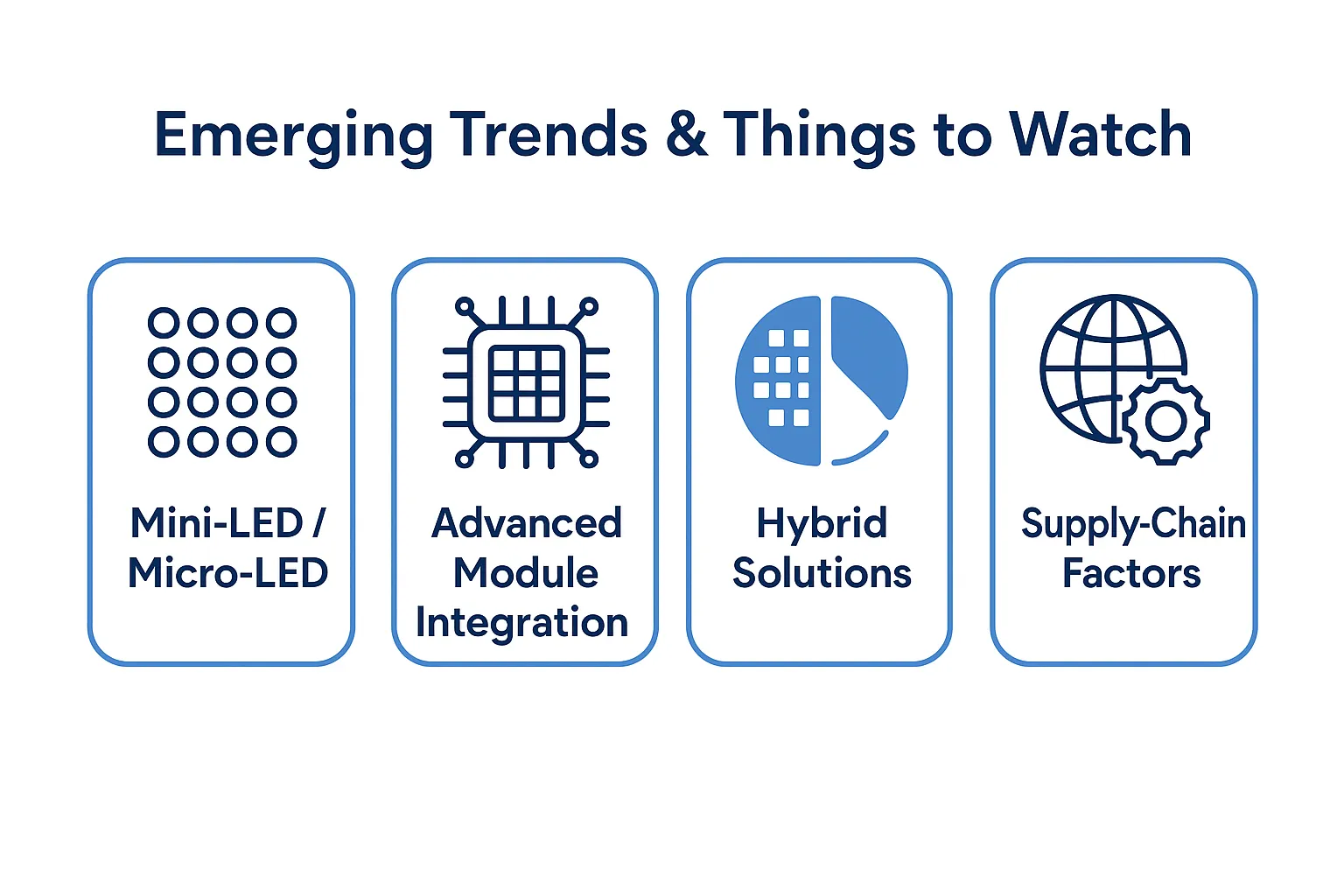
Looking ahead, the lines between SMD and COB are blurring in some ways, and new packaging and hybrid approaches are emerging:
- Mini-LED / Micro-LED: These are tightly packed SMD / CSP (Chip Scale Package) variants pushing resolution and density. The supply-chain for ultra-fine pitch displays is evolving. ([en.kinglight.com][9])
- COB on substrate / advanced module integration: Some manufacturers are applying even stricter integration and thermal management to COB modules — further raising performance but also raising supply chain complexity.
- Hybrid solutions: In some systems you’ll see a mix of COB for high-intensity zones + SMD for accent or colour zones — giving system integrators flexibility and differentiation.
- Supply-chain / geopolitical factors: Because COB tends to be less commoditised than SMD, lead-times, minimum order quantities and quality variability may matter more.
- Sustainability & lifecycle considerations: As customers demand lower total cost of ownership, longer lifetime, lower warranty exposures — thermal performance, ease of service and module replaceability will become increasingly key decision criteria.
Strategic Advice for B2B Buyers and Specifiers
Here are practical, actionable steps for B2B stakeholders (manufacturers, OEMs, specifiers, procurement) who are deciding on LED technologies:
- Start with the application scenario — define viewing distance, mounting environment (ambient temperature, ventilation), serviceability, aesthetic requirement, expected lifetime and budget.
- Define lifecycle cost, not just purchase price — ask: what are maintenance intervals, failure rate history, availability of replacement parts, upgrade path?
- Engage with your supplier on thermal performance, binning and colour consistency — ask for test data, real-world use case references and warranty terms.
- Evaluate modularity and serviceability — if replacement access is difficult (e.g., high ceiling, façade lighting), a more robust module (COB) might offset higher cost. If maintenance is easy and modular replacement desirable, SMD may be better.
- Align supply-chain and procurement risk — SMD supply chains are mature; COB may require fewer suppliers or more custom processing — factor in lead-time risk, MOQ, quality control.
- Stay flexible and future-aware — technology evolves (e.g., micro-LED, CSP), so avoid being locked into a single approach for all applications; consider building a portfolio where both SMD and COB solutions coexist.
- Focus on total system integration — the LED package is only part of the story: optics, driver electronics, thermal management, mechanical design all matter. A great LED package poorly integrated yields poor results.
Заключение
The debate between COB and SMD isn’t about declaring a winner — it’s about matching the right technology to the right purpose. Both have matured into powerful solutions that serve different needs across lighting, display, and industrial sectors.
- COB LEDs shine when you need high brightness, excellent color rendering, and long-term reliability. They’re ideal for professional-grade products, high-end commercial installations, and industrial environments where performance and stability drive value.
- SMD LEDs, on the other hand, offer unmatched flexibility, modularity, and scalability. For products where cost efficiency, design variety, or dynamic color control are priorities, SMD remains a smart, dependable choice.
Ultimately, the winning strategy for any business is to evaluate total lifecycle value, not just unit cost. The most competitive lighting brands and OEMs today are those that can intelligently combine COB and SMD technologies in a diversified portfolio — optimizing performance, cost, and user experience in each market segment.
Ready to Take the Next Step?
If your organization is exploring LED integration, upgrading product lines, or seeking OEM/ODM support:
- Let our team help you evaluate the right technology mix for your application — from optical simulation to thermal design and full module customization.
- Request a free consultation или sample comparison kit to see how COB and SMD differ in real-world performance.
- Contact us today at [📧 [email protected]]or visit www.tecolite.com to start your next lighting innovation project.