
Аккумуляторная светодиодная лампа GU10 для аварийного освещения в коммерческих проектах
Введение
A GU10 rechargeable LED bulb is not simply a standard spotlight with a battery added inside. In commercial projects, it solves a specific problem: how to maintain basic lighting when mains power is interrupted, without redesigning the entire ceiling layout or adding a separate emergency luminaire in every small area.
The TECO GU10 Rechargeable LED Bulb 4W Dimmable Emergency Light is designed for hotels, corridors, guest rooms, retail areas, service zones, and commercial interiors where uninterrupted light matters during power failure. It works as a normal GU10 LED spotlight under mains supply, while its integrated lithium-ion battery provides emergency output when power is cut.
For B2B buyers, the value is project simplification: one GU10 form factor, normal lighting output, emergency backup, dimming compatibility, and transport documentation in a compact product package.
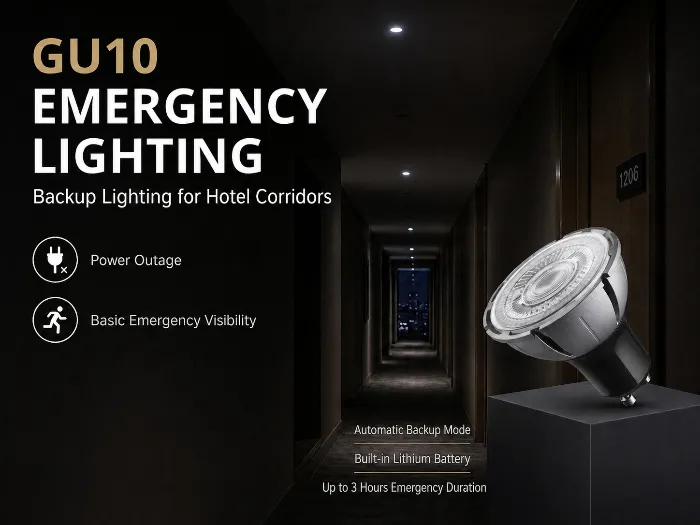
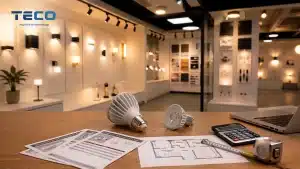
emergency lighting retrofit for hotel corridor with GU10 rechargeable LED bulb
Why Rechargeable GU10 LED Bulbs Matter in Commercial Retrofit Projects
In many retrofit projects, emergency lighting is difficult to add cleanly after the ceiling design has already been fixed. Hotels, corridors, apartments, small retail stores, and hospitality interiors may already use GU10 downlights or spotlights. Adding separate emergency luminaires can increase wiring work, ceiling modification, visual clutter, and approval complexity.
A rechargeable GU10 LED bulb offers another route: backup lighting inside a familiar GU10 lamp format, reducing extra components in selected areas.
The TECO model is rated at 4W in normal lighting mode and 0.5W in emergency mode. This distinction is important. During normal operation, the product functions as a compact LED spotlight. During emergency operation, the goal is not to maintain full decorative lighting brightness, but to provide enough backup illumination for orientation and safety support during a power outage.
Typical applications include hotel guest rooms, corridors, serviced apartments, small commercial interiors, retail circulation areas, and selected GU10 backup points.
When mains power is available, the lamp works as part of the normal lighting system. When power is cut, the integrated battery provides emergency light for up to 3 hours at room temperature, according to the product specification.1
This makes the product useful where a project needs backup lighting at selected GU10 points without changing the entire fixture family.
Key Product Specifications for Project Buyers
The TECO GU10 rechargeable LED bulb is built around a practical commercial specification: normal lighting, emergency operation, dimming support, and shipping safety documentation.
Key specifications include:
| Item | Спецификация |
|---|---|
| Model | TGU10AVD-4W-XDEMGY |
| Normal Power | 4W |
| Emergency Power | 0.5W |
| Световой поток | 350лм / 380лм / 425лм |
| CCT Options | 2700K / 3000K / 4000K |
| CRI | Ra80 |
| Однородность цвета | 5-step MacAdam ellipse |
| Входное напряжение | 220-240Vac, 50-60Hz |
| Коэффициент мощности | 0.8 |
| Продолжительность аварийной работы | 3 hours at room temperature |
| Совместимость с регулировкой яркости | Leading-edge and trailing-edge |
| Габариты | 50 мм x 56 мм |
| Certifications / Documents | IEC 60598, ISO 30061, UN38.3, MSDS |
For importers and distributors, three details matter. The 220-240Vac input makes this a mains-voltage GU10 product, not a 12V MR16 retrofit lamp. The integrated lithium-ion battery means buyers should check shipping documentation as well as lighting performance; the product page lists UN38.3 certification and MSDS.2 The 5-step MacAdam color consistency also helps control visible color variation in repeated hotel or corridor installations.
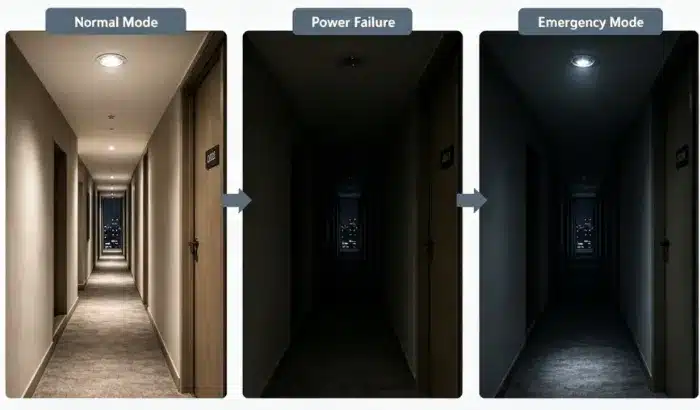
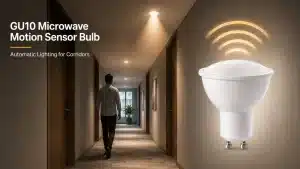
normal mode power failure emergency mode GU10 rechargeable LED bulb
Emergency Mode, Battery Management, and Dimming Compatibility
The strongest feature of this product is the combination of emergency backup and dimmable GU10 operation. Many emergency products are treated as separate safety devices, while many GU10 lamps are treated as decorative or functional spotlights. This product sits between the two categories.
The integrated lithium-ion battery allows the lamp to provide emergency lighting when mains power is interrupted. The product also includes battery charge management through an internal IC, designed to support battery lifetime and controlled charging behavior. According to the product page, battery capacity indication is provided through a red blinking LED.
Battery behavior should not be left to a simple uncontrolled charging circuit. Poor management can lead to inconsistent emergency performance, shorter service life, or unreliable backup behavior after long periods of normal operation.
The product also supports leading-edge and trailing-edge dimming compatibility. This is useful in retrofit projects where GU10 lighting may already be connected to wall dimmers. However, project buyers should still treat dimming as a system issue. A dimmable lamp does not guarantee perfect behavior with every dimmer in the market.3
Before bulk approval, buyers should confirm:
- dimmer type used on site
- number of lamps per dimming circuit
- low-end dimming behavior
- emergency-mode behavior after mains loss
- charging status after long operation
- whether the installation uses enclosed or restricted fixtures
These checks are important in hotels and commercial interiors, where one failed dimming circuit can affect many rooms or repeated ceiling points. Normal lighting mode and emergency mode should be tested separately during sample approval.
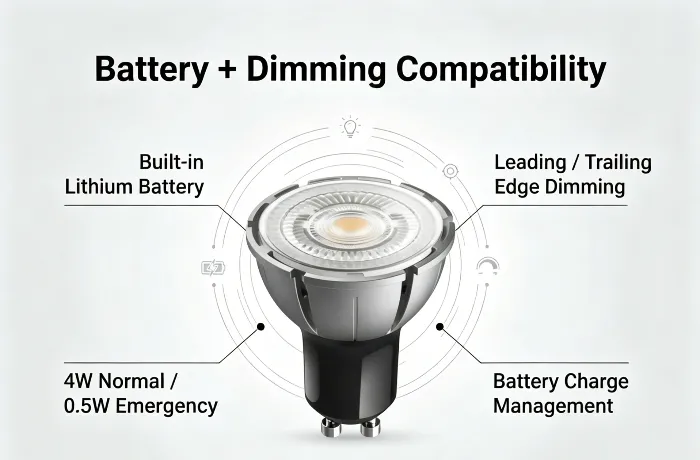
GU10 rechargeable emergency LED bulb battery and dimming compatibility
Rechargeable GU10 vs Traditional Emergency Lighting Systems
A rechargeable GU10 bulb should not be evaluated in the same way as a dedicated emergency luminaire. The two approaches solve different project problems.
Traditional emergency lighting systems are usually better for code-defined escape routes, centralized monitoring, large public buildings, and projects requiring dedicated emergency fixtures.4 A rechargeable GU10 bulb is more useful where selected existing GU10 points need backup illumination with minimal ceiling changes.
| Option | Best Fit | Main Advantage | Main Limitation |
|---|---|---|---|
| Rechargeable GU10 bulb | Selected retrofit points, rooms, corridors, small commercial zones | Uses existing GU10 format and reduces extra fixture work | Not a universal replacement for code-required emergency systems |
| Dedicated emergency luminaire | Escape routes, public buildings, regulated emergency layouts | Purpose-built emergency function and easier compliance review | Requires separate fixture position, wiring, or visual integration |
| Centralized emergency system | Large buildings and managed facilities | Central control and maintenance | Higher design and installation complexity |
For project buyers, the decision should be based on the role of the light point. If the goal is discreet backup lighting in an existing GU10 layout, a rechargeable GU10 can be practical. If the goal is formal emergency route compliance, local regulations and dedicated emergency systems still need to be reviewed.
Where This GU10 Emergency Bulb Fits Best
This product is not meant to replace every type of emergency lighting system. Large buildings may still require dedicated emergency luminaires, centralized systems, signage, battery packs, or code-specific emergency lighting layouts depending on local regulations. The strength of this GU10 rechargeable LED bulb is in selected retrofit and distributed-lighting scenarios.
It fits best where the project already uses GU10 lamps and needs additional emergency support without major redesign.
Good-fit applications include hotel guest rooms, corridors with existing GU10 fixtures, serviced apartments, small retail stores, discreet commercial rooms, and retrofit projects where ceiling rewiring is difficult or expensive.
Less suitable applications include high-ceiling industrial spaces, outdoor wet-location use unless the fixture system is approved, projects requiring centralized emergency monitoring, code-required dedicated emergency luminaires, and very high-output emergency zones.
This distinction is important. A rechargeable GU10 bulb is a practical project tool, not a universal emergency lighting replacement. Before bulk order, emergency duration, dimming performance, heat behavior, and visual output should be reviewed in the actual fixture and ceiling condition.
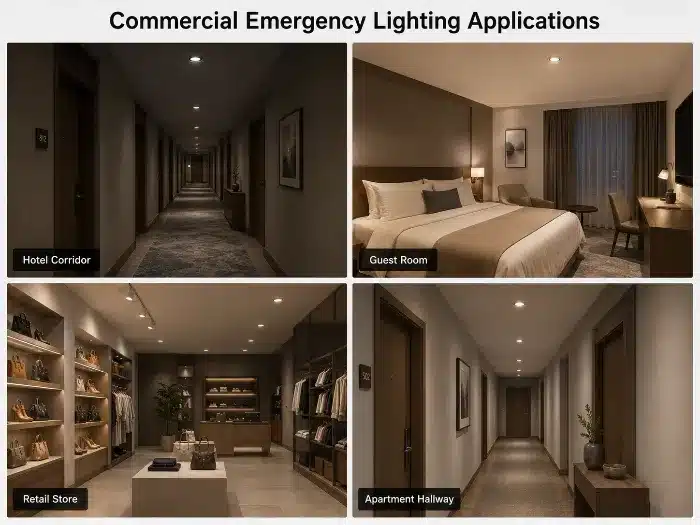
GU10 rechargeable emergency bulb applications in hotel apartment retail
Procurement Checklist Before Bulk Order
For importers, distributors, contractors, and project buyers, this type of product should be evaluated through both lighting and emergency-operation checks.
A practical pre-order checklist should include:
| Checkpoint | What to Confirm |
|---|---|
| Напряжение | Site uses 220-240Vac GU10 mains input |
| Fixture Fit | GU10 socket and available space support 50mm x 56mm lamp dimensions |
| Normal Output | 350lm / 380lm / 425lm option matches project brightness target |
| CCT | 2700K, 3000K, or 4000K fits the room atmosphere |
| Продолжительность аварийной работы | 3-hour backup meets project requirement at room temperature |
| Затемнение | Leading-edge or trailing-edge dimmer compatibility is tested |
| Battery Documentation | UN38.3 and MSDS are available for shipping |
| Однородность цвета | 5-step MacAdam is acceptable for repeated installations |
| Compliance Review | IEC 60598 / ISO 30061 references match buyer requirements5 |
| Maintenance Plan | Battery and lamp replacement policy is understood |
The most common mistake is treating a rechargeable GU10 lamp like a normal LED spotlight. It should be checked as a dual-function product: normal lighting plus emergency backup.
For hotel renovation projects, commercial retrofit programs, or emergency GU10 distribution plans, contact TECO for sample testing, dimming compatibility discussion, OEM cooperation, and bulk order evaluation. Buyers should share the fixture type, dimmer model, target CCT, required quantity, and emergency lighting expectation before final approval.
Заключение
The TECO GU10 Rechargeable LED Bulb 4W Dimmable Emergency Light is a compact solution for projects that need normal GU10 lighting with integrated emergency backup. For B2B buyers, it should be evaluated not only as a lamp, but as a small emergency lighting system inside a GU10 format. The best results come from sample testing, dimmer verification, fixture fit review, and emergency-mode confirmation before bulk purchase.
Сноски
Emergency duration should always be evaluated against the project requirement, battery condition, ambient temperature, charging state, and local emergency-lighting rules. UK emergency-lighting guidance, for example, commonly distinguishes 1-hour and 3-hour backup durations depending on evacuation and re-occupation strategy. See IHEEM / BS 5266-1 Emergency Lighting Pocket Guide. ↩
Lithium battery shipping documentation matters because lithium cells and batteries are subject to UN Manual of Tests and Criteria sub-section 38.3. PHMSA notes that lithium batteries must be subjected to design tests under UN 38.3 and provides guidance on lithium battery test summaries. See PHMSA Lithium Battery Test Summaries и UNECE UN Manual of Tests and Criteria. ↩
Phase-cut LED dimming should be treated as a compatibility issue between lamp, driver, dimmer, and connected load. PNNL’s DOE GATEWAY report explains why compatibility between a specific LED source and phase-cut dimmer can be difficult to assess without testing. See PNNL: Dimming LEDs with Phase-Cut Dimmers. ↩
Dedicated emergency lighting systems may be required for escape routes, public buildings, signage, high-risk task areas, or local compliance needs. Product selection should therefore be reviewed against local codes and emergency-lighting design requirements rather than treated as a universal lamp substitution. ↩
IEC 60598-1 defines general requirements and tests for luminaires, while IEC 60598-2-22 covers particular requirements for emergency lighting luminaires. See IEC 60598-1:2024 and the IEC 60598-2-22 preview from VDE Verlag. ↩
 English
 French
 German
 Italian
 Spanish
 Portuguese
 Arabic
 Russian
 Japanese
 Chinese