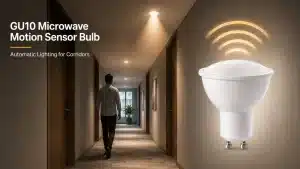
Роль умного освещения в циркадных системах
Many circadian lighting projects fail not because the luminaires are incorrect, but because lighting behavior is inconsistent once the system is in use.
Lights are switched manually, scenes are ignored, and timing drifts day after day—especially in hotels, offices, healthcare facilities, and shared residential projects.
Smart lighting in circadian systems exists to solve one core problem: human behavior is inconsistent, but circadian biology is not.
This article explains what circadian lighting actually requires to function, what smart lighting truly adds, where automation becomes critical, and how B2B buyers should decide whether smart lighting is essential or optional in real-world circadian applications.
What Circadian Lighting Requires to Function Properly

Diagram illustrating the essential elements of effective circadian lighting—spectrum, timing, intensity, and duration—aligned with human biological rhythms.
Circadian lighting is often mistaken for tunable white or warm lighting. In practice, it has much stricter biological requirements.
Circadian lighting functions only when spectrum, timing, intensity, and duration align consistently with human biological rhythms.
If any one of these factors is uncontrolled, the circadian signal weakens or collapses.
Non-negotiable biological requirements
A functional circadian lighting system requires:
| Требование | Why It Matters |
|---|---|
| Appropriate spectrum | Triggers or avoids biological response |
| Correct timing | Aligns with the internal circadian clock |
| Sufficient intensity | Ensures adequate circadian stimulus |
| Consistent duration | Prevents conflicting signals |
| Daily repeatability | Reinforces rhythm over time |
Adjusting color temperature alone does not meet these requirements.
Consistency matters more than precision
Circadian systems do not require minute-level accuracy.
They require repeatable daily patterns.
The human body responds primarily to:
- reliable morning stimulation
- predictable evening reduction
- consistent night-time protection
When lighting schedules drift randomly, circadian signaling degrades—even if the luminaires themselves are biologically appropriate.
Why manual control undermines circadian intent
Manual circadian systems rely on:
- user awareness
- discipline
- correct daily behavior
На практике:
- homeowners forget
- hotel guests ignore instructions
- office staff override settings
- facility managers prioritize convenience
As a result, biologically correct lighting designs fail in daily operation.
Circadian lighting is a system, not a feature
Circadian lighting success depends on how light is used over time, not just on the fixture specification.
Without behavioral consistency, even well-designed circadian luminaires underperform.
What Smart Lighting Adds—and What It Does Not

Infographic comparing smart lighting control features, such as scheduling and automation, with circadian lighting requirements focused on spectrum and intensity synchronized to human biology.
Smart lighting is often marketed as a circadian solution by itself. It is not.
Smart lighting strengthens circadian systems by enforcing control and automation, but it cannot replace correct spectrum, intensity, or placement.
What smart lighting actually contributes
Smart lighting adds:
- automated timing
- scheduled daily transitions
- consistent scene execution
- centralized control
These functions support circadian lighting automation benefits, particularly in shared or commercial environments.
What smart lighting does not provide
Smart control does not automatically deliver:
- biologically appropriate spectrum
- sufficient vertical illuminance at eye level
- night-safe light output
A smart system controlling biologically incorrect light simply automates the wrong signal.
Separating biological and control responsibilities
Circadian success depends on two distinct layers:
Light quality layer
- spectrum
- intensity
- direction and placement
Control layer
- timing
- transitions
- behavioral enforcement
Smart lighting operates only on the second layer.
A critical misconception
Many projects assume:
“Smart equals circadian.”
In reality:
- smart lighting for circadian rhythm works only if the luminaires are already circadian-capable
- poor spectral design remains poor, even when automated
Smart control amplifies what already exists—good or bad.
Why Automation Improves Circadian Consistency in Large Projects

Visual explanation of how automation helps maintain consistent circadian lighting in shared environments—such as offices, hotels, healthcare, and education—through scheduled controls and system protections.
Automation is not about convenience in circadian systems.
It is about reliability.
Circadian lighting automation benefits are most visible in large-scale environments where individual behavior cannot be controlled.
Human behavior vs biological expectation
Circadian biology expects:
- daily repetition
- gradual transitions
- absence of random overrides
Large projects involve:
- many users
- shifting occupancy
- conflicting preferences
Manual control cannot maintain biological consistency at scale.
Where automation delivers the most value
Automation becomes critical in:
- hotels and hospitality
- offices and workplaces
- healthcare facilities
- senior living environments
- educational buildings
In these settings, lighting behavior must remain consistent regardless of who occupies the space.
Automation functions that matter biologically
Effective circadian automation includes:
| Function | Circadian Benefit |
|---|---|
| Time-based scheduling | Reinforces daily rhythm |
| Gradual transitions | Avoids biological shock |
| Night-time lockout | Protects melatonin |
| Central override | Preserves system intent |
These functions define a true circadian lighting control system, not just a smart interface.
Reducing human error
Automation minimizes:
- accidental night-time white light
- skipped evening dimming
- inconsistent morning activation
In many projects, this improvement alone produces better circadian outcomes than changing luminaires.
Manual Control vs Smart Control from a Circadian Perspective

Side-by-side graphic illustrating manual lighting control as unpredictable due to inconsistent human behavior, versus smart control systems delivering predictable day–night transitions and improved night-time protection.
The real comparison is not smart versus manual.
It is predictable versus unpredictable.
From a circadian perspective, manual control is biologically unreliable, while smart control improves signal consistency.
Strengths of manual control
Manual systems offer:
- simplicity
- low upfront cost
- immediate user access
They can work when:
- occupancy is stable
- users are educated
- project scale is small
Biological weaknesses of manual systems
Manual control fails circadian goals because:
- habits drift
- overrides become permanent
- consistency collapses over time
Even well-designed circadian plans fail when behavior is inconsistent.
Strengths of smart control
Smart lighting enables:
- automatic daily repetition
- smooth phase transitions
- consistent night protection
This supports real-world smart LED circadian applications.
Limitations of smart systems
Smart control introduces:
- higher initial cost
- commissioning complexity
- dependence on programming quality
Poorly configured smart systems can undermine circadian intent just as badly as manual misuse.
Biological comparison
| Aspect | Manual Control | Интеллектуальное управление |
|---|---|---|
| Circadian consistency | Низкий | Высокий |
| User dependence | Высокий | Низкий |
| Scalability | Weak | Strong |
| Failure risk over time | Высокий | Ниже |
Circadian lighting values consistency over convenience.
When Smart Lighting Is Essential—and When It Is Optional

Slide outlining scenarios where smart lighting is essential—such as healthcare and hospitality with strict lighting protocols—and where it remains optional in cost-sensitive residential and small office environments.
Not every circadian project requires smart control.
Smart lighting is essential where behavioral consistency cannot be trusted and optional where behavior is controlled.
Applications where smart lighting is essential
Smart lighting is critical in:
- hospitality environments
- offices with variable schedules
- healthcare and care facilities
- shared residential buildings
In these spaces:
- users change frequently
- discipline is unreliable
- manual systems fail
Automation becomes the backbone of circadian integrity.
Applications where smart lighting may be optional
Smart lighting can be optional in:
- private homes
- single-family residences
- owner-occupied spaces
When occupants understand circadian principles and maintain habits, manual systems can function adequately.
Hybrid strategies
Many successful projects use:
- automated day–night schedules
- limited manual override
- protected night-time modes
This balances biological protection with user flexibility.
Cost–benefit reality
Smart lighting should not be added because it is fashionable.
It should be added because:
- circadian failure carries real project cost
- inconsistency undermines investment
- automation prevents silent system collapse
Circadian lighting fails quietly. Automation prevents that silence.
Common Mistakes in Smart Circadian Lighting Projects
Most failures come from misunderstanding the role of automation.
Human-centric smart lighting fails when automation is treated as a substitute for biology rather than a support mechanism.
Typical failure patterns
- Automating biologically incorrect spectrum
- Over-complex control logic that invites override
- Ignoring vertical eye-level illumination
- Allowing unrestricted night-time overrides
- Assuming “smart” equals WELL or circadian compliance
- Neglecting long-term schedule maintenance
Smart systems require ongoing stewardship, not set-and-forget assumptions.
How Buyers Should Decide on Smart Lighting for Circadian Projects
The decision should start with biology, not technology.
Buyers should evaluate smart lighting based on risk of inconsistency, project scale, and behavioral reliability—not feature lists.
Key evaluation questions
- Can users be trusted to follow circadian rules manually?
- How many people control the lighting?
- What is the cost of circadian failure?
- How long will the system operate unchanged?
If answers indicate uncertainty, automation adds value.
Right-sizing control depth
Not every project needs full smart infrastructure.
Some require only:
- fixed schedules
- defined dimming curves
- protected night modes
Effective circadian lighting control systems are right-sized, not maximal.
Thinking in failure-prevention terms
Smart lighting should be viewed as:
- insurance against behavioral inconsistency
- protection of biological intent
When circadian outcomes matter, automation is often justified.
Заключение
Smart lighting strengthens circadian systems by enforcing consistent timing and behavior, but it cannot replace correct spectrum, placement, or biological design.
When circadian lighting matters, automation is not a feature—it is risk control.
Teco supports B2B buyers developing smart lighting circadian systems by focusing on biological effectiveness and operational reliability rather than marketing claims.
We assist with:
- circadian-capable GU10 and standard LED solutions
- realistic smart lighting for circadian rhythm strategies
- coordination between luminaires and control systems
- avoiding over-engineered or biologically weak designs
Our experience spans hospitality, residential, and commercial circadian projects across Europe, the Middle East, and Asia.
Email: [email protected]
Website: www.tecolite.com
Tell us your project type, scale, and control expectations.
We will help you determine where smart lighting adds real circadian value—and where it does not.