户外用MR16 LED灯泡与传统灯泡对比:性能与成本的关键差异
In outdoor lighting projects, MR16 lamps are commonly used for landscape accents, pathways, façade uplighting, and architectural highlighting. Historically, these applications relied on halogen MR16 bulbs due to their compact size and focused beam control. However, traditional MR16 halogen lamps present well-documented limitations in outdoor environments, particularly in energy efficiency, service life, and resistance to weather exposure.
With the increased availability of MR16 LED bulbs designed for outdoor use, project owners and procurement teams are reassessing whether traditional MR16 lamps still make sense from a performance and total cost of ownership (TCO) perspective.
This article provides a project-level comparison of outdoor MR16 LED bulbs versus traditional MR16 halogen lamps, focusing on measurable performance differences, cost implications, and application suitability—rather than marketing claims.
Executive Summary: Outdoor MR16 LED vs Traditional Halogen
For outdoor applications, the differences between MR16 LED and traditional halogen lamps can be summarized as follows:
| 方面 | MR16 Halogen (Traditional) | MR16 LED (Outdoor-Rated) |
|---|---|---|
| 能源效率 | 低 | 高 |
| 典型寿命 | 约2,000小时 | 25,000–50,000小时 |
| Heat generation | 非常高 | 低 |
| 耐候性 | Fixture-dependent | IP-rated options available |
| 维护频率 | 高 | 低 |
| Total cost over time | 高 | Significantly lower |
In most outdoor projects, MR16 LED bulbs provide superior long-term performance and cost efficiency, particularly in installations with long operating hours or limited maintenance access.
Typical Outdoor Applications of MR16 Lamps

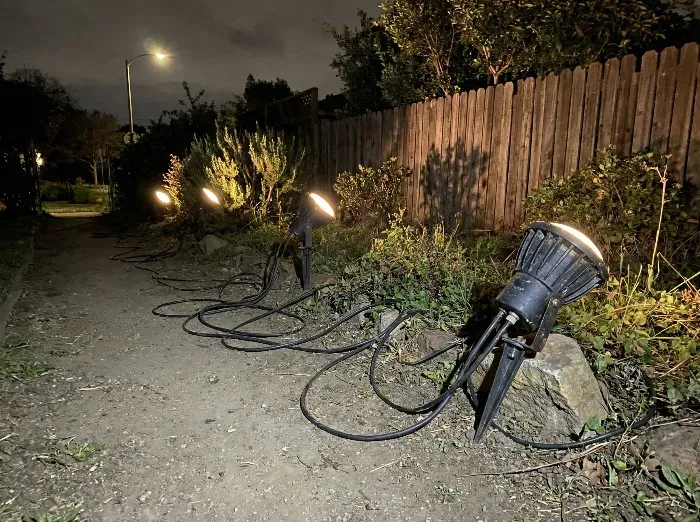
MR16 lamps are widely used in outdoor lighting due to their compact form factor and precise beam control. Common applications include:
- Landscape and garden accent lighting
- Pathway and step illumination
- Wall washing and façade uplighting
- Recessed fixtures in eaves or overhangs
These applications often operate for extended periods and are exposed to moisture, temperature variation, and airborne debris—conditions that directly affect lamp reliability.
Performance Differences in Outdoor Environments
1. Energy Efficiency and Light Output Stability
根据 美国能源部(DOE), LED lighting typically uses 至少节省75%的能量 than incandescent or halogen lighting while delivering comparable light output1.
For MR16 lamps, this translates into:
| Lamp Type | Typical Power Consumption | Light Output Behavior |
|---|---|---|
| MR16 Halogen | 20–50 W | Output degrades rapidly over life |
| MR16 LED | 3–7 W | Stable output over rated lifetime |
Lower power consumption reduces not only electricity usage but also thermal stress inside outdoor fixtures.
2. Service Life and Maintenance Impact
Lamp replacement frequency is a critical factor in outdoor installations, especially where fixtures are difficult to access.
| Lamp Type | 额定寿命 | Replacement Frequency (Typical Outdoor Use) |
|---|---|---|
| MR16 Halogen | 约2,000小时 | Multiple times per year |
| MR16 LED | 25,000–50,000小时 | Often several years |
DOE and ENERGY STAR data consistently show that LEDs reduce lighting maintenance interventions by more than 80% compared with halogen lamps12.
3. Heat Generation and Fixture Stress
Traditional halogen MR16 lamps operate at very high temperatures. In outdoor fixtures, this leads to:
- Accelerated gasket and seal degradation
- Increased condensation risk after thermal cycling
- Higher failure rates in enclosed or damp environments
LED MR16 lamps operate at significantly lower temperatures, reducing stress on fixtures and improving long-term system reliability1.
4. Weather Resistance and IP Protection
Traditional halogen MR16 lamps rely entirely on the fixture for environmental protection. Many MR16 LED bulbs designed for outdoor use incorporate additional sealing and are available with IP-rated designs.
根据 IEC 60529标准, IP ratings define protection against dust and moisture ingress[^3].
| IP防护等级 | Outdoor Suitability |
|---|---|
| IP20 | Indoor use only |
| IP44 | Sheltered outdoor locations |
| IP65 | Exposed outdoor environments |
| IP67 | Temporary immersion |
For outdoor MR16 LED installations, IP65-rated lamps or fixtures are typically recommended.
Cost Comparison: Total Cost of Ownership (TCO)
Upfront lamp price alone does not reflect true cost in outdoor lighting projects. Total cost of ownership includes:
- Energy consumption
- Lamp replacement frequency
- Maintenance labor
- Fixture degradation
Comparative Cost Factors
| Cost Element | MR16 Halogen | MR16 LED |
|---|---|---|
| Initial lamp cost | 低 | 中等 |
| Energy cost (per year) | 高 | 低 |
| Replacement labor | 频繁 | 最小 |
| Fixture wear | 高 | 低 |
| Long-term cost | 高 | Significantly lower |
ENERGY STAR analyses indicate that LED retrofits in outdoor and architectural lighting applications typically achieve payback periods within 1–3 years, depending on operating hours and electricity rates.
Replacement Compatibility Considerations
MR16 LED bulbs can replace traditional halogen MR16 lamps in many outdoor systems, provided the following conditions are met:
- Matching voltage (typically 12V AC or DC)
- GU5.3 base compatibility
- Transformer compatibility (electronic vs magnetic)
- Beam angle alignment with original design
Poor compatibility—especially with older transformers—can lead to flicker, reduced lamp life, or unstable operation. Pilot testing is recommended in retrofit projects.
When Traditional MR16 Lamps Still Appear Attractive
Despite their disadvantages, halogen MR16 lamps may still appear attractive in very limited scenarios:
- Extremely low initial budget constraints
- Temporary installations with short operating periods
- Applications where color rendering requirements outweigh efficiency concerns
However, these advantages are typically short-term and are outweighed by higher operating and maintenance costs in outdoor use.
Decision Summary: Outdoor MR16 LED vs Traditional
| Decision Factor | Recommended Choice |
|---|---|
| Long operating hours | MR16 LED |
| Limited maintenance access | MR16 LED |
| Outdoor exposure | MR16 LED |
| Lowest upfront cost only | Halogen (short-term only) |
| Long-term cost control | MR16 LED |
From a project and lifecycle perspective, MR16 LED bulbs are the preferred solution for the vast majority of outdoor applications.
结论
In outdoor lighting projects, MR16 LED bulbs outperform traditional halogen MR16 lamps across nearly all meaningful performance and cost metrics. Their advantages extend beyond energy savings to include reduced maintenance, improved fixture longevity, and greater reliability under environmental stress.
When evaluated on a total cost of ownership basis, MR16 LED solutions offer a more predictable and sustainable approach to outdoor lighting—particularly in projects with extended operating hours or limited maintenance access.
Selecting the right MR16 LED bulb for outdoor applications involves more than matching wattage or beam angle. Long-term performance depends on environmental exposure, transformer compatibility, IP protection, and operating hours.
对于 project owners, lighting designers, and procurement teams, improper MR16 LED selection can result in:
- premature lamp failure
- moisture-related issues
- unexpected maintenance costs
If you are planning:
- outdoor MR16 LED retrofits
- landscape or architectural lighting projects
- bulk replacement of traditional MR16 lamps
our team provides application-based technical support, including:
- MR16 LED vs halogen performance evaluation
- outdoor IP and fixture compatibility guidance
- transformer and dimming compatibility checks
- total cost of ownership assessment for bulk projects
Share your outdoor application details, and we can help you validate performance and cost assumptions before installation.
Contact: [email protected]
网站: https://www.tecolite.com
脚注
U.S. Department of Energy (DOE), LED Lighting, https://www.energy.gov/energysaver/led-lighting ↩ ↩ ↩
International Electrotechnical Commission (IEC), IEC 60529 – Degrees of Protection (IP Code), https://webstore.iec.ch/en/publication/2452 ↩