
Wholesale Dimmable LED Bulbs for Commercial Projects: Buyer’s Guide
Commercial facilities with high lighting demands face rising energy and maintenance costs. Traditional lighting systems—incandescent, halogen, or non-dimmable LEDs—often lack the efficiency, control, and durability required for modern business environments.
Wholesale dimmable LED bulbs provide scalable solutions that reduce energy consumption, enable flexible lighting control, and lower total cost of ownership (TCO) across offices, retail spaces, hospitality venues, warehouses, and other commercial areas.
In this guide, we explain why dimmable LED bulbs are ideal for commercial projects, how to choose and source them in bulk, and what performance and cost advantages they offer compared with legacy lighting.
Why Bulk Wholesale Dimmable LED Bulbs Matter in Commercial Lighting
Energy Savings and Operational Efficiency

根据 美国能源部(DOE), LED lighting uses 70–90% less energy than traditional incandescent lighting and typically 30–60% less than fluorescent systems while delivering equivalent or superior illumination in commercial settings.
This significant reduction translates into:
- Lower utility bills
- Reduced peak electrical loads
- Less heat output (reducing HVAC load)
Example Energy Impact
For a retail space with 10,000 sq ft of lighting operating 12 hours per day, replacing traditional lamps with high-efficiency dimmable LEDs can reduce annual lighting energy use substantially.
| Lighting Type | Annual Consumption | Avg Rate | Annual Cost* |
|---|---|---|---|
| Halogen / Incandescent | ~87,600 kWh | $0.12/kWh | ~$10,512 |
| Fluorescent | ~58,400 kWh | $0.12/kWh | ~$7,008 |
| Dimmable LED | ~17,520 kWh | $0.12/kWh | ~$2,102 |
*Calculated for comparison only; actual bills vary by region and tariff. Based on standard wattage equivalents.
Long Lifespan Reduces Maintenance
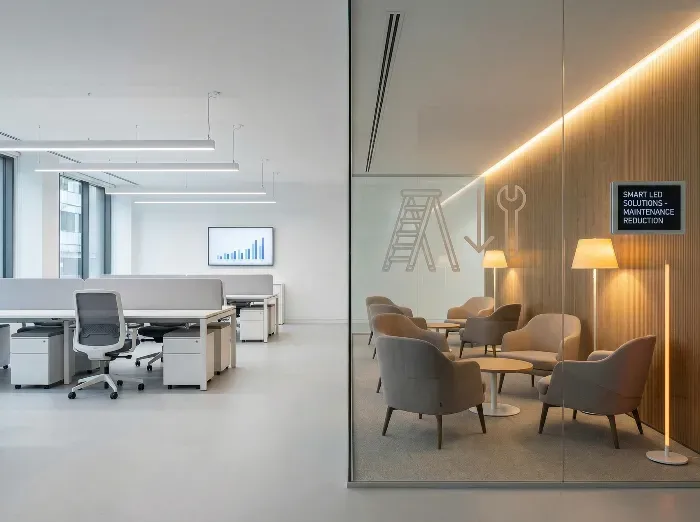
Industry benchmarks from 能源之星® and DOE show typical high-quality LED bulbs rated 25,000–50,000小时 of operation—far surpassing incandescent (~1,000 hours) and fluorescent (~8,000–15,000 hours).
This reduces failures and maintenance interventions, a key advantage in spaces requiring ladder access or service windows.
What Makes Dimmable LED Bulbs Better for Commercial Needs
Adaptive Lighting and Comfort
Dimmable LEDs support multiple brightness levels (often 10–100%), enabling:
- Task-based control (brighter for work zones)
- Ambience control (softer for public or hospitality areas)
- Zoned lighting (independent control of sections)
Flexible control improves occupant comfort and can contribute to productivity. The 照明工程学会(IES) notes that appropriate dimming improves visual comfort and user satisfaction in commercial interiors1.
Power Quality and Stability
Modern dimmable LEDs with properly designed drivers maintain stable light output without flicker or color shift across dimming ranges. This contrasts with legacy lighting, where dimming often causes buzzing, flicker, or uneven output.
Compatibility with Controls and Smart Systems
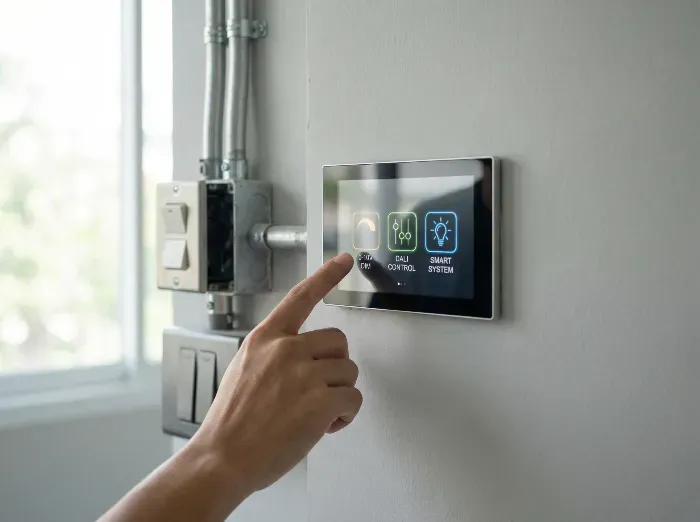
Dimmable LEDs integrate with:
- Phase-cut dimmers (TRIAC/ELV)
- 0–10V control systems
- DALI / POE / smart building systems
This compatibility is crucial for automated lighting strategies that reduce energy use further through scheduling and occupancy sensing.
How to Select and Buy Dimmable LED Bulbs in Bulk
Bulk procurement of dimmable LEDs requires attention to several key factors.
Assessing Your Lighting Requirements
Commercial lighting design follows defined standards:
- Offices: ~300–500 lux on work surfaces
- Retail: ~500–750 lux in display areas
- Warehouses: ~100–250 lux on aisles (higher in task zones)
These recommendations are consistent with IES lighting standards and other industry guidelines1.
When calculating your bulb requirements:
- Determine lumen target per fixture based on area type.
- Factor in room reflectances and ceiling heights.
- Use spacings and layouts to avoid under- or over-lighting.
Compatibility and Quality Checks
Not all LEDs dim the same. Before ordering large quantities wholesale:
- Verify “dimmable” is explicitly stated on datasheets.
- Ensure dimming method matches your control system (e.g., TRIAC vs 0–10V).
- Check CRI(显色指数)—80+ is typical for commercial use; 90+ recommended for retail and hospitality.
- Confirm certifications such as ENERGY STAR, UL, or CE marking for safety and performance validation.
Supplier Selection Best Practices
Bulk buyers should:
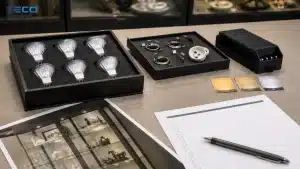
- Request product samples to test in real conditions.
- Review warranty and return policies.
- Evaluate supplier reliability via industry forums and B2B review platforms.
- Ask for compatibility matrices for dimmers and drivers.
For quantities of thousands of units, negotiate tiered pricing and clear lead times to secure predictable deployment.
Key Features to Prioritize in Dimmable LED Bulbs
Quality dimmable LED bulbs for commercial use should include:
| 特点 | Importance for Commercial Use |
|---|---|
| Dimming Range (10–100%) | Precise control and energy savings |
| High Efficacy (≥90 lm/W) | Maximizes light for power consumed |
| CRI ≥80 (IDEALLY 90+) | Better color fidelity, crucial for retail |
| Thermal Management | Extends lifespan under continuous operation |
| Driver Quality | Smooth dimming with minimal flicker |
| 认证 | ENERGY STAR / UL / CE for reliability |
Proper thermal design and driver selection reduce lumen depreciation and ensure consistent light output over rated life.
Commercial Dimmable LED vs Traditional Lighting at a Glance
| 方面 | Traditional Bulbs | Dimmable LED Bulbs |
|---|---|---|
| 能源效率 | 低 | High (70–90% less power) |
| 寿命 | 1,000–15,000 hrs | 25,000–50,000 hrs |
| 调光功能 | Limited or none | Full range (10–100%) |
| Maintenance Demand | 高 | 低 |
| 环境影响 | Higher (waste & heat) | Lower (no mercury, less CO₂) |
| Smart Control Integration | Rare | Common |
Common Questions
Can dimmable LED bulbs truly save energy?
Yes. DOE and ENERGY STAR analyses show that dimmable LEDs with control systems save significantly more than non-dimmable lamps because they can reduce output during lower occupancy or off-peak periods.
Do all dimmable LEDs work with every dimmer?
No. Compatibility varies by driver and dimmer type. Confirm with supplier compatibility lists or test samples prior to full deployment.
What warranty periods are typical for commercial LEDs?
Many commercial-grade dimmable LEDs carry 3–5 year warranties; extended warranties are available from some manufacturers.
结论
For commercial lighting projects, wholesale dimmable LED bulbs offer measurable benefits in energy savings, flexibility, lifespan, and total cost of ownership. Bulk purchasing optimizes unit pricing while high-quality components ensure reliability and performance in demanding environments.
If you’re planning a commercial lighting upgrade or bulk procurement, work with suppliers who provide technical support for dimming compatibility, lighting design validation, and product certification assurance. This reduces deployment risk and ensures predictable performance in your spaces.
联系我们 for specification support, sample testing, and detailed proposals tailored to your commercial lighting project.
脚注
Illuminating Engineering Society (IES) – Lighting Standards Guide
https://www.ies.org/standards ↩ ↩
 English
 French
 German
 Italian
 Spanish
 Portuguese
 Arabic
 Russian
 Japanese
 Chinese