
如何选择合适的GU10 LED灯泡:流明输出与亮度指南
Many buyers assume that selecting a GU10 LED bulb is straightforward: higher lumens mean brighter light, so choosing the maximum output should be safest. In real projects, this assumption frequently leads to glare complaints, uneven illumination, and disappointing user experience—especially in hotels, retail environments, and offices.
GU10 LED bulb lumen output is not a standalone indicator of brightness.
Brightness only becomes meaningful when lumen output is evaluated together with beam angle, application type, operating hours, and visual comfort expectations.
This guide explains what GU10 lumen output truly represents, why perceived brightness varies so dramatically, which lumen ranges work best for different applications, and how buyers can specify GU10 brightness correctly—without relying on trial and error.
Quick Answer for Buyers
Before diving into technical details, it helps to set expectations clearly:
- Most GU10 brightness problems are caused by incorrect beam angle selection, not insufficient lumens.
- Higher lumen output does not automatically improve visual quality and often increases glare.
- The “right” GU10 lumen output depends on application, beam control, and operating profile, not product category.
With that baseline in mind, the following sections explain how to choose GU10 brightness correctly.
What Does Lumen Output Really Mean for GU10 LED Bulbs?
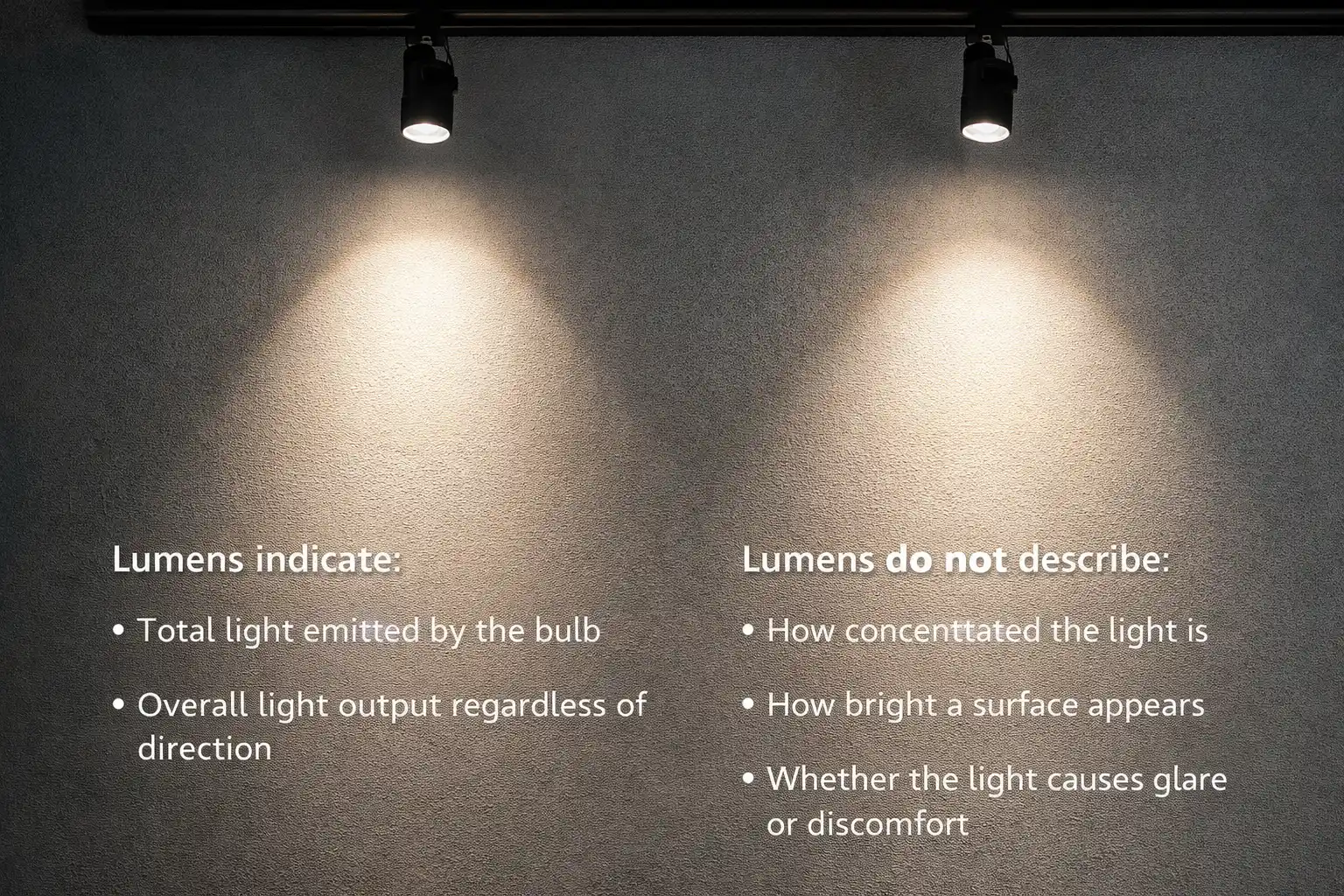
Side-by-side spotlight illustrations explaining lumens as total light output versus other critical factors such as beam concentration, perceived brightness, and the potential for glare or visual discomfort.
Lumen output is one of the most misunderstood parameters in GU10 purchasing.
Lumen output describes how much light a GU10 LED bulb emits in total—not how bright it will appear in a space.
Lumens measure quantity, not visual experience
Lumens indicate:
- Total light emitted by the bulb
- Overall light output regardless of direction
Lumens do 不 describe:
- How concentrated the light is
- How bright a surface appears
- Whether the light causes glare or discomfort
For directional lighting like GU10 spotlights, this distinction is critical.
Why GU10 lumens behave differently from E27 bulbs
GU10 bulbs are inherently directional.
Unlike omnidirectional lamps, GU10 brightness is shaped by optics and reflectors. As a result:
- Two GU10 bulbs with identical lumen output can look completely different
- Beam angle often influences perceived brightness more than lumen output itself
This is why any GU10 lumen comparison without beam angle context is incomplete.
Typical GU10 lumen ranges in the market
Most GU10 LED bulbs fall into these output bands:
- 250–350 lumens
- 350–450 lumens
- 450–550 lumens
- 550–700+ lumens
Each range has valid use cases. Problems arise when buyers assume higher ranges are universally better.
Why buyers get confused
In practice, many buyers compare GU10 bulbs using:
- Lumen numbers alone
- Marketing claims or halogen equivalents
This approach ignores how GU10 optics work and often results in over-lighting.
Understanding what lumens represent—and what they do not—is the foundation of correct GU10 brightness selection.
Lumen vs Beam Angle: Why Brightness Perception Changes Dramatically

Illustration of spotlight beam angles, comparing a narrow 24° beam delivering higher illuminance with a wide 60° beam providing broader, lower-intensity light distribution against a neutral wall.
Perceived brightness depends on how light is distributed, not just how much light exists.
In GU10 spotlights, beam angle often affects perceived brightness more than lumen output.
How beam angle concentrates light
Beam angle defines how wide the light spreads:
- Narrow beam = light concentrated in a small area
- Wide beam = light spread over a larger surface
A narrower beam produces higher illuminance (lux) on the target even with fewer lumens.
Same lumens, very different results
例如:
- 400 lm GU10 with a 24° beam
- 400 lm GU10 with a 60° beam
The 24° version will appear significantly brighter on shelves or walls, despite identical lumen output.
This is why the question “how many lumens for a GU10 spotlight?” cannot be answered without specifying beam angle.
Why wide beams often feel “dim”
Wide-beam GU10 bulbs may feel dim because:
- Light is distributed over a larger area
- Contrast is reduced
- Surfaces receive lower intensity
Buyers often compensate by choosing higher lumen bulbs, unintentionally creating glare.
Lux vs lumens in real spaces
- Lumens describe total light
- Lux describes light on a surface
Users perceive lux, not lumens.
Beam angle controls how lumens are converted into usable lux.
Practical takeaway
Never specify GU10 LED bulb lumen output without defining beam angle first.
Most brightness complaints originate from beam mismatch, not insufficient output.
Recommended GU10 Lumen Ranges for Common Applications
There is no single “correct” GU10 lumen output. Only appropriate ranges for specific applications.
Typical application-based guidance
| 应用 | 光束角度 | Recommended Lumens |
|---|---|---|
| 重点照明 | 10°–24° | 250–350 lm |
| General residential lighting | 36°–60° | 350–450 lm |
| Retail display | 24°–36° | 400–600 流明 |
| Office task areas | 36°–60° | 450–650 lm |
| Hospitality corridors | 36°–60° | 300–500 流明 |
These ranges reflect how GU10 brightness is specified in real projects, not laboratory conditions.
Why accent lighting needs fewer lumens
Accent lighting relies on:
- 对比度
- 专注
- Direction
A narrow beam with moderate lumens produces stronger visual impact than high-output wide beams.
Why general lighting requires balance
General lighting must:
- Avoid glare
- Provide comfort
- Maintain uniformity
Higher lumens are often needed—but only when paired with appropriate beam spread.
The risk of over-lighting
Choosing maximum lumen output “to be safe” frequently results in:
- Harsh visual environments
- Reduced comfort
- Complaints in hospitality and residential spaces
Brightness should support the space, not dominate it.
Commercial vs Residential GU10 Brightness Requirements
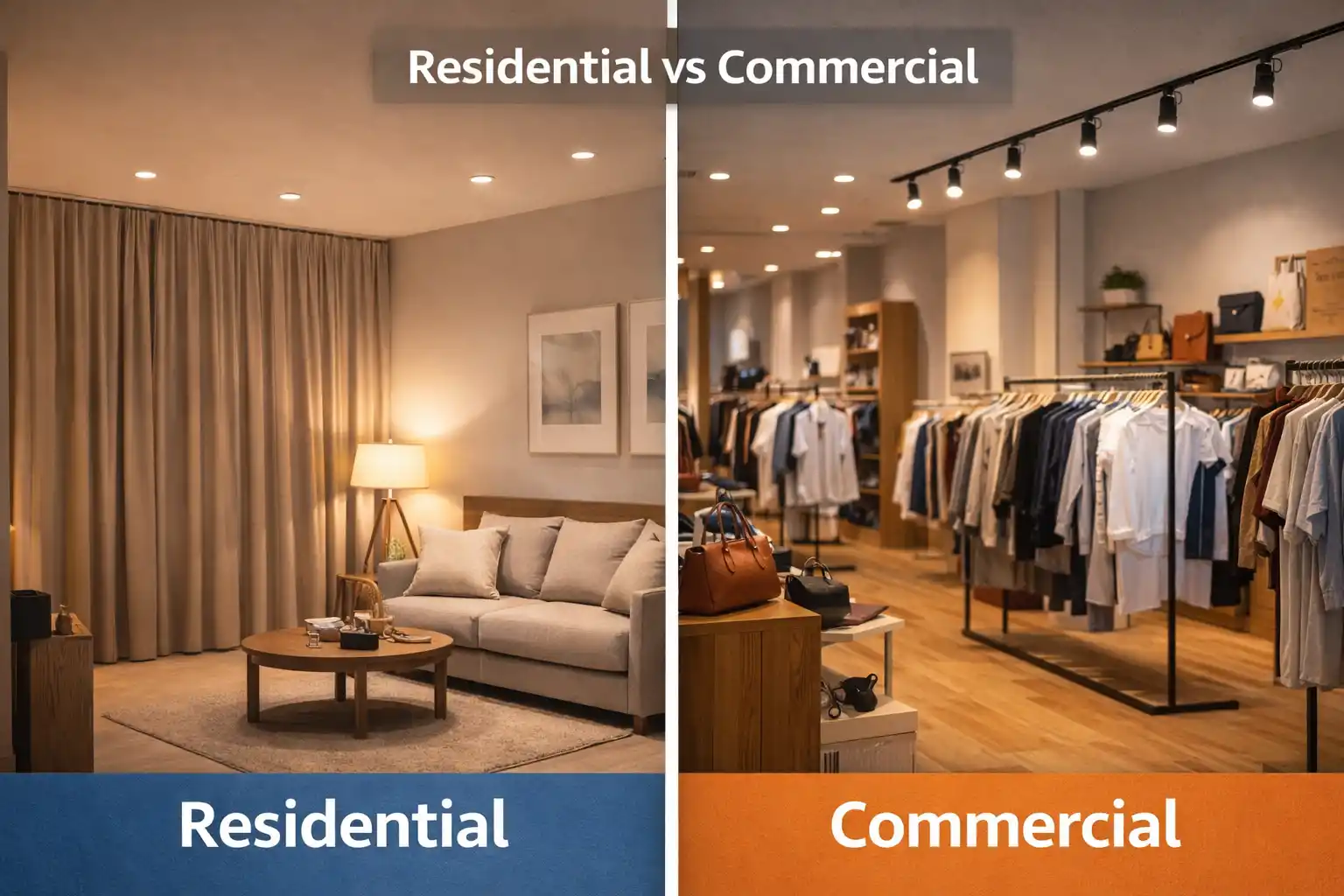
Visual comparison of residential versus commercial interior lighting setups, highlighting differences between home environments and retail applications.
Residential and commercial spaces use light very differently.
Commercial GU10 lumen requirements are often higher than residential, but tolerance for glare is lower.
Residential brightness logic
In homes, GU10 lighting supports:
- Comfort
- Mood
- 灵活性
Typical residential ranges:
- 250–400 lm for accent
- 350–450 lm for general lighting
Overly bright GU10 bulbs quickly feel uncomfortable in living spaces.
Commercial brightness logic
Commercial environments prioritize:
- 可见度
- 一致性
- 功能清晰度
Typical commercial ranges:
- 400–600 lm for retail and offices
- Up to 700 lm in high-ceiling or task-focused areas
However, glare control becomes more critical as brightness increases.
Hospitality as a hybrid case
Hotels combine residential comfort with commercial scale:
- Guest rooms usually require lower lumens
- Public areas often require higher output
Many hotel lighting complaints stem from applying commercial brightness logic to residential-style spaces.
Buyer implication
Always clarify whether the GU10 bulb is intended for:
- Private residential use
- Public commercial spaces
- Mixed hospitality environments
Brightness targets change accordingly.
Common Mistakes Buyers Make When Choosing GU10 Lumens

Living room scene illustrating overly bright GU10 ceiling spotlights that cause significant glare and visual discomfort while occupants watch television.
Most GU10 brightness issues follow predictable patterns.
Mistake 1: Choosing the highest lumen available
High-lumen GU10 bulbs often cause:
- 眩光
- Hot spots
- Visual fatigue
Especially when paired with narrow beams.
Mistake 2: Ignoring beam angle
Comparing lumen numbers alone leads to:
- Over-bright narrow beams
- Underwhelming wide beams
Beam angle should be specified before lumen output.
Mistake 3: Blindly copying halogen equivalents
Halogen-to-LED equivalence charts are approximations.
LED optics behave differently and require independent evaluation.
Mistake 4: Using one lumen level everywhere
Uniform brightness across all areas:
- Flattens visual hierarchy
- Wastes energy
- Reduces comfort
Layered lighting requires varied lumen outputs.
Mistake 5: Ignoring surface reflectance
Dark surfaces absorb light; bright surfaces reflect it.
The same GU10 lumen output feels very different in each environment.
Mistake 6: Overlooking dimming behavior
If dimming is used, full lumen output is rarely needed.
Moderate lumen output with stable dimming often performs better than extreme brightness.
Practical Buyer Checklist: How to Specify GU10 Brightness Correctly
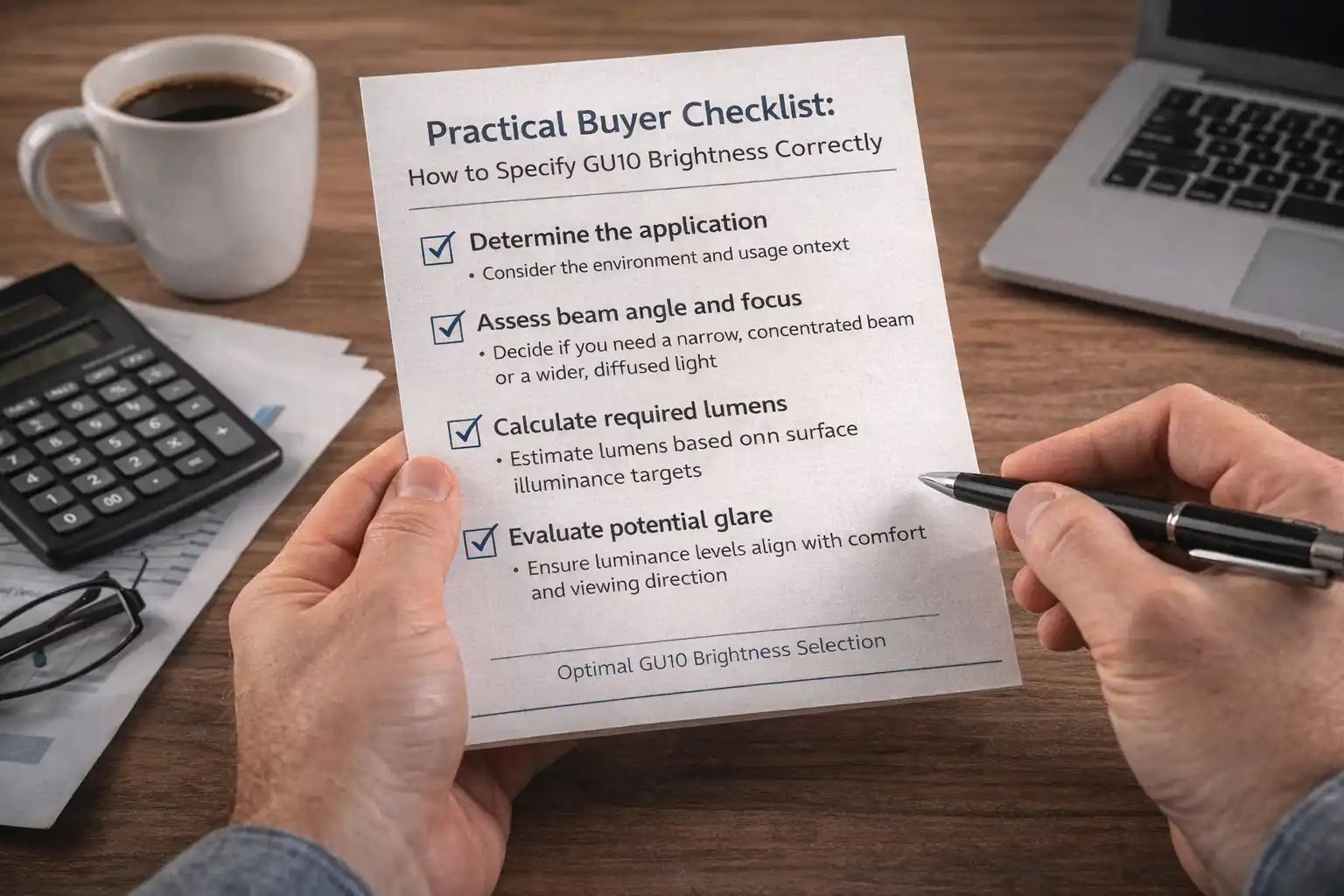
Practical buyer checklist for specifying GU10 brightness correctly, featuring steps such as environment assessment, beam focus selection, and optimal luminance planning in an office setting.
Correct GU10 brightness selection starts with the right questions.
Step 1: Define the application
- Accent or general lighting?
- Residential, commercial, or hospitality?
Step 2: Choose beam angle first
- Narrow (10°–24°)
- Medium (36°)
- Wide (60°)
Step 3: Select a lumen range, not a single number
Consider:
- 天花板高度
- Fixture spacing
- Surface reflectance
Step 4: Evaluate glare and comfort
Check:
- Viewing angles
- Eye-level exposure
- Reflective materials
Step 5: Align with dimming strategy
Ensure:
- Stable low-end dimming
- No need to rely on extreme output
Step 6: Standardize SKUs intelligently
For bulk buyers:
- Use a limited set of lumen levels
- Match beam angles consistently
This reduces inventory complexity without sacrificing performance.
结论
Choosing the right GU10 LED bulb lumen output is not about selecting the brightest option. It is about balancing beam angle, application requirements, operating profile, and user comfort.
Projects succeed when brightness supports visual intent rather than overpowering it. Buyers who treat lumen output as part of a system—rather than a standalone number—achieve more predictable, comfortable, and professional lighting results.
Technical Support for GU10 Brightness Specification
Selecting the right GU10 LED bulb brightness is rarely about choosing a higher lumen number—it is about matching beam angle, operating hours, and visual comfort to the actual application.
For bulk buyers, project managers, and lighting specifiers, incorrect GU10 lumen selection often becomes visible only after installation, when glare complaints or uneven lighting appear.
如果您正在从事:
hotel or hospitality lighting projects
retail or office GU10 spotlight specifications
mixed residential–commercial environments
bulk GU10 LED bulb procurement
our team supports buyers with application-based GU10 brightness guidance, including:
GU10 lumen range validation by beam angle
residential vs commercial brightness alignment
mock-up and sample review recommendations
SKU standardization strategies for bulk orders
Share your application scenario, beam angle, and project scale, and we can help you define GU10 brightness that performs correctly in real spaces—not just on datasheets.
Contact: [email protected]
网站: www.tecolite.com



 English
 French
 German
 Italian
 Spanish
 Portuguese
 Arabic
 Russian
 Japanese
 Chinese