如何在没有墙壁调光开关的情况下调暗LED灯:商业项目解决方案
In commercial lighting projects, dimming does not always need to depend on a traditional wall dimmer switch. Hotels, restaurants, retail stores, display cabinets, offices, and low-voltage lighting systems often require brightness control without placing a dimmer on every wall circuit.
The right solution depends on the project type, wiring condition, control system, LED driver, fixture design, and maintenance expectations. A simple “dimmer switch replacement” may work in a small room, but it is rarely the best answer for a commercial project where consistency, safety, compatibility, and long-term reliability matter.
This guide explains practical ways to dim LED lights without wall dimmer switches in commercial projects, including 3-step dimming bulbs, smart control, 0-10V, DALI, PWM dimming, dimmable LED drivers, scene control, and optical brightness reduction.
总结
Commercial LED dimming does not always require a wall dimmer switch. In hotels, retail stores, restaurants, offices, display cabinets, and low-voltage systems, brightness can be controlled through 3-step lamps, dimmable drivers, 0-10V, DALI, PWM, smart control, dim-to-warm products, or optical design. The best method depends on wiring conditions, control requirements, lamp type, driver compatibility, and long-term maintenance risk.
commercial LED dimming without wall dimmer switches
Can LED lights be dimmed without a wall dimmer switch?
Yes, LED lights can be dimmed without a traditional wall dimmer switch, but the method must match the LED product and the electrical design.
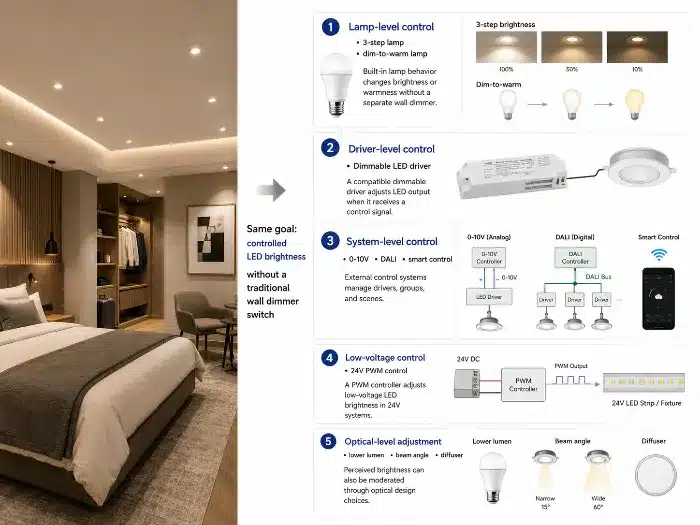
A wall dimmer switch is only one way to control brightness. In commercial projects, dimming can also happen through:
the LED bulb itself
the LED driver
a centralized control system
a smart lighting controller
a 0-10V or DALI control line
a PWM controller in low-voltage systems
scene control software
optical design and lumen selection
The important point is that LED dimming is not only about reducing visible brightness. A stable dimming system must also control flicker, driver behavior, minimum dimming level, acoustic noise, thermal performance, and compatibility between the lamp, driver, and control device.
For one residential room, a wall dimmer may be enough. For a commercial project, the better question is:
Where should the dimming function be designed: at the switch, at the driver, at the lamp, or at the control system?
Why do commercial projects avoid wall dimmer switches?
Commercial projects may avoid wall dimmer switches for several practical reasons.
First, many projects use centralized lighting control. A hotel room, restaurant, retail store, or office may use a scene controller, building management system, smart panel, or automation system instead of individual wall dimmers.
Second, wall dimmers can create compatibility problems when the LED lamp, driver, and dimmer are not tested together. In large projects, even a small compatibility issue can become a high RMA risk after hundreds or thousands of lamps are installed.
Third, some areas need restricted user control. Retail stores, hotel corridors, galleries, and restaurants often do not want customers or staff to manually adjust each lighting circuit. Brightness is usually controlled by preset scenes, time schedules, sensors, or central management.
Fourth, many commercial projects use low-voltage lighting. Display cabinets, yachts, outdoor low-voltage lighting, RVs, and smart home systems may use 12V or 24V DC power with PWM dimming instead of an AC wall dimmer.
Finally, retrofit projects may have limited wiring access. When the wall box, wiring route, or existing switch system cannot be changed easily, the project needs a dimming solution that works without replacing every wall switch.
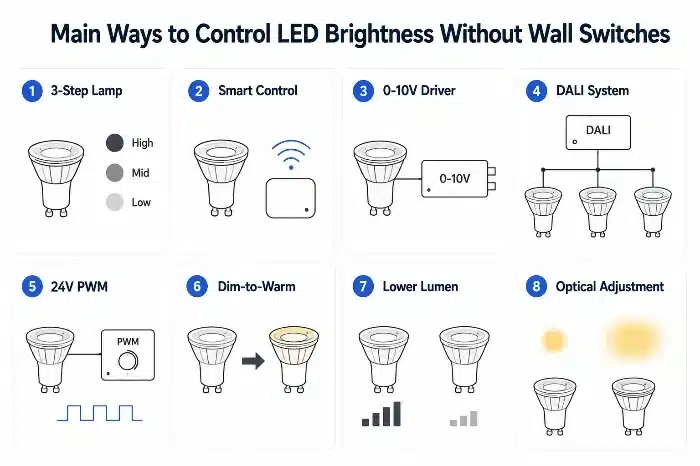
What are the main ways to dim LED lights without wall dimmer switches?
The main methods include internal lamp dimming, driver-level dimming, centralized control, low-voltage PWM control, smart control, and optical brightness control.
Each method solves a different project problem.
main ways to dim LED lights without wall switches
| Method | 最适合 | Main Advantage | Main Limitation |
|---|---|---|---|
| 3-step dimming LED bulbs | Retrofit rooms, hotels, small commercial areas | Works with a normal switch | Limited dimming levels |
| Smart LED bulbs or smart drivers | Small projects, flexible control | App, wireless, scene control | Platform compatibility must be checked |
| 0-10V dimmable drivers | Offices, commercial fixtures, linear lights | Simple analog control | Requires control wiring |
| DALI照明控制 | Hotels, offices, retail, large projects | Addressable digital control | Higher system design requirement |
| PWM 调光 | 12V / 24V LED systems, cabinets, strips, low-voltage spotlights | Stable low-voltage dimming | Requires correct controller and power supply |
| Dim-to-warm LEDs | Hospitality, restaurants, premium interiors | Warmer light at lower brightness | Needs matching product and control method |
| Lower-lumen lamps | Simple retrofit projects | Easy and low-risk | Not adjustable |
| Optical diffusion or beam angle change | Retail, display, glare control | Improves visual comfort | Does not truly dim the LED electrically |
When should commercial projects use 3-step dimming LED bulbs?
3-step dimming LED bulbs are useful when the project needs basic brightness control without installing a wall dimmer switch.
3-step dimming LED bulbs for retrofit projects
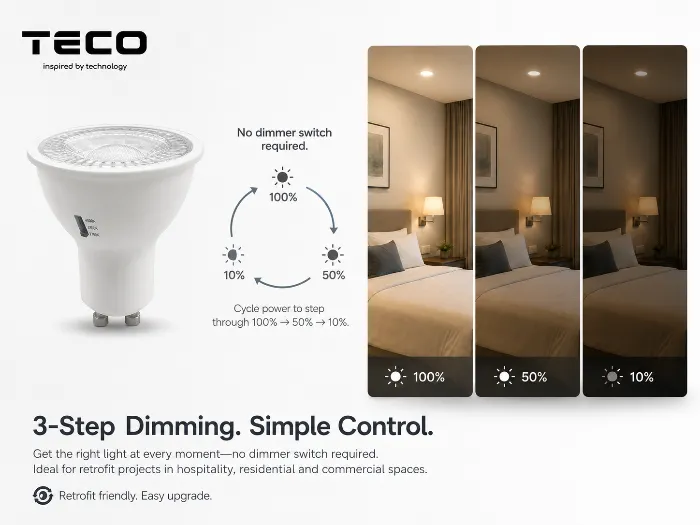
These bulbs use an internal dimming circuit. The user can change brightness levels by switching a normal wall switch on and off. A typical sequence may be:
100% 亮度
50% 亮度
10% brightness
This solution is suitable for retrofit projects where changing wiring is difficult. It can also work well in hotel rooms, apartments, small restaurants, corridors, and decorative lighting areas where users need simple brightness adjustment but not precise control.
For retrofit hotel rooms, apartments, and small hospitality areas, a 3-step dimming GU10 lamp can be considered when the project needs basic brightness adjustment without changing the wall switch. The key is to confirm switching sequence, memory behavior, minimum brightness stability, and batch consistency before bulk ordering.
The advantage is simplicity. There is no need for a phase-cut dimmer, 0-10V line, DALI system, or smart app. The normal switch remains in place.
However, 3-step dimming is not the right solution for every project. It does not provide smooth continuous dimming. It also may not be suitable for complex scene control, central management, or projects requiring exact lux levels.
For B2B buyers, the key is not only whether the bulb has 3-step dimming. The buyer should also check switching cycle durability, memory function, minimum brightness stability, color consistency, CRI, beam angle, lamp size, and batch-to-batch consistency.
When should projects use 0-10V dimming instead of wall dimmers?
0-10V dimming is common in commercial lighting systems where LED drivers receive a low-voltage control signal. Instead of reducing power through a wall dimmer, the system sends a control voltage to the driver, and the driver adjusts the LED output.
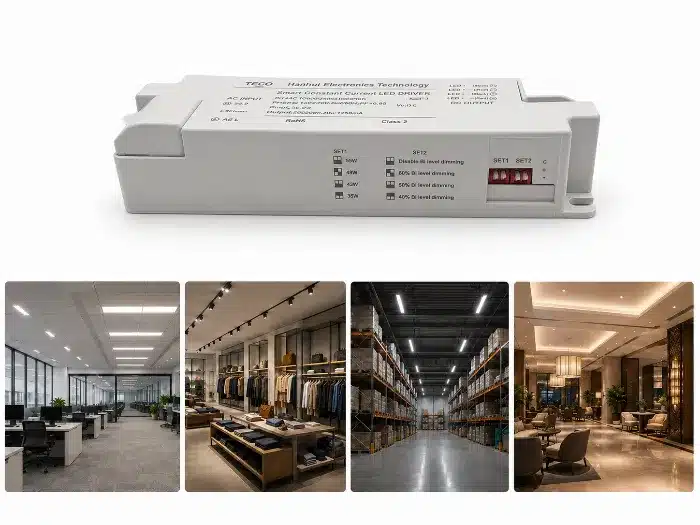
0-10V dimming driver for commercial LED lighting
This method is often used for:
办公室照明
linear luminaires
panel lights
commercial downlights
suspended lighting systems
large open areas
daylight harvesting systems
occupancy sensor control
The main advantage of 0-10V is that it is simple and widely used in commercial projects. It separates power wiring from control wiring, which can improve dimming stability compared with trying to force every LED fixture through a wall dimmer.
The limitation is that 0-10V requires compatible drivers and control wiring. A 0-10V control signal does not make every LED product dimmable; the driver must be designed for 0-10V control.1 It is not usually a plug-and-play solution for a finished retrofit site unless the wiring already supports it.
For project buyers, 0-10V should be considered early in the design stage. The lighting supplier, electrical contractor, and control system provider should confirm the dimming range, minimum output level, wiring layout, driver type, and control compatibility before bulk ordering.
When is DALI a better choice for commercial LED dimming?
DALI is a digital lighting control system used in many professional commercial and architectural projects. It is specified in the IEC 62386 family of standards, and DALI-2 certification is maintained by the DALI Alliance to improve tested interoperability.23 Compared with simple switching or analog control, DALI allows more advanced control of individual luminaires, groups, scenes, sensors, and system feedback.
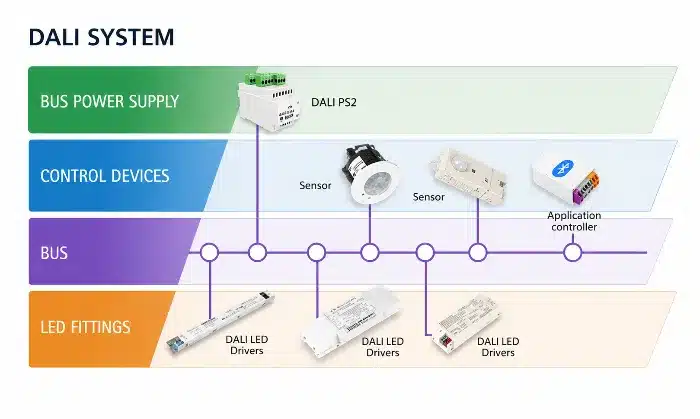
DALI lighting control system for commercial LED dimming
DALI can be a better choice when the project needs:
addressable fixture control
scene setting
hotel room control
office automation
retail lighting zones
gallery or museum lighting
integration with sensors
maintenance feedback
flexible grouping after installation
In a DALI system, luminaires can be assigned to groups and scenes through software or commissioning tools. This makes it useful for projects where lighting needs may change over time.
For example, a retail store may need different scenes for daytime, evening, product launch events, and cleaning hours. A hotel may need welcome, reading, night, and cleaning scenes. An office may need daylight response and occupancy-based control.
DALI is not always necessary for small projects. It requires correct system design, compatible drivers, commissioning, and trained installation. But for larger projects, it can reduce long-term control limitations and make the lighting system more flexible.
How can 24V PWM dimming work without wall dimmer switches?
PWM dimming is especially useful for low-voltage LED lighting systems. Instead of using a wall dimmer switch on the AC side, a PWM controller adjusts the LED output on the DC side.
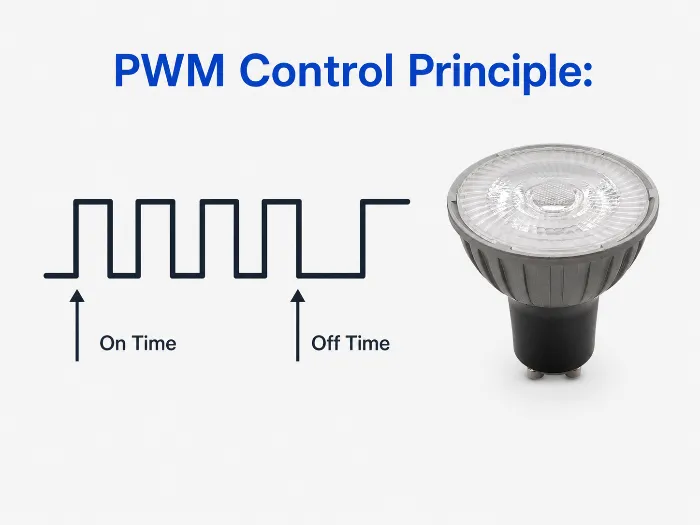
24V PWM dimming for low-voltage LED lighting
This is common in:
24V LED strips
cabinet lighting
display case lighting
yacht and marine lighting
RV lighting
outdoor low-voltage systems
smart home systems
centralized 24V lighting systems
low-voltage spotlight applications
In a 24V PWM system, the power supply provides stable 24V DC output, and the PWM controller controls brightness by rapidly switching the LED output on and off at a frequency that should not be visible to the human eye when properly designed.
This method can provide stable dimming in low-voltage systems when the LED lamp, driver, controller, cable length, voltage drop, and load capacity are correctly matched.
For commercial buyers, the key questions are:
Is the LED product designed for 24V DC input?
Is the dimming method PWM-compatible?
Is the controller rated for the total load?
Is the cable length acceptable for voltage drop?
Is the system suitable for the project environment?
Is the dimming frequency appropriate for visual comfort and video recording?
This method is not the same as installing a normal mains-voltage GU10 lamp into a standard socket. A 24V PWM LED bulb or spotlight must be used with a suitable 24V DC power supply and PWM control system.
In centralized 24V projects, such as cabinets, yachts, RVs, outdoor low-voltage systems, and smart-control installations, a 24V PWM-compatible GU10 spotlight may be more suitable than a mains-voltage lamp. The power supply, PWM controller, cable length, load capacity, and lamp input type should be specified together rather than selected separately.
Can smart lighting control replace wall dimmer switches?
Smart lighting control can replace wall dimmer switches in some commercial projects, but it must be selected carefully.
Smart dimming may use:
智能LED灯泡
smart LED drivers
Bluetooth control
Wi-Fi control
Zigbee systems
app-based control
gateway-based control
voice or scene control
central management platforms
This approach can work well for small restaurants, boutique hotels, meeting rooms, showrooms, apartments, and flexible display areas. It allows lighting scenes without changing every wall switch.
However, smart control is not only about convenience. For B2B projects, the buyer must check signal stability, platform support, device pairing process, long-term firmware support, local control behavior, cloud dependency, and replacement availability.
In a commercial project, a smart product that works well in one sample test may still create problems if it is not reliable across many rooms or many fixtures. Batch consistency, reset behavior, commissioning time, and maintenance procedures should be confirmed before mass installation.
How can restaurants and hotels dim lights without wall dimmers?
Restaurants and hotels often need warm, comfortable, low-glare lighting. In these spaces, dimming is not only a technical function. It directly affects atmosphere, guest comfort, and brand perception.
Common solutions include:
dim-to-warm LED lamps
3-step dimming bulbs for simple room control
DALI or smart scene control for guest rooms
lower-lumen lamps in decorative fixtures
indirect lighting
warm CCT selection
narrow or medium beam spotlights for accent lighting
optical accessories to reduce glare
For hotel guest rooms, the best solution may be a combination of scene control and suitable lamps. A bedside area may not need a traditional wall dimmer if the system already has preset scenes such as reading, relaxing, night, and welcome mode.
For restaurants, dim-to-warm lighting can be valuable because the light becomes warmer as brightness decreases. This creates a more natural evening atmosphere than simply reducing brightness while keeping the same cool white color temperature.
For hospitality projects, the buyer should test low-end dimming performance before ordering. Poor dimming can create flicker, sudden drop-off, color shift, buzzing, or inconsistent brightness between rooms.
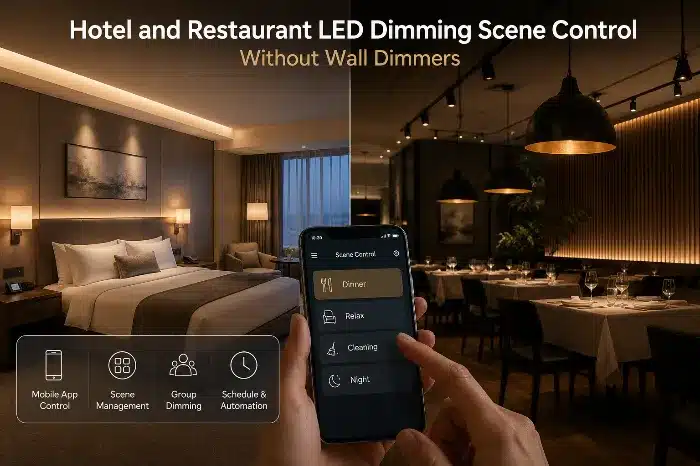
hotel and restaurant LED dimming scene control without wall dimmers
How can retail stores reduce brightness without wall dimmers?
Retail lighting is different from general room lighting. The goal is not simply to make the store brighter or darker. The goal is to create the right contrast between products, walls, aisles, shelves, and customer viewing direction.
In retail projects, brightness can be controlled without wall dimmer switches by using:
correct lumen output
beam angle selection
track spotlight aiming
center intensity control
DALI or smart scene control
lower-output lamps in secondary areas
accent lighting zones
glare-controlled optics
For example, a retail store may not need to dim every track spotlight manually. It may be better to select the correct beam angle and lumen package from the beginning. A narrow beam can create stronger product emphasis, while a wider beam can reduce contrast and soften the visual effect.
If the store uses a centralized lighting control system, scenes can be set for opening hours, evening hours, display mode, cleaning mode, and energy-saving mode.
For multi-store rollout projects, the most important issue is repeatability. The lighting supplier should provide consistent CCT, CRI, beam angle, lumen output, and housing finish across batches so that different stores do not look visually inconsistent.
Can lower-lumen lamps solve the problem without dimming?
Sometimes, yes. If the project does not require adjustable brightness, selecting a lower-lumen lamp may be the simplest and most reliable solution.
This works well when:
the existing lighting is permanently too bright
users do not need brightness adjustment
the space has too many fixtures
the project wants to avoid compatibility risk
the existing switch wiring cannot be changed
the budget does not support a control system
However, lower-lumen lamps are not the same as dimming. They provide a fixed brightness level. Once installed, the brightness cannot be adjusted unless the lamp is replaced again.
For commercial projects, this method is suitable for corridors, decorative fixtures, low-activity areas, small hospitality spaces, and retrofit cases where simplicity is more important than flexible control.
The buyer should still check lumen output, beam angle, color temperature, CRI, lamp dimensions, thermal condition, and compatibility with the existing fixture.
Can optical design make LED lights look dimmer?
Yes. Optical design can reduce perceived brightness, glare, and contrast without electrically dimming the LED.
Useful methods include:
using a wider beam angle
choosing frosted or diffused optics
using indirect lighting
adding suitable lampshades
selecting lower center beam intensity
improving fixture shielding
changing the aiming angle of spotlights
reducing reflected glare from glossy surfaces
This is especially important in retail, hospitality, office, gallery, and restaurant projects. A lamp may not be too bright in lumen output, but it can still feel uncomfortable if the beam is too narrow, the center intensity is too high, or the fixture creates direct glare.
In some projects, the correct beam angle and optical control can solve the visual problem better than dimming. For example, replacing a narrow high-intensity spotlight with a wider beam may reduce harsh contrast while keeping enough useful illumination on the display.
However, optical control is not a replacement for electrical dimming when the project requires adjustable lighting scenes.
What should project buyers avoid when dimming LEDs without wall switches?
Project buyers should avoid unsafe or unstable solutions.
Do not cover LED lamps with cloth, tape, paper, or unsuitable films to reduce brightness. These materials can affect heat dissipation and may create safety risks.
Do not randomly reduce input voltage to mains-voltage LED lamps. LED lamps contain drivers that are designed for a specific input range. Incorrect voltage can cause flicker, unstable operation, overheating, or failure.
Do not connect non-dimmable LED lamps to dimming systems unless the manufacturer confirms compatibility.
Do not assume every dimmable LED product works with every control method. Triac dimming, 0-10V dimming, DALI, PWM, and smart control are different systems.
Do not approve a commercial project based only on one sample lamp tested in a small room. Bulk orders should be tested under real project conditions, including cable length, driver load, control system behavior, minimum dimming level, flicker, noise, and thermal environment.
How should buyers choose the right dimming method?
The best dimming method depends on the project condition.
| Project Condition | Recommended Direction |
|---|---|
| Existing wall switches cannot be changed | 3-step dimming bulbs or lower-lumen lamps |
| Hotel rooms need preset scenes | DALI, smart control, or dim-to-warm system |
| Retail store needs lighting zones | DALI, smart control, or beam angle optimization |
| Cabinet or display lighting uses 24V DC | PWM 调光 |
| Office requires daylight and sensor control | 0-10V or DALI |
| Restaurant needs warm low-level lighting | Dim-to-warm lamps or scene control |
| Small retrofit project needs simple adjustment | 3-step bulbs, smart bulbs, or lower-lumen lamps |
| Large project needs long-term flexibility | DALI or centralized control system |
For B2B projects, the correct dimming method should be selected before mass production or bulk purchasing. A good supplier should help confirm lamp type, driver type, dimming protocol, wiring condition, optical requirement, thermal condition, and project application.
Why should dimming compatibility be tested before bulk orders?
LED dimming performance can vary even when products appear similar on paper, especially when lamps, drivers, and controls have not been verified together.4

LED dimming compatibility testing before bulk orders
A proper pre-order test should check:
minimum dimming level
flicker behavior
visible stepping
audible noise
turn-on delay
drop-out point
color shift
brightness consistency
driver temperature
compatibility with the selected control system
performance after long operating hours
This is especially important for hotels, restaurants, retail stores, and other projects where visual comfort and reliability directly affect the user experience.
For wholesalers, distributors, and project contractors, dimming compatibility is not only a technical issue. It affects installation time, after-sales service, return rate, and long-term customer satisfaction.
What product options should buyers prepare before supplier discussion?
Before discussing a commercial project with a lighting supplier, buyers should prepare the expected control method, installation environment, lamp type, brightness range, CCT, CRI, beam angle, and wiring condition. For projects without wall dimmer switches, the product direction may include 3-step dimming bulbs for normal-switch retrofit, phase-cut dimmable GU10 or A60 lamps for conventional circuits, 24V PWM-compatible spotlights for low-voltage systems, dim-to-warm lamps for hospitality atmosphere, or customized OEM/ODM solutions for specific beam angle, lumen output, and dimming behavior.
The product should not be selected only by wattage. Buyers can share drawings, control requirements, sample-test expectations, and target specifications with the TECO engineering team so the lamp type, dimming method, optical design, and compatibility test plan can be reviewed before mass production. After the project requirements are clear, the broader TECO product range can be used as a reference for matching the required lamp format, control method, beam angle, CCT, CRI, and output level.
常见问题
Can LED lights be dimmed without wall dimmer switches?
Yes. Depending on the project, brightness can be controlled by 3-step LED bulbs, dimmable drivers, smart control, 0-10V, DALI, PWM dimming, lower-lumen lamps, or optical design.
Is a 3-step dimming bulb suitable for commercial projects?
It can be suitable for simple retrofit rooms, hotel areas, apartments, corridors, and decorative lighting where basic brightness levels are enough. It is not ideal for precise scene control or centralized management.
Can 24V PWM dimming replace wall dimmer switches?
Yes, in low-voltage systems. A 24V DC power supply, PWM controller, and PWM-compatible LED product must be specified together.
Is DALI better than 0-10V for commercial dimming?
Not always. DALI is better when the project needs addressable control, grouping, scenes, sensors, or future reconfiguration. 0-10V can be enough for simpler commercial dimming systems.
What is the safest way to dim LEDs without wall dimmers?
The safest way is to select the correct dimmable lamp, driver, control protocol, and optical design before installation, then test compatibility under real project conditions before bulk orders.
Final thoughts
Commercial projects do not always need wall dimmer switches to achieve LED brightness control. In many cases, better solutions are available through 3-step dimming bulbs, dimmable drivers, 0-10V systems, DALI control, PWM dimming, smart lighting, dim-to-warm products, lower-lumen lamps, or optical design.
The right choice depends on whether the project needs simple retrofit dimming, centralized scene control, low-voltage compatibility, hospitality atmosphere, retail accent lighting, or long-term system flexibility.
For professional lighting buyers, the key is to treat dimming as a system decision, not only a switch decision. The lamp, driver, controller, wiring, optics, installation environment, and maintenance plan must work together.
A stable commercial dimming solution should reduce site risk, improve lighting comfort, support consistent project results, and avoid unnecessary after-sales problems after installation.
脚注
0-10V control is a common lighting-control topology, but it requires compatible control devices and dimmable drivers. Source: Lutron, 0-10V Control Topology Application Note PDF. ↩
DALI is specified in the IEC 62386 family of international standards. Source: DALI Alliance, IEC 62386. ↩
DALI-2 certification is based on tests created and maintained by the DALI Alliance to improve product compliance and interoperability. Source: DALI Alliance, DALI-2 certification status. ↩
The U.S. Department of Energy notes that dimming and lighting controls can reduce output and save energy, but efficient lamps and controls should be selected for compatibility. Source: U.S. Department of Energy, Lighting Controls. ↩