What Is a Good CRI for LED Lights? A Complete Guide to Color Rendering Index
Last updated on March 3, 2026
When selecting LED lighting, most buyers focus on brightness (lumens) and color temperature (Kelvin). However, one of the most critical — and often misunderstood — lighting metrics is CRI (Color Rendering Index).
This guide explains:
- What CRI is
- How CRI is measured
- What CRI range is considered “good”
- CRI 80 vs 90 differences
- When high CRI truly matters
What Is CRI (Color Rendering Index)?
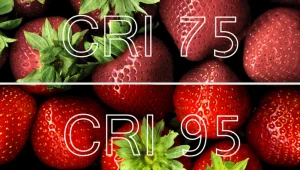
Higher CRI lighting reproduces colors more accurately and naturally, making it suitable for retail, hospitality, and residential applications where color quality is critical.
The Color Rendering Index (CRI) measures how accurately a light source reproduces the colors of objects compared to a reference light source (usually natural daylight or a blackbody radiator).
CRI is rated on a scale from 0 to 100, where:
- 100 = identical color rendering to reference light
- Lower values = greater color distortion
According to the International Commission on Illumination (CIE), CRI is based on standardized color sample comparisons.
Source: CIE 13.3-1995 – Method of Measuring and Specifying Colour Rendering
https://cie.co.at/publications
How Is CRI Measured?
CRI is calculated by testing a light source against eight standardized pastel color samples (R1–R8).
The average color deviation determines the general CRI (Ra).
Important notes:
- Standard CRI (Ra) does NOT include saturated red (R9)
- High-quality lighting often specifies R9 separately
- Two lights with the same CRI can still differ in red rendering
This is why CRI alone does not always tell the full story.
CRI vs Color Temperature (CCT)
Many people confuse CRI with color temperature.
| Metric | What It Measures | Example |
|---|---|---|
| CRI | Color accuracy | 80, 90, 95 |
| CCT | Warmth/coolness | 2700K, 4000K, 5000K |
You can have:
- Warm 3000K with low CRI
- Cool 5000K with high CRI
They are independent characteristics.
What Is Considered a “Good” CRI?
Here is the general guideline:
| CRI Range | Quality Level | Typical Applications |
|---|---|---|
| <70 | Poor | Industrial, security lighting |
| 70–80 | Acceptable | Outdoor, warehouses |
| 80–90 | Good | Residential & offices |
| 90+ | Excellent | Retail, galleries, healthcare |
For most homes:
CRI 80+ is sufficient
For color-critical tasks:
CRI 90+ is recommended
CRI 80 vs CRI 90: Can You See the Difference?

Yes — especially in:
- Skin tones
- Food presentation
- Clothing colors
- Artwork
Under CRI 80:
- Reds may look dull
- Skin tones slightly gray
Under CRI 90+:
- Colors appear richer
- Better depth perception
- Improved realism
In controlled tests, observers can distinguish CRI 80 from CRI 90 lighting in side-by-side comparison.
Does Higher CRI Mean Lower Efficiency?
Historically yes.
Modern LED technology has improved significantly.
According to the U.S. Department of Energy (DOE), advances in phosphor technology allow high CRI LEDs to maintain strong luminous efficacy.
Source: U.S. DOE SSL Program
https://www.energy.gov/eere/ssl
Today, many CRI 90 LEDs achieve comparable efficiency to CRI 80 models.
When Does High CRI Really Matter?
High CRI is most important when:
- Accurate color judgment is required
- Aesthetic presentation matters
- Human perception is critical
For garages or parking lots, high CRI is often unnecessary.
Frequently Asked Questions
Is CRI 100 possible?
Natural sunlight and incandescent lamps approach CRI 100. Most LEDs range between 80–98.
Is CRI 80 good enough?
For general home lighting, yes.
Should I always choose CRI 95?
Only when color accuracy is essential.
Related Guide
If you are selecting CRI for a specific environment, read our detailed application guide:
Best CRI for Different Applications (Home, Retail, Healthcare)
Conclusion
A “good” CRI depends on application.
- CRI 80+ works for most residential spaces
- CRI 90+ improves visual accuracy
- CRI 95+ is ideal for professional environments
Selecting the right CRI ensures better comfort, realism, and visual quality.