Biological vs Visual Lighting: Why CCT Alone Is Not Enough
Commercial lighting has traditionally been specified around CCT (Correlated Color Temperature) because it is easy to describe, easy to compare, and familiar to designers and procurement teams.
But as more buildings pursue wellness goals and measurable outcomes like alertness, sleep quality, and cognitive performance, CCT has started to show its limitations.
Two lights can share the same CCT—say, 4000K—and look identical, yet deliver very different biological effects, depending on their spectral power distribution (SPD). This gap is increasingly recognized in standards from CIE, WELL, and emerging EU frameworks, which shift focus from color appearance to circadian impact.
Lighting that is visually comfortable but biologically ineffective is increasingly seen not just as a missed opportunity, but as a design flaw.
1. Why CCT Fails to Predict Biological Impact

CCT describes whether a light appears visually “warm” or “cool,” based on similarity to a theoretical blackbody radiator.
It was never designed to predict:
- Melatonin suppression
- Alertness or cognitive effect
- Phase shifting of circadian rhythms
- Sleep disruption
Biological responses are driven primarily by specific wavelengths, especially in the blue-cyan region around ~480 nm, which CCT does not disclose.
When “same CCT” becomes a misleading assumption
In real projects, it is common to see two luminaires labeled 3000K or 4000K performing very differently:
- A light with a high melanopic component can stimulate alertness
- Another with a suppressed blue peak can feel neutral or calming
Yet visually, both look “neutral white.”
Designers often assume CCT communicates more than it actually does, which leads to mismatched outcomes when projects aim for health-centric goals.
2. Two Human Light Perception Systems

Lighting impacts humans through two independent sensory pathways.
Professionals often treat them as one, and that is where mistakes begin.
Visual system (for sight)
- Driven by rods and cones
- Peak sensitivity around 555 nm
- Determines brightness, color rendering, glare
Metrics like CCT, CRI, UGR primarily belong to this domain.
This system explains whether lighting “looks good.”
Non-visual system (for biology)
- Driven by ipRGCs (intrinsically photosensitive retinal ganglion cells)
- Sensitivity peak around ~480 nm
- Regulates circadian timing, hormone cycles, and alertness
Metrics like:
- melanopic EDI
- EML
- circadian stimulus
represent this domain.
Lighting that “looks fine” visually can still disrupt sleep or fail to support alertness during working hours.
The two systems are complementary, but not interchangeable.
3. SPD: The Real Driver of Biological Lighting

Professionals often treat SPD as a technical detail, but it is the only reliable representation of the wavelengths that matter biologically.
What SPD reveals
- Blue peak height
- Cyan valley
- Red/amber balance
- Spectral shift during dimming
- Biological potency over time
The WELL Building Standard uses SPD-derived metrics to set lighting requirements for both day and night environments, because no single color temperature can predict circadian performance.
Why SPD changes outcomes even when CCT stays constant
Two sources labeled 4000K may have:
- Different EML values
- Different circadian stimulus
- Different effects on alertness
When used in offices, hospitals, or schools, these deltas translate into:
- Productivity differences
- Sleep complaints
- Staff fatigue
- Patient recovery delays
Manufacturers rarely highlight this because SPD is harder to market than CCT.
4. Balancing Visual Comfort and Biological Health

In many commercial projects, design decisions prioritize visual quality because it is measurable and familiar:
- Low glare (UGR < 19)
- High CRI / TM-30 fidelity
- Uniform CCT across fixtures
These are valid priorities—nobody wants a visually unpleasant environment.
But visually comfortable lighting is not automatically biologically supportive.
Biological needs are different
Daytime environments benefit from higher melanopic EDI to promote alertness.
Evening environments should limit melanopic content to avoid delayed sleep.
This is why well-being focused buildings are moving toward tunable spectra, not just tunable white.
Practical implications
| Space Type | Visual Priority | Biological Priority |
|---|---|---|
| Offices | Glare + CRI | High melanopic EDI |
| Hospitality | Warm ambience | Low melanopic EDI |
| Healthcare | Color accuracy | SPD calibrated cycles |
Wellness-focused design is less about “warm vs cool” and more about matching spectra to human needs over time.
5. Frequent Mistakes in Commercial Projects
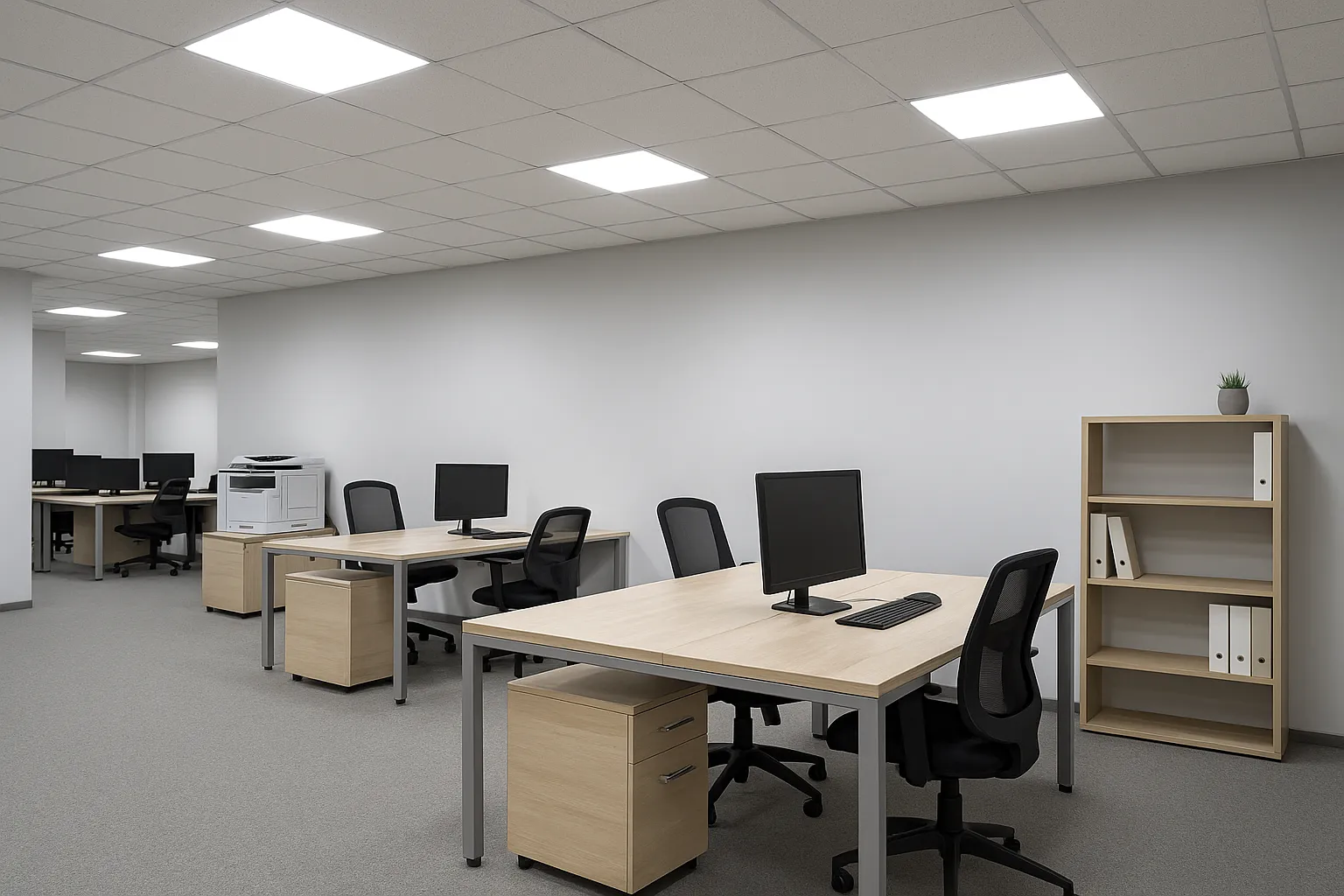
These mistakes appear repeatedly in audits, commissioning reviews, and retrofit evaluations.
Mistake 1: Specifying CCT without SPD requirements
Procurement documents often say:
“4000K, UGR<19, CRI>80”
Without asking for:
- SPD curve
- Melanopic EDI / EML
- TM-30 fidelity
Suppliers comply—but performance varies wildly.
Mistake 2: Assuming warm CCT means low biological impact
Some 2700K or 3000K LEDs still contain prominent blue peaks due to phosphor design.
Hospitals frequently discover this after installation.
Mistake 3: Ignoring spectral drift over time
LEDs modify their SPD as they age or dim:
- Higher correlated CCT shift
- Biological potency collapse
- Reduced consistency across rooms
Most buildings never re-measure SPD post-installation.
Mistake 4: Using static lighting all day
A single uniform spectral environment encourages:
- Afternoon energy dips
- Reduced mood
- Cognitive fatigue
Lighting schedules that never change are rarely aligned with human physiology.
6. Industry Shift Toward SPD-Based Standards
Across major frameworks, the shift is underway.
CIE and WELL
Both reference:
- melanopic EDI
- EML thresholds
- circadian stimulus
not just CCT.
Regulation and certification pressures
Emerging standards push for:
- SPD disclosure
- Biological reporting
- Tunable spectral systems
- Evidence-based commissioning
For high-performance buildings, this is moving from “optional” to expected.
Why now?
Because the industry has enough data to link SPD with:
- alertness
- learning outcomes
- workplace satisfaction
- patient health metrics
Lighting is no longer treated purely as a visual utility.
7. What Buyers and Designers Should Ask For
Experienced teams now request:
Documentation
- SPD curve
- Melanopic EDI / EML levels
- TM-30 fidelity report
- UGR test results
- Dimming SPD stability
Technology Capabilities
- Multi-channel LED engines
- Consistent SPD through dimming
- Low flicker
- Adjustable circadian cycles
Functional Intent
Lighting no longer needs to simply “look good.”
It needs to perform measurably well for humans.
Conclusion
CCT remains a useful metric for describing visual color appearance, but it is not designed to predict biological impact.
Biological lighting depends on spectral composition, and this requires examining SPD, melanopic lux, and circadian stimulus, not just Kelvin.
Commercial buildings that are energy-efficient but biologically ineffective are increasingly viewed as outdated.
Design standards, procurement practices, and performance expectations are shifting toward lighting that supports both visual comfort and human health, not just one or the other.
If you’re developing lighting products or specifying fixtures for commercial environments, and you want solutions that deliver measurable results—visual comfort, circadian support, SPD transparency, and long-term reliability—it’s worth having a conversation early in the design process.
We work with procurement teams, lighting designers, and OEM/ODM partners to translate high-level performance targets into practical specifications:
SPD and melanopic metrics you can verify
High-CRI, low-glare optical strategies
Tunable or multi-channel LED platforms
Driver compatibility and dimming stability
Lifecycle performance and certification alignment
If you want to evaluate whether your current specs meet emerging standards—or explore custom optical or spectral configurations—feel free to reach out with your project brief.
WhatsApp / Email / RFQ welcome.
A short technical discussion can often prevent expensive redesigns later.