داخل سلسلة توريد إضاءة LED في تشيجيانغ: لماذا تهيمن على تصنيع مصابيح LED
Many global buyers still view China as a single manufacturing block. In reality, China’s LED lighting industry is built on strong regional specialization. Nowhere is this more evident than in Zhejiang.
Zhejiang is not simply another production base. It is one of the key reasons LED bulb manufacturing became stable, repeatable, and scalable for long-term export markets.
Zhejiang dominates LED bulb manufacturing because its supply chain evolved around consistency, mechanical reliability, and export discipline—rather than rapid product turnover or short-term trends.
For buyers sourcing standardized LED bulbs such as GU10, MR16, A60, and other general-service lamps for Europe, the Middle East, or other regulated markets, understanding Zhejiang’s supply chain logic is often more important than comparing factory price lists.
The Formation of Zhejiang’s LED Lighting Cluster
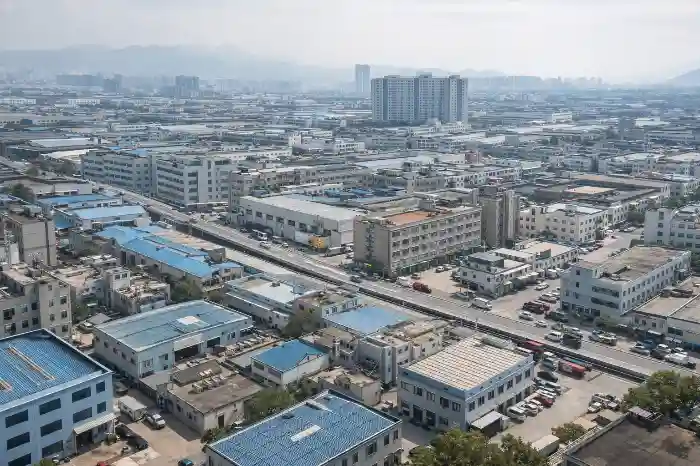
This image captures an overhead perspective of a dense city neighborhood featuring multi-story buildings, factories, streets lined with cars, and surrounding misty peaks.
Zhejiang did not become strong in LED bulb manufacturing by chance. Its lighting industry grew out of decades of hardware, electrical, and mechanical production.
Zhejiang’s LED lighting cluster evolved from traditional electrical and mechanical industries, creating a natural foundation for standardized bulb manufacturing.
Industrial roots before LEDs
Before LED lighting gained momentum, Zhejiang was already a major production base for:
- electrical components
- wiring devices and connectors
- switches and sockets
- die-cast metal parts
- small household electrical appliances
These industries share critical characteristics with LED bulb manufacturing:
- repeatable assembly processes
- tight tolerance control
- mechanical consistency
- long production cycles
When LEDs entered the market, Zhejiang factories did not need to reinvent their operating logic. They adapted existing industrial discipline to a new light source.
Geographic concentration and specialization
Cities such as Ningbo, Shaoxing, Hangzhou, and Jiaxing formed dense supplier networks within short transport distances. This proximity enabled:
- fast material sourcing
- stable subcontractor relationships
- low logistics friction
Unlike regions driven by fast electronics iteration, Zhejiang’s clusters favored process continuity over rapid change.
Export-driven mindset from the start
Zhejiang manufacturers entered LED lighting with overseas markets as their primary focus. Early customers included:
- European importers
- Japanese trading companies
- Middle Eastern distributors
These buyers demanded consistent specifications, repeatable documentation, and long product life cycles. As a result, Zhejiang factories structured production systems around reliability rather than frequent redesign.
Why this history still matters
Supply chains retain memory. Factories shaped by long-term export pressure tend to resist unnecessary change, prioritize documentation accuracy, and protect stable customer programs. This inherited discipline explains why Zhejiang remains dominant in LED bulb manufacturing today.
Product Focus: LED Bulbs (GU10, MR16, A60)

Production line showing employees assembling and inspecting LED bulbs in a modern manufacturing facility with automated equipment.
Zhejiang’s strength is not evenly distributed across all lighting categories. It is concentrated where stability matters most.
Zhejiang specializes in LED bulbs because bulb manufacturing rewards process discipline and thermal consistency more than rapid feature innovation.
Why bulbs align with Zhejiang’s manufacturing DNA
LED bulbs demand:
- stable driver behavior
- controlled thermal pathways
- precise mechanical assembly
- tight binning control
- predictable lifetime performance
These requirements align naturally with Zhejiang’s industrial approach.
Compared with luminaires, bulbs are highly standardized, price-sensitive, and compliance-driven. Small deviations can create large downstream problems for importers and brand owners.
GU10 and MR16 as core categories
GU10 and MR16 spotlights represent the strongest overlap between Zhejiang capability and global demand.
These products are:
- compact and thermally sensitive
- heavily scrutinized for dimming behavior
- highly visible when failures occur
Zhejiang factories invest heavily in:
- aluminum housing consistency
- thermal interface control
- driver matching
- aging and burn-in processes
These details matter more than marketing features.
A60 and general-service bulbs
For E27 and A60 bulbs, Zhejiang excels in:
- lumen stability over time
- batch-to-batch color consistency
- conservative wattage claims
- long production continuity
Many buyers underestimate how disruptive frequent bulb changes can be. Zhejiang factories typically freeze BOMs, avoid opportunistic component substitutions, and maintain the same models for years—benefiting wholesalers and private-label brands alike.
Intentional avoidance of trend-driven products
Zhejiang is less aggressive in RGB bulbs, app-controlled lamps, and short-cycle smart lighting. This is not a weakness, but a strategic choice.
Bulb manufacturing favors predictable behavior over novelty.
Supply Chain Advantages for Bulb Manufacturing
Zhejiang’s dominance is not built on a single factory, but on how the entire supply chain behaves.
Zhejiang’s LED bulb supply chain is optimized for repeatable output, component continuity, and long-term supplier alignment.
Tight upstream control
Factories typically rely on fixed LED chip suppliers, long-term driver partners, and stable housing vendors. Supplier changes are rare and deliberate, reducing requalification cycles and certification risks.
Mechanical and thermal discipline
Thermal performance is treated as a core reliability factor. Emphasis is placed on:
- die-cast aluminum quality
- consistent wall thickness
- uniform surface treatment
This improves lumen maintenance, color stability, and driver lifespan.
Conservative engineering philosophy
Engineering teams focus on incremental optimization rather than experimental redesign. Product life cycles are extended quietly, frustrating trend-driven buyers but reassuring professional ones.
Embedded quality control
Quality assurance is integrated throughout the process—material inspection, in-line checks, and aging tests—rather than relying solely on final inspection. This significantly reduces field failures, especially for dimmable GU10 and MR16 products.
Export readiness
Zhejiang’s logistics infrastructure supports stable shipping schedules and high-volume export. Factories are familiar with EU documentation, CB reports, and RoHS workflows, reducing friction for buyers serving regulated markets.
Cost Structure and Production Consistency
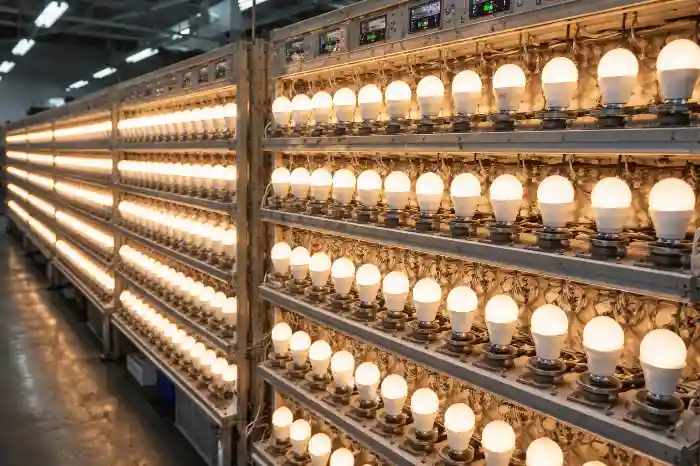
Rows of illuminated LED bulbs arranged on metal frames in a modern production line setting with control panels nearby.
Many buyers assume Guangdong is always cheaper. In practice, the comparison is more nuanced.
Zhejiang’s cost advantage lies in predictability and reduced downstream risk rather than the lowest unit price.
Labor and operational stability
Zhejiang typically offers moderate labor costs, lower employee turnover, and better retention. This supports consistent workmanship and reduces quality variability.
BOM continuity reduces hidden costs
Frequent component changes create hidden expenses: retesting, recertification, returns, and customer complaints. Zhejiang factories reduce these risks by maintaining stable BOMs and inventory buffers.
Production rhythm and yield
Factories favor longer production runs, fewer SKUs, and higher yields. This improves planning accuracy and delivery reliability—critical for B2B programs.
Behavior during volatility
During shortages or logistics disruptions, Zhejiang suppliers are more likely to protect existing orders and specifications rather than renegotiate aggressively. For long-term buyers, this reliability matters.
Ideal Buyer Profiles for Zhejiang Manufacturers

Images depicting shoppers and workers handling energy-efficient LED bulbs in modern retail and industrial warehouse environments.
Zhejiang is not the right fit for every buyer. It is ideal for those whose priorities align with its strengths.
Zhejiang manufacturers suit buyers who value consistency, compliance, and long-term supply continuity.
They work particularly well for:
- private-label brand owners
- wholesalers and distributors
- hospitality and project buyers
- importers serving regulated markets
Buyers focused on rapid cosmetic updates or smart-feature experimentation may find Guangdong better aligned with their strategy.
Supply chain alignment determines partnership success.
الخلاصة
Zhejiang dominates LED bulb manufacturing because its supply chain prioritizes mechanical reliability, component continuity, and export discipline—qualities that matter most in GU10, MR16, and A60 production.
Working with Zhejiang-Based LED Supply Chains
Teco operates its manufacturing base in Zhejiang, focusing on long-term LED bulb programs for GU10, MR16, and general-service lamps supplied to global B2B markets.
We support stable supply, verified compliance, and predictable delivery for buyers serving Europe, the Middle East, North America, and Asia.
If you are sourcing LED bulbs from Zhejiang and want to understand whether this supply chain fits your business model, we help validate sourcing decisions before procurement—not after installation.