Buying 24V LED Bulbs? Check the Voltage and Dimmer First
مقدمة
In low-voltage retrofit projects, the lamp is often not the real problem. The real problem is system mismatch: supply type, driver topology, control method, and base compatibility are not verified before ordering. On site, that leads to flicker, non-dimming loads, premature failure, rework, and delayed handover.
This is especially common in hospitality, landscape, marine, display, and custom joinery projects where 24V lighting is already built into the installation. A bulb marked “24V” or “dimmable” may still be incompatible with the existing transformer, controller, or lamp holder. For distributors, contractors, and project buyers, that translates directly into batch risk, avoidable returns, and costly troubleshooting at commissioning.
ملخص تنفيذي
A 24V LED bulb should be selected by supply type, dimming method, and lamp base together. Confirm whether the system is 24V AC or 24V DC, identify the control method, and verify the fitting before placing the batch order.

24V LED bulb voltage and dimmer compatibility
First, Is Your Supply 24V AC or 24V DC?
الواقع الميداني / التجاري
This is the first screening point because a voltage mismatch is usually not recoverable on site. If the project wiring is already closed, ceiling access is limited, or fittings are installed in guest rooms, corridors, or display joinery, replacing the wrong lamp type becomes a labor issue rather than a product issue.
In many retrofit jobs, the purchasing team sees “24V” and assumes all 24V lamps are interchangeable. They are not. A 24V AC system and a 24V DC system impose different electrical conditions on the lamp’s internal driver1. If this is not checked before ordering, the result may be immediate non-operation, unstable output, or shortened service life.
غوص عميق وحل هندسي
A lamp marked 12–24V AC/DC is designed to accept both alternating current and direct current and automatically adapt within that voltage range. In practical terms, this is commonly the safest first option for a non-dimmable low-voltage replacement lamp because it gives more tolerance when the site supply is not clearly documented.
A lamp marked 24V DC is different. Unless specifically stated otherwise, it should not be assumed compatible with 24V AC. The internal LED driver design is not the same. A DC-only lamp is generally built for a stable direct-current input, while an AC/DC lamp includes circuitry to handle both input forms.
A further practical point: a 24V DC lamp is, unless otherwise specified, much more likely to work with تعتيم PWM2. That makes it suitable for systems using low-voltage LED controllers, remotes, app-based control, or DC dimming knobs.
| Marking on Lamp | Typical Input Compatibility | Typical Control Expectation | التأثير على الصيانة / العائد على الاستثمار |
|---|---|---|---|
| 12–24V AC/DC | Works with both AC and DC within range | Commonly used as non-dimmable replacement | Lower replacement risk when site supply is uncertain |
| 24V DC | DC only unless explicitly specified otherwise | Often suited to PWM dimming | Good for controlled DC systems, but high risk if installed on AC supply |
| 24V AC | AC only | مخصص للتطبيق | Must match existing transformer and load conditions exactly |
ملاحظة المصنع
From a manufacturing perspective, many field complaints described as “lamp failure” are actually supply mismatch cases. The lamp marking was technically correct, but the system input was never verified. For project orders, the supply type should be checked before samples are approved, not after installation begins.
24V AC vs 24V DC LED bulb selection
“Dimmable” Doesn’t Tell You How the Bulb Dims
الواقع الميداني / التجاري
A carton label that says “dimmable” is not enough for project purchasing. On site, the critical question is: dimmable with what controller? If the lamp and dimmer use different control methods, the symptoms are predictable—dead travel, pop-on, shimmer, limited dimming range, or complete non-response.
This becomes expensive in restaurants, suites, lobbies, and guestroom mockups where the expected scene level matters more than full output. If the control protocol is wrong, electricians may spend hours swapping lamps, dimmers, and power units before identifying the mismatch.
غوص عميق وحل هندسي
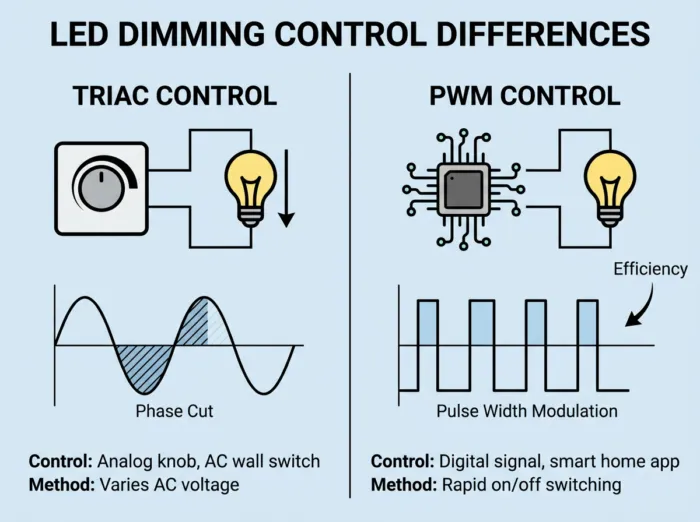
In low-voltage bulb applications, “dimmable” usually refers to one of two very different methods:
TRIAC dimming3
This is the traditional phase-cut dimming method used with a wall dimmer that cuts part of the AC waveform. It is common in legacy halogen systems and in many retrofit dimmable lamps.تعتيم PWM
This method is generally used on 24V DC systems. The controller rapidly switches the DC output on and off at high frequency while changing duty cycle to control perceived brightness. These systems often use a remote controller, app control, or a dedicated low-voltage knob interface.
These are not interchangeable just because both are described as “dimmable.”
| نوع التعتيم | Typical System | Common Control Device | التأثير على الصيانة / العائد على الاستثمار |
|---|---|---|---|
| TRIAC / phase-cut | AC-side dimming, often legacy halogen retrofit | Wall dimmer | Useful for retrofit compatibility, but requires careful lamp-dimmer matching |
| PWM | 24V DC system | Remote, app, low-voltage controller, DC knob | Stable in the correct DC architecture, but incompatible with AC phase-cut dimmers |
If the lamp is a 24V DC PWM-dimmable design, it is normally intended to work downstream of a DC controller, not directly with a traditional TRIAC wall dimmer. By contrast, a TRIAC-dimmable lamp is designed around phase-cut behavior and must be validated against the intended dimmer model.
ملاحظة المصنع
During hotel commissioning, dimming complaints are often traced back to one specification shortcut: the schedule says “dimmable lamp” but does not define the dimmer family. That is not enough for procurement. The control method must be stated explicitly.
dimmable LED bulb TRIAC vs PWM control
GU10, MR16 or A60? Start With the Existing Fitting
الواقع الميداني / التجاري
Lamp shape is often treated as a visual issue, but in retrofit work it is a mechanical and electrical issue first. If the base, holder, or input assumption is wrong, the product may not install at all, or may fit physically while being electrically incorrect.
This is common when a project team orders by lamp code alone without checking the actual socket, supply, and available space inside the fixture. Rework becomes even more disruptive when fittings are already mounted in ceilings, millwork, bedside panels, or decorative housings.
غوص عميق وحل هندسي
Many buyers assume:
- GU10 = mains voltage
- A60 = standard screw bulb on mains
- MR16 = low voltage
That assumption is no longer reliable.
Today, these lamp designations do ليس automatically define the input voltage. A GU10, MR16, or A60 format may be built for 120V, 230V, 12V, 24V, or even 48V depending on the product design. The lamp code tells you about form factor or base family, not the full electrical specification.
Practical selection points:
- GU10: often associated with mains input, but low-voltage versions also exist. Check the datasheet, not the shape.
- MR16: commonly paired with GU5.3 base4, but a base photo is still the safest verification method.
- A60: the bulb shape alone does not tell you whether the screw base is E26 أو E275, and it does not confirm voltage.
For project accuracy, request:
- A photo of the lamp base
- A photo of the socket
- Existing lamp label details
- Supply voltage information from site
| Lamp Type | What It Tells You | What It Does Not Tell You | التأثير على الصيانة / العائد على الاستثمار |
|---|---|---|---|
| GU10 | Base/form factor | Actual operating voltage | Prevents ordering the right shape but wrong electrical version |
| MR16 | Reflector lamp format | Exact base and control method | Base confirmation avoids avoidable returns |
| A60 | Bulb shape | Screw base type and voltage | Important for socket compatibility and replacement planning |
ملاحظة المصنع
From a manufacturing perspective, base confusion is one of the most preventable causes of sample rejection. A simple photo of the existing lamp and holder usually removes most of the risk before quotation. In low-voltage projects, that check is more useful than relying on lamp code descriptions from memory.
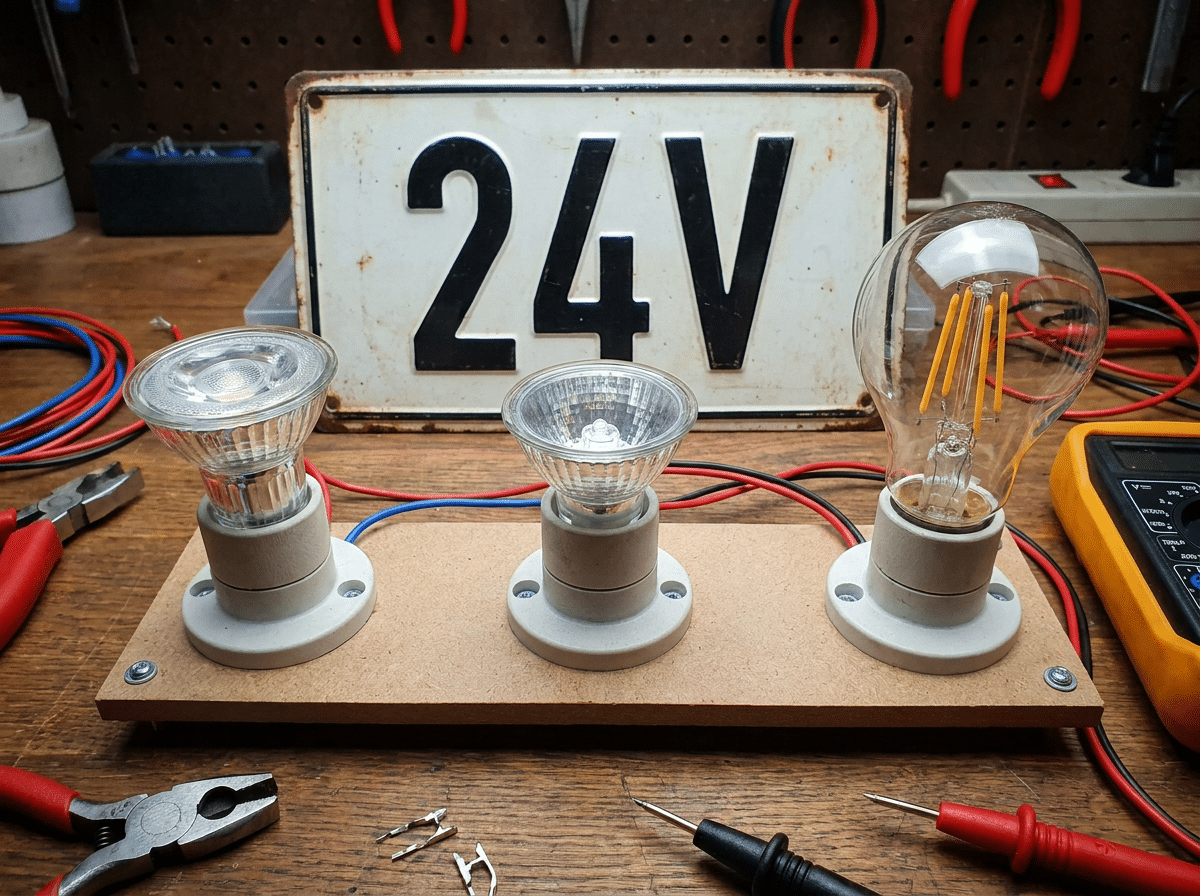
GU10 MR16 A60 low voltage bulb fitting check
Will It Dim Smoothly at the Brightness You Actually Use?
الواقع الميداني / التجاري
Most dimming problems do not appear at 100% output. They show up in the lower part of the dimming range, where the space is actually used. In hospitality and commercial projects, that is where guestroom night scenes, restaurant mood lighting, bar counters, and corridor levels are set.
If the lamp only behaves acceptably at high brightness, the installation may still fail in practice. Visible stepping, flicker, early dropout, or inconsistent lamp-to-lamp response create an immediate quality issue for the operator.
غوص عميق وحل هندسي
The relevant question is not whether the lamp dims. It is whether it dims stably and consistently at the target scene levels used by the project.
This depends on several factors:
- Internal driver design
- Minimum conduction behavior with phase-cut systems
- PWM control quality in DC systems
- Interaction between controller output and lamp electronics
- Batch consistency at low-end output
For phase-cut systems, poor compatibility may cause:
- Late turn-on
- Sudden brightness jumps
- Flicker near the low end
- Lamps dropping out at different points
For PWM-controlled 24V DC systems, performance depends on:
- Controller frequency
- Driver response
- Whether the lamp was designed for PWM control rather than only fixed DC input
A sample should therefore be tested at the actual use levels, not only in a quick full-brightness check.
ملاحظة المصنع
In large hospitality projects, smooth low-end dimming matters more than headline lumen output. The commissioning team will judge the result at 10% to 40%, not at 100%. That is where compatibility should be validated before release for volume order.
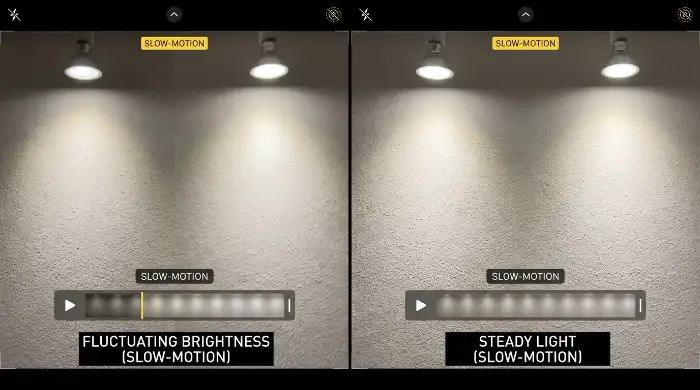
smooth low-end dimming test for 24V LED bulbs
Check the Controller Before Ordering the Full Batch
الواقع الميداني / التجاري
Bulk ordering before controller verification is one of the fastest ways to create avoidable RMA exposure. Even when voltage and base are correct, the wrong dimmer or control interface can make a full batch unusable for its intended application.
On a live project, this usually appears during mockup approval or first-area installation. By that point, the cost is no longer the lamp alone. It includes labor, access equipment, schedule pressure, and loss of confidence from the client or consultant.
غوص عميق وحل هندسي
Before mass purchase, confirm:
- Input supply: 24V AC or 24V DC
- Dimming method: TRIAC or PWM
- Exact controller or dimmer model
- Lamp base and dimensions
- Intended operating brightness range
If the controller is unknown, request its label photo or wiring diagram. If the site uses a legacy dimming system, sample testing becomes mandatory. The same lamp may perform differently across dimmer models even when the nominal dimming method appears similar.
For project-scale orders, the correct process is:
- Collect the load schedule
- Identify power source and control method
- Review fitting details
- Test sample lamps with the real controller
- Release batch only after validation
ملاحظة المصنع
From a manufacturing perspective, compatibility work should happen before mass production, not after delivery. Once a project enters installation, every unresolved interface issue becomes more expensive. Controller verification is one of the lowest-cost checks in the whole procurement cycle.

verify LED controller before bulk bulb order
A Short Checklist Before You Buy
الواقع الميداني / التجاري
Most purchasing errors come from missing one basic confirmation, not from complex engineering. A short pre-order checklist prevents avoidable returns and keeps installation teams out of rework loops.
غوص عميق وحل هندسي
Use this checklist before approving the order:
| Check Item | What to Confirm | التأثير على الصيانة / العائد على الاستثمار |
|---|---|---|
| Supply type | 24V AC, 24V DC, or 12–24V AC/DC | Prevents immediate incompatibility |
| Dimming requirement | Non-dimmable, TRIAC dimmable, or PWM dimmable | Avoids controller mismatch |
| Controller type | Wall dimmer, PWM controller, remote, app, knob | Reduces commissioning risk |
| قاعدة المصباح | GU10, GU5.3/MR16, E26, E27, other | Prevents installation failure |
| Existing fitting photo | Socket, lamp, housing depth | Confirms practical fit |
| Sample test | Real dimmer and real power supply | Verifies actual field performance |
| Brightness use case | Typical operating dim level | Confirms smooth scene performance |
If the project involves 24V GU10, MR16, or A60 lamps, do not assume voltage from the lamp family name alone. Read the specification carefully and verify the base detail.
ملاحظة المصنع
During project approval, the most useful documents are often simple ones: a base photo, a controller label, and a power supply image. Those three checks solve more compatibility problems than broad product descriptions ever will.
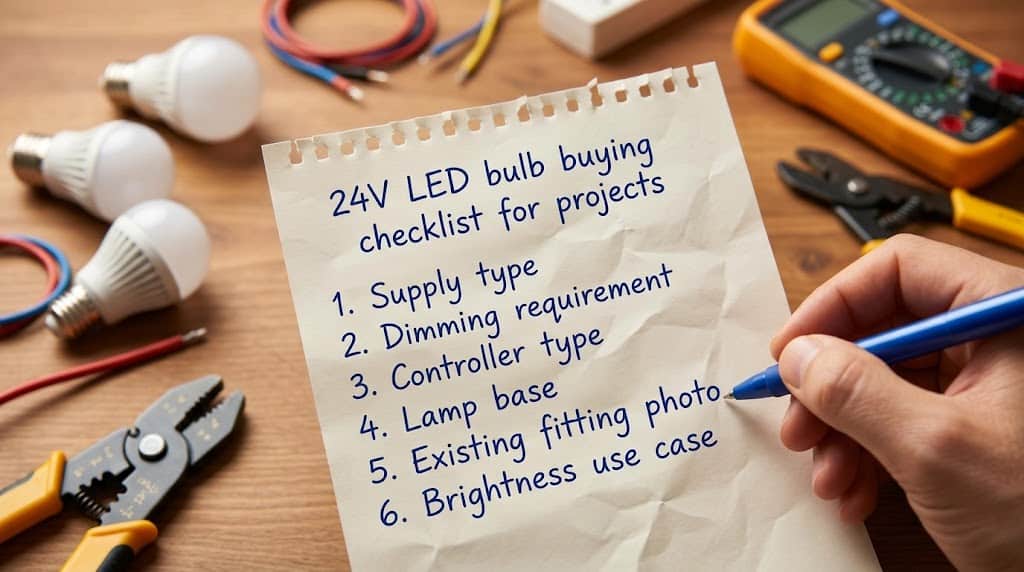
24V LED bulb buying checklist for projects
Conclusion: Business Value
For 24V LED bulb selection, the correct approach is system matching, not part-number matching. Supply type, dimming method, controller, and fitting must all align. When these are verified early, the project gains better reliability, lower maintenance effort, and reduced lifetime system cost.
توصية هندسية بين الشركات
For large projects with specific dimming requirements, request the load schedule. The Teco engineering team will simulate the system in-lab to verify compatibility before mass production.
هوامش
LED driver: The internal electronic circuit that converts incoming power into the controlled current or voltage required by the LED light source. ↩
PWM dimming: Pulse Width Modulation, a dimming method that controls perceived light output by rapidly switching DC power on and off while varying duty cycle. ↩
TRIAC dimming: A phase-cut dimming method using a TRIAC-based controller to reduce effective power delivered over an AC waveform. ↩
GU5.3: A two-pin lamp base with 5.3 mm pin spacing, commonly used for MR16-format low-voltage lamps. ↩
E26 / E27: Edison screw lamp bases with nominal diameters of 26 mm and 27 mm respectively; mechanical compatibility and regional standards should be verified separately. ↩