Last updated: March 19, 2026
Introduction: Choosing the Right CCT Is a Business Decision
In commercial lighting projects, color temperature selection is not just a design preference — it directly affects customer experience, productivity, and overall project performance.
Incorrect CCT specification can result in:
- Poor retail presentation
- Uncomfortable office environments
- Inconsistent lighting across large installations
يركز هذا الدليل على how to select the right LED color temperature for commercial spaces, based on real application scenarios rather than simple comparisons.
What Is LED Color Temperature (CCT)?
Correlated Color Temperature (CCT) describes the visual appearance of white light, measured in Kelvin (K).
- Lower CCT → warmer, softer light
- Higher CCT → cooler, brighter light
In commercial environments, CCT directly influences:
- Visual clarity
- Material appearance
- Space perception
- User comfort
Commercial Lighting Ranges: 3000K, 4000K, and 5000K

In most commercial projects, three primary CCT ranges are used:
| CCT Range | التأثير البصري | Typical Commercial Use |
|---|---|---|
| 3000 كلفن | Warm, inviting | Hospitality, boutique retail |
| 4000 كلفن | Neutral, balanced | Offices, supermarkets |
| 5000K | Bright, high contrast | Warehouses, industrial |
Instead of asking “which is better,” the correct approach is:
Which CCT aligns with your project function?
Best LED Color Temperature by Commercial Application
بيئات المكاتب
Recommended: 4000K
- Supports focus and productivity
- Provides balanced and comfortable lighting
- Aligns with modern workplace standards
In some markets (especially North America), 3500K is also used as a balanced option between warmth and clarity.
Retail Stores
Recommended: 3000K–4000K
- 3000K enhances warmth and customer experience
4000K improves product visibility
Many retail environments combine both for layered lighting design
Important:
In retail environments, color rendering is as important as color temperature.
- Recommended: CRI (Ra) ≥ 90
- Ensures products appear vivid and true-to-color
Even with correct CCT, low CRI lighting can make merchandise look dull or low-quality.
Hospitality Spaces (Hotels & Restaurants)
Recommended: 2700K–3000K
- Creates a relaxing and welcoming atmosphere
Enhances guest comfort and perception
Higher CCT levels should generally be avoided, as they may feel overly clinical
Warehouses and Industrial Facilities
Recommended: 5000K
- Provides strong brightness and contrast
- Improves operational visibility and safety
However, in customer-facing commercial spaces, 5000K should be used cautiously, as it may feel too harsh depending on the environment.
Healthcare and Educational Spaces
Recommended: 3500K–5000K
- Balanced lighting supports both comfort and accuracy
- Suitable for task-oriented environments
For these applications, high CRI lighting (Ra ≥ 90) is recommended to improve visual accuracy and reduce eye strain.
How to Select the Right CCT for Commercial Projects
1. Define the Function of the Space
Determine whether the space is:
- Customer-facing
- Task-driven
- Multi-functional
2. Evaluate Materials and Interior Design
CCT interacts with:
- Finishes (wood, metal, fabric)
- Product colors
Surface reflectivity
Always test lighting samples in real environments
3. Consider User Experience
Lighting should support:
- Comfort
- Visibility
- Intended atmosphere
4. Verify Standards and Consistency
For commercial projects, ensure:
- ANSI C78.377 bin consistency
- Compliance with EN 12464-1
Fixed CCT vs Tunable White Systems
Fixed CCT Lighting
الأفضل لـ:
- Standard commercial projects
- Large-scale installations
Advantages:
- Stable chromaticity
- Lower cost
- Simple installation
Tunable White Lighting
الأفضل لـ:
- المكاتب
- Retail showrooms
- Multi-purpose environments
Advantages:
- Adjustable color temperature
- مشاهد إضاءة مرنة
- Future-proof system design
CCT-Selectable Lighting (3CCT Switchable)
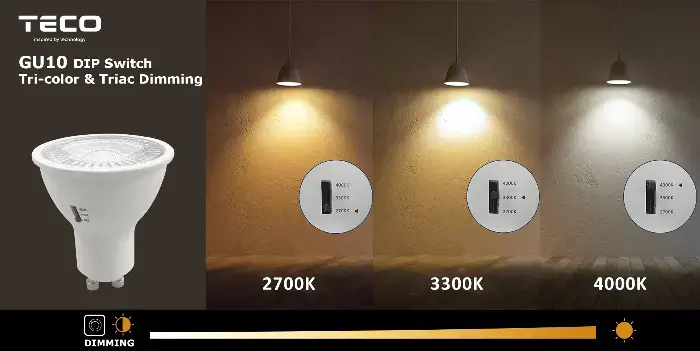
In many commercial projects, contractors increasingly prefer CCT-selectable fixtures (e.g., 3000K / 4000K / 5000K in one product).
This solution offers:
- Reduced inventory complexity
- Greater flexibility during installation
- Lower risk of incorrect CCT selection
It is especially useful for:
- Retail chain rollouts
- Renovation projects
- Multi-region distribution
However, for projects requiring strict visual consistency, fixed CCT with controlled binning remains the preferred solution.
Common Mistakes in Commercial Color Temperature Selection
1. Using High CCT in Customer-Facing Areas
→ Creates harsh and uncomfortable environments
2. Mixing Inconsistent CCT Bins
→ Leads to visible color mismatch across fixtures
3. Focusing Only on CCT
→ Ignoring CRI, glare control, and illuminance
4. Using a Single CCT Across All Areas
→ Reduces lighting effectiveness and spatial layering
When to Use Each CCT (Quick Commercial Reference)
- 3000 كلفن → Atmosphere-driven environments
- 4000 كلفن → Balanced commercial spaces
5000K → High-visibility, task-critical areas
In many commercial projects, combining multiple CCT layers delivers the best results
Related Guide for Residential Applications
Commercial and residential lighting require different approaches.
For home lighting decisions, refer to:
3000K vs 4000K for Home Lighting (Living Room, Kitchen & Bedroom Guide)
Business Impact of Proper CCT Selection
Correct LED color temperature selection can:
- Improve customer experience
- Enhance retail presentation
- Increase workplace productivity
- Reduce project errors and revisions
For B2B buyers, this results in:
- More reliable project delivery
- Higher client satisfaction
- Reduced after-sales issues
الخلاصة
Selecting the right LED color temperature for commercial spaces is a strategic decision that impacts both performance and perception.
Rather than focusing on simple comparisons, project stakeholders should:
- Match CCT with space function
- Consider user experience and material interaction
- Ensure consistency and compliance
A well-planned CCT strategy leads to better lighting outcomes and long-term project success.
توصية هندسية بين الشركات
For commercial lighting projects, always verify:
- CCT consistency (ANSI binning)
- CRI performance (preferably Ra ≥ 90 for critical areas)
- Application-specific requirements
If flexibility is required, consider:
- Multi-CCT (3CCT) products
- Tunable white systems
- Custom project-based solutions