Warum Zertifizierung der Grundstein für B2B-Beleuchtungszuverlässigkeit ist
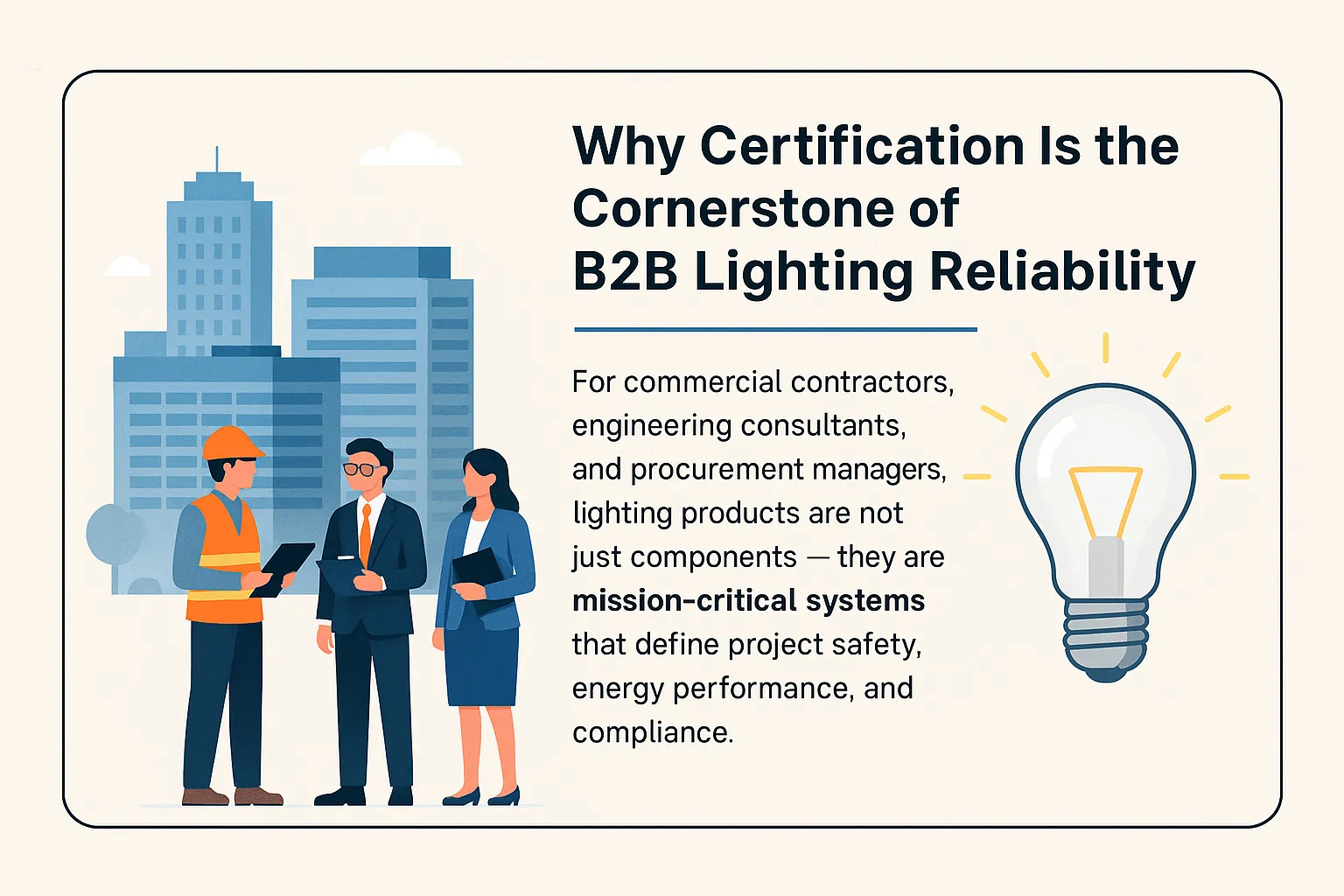
Für gewerbliche Auftragnehmer, Ingenieurberater und Beschaffungsmanager sind Beleuchtungsprodukte nicht nur Komponenten — sie sind missionkritische Systeme die die Projektsicherheit, Energieeffizienz und Konformität definieren.
Gemäß dem Internationale Energieagentur (IEA, 2024), China produziert jetzt über 80% der weltweiten LED-Beleuchtungsprodukte, die jährlich Milliarden von Einheiten exportieren. Allerdings variieren Produktqualität und Konformität stark zwischen den Lieferanten.
In der B2B-Umgebung — wo Projekte oft Millionen von Dollar übersteigen — kann eine nicht zertifizierte LED-Lampe zu Inspektionsfehlern, Garantie-Streitigkeiten und Reputationsschäden führen.
Ein Beispiel: Eine groß angelegte Hotelrenovierung in Dubai verzögerte sich um Monate, als eine Lieferung nicht zertifizierter Leuchtmittel die SASO-Energieeffizienzprüfungen nicht bestand. Die Neuinstallation kostete mehr als 15% des gesamten Projektbudgets.
Lektion: Zertifizierung ist nicht nur Papierkram. Es ist ein strategische Absicherung gegen technische Risiken, regulatorische Strafen und Kundenzufriedenheit.
Verständnis, was LED-Zertifizierung wirklich bedeutet
Zertifizierung vs. Konformität

Obwohl diese Begriffe oft synonym verwendet werden, haben sie unterschiedliche Bedeutungen:
- Zertifizierung: Das Produkt wurde unabhängig von einer anerkannten Behörde (z. B. TÜV, UL, Intertek) geprüft und zugelassen.
- Konformität: Der Hersteller behauptet um Standards zu erfüllen, aber möglicherweise ohne Drittvalidierung.
Wer erteilt Zertifizierungen
Weltweit anerkannte Zertifizierungs- und Prüfstellen umfassen:
- TÜV Rheinland (Deutschland)
- UL (Underwriters Laboratories, USA)
- Intertek (ETL)
- CSA Group (Kanada)
- SAA-Zulassungen (Australien)
- CB-System (IECEE)
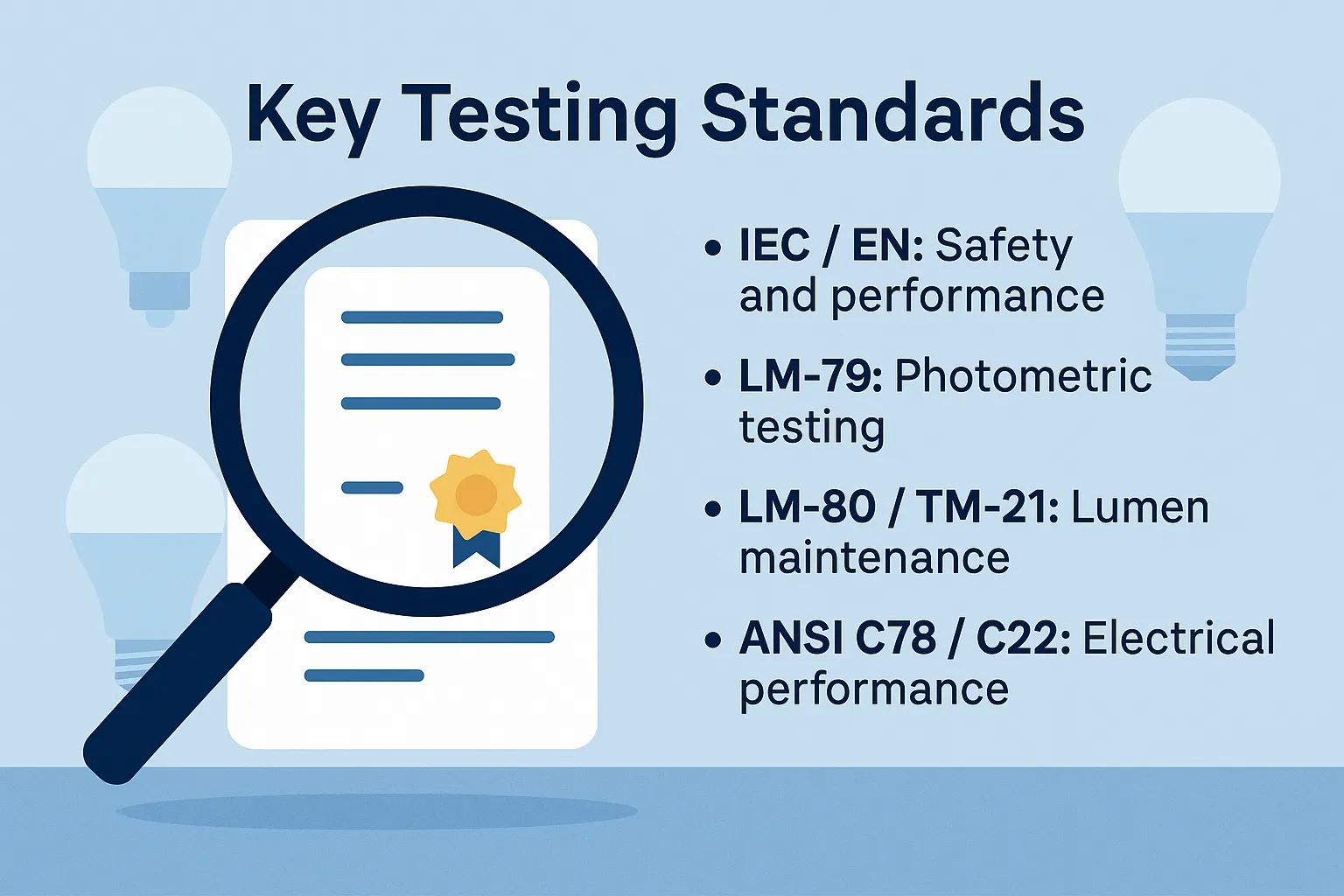
Wichtige Prüfnormen
- IEC / EN Normen: Sicherheits- und Leistungsgrundlagen, die weltweit anerkannt sind.
- LM-79: Prüfung des Lichtstroms, der Effizienz und der Farbmetrik für LED-Lampen.
- LM-80 / TM-21: Lumenerhaltung und Lebensdauerprognosen.
- ANSI C78 / C82: Elektrische und photometrische Leistungsstandards für Nordamerika.
(Quelle: US-Energieministerium – Solid-State Lighting Program)
Verständnis von Prüfstandards und Zertifizierungsdetails
Um für internationale Märkte qualifiziert zu sein, muss ein zuverlässiger LED-Lampenhersteller spezifische Richtlinien und Prüfstandards die je nach Region variieren.
1. CE-Kennzeichnung (Europa & UK)
Niederspannungsrichtlinie (2014/35/EU)
Sicherstellung der elektrischen Sicherheit von Geräten, die mit 50–1000 V AC betrieben werden.
Prüfgegenstände:
- Isolationswiderstand und dielektrische Festigkeit
- Schutz gegen elektrischen Schlag
- Temperaturanstieg unter abnormalen Bedingungen
- Flammen- und Brandgefahrenprüfungen (Glühdraht, Nadelflamme)
Referenzierte Standards:
- EN/IEC 62560 (Sicherheit von selbstballastierten LED-Lampen)
- EN 60529 (IP-Schutz)
- EN/IEC 62471 (Photobiologische Sicherheit)
EMV-Richtlinie (2014/30/EU)
Verhindert Interferenzen zwischen elektrischen Geräten.
Hauptprüfungen:
- Emissionen: EN 55015 / CISPR 15
- Oberschwingungen: EN 61000-3-2 (Klasse C Beleuchtungsgeräte)
- Flimmern / Spannungsschwankungen: EN 61000-3-3
- Immunität: EN/IEC 61547
RoHS (2011/65/EU + 2015/863)
Begrenzt gefährliche Stoffe wie Blei, Cadmium und Quecksilber.
Hersteller müssen eine bereitstellen Konformitätserklärung und Materialprüfberichte.
(Referenz: Richtlinie der Europäischen Kommission zur Beschränkung gefährlicher Stoffe (RoHS))
Ökodesign & Energieverbrauchskennzeichnung (EU 2019/2020 & EU 2019/2015)
Definiert Mindestanforderungen an die Energieeffizienz und Produktinformationen.
Hauptprüfungen:
- Lichtausbeute und Standby-Leistung
- Lebensdauer und Lichtstromerhalt
- Flimmern (Pst LM) und stroboskopischer Effekt (SVM)
- Registrierung in EPREL-Datenbank
2. Nordamerika: UL / ETL / FCC
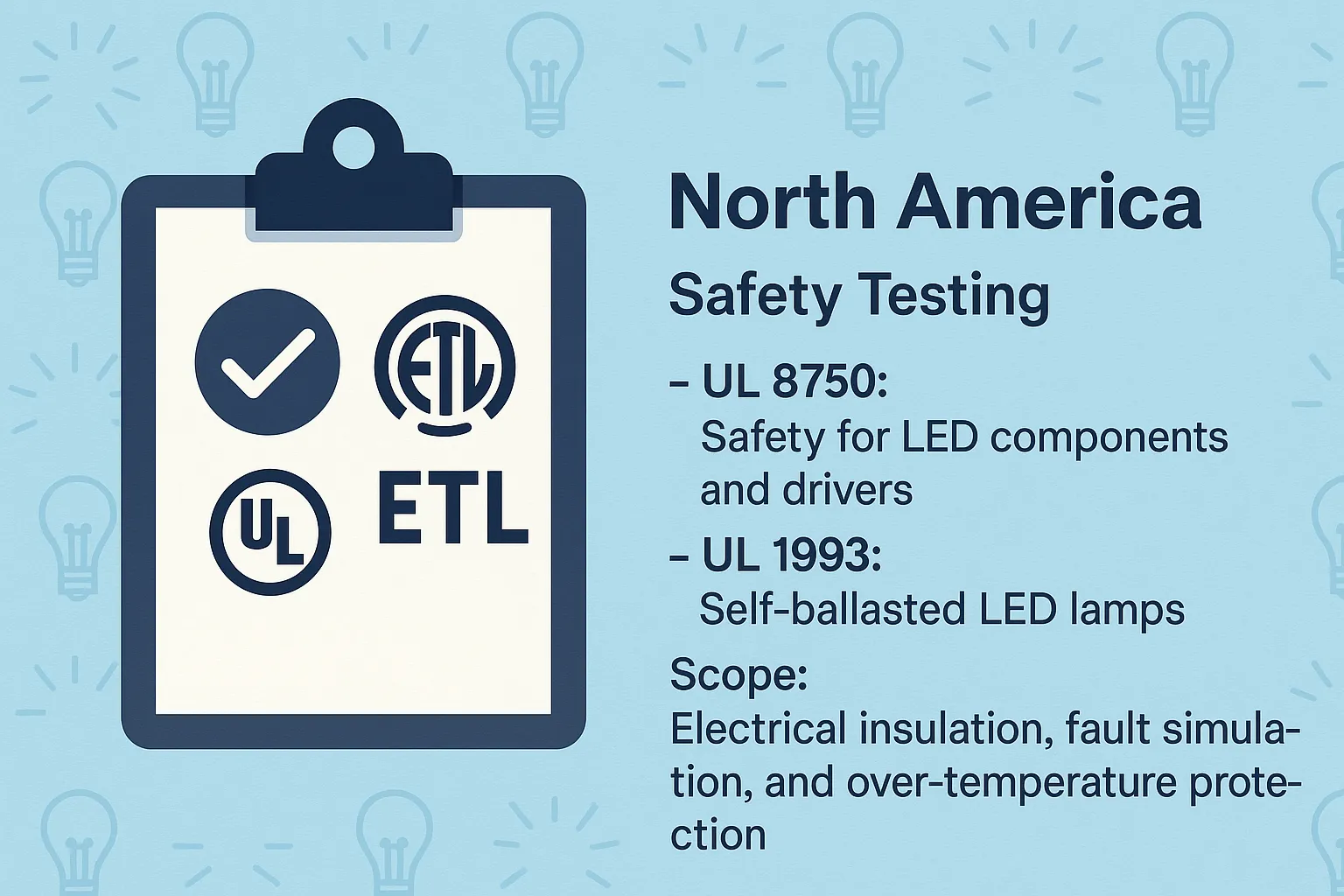
UL / ETL-Sicherheitsprüfung
- UL 8750: Sicherheit für LED-Komponenten und Treiber
UL 1993: Selbstballastierte LED-Lampen
- Anwendungsbereich: Elektrische Isolierung, Fehlersimulation und Übertemperaturschutz
- Authentizität überprüfen in der UL Product iQ-Datenbank
FCC Teil 15 (Unterabschnitt B)
- Regelt elektromagnetische Emissionen für Klasse B (Wohnbereich) Beleuchtungsgeräte
- Prüfmethoden: Geführte und abgestrahlte Emission nach ANSI C63.4
(Referenz: FCC Teil 15 Vorschriften)
Leistungsstandards
- IES LM-79 — Komplette photometrische Prüfung der Leuchte
- IES LM-80 / TM-21 — LED-Chip-Lumen-Erhaltung und Lebensdauerprognose
3. Naher Osten: SASO & G-Mark
SASO Energieeffizienz und Sicherheit
- SASO 2902 — Energieeffizienz, optische Leistung und Sicherheit für Beleuchtungsprodukte
- Erforderlich für die Zollabfertigung und die Ausschreibungsqualifikation von Projekten
G-Mark (Golf-Konformitätszeichen)
- Ausgestellt unter der GCC-Standardisierungsorganisation (GSO)
- Abdeckungen Niederspannung und EMV Konformität unter einheitlichen Golfvorschriften
Tipp: Für Ausschreibungen in der Golfregion doppelte Konformität sicherstellen — CB-Bericht + SASO-Registrierung — um Probleme bei der Zollabfertigung zu vermeiden.
4. Australien & Neuseeland: RCM und AS/NZS-Normen
RCM (Regulatory Compliance Mark)
- Steht für die Einhaltung von Elektrische Sicherheit (EESS) und EMV (ACMA) Rahmenwerke
- Lieferant muss in der nationalen Datenbank registriert sein
AS/NZS 62560:2017
- Basierend auf IEC 62560, angepasst an lokale Spannungs- und Sicherheitsumgebungen
- Kombiniert mit CISPR 15 für EMV-Emissionsprüfungen
5. ISO Qualitäts- und Umweltmanagementsysteme
- ISO 9001 – Qualitätsmanagement
- ISO 14001 – Umweltmanagement
- ISO 45001 – Arbeitsschutz und Sicherheit
(Quelle: ISO-Offizielle Website)
Ingenieurwissen:
Zertifizierte Hersteller integrieren diese Standards in jede Phase – von der SMT-Produktion über Alterungstests bis zur Sendungsverfolgung – und gewährleisten so gleichbleibende Zuverlässigkeit über alle Chargen hinweg.
Kernzertifizierungen, die jeder zuverlässige LED-Lampenhersteller bereitstellen sollte
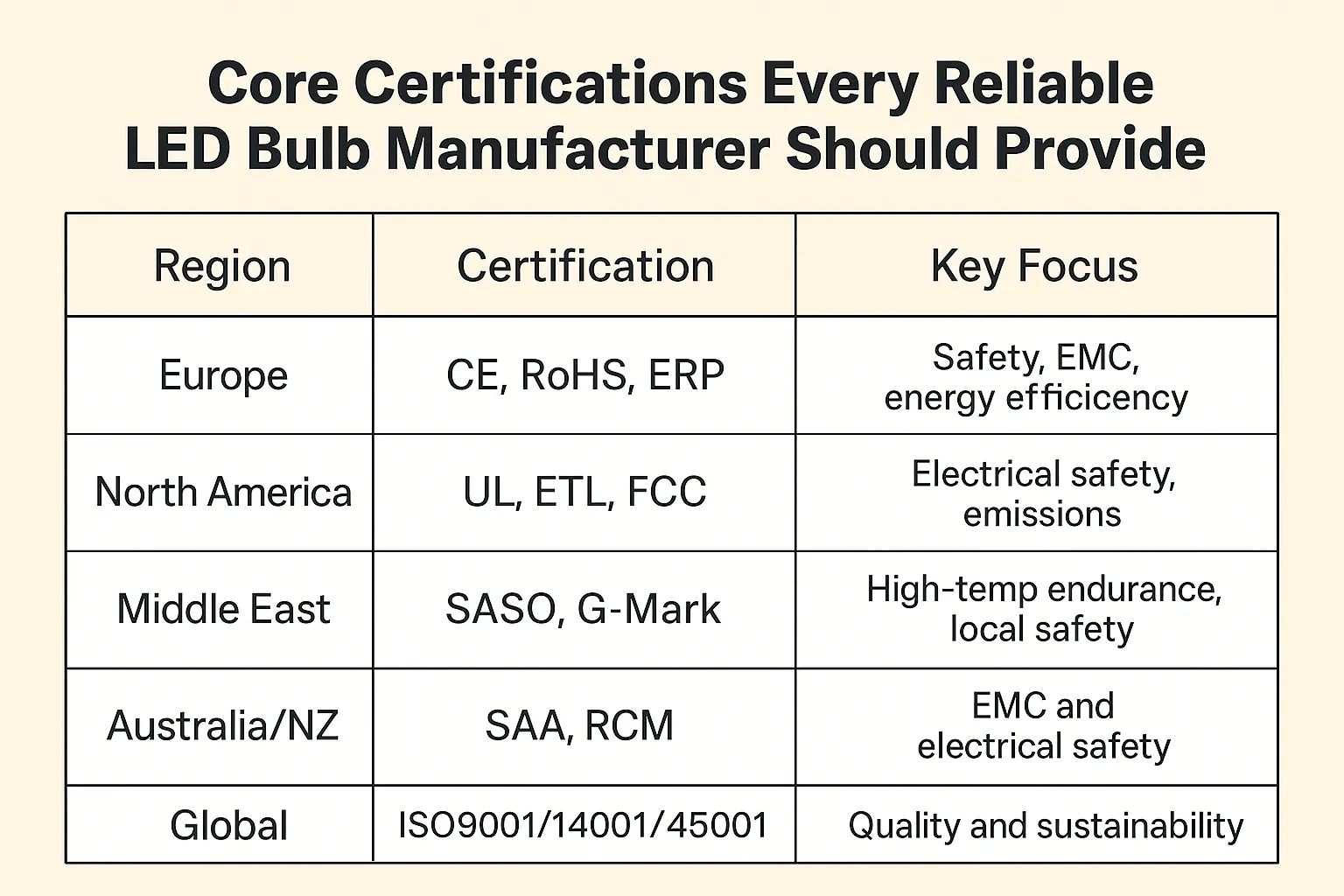 | Region | Zertifizierung | Schwerpunkt |
|---|---|---|---|
| Europa | CE, RoHS, ERP | Sicherheit, EMV, Energieeffizienz | |
| Nordamerika | UL, ETL, FCC | Elektrische Sicherheit, Emissionen | |
| Naher Osten | SASO, G-Mark | Hochtemperaturbeständigkeit, lokale Sicherheit | |
| Australien/Neuseeland | SAA, RCM | EMV und elektrische Sicherheit | |
| Global | ISO9001/14001/45001 | Qualität und Nachhaltigkeit |
Ein vertrauenswürdiger Lieferant wird proaktiv Dokumentation teilen und erklären Sie den Testprozess detailliert, einschließlich Berichten, Namen der Testlabore und Ablaufdaten der Zertifikate.
Wie B2B-Käufer die Echtheit von Zertifikaten überprüfen können
Ein strukturierter Verifizierungsprozess gewährleistet Compliance-Integrität.
Checkliste zur Überprüfung:
- Fordern Sie Zertifikate mit Seriennummern und Details der ausstellenden Stelle.
- Authentizität über offizielle Datenbanken überprüfen (z.B. TÜV, UL, SASO).
- Überprüfen Ablauf und Umfang der Abdeckung.
- Nachfragen nach LM-79 / LM-80 / TM-21 Berichte mit originalen Laborlogos.
- Bestätigen Sie die Firmenname stimmt mit Gewerbeschein überein.
- Nutzen Sie vor dem Versand unabhängige Inspektoren (SGS, QIMA oder Intertek).
- Lehnen Sie alle “geteilten” Zertifikate oder nicht verifizierbare PDFs ab.
(Siehe TÜV Rheinland Certipedia-Datenbank)
Zertifizierung als Indikator für Fertigungsreife
Zuverlässige LED-Lampenhersteller integrieren Compliance auf jeder Ebene:
- Automatisierte SMT-Montage und AOI-Optikprüfung
- Hauseigene Testlabore für EMC-, Temperatur- und Überspannungstests
- ERP-Systeme für Batch-Rückverfolgbarkeit
- Dokumentierte interne Audits nach ISO9001
Als Compliance-Bericht von LightingEurope (2024) Hinweise, Hersteller mit hauseigenen Zertifizierungssystemen Erfahrung 40% weniger Garantieansprüche und eine deutlich bessere Produktkonsistenz.
Häufige Fehler und Warnsignale
Vermeiden Sie Lieferanten, die:
- Verwendung gefälschte CE- oder UL-Logos ohne gültige IDs.
- Zertifikate vorlegen, die nichts mit LED-Lampen zu tun haben.
- Bieten ultra-niedrige Preise ohne Testdokumentation an.
- Videoaudits oder Verifizierung durch Dritte ablehnen.
- Betreiben als Händler, die sich als Hersteller ausgeben.
Professioneller Tipp: Durchführung einer Vorversandskontrolle (PSI) — eine geringe Kosten, die große Verluste verhindert.
Wie sich Zertifizierung auf ROI und Projekterfolg auswirkt
Zertifizierte Beleuchtung verbessert direkt Projektergebnisse:
- 35% längere Lebensdauer im Durchschnitt (DOE SSL-Bericht, 2024)
- 10–15% niedrigere Garantiekosten
- Verbesserte Ausschreibungsfähigkeit in Regierungs- und ESG-Projekten
- Reduzierter Wartungsaufwand, Verbesserung der Gesamtbetriebskosten (TCO)
Zertifizierung gewährleistet nicht nur Konformität, sondern Geschäftskontinuität für mehrjährige Projekte.
Entstehende Trends in der globalen LED-Zertifizierung
Die nächste Phase der LED-Konformität betrifft intelligente, nachhaltige und digitale Verifizierung.
1. Intelligente Beleuchtungsprotokolle
- DALI-2, Zigbee und Bluetooth Mesh erfordern nun Interoperabilitätszertifizierung.
2. ESG- und CO₂-Fußabdruck-Verifizierung
- ISO 50001 (Energiemanagement) und Lebenszyklusanalyse (LCA) werden zum Standard im grünen Beschaffungswesen.
3. Digitaler Produktpass (DPP)
- Eingeführt im Rahmen des EU-Ökodesign-Verordnung für nachhaltige Produkte (2024), das nachverfolgbare digitale IDs für jedes Beleuchtungsprodukt vorschreibt.
4. Bereitschaft für Kreislaufwirtschaft
Hersteller sollen recycelbare Materialien und Verpackungen verwenden — im Einklang mit der Europäischer Green Deal.
Fazit: Zertifizierung als strategische Investition
Für B2B-Beschaffungsteams und Ingenieurbüros ist Zertifizierung mehr als nur ein Konformitäts-Häkchen – sie ist eine strategische Garantie für Zuverlässigkeit und Professionalität.
Ein zertifizierter LED-Lampenhersteller zeigt:
- Globale Marktreife
- Transparentes Qualitätsmanagement
- Ingenieurmäßige Konsistenz
- Nachhaltige Produktionspraktiken
Die Zusammenarbeit mit zertifizierten Lieferanten mindert nicht nur Risiken, sondern stärkt auch die Marktglaubwürdigkeit und stellt sicher, dass jedes Projekt termingerecht, spezifikationskonform und nach internationalen Standards geliefert wird.