
Last updated on March 17, 2026
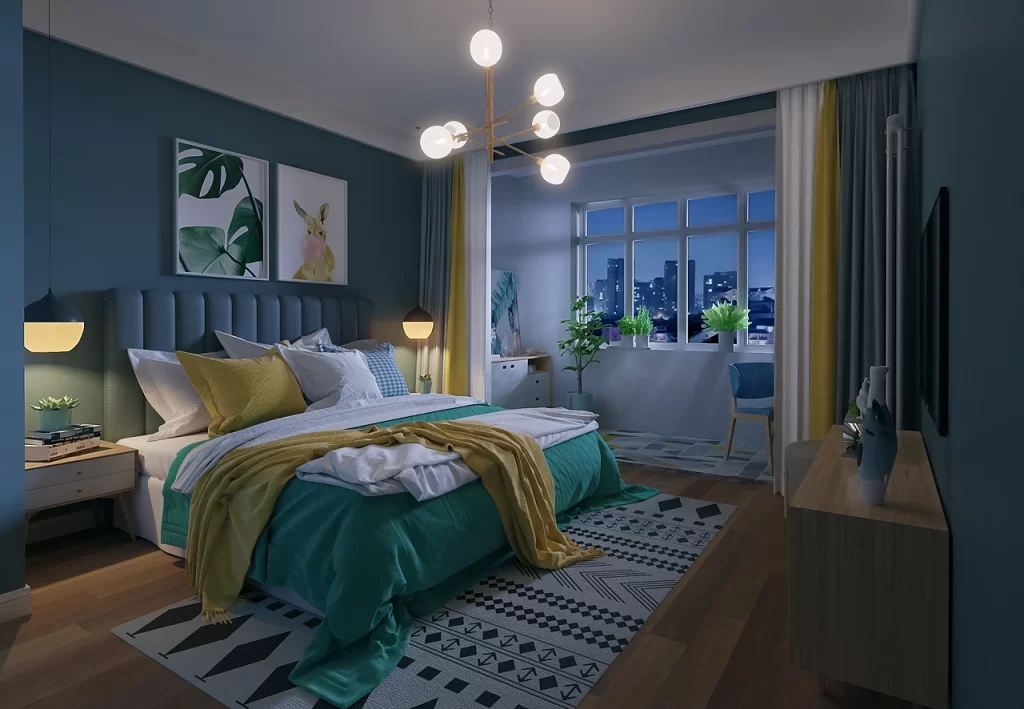
Modern bedroom lighting with dimmable LED fixtures
Einführung
LED dimming has become a standard requirement in modern lighting systems. From residential homes to hospitality environments, retail spaces, and commercial offices, dimmable LED lighting allows users to control brightness levels, create flexible lighting scenes, and improve energy efficiency.
However, LED dimming works differently from traditional incandescent or halogen lighting. Because LEDs rely on electronic drivers to regulate current, compatibility between the LED driver and dimmer switch is essential.
In many installations, problems such as flicker, buzzing, or unstable brightness occur due to mismatched dimming technologies.
This guide explains how LED dimming works, the main dimming technologies used in modern lighting systems, and how to ensure compatibility in both residential and commercial lighting projects.
Choosing the right dimming system is critical for avoiding flicker, ensuring compatibility, and achieving stable lighting performance.
For readers looking specifically for lamps, see our guide to dimmable LED light bulbs.
Quick Guide: How to Choose the Right LED Dimming System
Before exploring each dimming technology in detail, here is a quick selection guide:
• TRIAC (phase-cut): best for residential retrofit projects
• PWM: best for stable and precise dimming performance
• 0–10V: best for commercial lighting systems
• DALI: best for smart buildings and advanced control
Selecting the correct dimming system helps avoid compatibility issues and ensures smooth, flicker-free performance.
What Is LED Dimming?
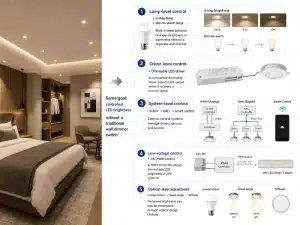
LED dimming refers to the ability to adjust the brightness of LED lighting fixtures by controlling the electrical current supplied to the LED driver.
Unlike incandescent lamps, which dim naturally as voltage decreases, LED chips require a constant current supply. The LED driver interprets dimming signals and adjusts current output to regulate brightness.
This process allows LED lighting systems to achieve:
- adjustable light levels
- improved energy efficiency
- customizable lighting scenes
- enhanced visual comfort
LED dimming is widely used in residential lighting, commercial lighting, hospitality environments, and architectural lighting design.
How LED Dimming Works

Example of dimmable LED spotlight installation
LED dimming relies on electronic drivers that control the electrical current flowing through LED chips.
When a dimmer sends a control signal, the LED driver adjusts the current supplied to the LEDs, which changes the brightness output.
Two main principles are commonly used:
Phase-Cut Dimming
Phase-cut dimming modifies the AC waveform to reduce the amount of electrical power delivered to the LED driver.
There are two common phase-cut methods:
- Leading-edge dimming (TRIAC)
- Trailing-edge dimming
Trailing-edge dimmers are typically more compatible with LED lighting because they are designed for electronic loads.
👉 For detailed comparison, see:
https://tecolite.com/triac-dimming-vs-0-10v-dimming-key-differences-compatibility-applications/
Pulsweitenmodulation (PWM)
PWM dimming works by rapidly switching the LED on and off at high frequency. The ratio between the “on” time and “off” time determines the perceived brightness.
Because switching occurs at high frequency, the human eye perceives a smooth brightness change.
PWM dimming is widely used in smart lighting systems and professional lighting controls.
👉 Related guide:
https://tecolite.com/pwm-frequency-led-flicker/
Types of LED Dimming Systems
Different lighting installations use different dimming technologies depending on application requirements.
| Dimmtechnologie | Typical Application | Control Method |
|---|---|---|
| TRIAC / Phase-Cut | Residential lighting | AC waveform control |
| PWM | Smart lighting systems | High-frequency switching |
| 0–10V Dimming | Commercial buildings | Analog control signal |
| DALI | Smart commercial lighting | Digital control network |
Each dimming system has different advantages depending on application, control requirements, and driver compatibility.
TRIAC Dimming
TRIAC dimming is commonly used in residential lighting systems. It works by cutting part of the AC waveform to reduce the electrical energy delivered to the LED driver.
Although widely used, TRIAC dimming can sometimes cause flicker if the LED driver is not compatible with the dimmer.
PWM-Dimmung
PWM dimming is often used in LED drivers and smart lighting systems. Because it maintains constant current during each pulse cycle, it can provide very stable brightness control.
0–10V Dimming
0–10V dimming is widely used in commercial lighting installations. A low-voltage control signal determines brightness levels, allowing centralized lighting control.
This technology is common in:
- office lighting
- retail stores
- warehouses
- commercial buildings
DALI Dimming
DALI (Digital Addressable Lighting Interface) is a digital lighting control protocol used in advanced lighting systems.
DALI systems allow each fixture to be individually controlled and integrated with building automation systems.
Dimmer Compatibility Explained
Dimmer compatibility is one of the most important factors affecting LED dimming performance.
Using an incompatible dimmer may result in:
- flicker
- buzzing noise
- unstable brightness
- limited dimming range
| Dimmer Type | LED Compatibility | Typical Use |
|---|---|---|
| Leading-edge (TRIAC) dimmer | Medium | Older residential systems |
| Trailing-edge dimmer | Hoch | Modern LED installations |
| 0–10V dimming | Hoch | Commercial lighting |
| DALI control | Very high | Smart buildings |
To avoid compatibility problems, dimmers designed specifically for LED loads should be used.
Common LED Dimming Problems
Although dimmable LED lighting is widely used, improper installation can lead to several common issues.
| Problem | Cause | Solution |
|---|---|---|
| Flickering | incompatible dimmer | replace with LED-compatible dimmer |
| Buzzing noise | electrical vibration in dimmer | use trailing-edge dimmer |
| Limited dimming range | driver limitations | use high-quality LED drivers |
| Lights not dimming | non-dimmable lamps installed | install dimmable LED bulbs |
👉 For detailed troubleshooting, see:
https://tecolite.com/led-gu10-bulb-flickering/
Choosing the Right Dimming System
Selecting the correct dimming system depends on the lighting application, control requirements, and system compatibility.
| Anmeldung | Recommended Dimming Technology |
|---|---|
| Residential lighting | TRIAC or trailing-edge dimming |
| Retail lighting | 0–10V dimming |
| Hospitality lighting | TRIAC or DALI |
| Smart buildings | DALI lighting control |
In general:
• choose TRIAC for simple retrofit projects
• choose 0–10V for stable commercial lighting
• choose DALI for advanced control systems
• choose PWM for high-performance dimming
Proper system selection ensures stable brightness control and prevents flicker or compatibility issues.
Looking for Reliable Dimmable LED Lighting?
If you are sourcing dimmable LED lighting products for residential or commercial lighting projects, selecting compatible LED lamps and drivers is essential.
Teco specializes in high-performance dimmable LED spotlights including GU10 and MR16 lamps designed for stable dimming compatibility with common dimmer systems.
Our engineering team works with distributors, lighting designers, and project contractors to provide reliable dimmable LED lighting solutions.
Feel free to contact us for technical advice or product information.
Schlussfolgerung
LED dimming technology provides flexible lighting control, improved energy efficiency, and customizable lighting environments. However, achieving reliable dimming performance requires selecting compatible dimming technologies, drivers, and control systems.
For most projects:
• use TRIAC for residential applications
• use 0–10V for commercial lighting
• use DALI for smart building systems
Choosing the correct dimming system is the key to achieving stable, flicker-free LED lighting performance.



 English
  French
  German
  Italian
  Spanish
  Portuguese
  Arabic
  Russian
  Japanese
  Chinese