Enclosed Fixture Rated LED: What It Means and Why It Matters for Lifespan
Introduction
An LED lamp that performs well in open air can fail early once it is installed inside a sealed ceiling can, decorative glass fitting, or outdoor bulkhead. For distributors, contractors, and project teams, this is not a minor product-detail issue. It affects warranty returns, maintenance access, labor scheduling, and client confidence.
The core problem is thermal management.1 In an enclosed fixture, heat generated by the LED package and driver has fewer paths to escape. Junction temperature rises, electrolytic components age faster, light output drops sooner, and the probability of visible flicker or outright failure increases. In hospitality corridors, guestrooms, bathrooms, and façade lanterns, this often appears as inconsistent lamp life across the same project.
For commercial buyers, the practical question is not simply can LED bulbs be used in enclosed fixtures. The more important question is whether the specific lamp was engineered, tested, and verified for that thermal environment. That is the real meaning behind an enclosed fixture rated LED.
Executive Summary
An enclosed fixture rated LED is designed and tested to survive higher operating temperatures inside sealed or restricted-airflow luminaires. Using a non-rated lamp in an enclosed fixture typically shortens LED lifespan, increases failure risk, and raises maintenance cost.
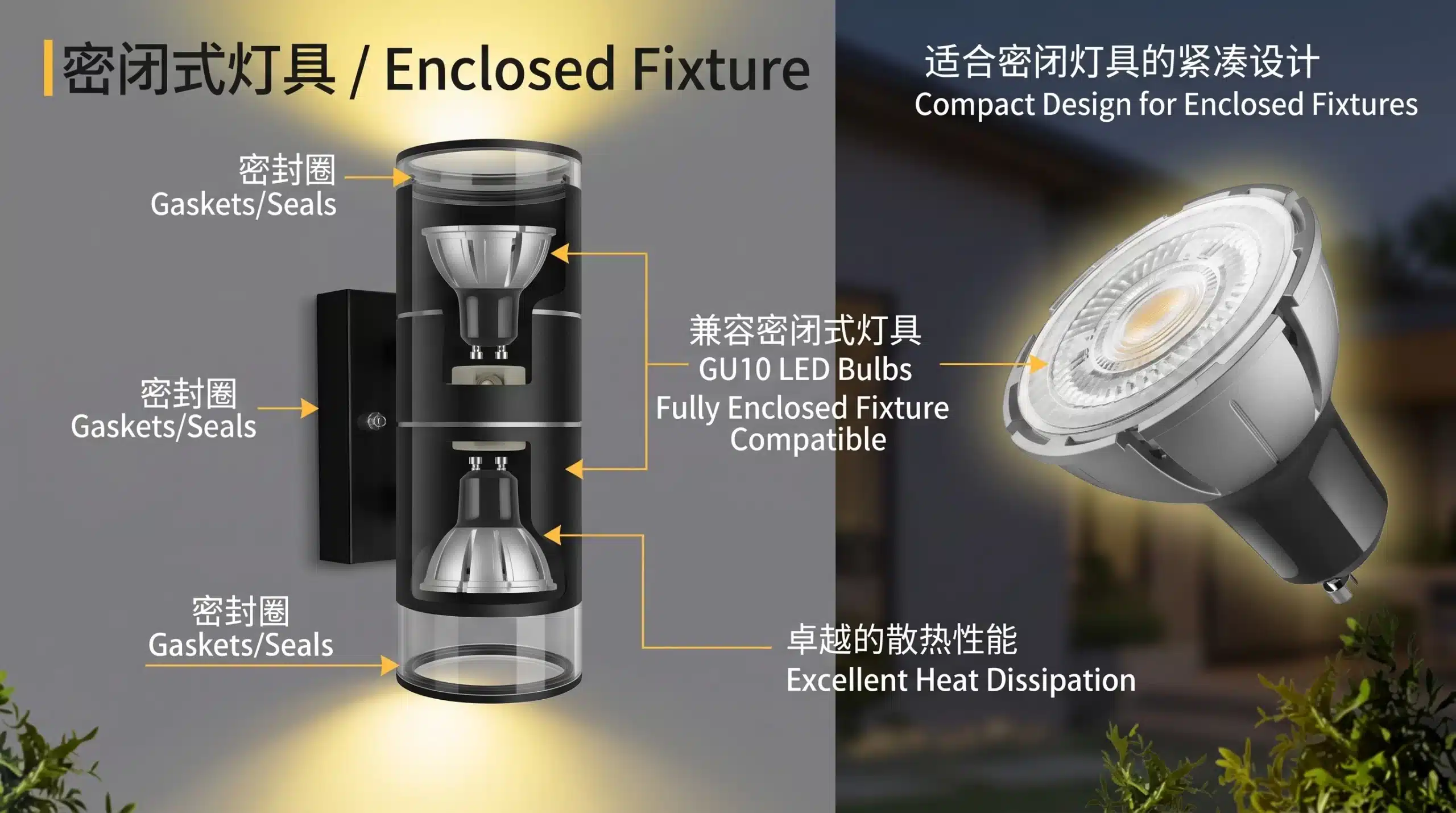
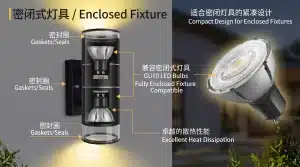
enclosed fixture rated LED lamp in sealed ceiling housing
1.Introduction
On-Site / Commercial Reality
On projects with hundreds or thousands of lamps, a specification mismatch inside enclosed fittings usually shows up after handover, not before. That means repeat access, room-entry coordination, lift rental, and avoidable service calls. In hotels and managed properties, the lamp cost is often the smallest part of the failure cost.
Deep Dive & Engineering Solution
The search term enclosed fixture rated LED exists because enclosed environments impose thermal stress beyond standard open-air operation. LEDs are efficient, but they are not heat-free. A significant portion of input power still becomes heat, and that heat must move from the LED junction to the ambient air through the lamp body and luminaire structure.
When airflow is restricted, internal ambient temperature rises. Every 10°C increase in operating temperature can materially reduce the life of driver components, especially electrolytic capacitors.2 This is why LED overheating in enclosed fixtures is a system issue, not only a chip issue.
Factory Note
From a manufacturing perspective, lamp survival in enclosed fixtures depends less on brochure wattage and more on actual thermal headroom, driver layout, capacitor grade, and validation under elevated ambient conditions. This is where many low-cost substitutions fail.
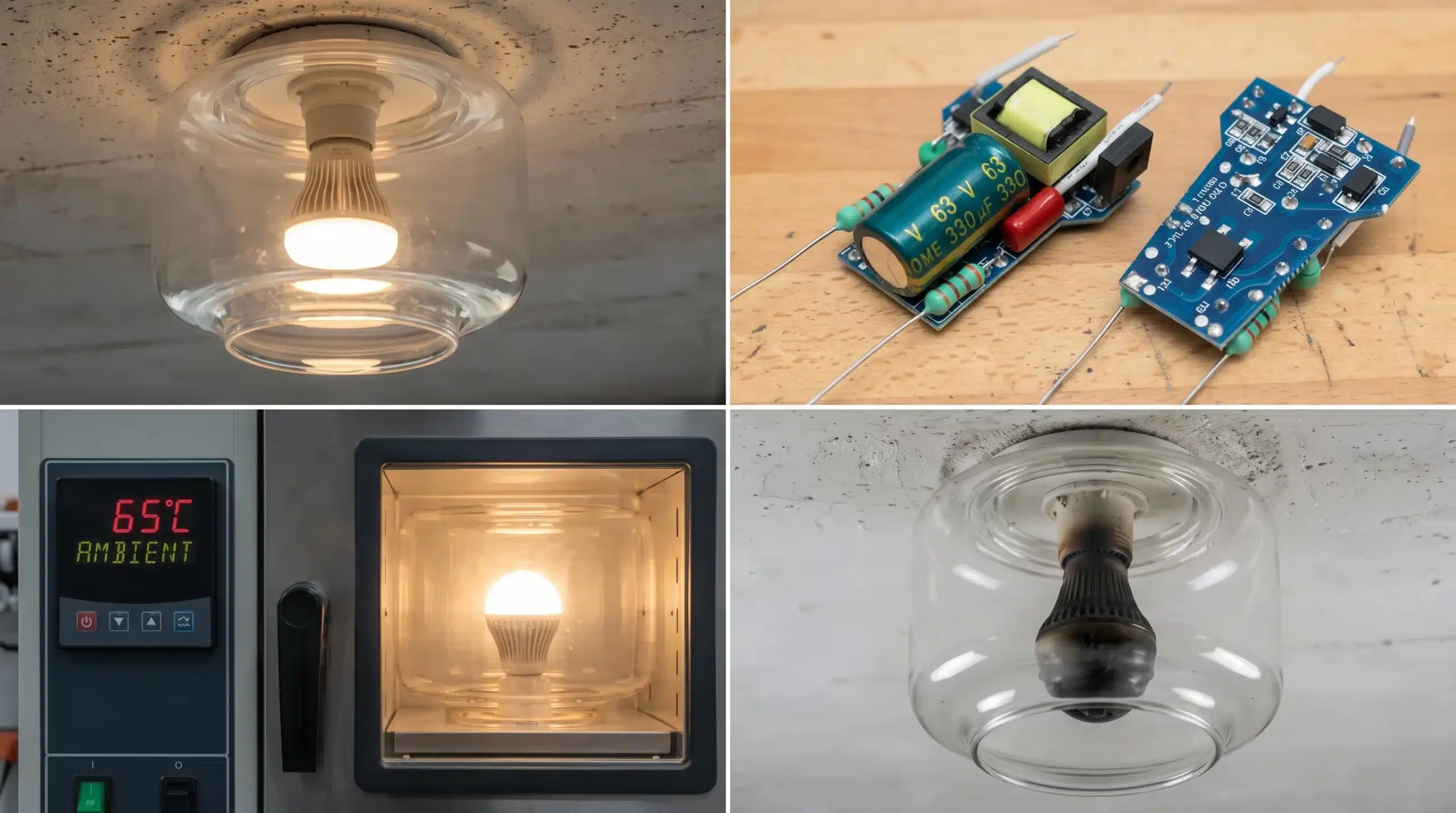
LED bulbs for enclosed fixtures thermal testing and aging
2. What Is an Enclosed Fixture?
On-Site / Commercial Reality
Many installation teams assume only fully sealed outdoor fittings count as enclosed. In practice, many indoor decorative luminaires, glass shades, fire-rated downlights, and compact ceiling cans also create restricted-airflow conditions. Misclassification at procurement stage leads directly to premature failures.
Deep Dive & Engineering Solution
An enclosed fixture is a luminaire where the lamp operates in a space with limited ventilation and reduced heat dissipation. It may be fully sealed, partially sealed, or simply confined enough to trap heat. Common examples include:
- Glass globe ceiling lights
- Recessed downlights with tight housings
- Outdoor wall lanterns
- Bathroom vanity fittings with covers
- Decorative pendants with narrow lamp chambers
The relevant engineering factor is not only whether a cover exists, but whether the lamp can reject heat effectively to the surrounding air.
| Fixture Type | Airflow Level | Thermal Risk | Impact on Maintenance / ROI |
|---|---|---|---|
| Open pendant or open reflector | High | Low | Longer stable service life |
| Decorative glass shade | Medium to low | Moderate | Higher replacement frequency if lamp is not rated |
| Recessed can with cover | Low | High | Access labor increases total maintenance cost |
| Sealed outdoor bulkhead or lantern | Very low | High | Early lamp and driver failures create recurring service visits |
Factory Note
During hotel commissioning, the same lamp can behave differently between corridor downlights and open lobby fittings, even at identical wattage. The luminaire geometry changes the thermal environment enough to alter actual field lifespan.
3. Why LED Bulbs Fail in Enclosed Fixtures
On-Site / Commercial Reality
A failed lamp in an enclosed fitting is rarely random. If the root cause is thermal overload, replacing it with the same non-rated product usually repeats the same failure pattern. This is why a simple one-for-one replacement does not solve the issue.
Deep Dive & Engineering Solution
LED bulbs for enclosed fixtures fail mainly because heat accumulates around three sensitive areas:
LED junction
Higher junction temperature reduces lumen maintenance3 and can shift color over time.Driver electronics
The driver often fails before the LED package. Heat stresses capacitors, switching components, and solder joints.Lamp housing materials
Lower-grade plastics and poorly designed thermal paths can deform, discolor, or trap additional heat.
The U.S. Department of Energy has repeatedly documented that temperature is a key factor in LED system performance and reliability.4 The Illuminating Engineering Society also treats thermal conditions as central to evaluating useful life and lumen maintenance.5
Factory Note
From a manufacturing perspective, most early failures in enclosed spaces come from the driver side, not the LED chip itself. A lamp may still illuminate initially, but flicker, dropout, or fast lumen depreciation often begins with driver stress.
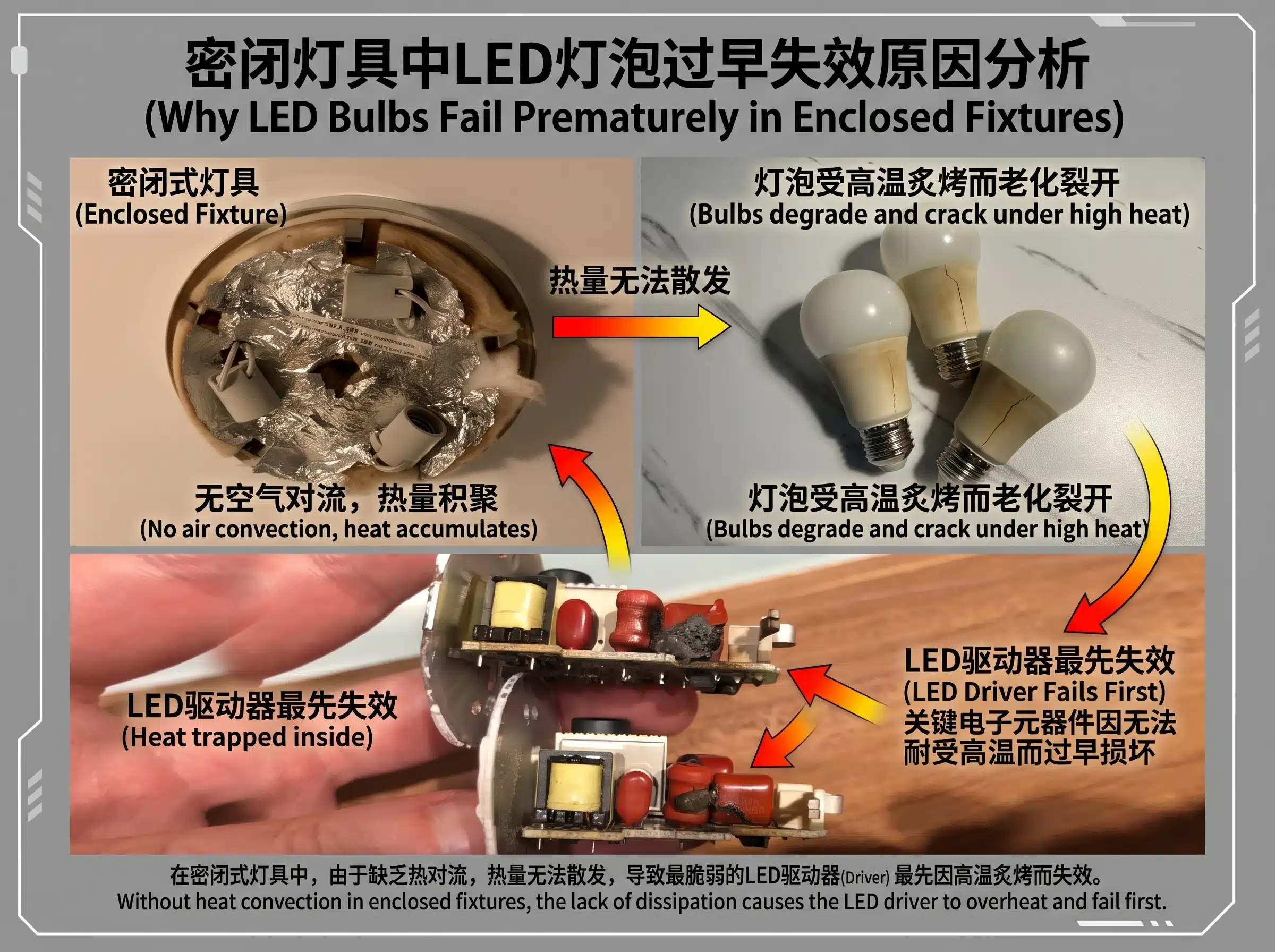
LED overheating in enclosed fixtures and driver failure risk
4. What Does “Enclosed Fixture Rated” Mean?
On-Site / Commercial Reality
Procurement teams often ask what does enclosed fixture rated LED mean because packaging language varies between brands. If the wording is vague, installers and maintenance teams carry the risk later.
Deep Dive & Engineering Solution
An enclosed fixture rated LED is a lamp that the manufacturer states is suitable for use in enclosed luminaires, based on its thermal design and validation testing. In practical terms, it means the lamp has been built to tolerate higher operating temperatures than standard general-purpose lamps.
This usually involves:
- Lower internal thermal resistance
- Better heat sink design
- Driver components with higher temperature tolerance
- Validation in elevated ambient conditions
- Clear usage limitations on the datasheet or packaging
However, enclosed rated does not mean universal suitability. It does not automatically confirm performance in every fixture, every orientation, or every ambient temperature. Some lamps are approved only for specific fixture types or maximum ambient conditions.
Factory Note
From a manufacturing perspective, the most reliable enclosed fixture rated LED products are those validated as complete thermal systems, not just relabeled standard lamps. Real verification includes aging, burn-in, and temperature rise checks across production batches.
5. What Happens If You Use the Wrong LED?
On-Site / Commercial Reality
Using a non-rated lamp in a sealed fitting may not fail immediately, which is exactly why the mistake is common. The first months may look normal. Failures then begin in waves, often after occupancy, when replacement becomes more expensive and disruptive.
Deep Dive & Engineering Solution
If the wrong LED is used in an enclosed fixture, typical outcomes include:
- Reduced LED lifespan in enclosed fixtures
- Faster lumen depreciation
- Visible flicker
- Color instability
- Driver shutdown or early failure
- Higher warranty claim rates
The U.S. Federal Trade Commission requires Lighting Facts and packaging claims to be truthful and substantiated.6 If a lamp is not clearly marked for enclosed fixtures, it should not be assumed suitable.
| Condition | Enclosed Rated LED | Standard Non-Rated LED | Impact on Maintenance / ROI |
|---|---|---|---|
| Heat tolerance | Higher | Lower | Non-rated product increases replacement frequency |
| Driver survival | Better controlled | Higher stress | More service calls and stock consumption |
| Lumen stability | More consistent | Drops faster | Visual inconsistency across project areas |
| Warranty risk | Lower when correctly specified | Higher | Greater RMA and labor cost |
Factory Note
In large hospitality projects, the hidden cost is not the failed lamp. It is coordinated access to rooms, tenant disruption, and maintenance labor spent replacing products that should never have been specified for that luminaire type.
6. Not All “Enclosed Rated” LEDs Are the Same
On-Site / Commercial Reality
Two lamps may both claim enclosed fixture compatibility, yet show very different field performance. This is where distributors and project buyers need more than a packaging statement.
Deep Dive & Engineering Solution
Not all enclosed rated LED spotlight or A-lamp products are engineered to the same standard. Differences usually come from:
- Driver topology and component temperature rating
- Heat sink mass and material
- Total wattage versus body size
- Optical chamber design
- Orientation sensitivity
- Testing conditions and declared limits
A compact high-output lamp operating near its thermal ceiling will have less margin than a slightly lower-output lamp built with more conservative driver loading.
When reviewing product options, ask for:
- Maximum ambient temperature
- Enclosed fixture declaration in datasheet
- Rated life test basis
- LM-80 and TM-21 related LED package data where relevant78
- Warranty conditions tied to enclosed use
Factory Note
From a manufacturing perspective, the best predictor of reliability is margin. A lamp that runs cooler at the same application point almost always delivers better long-term consistency than one optimized only for headline lumen output.
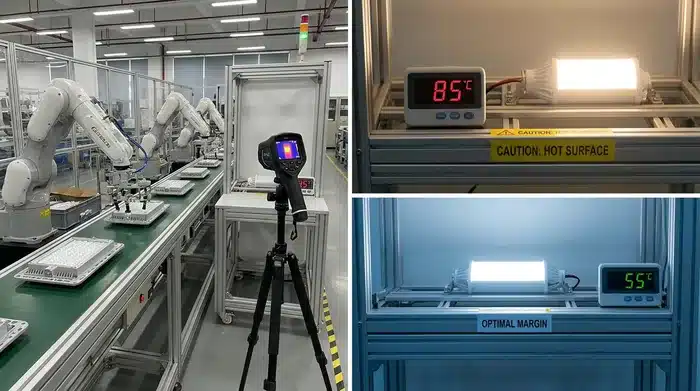
High-quality light bulbs are ensured through stringent QC and extreme temperature testing.
7. How to Choose the Right LED for Enclosed Fixtures
On-Site / Commercial Reality
How to choose LED bulbs for enclosed fixtures should be decided before ordering, not after failures begin. Late correction usually means mixed batches on-site and inconsistent appearance across the installation.
Deep Dive & Engineering Solution
Use the following screening process:
- Confirm whether the luminaire is thermally enclosed or airflow-restricted.
- Check the lamp datasheet for explicit enclosed fixture approval.
- Review ambient temperature limits, especially for ceiling voids and outdoor fittings.
- Match lamp dimensions to the fixture to avoid blocking thermal paths.
- For dimmed circuits, verify driver and dimmer compatibility separately.
- Run a pilot installation in the actual luminaire.
| Selection Factor | What to Check | Impact on Maintenance / ROI |
|---|---|---|
| Fixture ventilation | Open, restricted, sealed | Determines whether enclosed rating is necessary |
| Lamp approval | Explicit enclosed fixture statement | Reduces specification ambiguity |
| Ambient temperature | Ta rating | Prevents thermal overstress in hot locations |
| Driver compatibility | Dimming, switching cycles | Avoids nuisance failures unrelated to LED package |
| Trial validation | Real fixture test | Prevents large-scale replacement risk |
Factory Note
During hotel commissioning, pilot tests in real luminaires routinely catch issues that sample-bench checks miss. The fixture body, mounting orientation, ceiling void temperature, and dimming profile all influence actual operating temperature.
8.Real Lifespan vs Rated Lifespan
On-Site / Commercial Reality
A lamp listed at 15,000 or 25,000 hours does not guarantee that life in a sealed fitting. Project stakeholders often discover this only when maintenance cycles arrive much earlier than expected.
Deep Dive & Engineering Solution
Rated lifespan is usually derived under controlled test conditions. Real lifespan depends on the application environment, switching frequency, ambient temperature, and fixture design. For enclosed installations, the difference between rated life and field life can be substantial.
This is why LED lifespan in enclosed fixtures should be evaluated as application life, not only catalog life. A realistic commercial review should consider:
- Operating hours per day
- Fixture temperature build-up
- Accessibility of replacement
- Failure mode: lumen loss vs complete outage
- Whether uniform appearance matters across the site
Factory Note
From a manufacturing perspective, nominal life claims are useful only when tied to a defined operating condition. Without the fixture context, lifespan figures can be technically true but commercially misleading.
9.Best Solutions for Enclosed Fixtures
On-Site / Commercial Reality
The best solution is not always the highest-lumen retrofit lamp. In many enclosed applications, a thermally conservative lamp or an integrated luminaire provides lower lifetime cost.
Deep Dive & Engineering Solution
Best solutions for enclosed fixtures typically fall into three categories:
Verified enclosed fixture rated retrofit lamps
Suitable when the fixture must remain in place.Lower-wattage lamps with higher thermal margin
Often more reliable than pushing maximum output from a compact body.Integrated LED luminaires designed as complete systems
In some commercial projects, replacing the fixture instead of only the lamp gives better thermal control and lower maintenance.
For enclosed rated LED spotlight applications, beam control and heat density must both be checked. Small spotlight bodies have less space for heat dissipation, so validation quality matters even more.
Factory Note
In large hospitality projects, integrated solutions often outperform lamp-only retrofits where decorative housings trap heat. The maintenance saving over several years can justify the higher initial material cost.
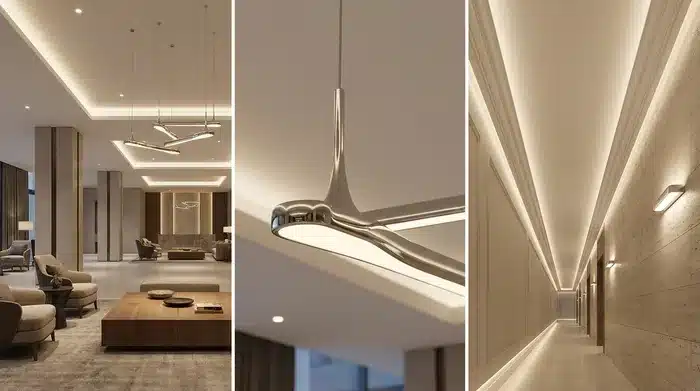
enclosed rated LED spotlight and integrated luminaire options
10. Common Mistakes to Avoid
On-Site / Commercial Reality
Most enclosed fixture failures are preventable. The recurring mistakes usually happen during product substitution, value engineering, or emergency replenishment.
Deep Dive & Engineering Solution
Avoid these common errors:
- Assuming all LED bulbs can be used in enclosed fixtures
- Relying only on marketplace listing text instead of datasheets
- Ignoring ambient temperature limits
- Replacing failed lamps with the same non-rated model
- Mixing enclosed-rated and non-rated lamps in one area
- Overlooking dimmer compatibility in retrofit circuits
- Judging quality only by initial brightness
Factory Note
From a manufacturing perspective, specification drift is one of the biggest causes of avoidable RMA. A validated sample is useful only if the delivered production batch uses the same driver, thermal structure, and component class.
Conclusion: Business Value
Choosing the right enclosed fixture rated LED is a reliability decision, not a packaging-detail decision. In restricted-airflow luminaires, thermal stress directly affects lumen maintenance, driver survival, and replacement frequency. For commercial sites, the result is simple: the correct specification reduces maintenance visits, avoids repeated labor cost, and lowers lifetime system cost.
B2B Engineering Recommendation
For large projects with specific dimming requirements, request the load schedule. The Teco engineering team will simulate the system in-lab to verify compatibility before mass production.
Footnotes
Thermal management: the control of heat flow and operating temperature within an electronic or lighting system to maintain performance and reliability. ↩
Electrolytic capacitor: a polarized capacitor commonly used in LED drivers; lifetime is highly sensitive to operating temperature. ↩
Lumen maintenance: the ability of a light source to retain its light output over time rather than losing brightness prematurely. ↩
U.S. Department of Energy, Solid-State Lighting program resources on LED performance and reliability: https://www.energy.gov/eere/ssl/solid-state-lighting ↩
Illuminating Engineering Society, terminology and standards resources related to lighting performance and life evaluation: https://www.ies.org/standards/ ↩
U.S. Federal Trade Commission, Lighting Facts label and lamp claim guidance: https://www.ftc.gov/business-guidance/resources/lighting-facts-labels ↩
LM-80: an IES approved method for measuring lumen maintenance of LED packages, arrays, and modules over time. Overview: https://www.ies.org/standards/technical-memoranda/ ↩
TM-21: an IES technical memorandum used to project long-term lumen maintenance from LM-80 test data. Overview: https://www.ies.org/standards/technical-memoranda/ ↩