Última actualización: 19 de marzo de 2026
Introducción: Elegir la CCT Correcta es una Decisión de Negocio
En proyectos de iluminación comercial, la selección de temperatura de color no es solo una preferencia de diseño — afecta directamente experiencia del cliente, productividad y rendimiento general del proyecto.
Una especificación incorrecta de CCT puede resultar en:
- Mala presentación minorista
- Entornos de oficina incómodos
- Iluminación inconsistente en instalaciones grandes
Esta guía se centra en cómo seleccionar la temperatura de color LED adecuada para espacios comerciales, basado en escenarios de aplicación real en lugar de comparaciones simples.
¿Qué es la Temperatura de Color LED (CCT)?
Temperatura de color correlacionada (CCT) describe la apariencia visual de la luz blanca, medida en Kelvin (K).
- CCT más bajo → luz más cálida y suave
- CCT más alta → luz más fría y brillante
En entornos comerciales, el CCT influye directamente en:
- Claridad visual
- Apariencia del material
- Percepción del espacio
- Comodidad del usuario
Gamas de Iluminación Comercial: 3000K, 4000K y 5000K

En la mayoría de proyectos comerciales, se utilizan tres rangos principales de CCT:
| Rango de CCT | Efecto visual | Uso comercial típico |
|---|---|---|
| 3000K | Cálido, acogedor | Hostelería, comercio minorista especializado |
| 4000K | Neutral, equilibrado | Oficinas, supermercados |
| 5000K | Brillante, alto contraste | Almacenes, industrial |
En lugar de preguntar “cuál es mejor”, el enfoque correcto es:
¿Qué CCT se alinea con la función de su proyecto?
Mejor Temperatura de Color LED por Aplicación Comercial
Entornos de oficina
Recomendado: 4000K
- Apoya la concentración y productividad
- Proporciona iluminación equilibrada y cómoda
- Se alinea con los estándares modernos del lugar de trabajo
En algunos mercados (especialmente América del Norte), 3500K también se utiliza como una opción equilibrada entre calidez y claridad.
Tiendas Minoristas
Recomendado: 3000K–4000K
- 3000K realza la calidez y la experiencia del cliente
4000K mejora la visibilidad del producto
Muchos entornos minoristas combinan ambos para un diseño de iluminación por capas
Importante:
In retail environments, color rendering is as important as color temperature.
- Recommended: CRI (Ra) ≥ 90
- Ensures products appear vivid and true-to-color
Even with correct CCT, low CRI lighting can make merchandise look dull or low-quality.
Hospitality Spaces (Hotels & Restaurants)
Recommended: 2700K–3000K
- Creates a relaxing and welcoming atmosphere
Enhances guest comfort and perception
Higher CCT levels should generally be avoided, as they may feel overly clinical
Warehouses and Industrial Facilities
Recommended: 5000K
- Provides strong brightness and contrast
- Improves operational visibility and safety
However, in customer-facing commercial spaces, 5000K should be used cautiously, as it may feel too harsh depending on the environment.
Healthcare and Educational Spaces
Recommended: 3500K–5000K
- Balanced lighting supports both comfort and accuracy
- Suitable for task-oriented environments
For these applications, high CRI lighting (Ra ≥ 90) is recommended to improve visual accuracy and reduce eye strain.
How to Select the Right CCT for Commercial Projects
1. Define the Function of the Space
Determine whether the space is:
- Customer-facing
- Task-driven
- Multi-functional
2. Evaluate Materials and Interior Design
CCT interacts with:
- Finishes (wood, metal, fabric)
- Product colors
Surface reflectivity
Always test lighting samples in real environments
3. Consider User Experience
Lighting should support:
- Comfort
- Visibilidad
- Intended atmosphere
4. Verify Standards and Consistency
For commercial projects, ensure:
- ANSI C78.377 bin consistency
- Compliance with EN 12464-1
Fixed CCT vs Tunable White Systems
Fixed CCT Lighting
Ideal para:
- Standard commercial projects
- Large-scale installations
Advantages:
- Stable chromaticity
- Lower cost
- Simple installation
Tunable White Lighting
Ideal para:
- Oficinas
- Retail showrooms
- Multi-purpose environments
Advantages:
- Adjustable color temperature
- Flexible lighting scenes
- Future-proof system design
CCT-Selectable Lighting (3CCT Switchable)
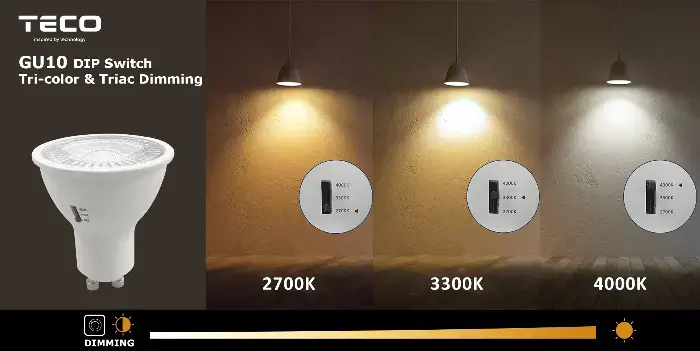
In many commercial projects, contractors increasingly prefer CCT-selectable fixtures (e.g., 3000K / 4000K / 5000K in one product).
This solution offers:
- Reduced inventory complexity
- Greater flexibility during installation
- Lower risk of incorrect CCT selection
It is especially useful for:
- Retail chain rollouts
- Renovation projects
- Multi-region distribution
However, for projects requiring strict visual consistency, fixed CCT with controlled binning remains the preferred solution.
Common Mistakes in Commercial Color Temperature Selection
1. Using High CCT in Customer-Facing Areas
→ Creates harsh and uncomfortable environments
2. Mixing Inconsistent CCT Bins
→ Leads to visible color mismatch across fixtures
3. Focusing Only on CCT
→ Ignoring CRI, glare control, and illuminance
4. Using a Single CCT Across All Areas
→ Reduces lighting effectiveness and spatial layering
When to Use Each CCT (Quick Commercial Reference)
- 3000K → Atmosphere-driven environments
- 4000K → Balanced commercial spaces
5000K → High-visibility, task-critical areas
In many commercial projects, combining multiple CCT layers delivers the best results
Related Guide for Residential Applications
Commercial and residential lighting require different approaches.
For home lighting decisions, refer to:
3000K vs 4000K for Home Lighting (Living Room, Kitchen & Bedroom Guide)
Business Impact of Proper CCT Selection
Correct LED color temperature selection can:
- Improve customer experience
- Enhance retail presentation
- Increase workplace productivity
- Reduce project errors and revisions
For B2B buyers, this results in:
- More reliable project delivery
- Higher client satisfaction
- Reduced after-sales issues
Conclusión
Selecting the right LED color temperature for commercial spaces is a strategic decision that impacts both performance and perception.
Rather than focusing on simple comparisons, project stakeholders should:
- Match CCT with space function
- Consider user experience and material interaction
- Ensure consistency and compliance
A well-planned CCT strategy leads to better lighting outcomes and long-term project success.
B2B Engineering Recommendation
For commercial lighting projects, always verify:
- CCT consistency (ANSI binning)
- CRI performance (preferably Ra ≥ 90 for critical areas)
- Application-specific requirements
If flexibility is required, consider:
- Multi-CCT (3CCT) products
- Tunable white systems
- Custom project-based solutions