Explicación de los focos LED para riel: Ángulos del haz, aplicaciones y cómo elegir el accesorio correcto
Introducción
En un despliegue comercial, un ángulo de haz incorrecto puede convertir un sistema de riel flexible en un costoso problema de reorientación. Los focos de riel LED a menudo se especifican porque parecen flexibles en papel: cabezas móviles, luminarias reposicionables y una amplia gama de distribuciones de haz. Sin embargo, en proyectos reales, la flexibilidad por sí sola no garantiza un resultado de iluminación exitoso. Una mala selección del haz, un espaciado incorrecto de las luminarias o una orientación inadecuada pueden crear puntos calientes, zonas oscuras, quejas por deslumbramiento, contraste débil de la mercancía y ajustes repetidos en el sitio.
Para tiendas minoristas, galerías, establecimientos de hostelería e interiores comerciales, el rendimiento de los focos de riel debe evaluarse como un sistema de iluminación completo en lugar de como una decisión únicamente de luminaria. La altura del techo, la iluminancia objetivo, el contraste de acento, la geometría de la exhibición, la reflectancia de la superficie, la dirección de visualización y los cambios futuros de diseño afectan la especificación final. Si estos factores no se alinean desde el principio, el resultado suele ser un mayor costo de mano de obra, una puesta en marcha retrasada y un reemplazo innecesario de luminarias después de la instalación.
Resumen Ejecutivo
Los focos de riel LED se seleccionan haciendo coincidir el ángulo del haz, la distribución de intensidad luminosa, la flexibilidad de orientación y la estabilidad mecánica con la condición real del proyecto. Los datos más importantes son la altura del techo, el tamaño del objetivo, el tipo de exhibición, la relación de acento requerida, el riesgo de deslumbramiento y la flexibilidad futura del diseño.
En la práctica de iluminación comercial, los haces estrechos se utilizan comúnmente para objetos focales, obras de arte, maniquíes y distancias de lanzamiento más largas. Los haces medios son adecuados para estanterías, mostradores, exhibiciones en pared y uso comercial mixto. Los haces anchos se utilizan para objetivos amplios, énfasis más suave y apoyo ambiental complementario. Los rangos exactos de ángulo y la nomenclatura varían según el fabricante, por lo que se deben verificar los archivos fotométricos, las pruebas de muestra y las maquetas en el sitio antes del despliegue final.1
Una especificación correcta reduce el deslumbramiento, mejora el enfoque visual, favorece un mejor merchandising y reduce el riesgo de reorientación o sustitución de luminarias durante la puesta en marcha.
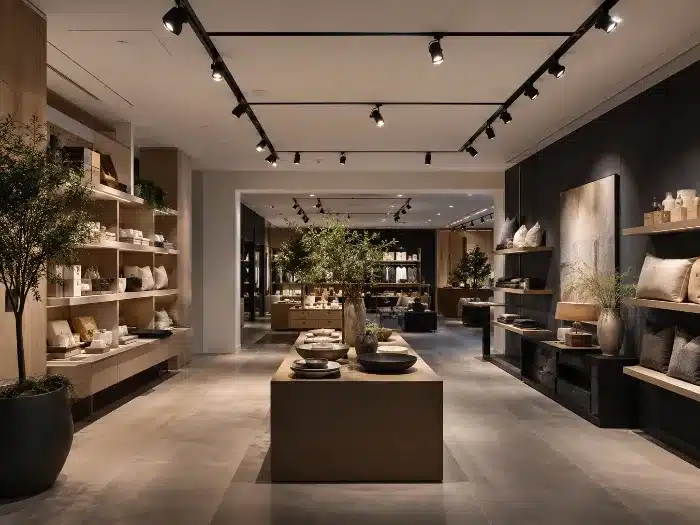
Los ángulos de haz controlados ayudan a los focos de riel LED a crear un enfoque visual claro en exhibiciones minoristas.
¿Qué es un sistema de iluminación de riel?
Realidad en el sitio / comercial
En los acabados comerciales, la iluminación de riel a menudo se elige porque los diseños de exhibición rara vez permanecen fijos. Los estantes minoristas cambian, las exposiciones de las galerías rotan y los espacios de hostelería pueden rediseñarse estacionalmente. Un diseño de downlights fijo puede volverse ineficiente cuando los puntos focales se mueven, mientras que un sistema de riel bien planificado permite que las luminarias se reposicionen y reorienten con menos trabajo de techo.
Análisis Profundo y Solución de Ingeniería
Un sistema de iluminación de riel es un riel de montaje electrificado lineal que suministra energía a luminarias compatibles. Los focos de riel pueden instalarse, reubicarse y orientarse a lo largo del riel a medida que cambian los requisitos de exhibición o tarea.
Para iluminación comercial, el valor de un sistema de riel reside en tres capacidades principales:
Flexibilidad posicional
Las luminarias pueden desplazarse a lo largo del riel para alinearse con mercancías, obras de arte, mesas, mostradores o elementos arquitectónicos.Ajustabilidad direccional
La cabeza del foco generalmente puede rotar e inclinarse, permitiendo una iluminación de acento controlada en lugar de una iluminación general amplia.Selección del haz a nivel de luminaria
Pueden utilizarse distintos ángulos de haz dentro de un mismo proyecto, lo que resulta útil cuando un espacio incluye exposiciones en pared, mesas destacadas, mostradores de recepción, superficies decorativas y zonas de circulación.
Los sistemas de riel son más efectivos cuando la estrategia de iluminación requiere énfasis adaptable, jerarquía visual y posicionamiento a prueba de futuro.
Nota de Fábrica
Desde una perspectiva de fabricación, la iluminación de riel no debe tratarse como una categoría puramente decorativa. En proyectos comerciales, la estabilidad mecánica del adaptador, la consistencia del contacto eléctrico y la fricción de orientación de la cabeza del foco afectan al rendimiento del servicio a largo plazo. Una luminaria que se desplaza tras orientarse o pierde contacto intermitentemente genera problemas de mantenimiento inmediatos en obra.
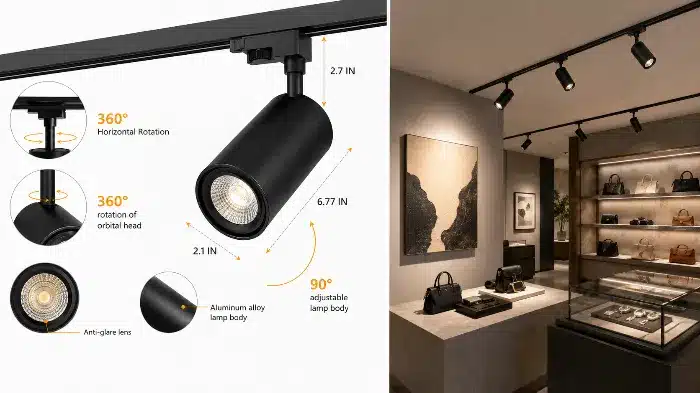
El diseño del sistema de iluminación de riel influye en la estabilidad de orientación y la fiabilidad a largo plazo.
Cómo funcionan los focos de riel LED
Realidad en el sitio / comercial
Los instaladores y especificadores a menudo se enfocan primero en la potencia y la temperatura de color, pero los problemas de puesta en marcha generalmente provienen del rendimiento óptico y direccional. Un foco de riel puede entregar suficientes lúmenes en papel, pero aún así fallar en resaltar una pared de productos si la dispersión del haz, la intensidad central, la distribución o el ángulo de orientación son incorrectos.
Por eso los focos de riel LED no deben seleccionarse solo por su flujo luminoso. En proyectos reales, dos luminarias con lúmenes similares pueden crear resultados visuales muy distintos porque su control del haz, intensidad del haz central, luz dispersa, consistencia cromática y protección contra deslumbramiento son diferentes.2
Análisis Profundo y Solución de Ingeniería
Los focos LED de riel combinan una fuente LED direccional con un reflector, lente o conjunto óptico híbrido para controlar la forma del haz y la distribución de intensidad luminosa. El accesorio se monta en un adaptador de riel electrificado y generalmente puede girar horizontalmente e inclinarse verticalmente.
Su rendimiento de iluminación depende de cuatro factores interrelacionados:
Ángulo del haz
El ángulo del haz describe la dispersión angular del haz principal. Afecta al tamaño de la zona iluminada y a la concentración de luz sobre el objetivo.3Distribución de intensidad luminosa
Esto describe cómo se entrega la luz en diferentes direcciones. Una luminaria con un control óptico más estricto puede crear un énfasis más fuerte incluso cuando la salida total de lúmenes es similar.Ajustabilidad de orientación
La rotación y la inclinación determinan si la luz llega al objetivo de manera limpia o produce luz dispersa, deslumbramiento reflejado o énfasis desigual.Control de deslumbramiento y accesorios
Las lamas, caperuzas, deflectores, lentes y el blindaje bien diseñado de las luminarias pueden reducir la vista directa de la fuente LED y mejorar el confort visual.
En la práctica, los diseñadores evalúan cuánta luz útil llega al plano de exposición, superficie vertical u objeto focal a la distancia real de montaje.
| Característica | Foco de riel de haz ancho | Foco de riel de haz estrecho | Impacto del proyecto |
|---|---|---|---|
| Área de cobertura | Más grande | Más pequeño | Los haces anchos cubren zonas más amplias, mientras que los haces estrechos concentran la luz en objetivos focales. |
| Intensidad del haz central | Inferior | Más alto | Una mayor intensidad ayuda a mantener el efecto de acento a distancias de proyección mayores. |
| Contraste de exposición | Moderado | Fuerte | Un mejor contraste mejora la calidad del merchandising y la presentación. |
| Tolerancia de dirección | Más indulgente | Más crítico | Los haces estrechos requieren una puesta en marcha más precisa |
| Riesgo de luz derramada | Más alto | Menor cuando está correctamente dirigido | Un mejor control del derrame mejora el confort visual y reduce la luz desperdiciada |
| Riesgo de deslumbramiento | Depende de la protección y la dirección | Depende fuertemente de la dirección | El deslumbramiento debe evaluarse desde las posiciones reales de observación |
Nota de Fábrica
En la puesta en marcha de hoteles, galerías y comercios, la diferencia entre el flujo luminoso y el efecto de acento útil se vuelve muy evidente. Un foco con un flujo nominal aceptable puede aún tener un rendimiento inferior si su control óptico es demasiado suave. Para mostradores de recepción, obras de arte, exhibiciones de productos y texturas decorativas en paredes, el control del haz central suele ser más importante que la potencia nominal.
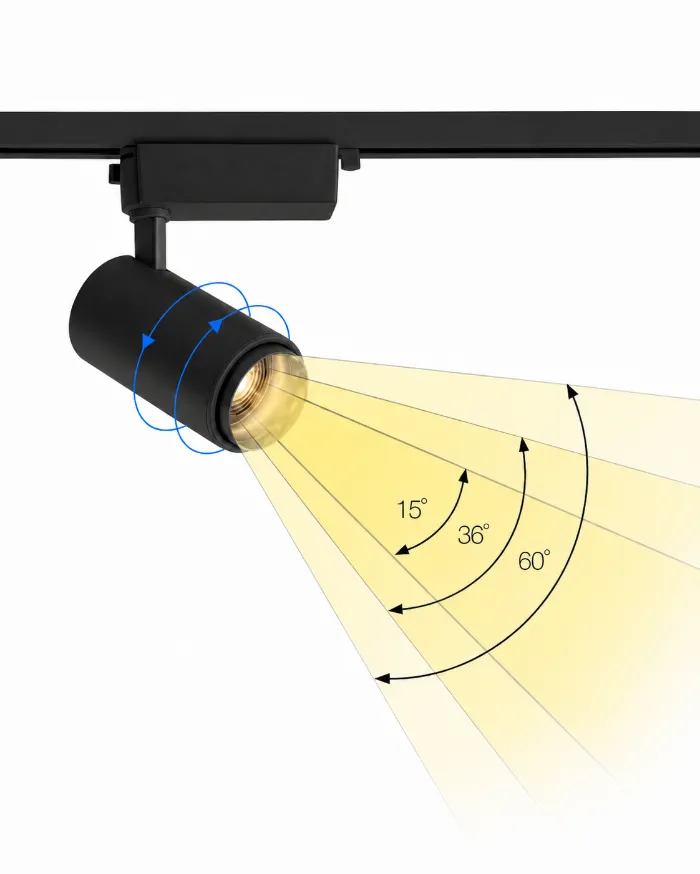
El diseño óptico afecta la dispersión del haz, intensidad central, luz derramada y control de deslumbramiento.
Elegir el Ángulo de Haz Correcto para Focos de Riel
Realidad en el sitio / comercial
La selección del ángulo del haz es una de las causas más comunes de retrabajo en proyectos de iluminación de pista. Un haz demasiado estrecho puede iluminar solo parcialmente productos o exhibiciones, mientras que un haz demasiado ancho puede aplanar el efecto de acento y derramarse en áreas adyacentes. Una vez instalado el ángulo de haz incorrecto en una tienda, galería o restaurante, la corrección generalmente implica el reemplazo del accesorio, el cambio óptico o un ejercicio completo de redirección.
Análisis Profundo y Solución de Ingeniería
El ángulo del haz debe seleccionarse según tres entradas prácticas:
Altura de montaje sobre el plano objetivo
Tamaño y reflectancia del objeto o área de exhibición
Contraste requerido entre la iluminación de acento y la iluminación ambiental
En la práctica de iluminación comercial, las distribuciones de haz a menudo se agrupan como estrechas, medias y anchas. Estas son categorías de especificación prácticas en lugar de estándares fijos universales.1
| Tipo de Haz | Uso práctico común | Lógica de Proyecto Típica |
|---|---|---|
| Haz estrecho | Obras de arte, maniquíes, objetos pequeños, mesas destacadas, techos altos | Concentra la luz, favorece un acento fuerte y ayuda a mantener la intensidad en distancias de lanzamiento más largas |
| Haz medio | Estanterías, mostradores, paredes comerciales, exhibiciones comerciales mixtas | Equilibra cobertura, intensidad y tolerancia de dirección |
| Haz ancho | Mesas amplias, soporte de circulación, énfasis suave, zonas de exhibición más amplias | Cubre superficies más grandes pero puede reducir el contraste focal si se usa en exceso |
A medida que aumenta la altura de montaje, la huella del haz se expande y la intensidad central se vuelve más crítica. El mismo foco puede funcionar de manera muy diferente a 2.8 m, 4 m o 6 m, por lo que los diseñadores evalúan el diámetro iluminado, la iluminancia vertical útil, la calidad del borde del haz y la luz derramada a la distancia objetivo.
La iluminación de exhibición minorista a menudo utiliza luz de acento para crear prioridad visual sobre el nivel ambiental. Dependiendo del tipo de tienda y la estrategia de exhibición, la iluminación de acento puede diseñarse a varias veces el nivel ambiental en lugar de como un valor fijo único de lux.4 Para galerías y museos, el proceso es más conservador porque la iluminancia, el espectro, el tiempo de exposición, el deslumbramiento y los requisitos de conservación deben controlarse conjuntamente.5
| Factor de Selección | Haz Estrecho | Haz medio | Haz ancho | Impacto del proyecto |
|---|---|---|---|---|
| Altura del techo | Mejor para techos más altos o alcances más largos | Bueno para techos comerciales estándar | Mejor para techos más bajos o objetivos amplios | La correcta correspondencia reduce el riesgo de reemplazo de luminarias |
| Tamaño de la exhibición | Objetos pequeños, obras de arte, maniquíes | Estanterías, paredes destacadas, mostradores | Mesas grandes, superficies amplias | Un mejor ajuste reduce la redirección en el sitio |
| Contraste de acento | Alta | Equilibrado | Low to moderate | Proper contrast improves visual hierarchy |
| Aiming sensitivity | Alta | Moderado | Inferior | Wider beams are easier to commission but may weaken focus |
| Spill light control | Strong when aimed correctly | Equilibrado | More spill risk | Better spill control improves comfort and visual discipline |
Nota de Fábrica
In large hospitality and retail projects, beam angle is sometimes specified too broadly because teams want to avoid sharp hot spots. The result is often flat lighting with poor visual hierarchy. A better approach is to use controlled narrow or medium beams for focal elements and let ambient lighting handle background brightness.
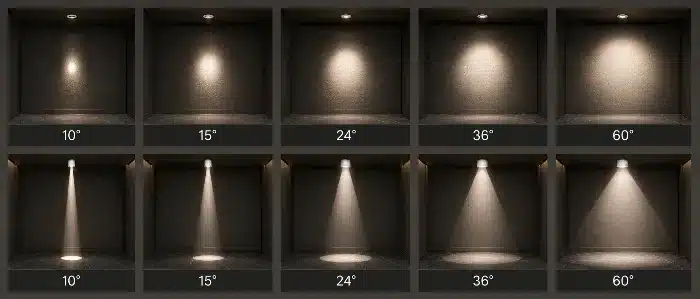
Different beam angles change the illuminated area, accent contrast, and aiming tolerance.
Common Applications of Track Lighting
Realidad en el sitio / comercial
Commercial spaces rarely need uniform lighting everywhere. Products must stand out, artwork must be framed by light, tables must feel inviting, and brand zones must read clearly from circulation paths. Track spotlights can create this hierarchy without locking the project into a rigid ceiling plan, but the same strategy should not be copied directly from a gallery to a fashion store or from a cafe to a hotel lobby.
Análisis Profundo y Solución de Ingeniería
LED track spotlights are widely used in the following commercial applications:
Tiendas minoristas
Used for mannequins, shelving, promotional walls, feature tables, and shopfront presentation. Here, contrast, color quality, vertical display visibility, and merchandise modeling are critical.6Galleries and museums
Used to highlight artwork, sculptures, and temporary exhibitions with precise aiming and controlled beam spread. In these spaces, mock-up testing, spectrum evaluation, glare control, and conservation requirements are especially important.5Hospitality spaces
Used in lobbies, restaurants, lounges, bars, and reception areas to reinforce atmosphere, focal points, and material texture.Commercial interiors
Used in showrooms, sales offices, brand experience centers, and circulation zones where flexibility and visual emphasis are needed.
The key difference is the target surface and viewing condition. Vertical displays often need controlled front light, table or object displays rely more on concentrated beam placement, and architectural features may require grazing, accenting, or layered composition with ambient lighting.
Nota de Fábrica
During hotel and retail commissioning, track spotlights are often adjusted several times after furniture, signage, merchandise, and decorative elements are fully in place. This is normal. The most reliable specifications are the ones that allow some aiming margin on site rather than depending on an exact theoretical position only.
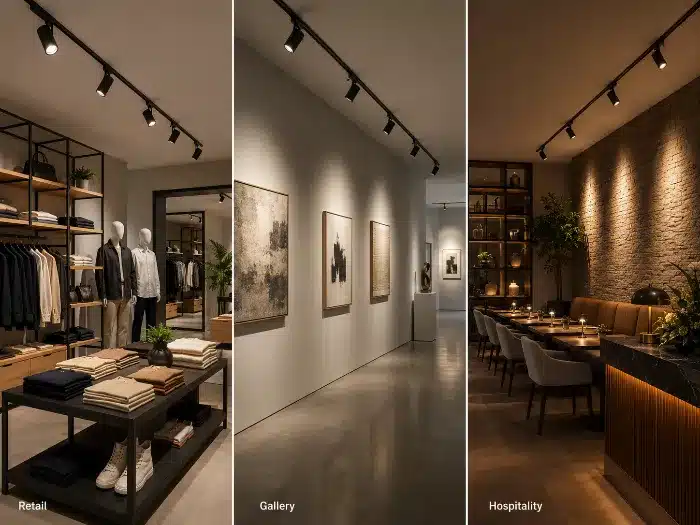
Track spotlights create flexible accent lighting for retail, gallery, and hospitality spaces.
Advantages of LED Track Spotlights in Commercial Lighting
Realidad en el sitio / comercial
For B2B buyers, the value of track spotlights is not just appearance. In leased retail units, evolving product displays, and hospitality refurbishments, a flexible lighting platform can reduce repeated ceiling work and shorten update cycles, especially where maintenance access is difficult or business interruption has a direct cost.
Análisis Profundo y Solución de Ingeniería
LED track spotlights offer several practical advantages in commercial lighting:
Flexible fixture positioning
Luminaires can be relocated without major rewiring, making them suitable for changing layouts.Accurate accent lighting
Controlled optics and adjustable aiming improve focal emphasis and support visual merchandising.Layered lighting integration
Track spotlights work effectively with downlights, linear lighting, and decorative luminaires to build contrast and hierarchy.Better adaptation to display changes
When products, artwork, furniture, or seasonal layouts move, the lighting can move with them.Efficient use of output
Directional lighting places light where it is needed, which is more effective than relying on uniform ambient lighting to create emphasis.Lower long-term operating cost when correctly specified
LED systems can reduce energy use and maintenance cost, but rated life, thermal conditions, dimming compatibility, optical stability, and actual operating hours should be verified from product data and project conditions.7
From a project standpoint, these advantages improve lighting quality and operational flexibility in spaces that require regular updates rather than static layouts.
Nota de Fábrica
From a manufacturing perspective, the best commercial track spotlight is not the one with the most aggressive specification sheet. It is the one that keeps optical consistency, mechanical aiming stability, electrical contact reliability, thermal performance, and color consistency across batches. In multi-store rollouts, batch-to-batch beam and color consistency are often more important than headline efficacy alone.
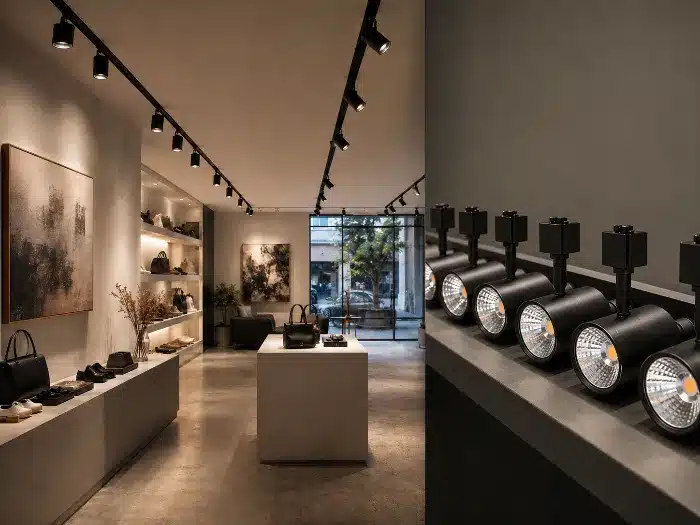
LED track spotlights support flexible accent lighting and long-term layout adaptation.
Track Lighting Layout Tips for Commercial Spaces
Realidad en el sitio / comercial
A good fixture can still produce poor results if the layout ignores sightlines, target positions, ceiling geometry, or reflective surfaces. Common late-stage problems include uneven accent rhythm, shadow interference from shelving or signage, and glare caused by aiming directly into customer or guest view.
Análisis Profundo y Solución de Ingeniería
Effective track lighting layout starts with the target, not the ceiling. The design process should evaluate:
What needs emphasis
From where it will be viewed
At what mounting height the fixtures will operate
How much ambient light already exists
Whether the target is horizontal, vertical, glossy, matte, flat, or textured
How often the layout is expected to change
Practical layout principles include:
Align tracks with display logic
In retail, tracks are often placed parallel to shelving runs, feature walls, or circulation routes. In galleries, they are aligned for flexible artwork aiming. In hospitality, they may define focal islands or layered zones.Match spacing to beam spread and throw distance
Fixture spacing should reflect the actual beam footprint at the target plane, not just the ceiling grid.Avoid direct glare angles
Spotlights should be aimed to highlight the target while limiting direct visual intrusion into guest or shopper sightlines.Check reflected glare
Glass shelves, polished counters, glossy artwork protection, metal finishes, and dark reflective surfaces can all create reflected glare even when the fixture itself appears well shielded.Plan for adjustability margin
Leave enough aiming range and track capacity for future changes. A layout that is too tight on paper becomes difficult to adapt later.Balance accent and ambient lighting
Track spotlights should support a layered lighting scheme, not replace all general lighting unless the concept specifically requires it.
For commercial projects, mock-up testing is highly recommended, especially when display reflectance, ceiling height, and target lux levels are critical. Photometric data should be checked against real mounting conditions before final rollout.89
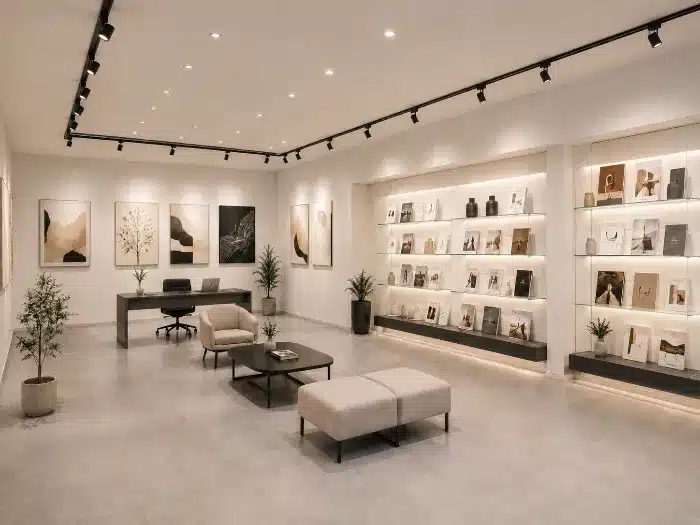
Track lighting layout should follow target positions, viewing direction, and beam spread.
How to Choose LED Track Spotlights for Commercial Projects?
| Project Requirement | Recommended Specification Focus |
|---|---|
| Retail shelf display | Medium beam, high CRI, stable color consistency, adjustable aiming |
| Mannequin or feature table | Narrow to medium beam, higher center intensity, controlled spill light |
| Gallery artwork | Precise beam control, low glare, suitable spectrum, mock-up testing |
| Hotel lobby or lounge | Warm CCT, low glare, stable dimming, refined material rendering |
| High ceiling application | Narrower beam, higher center beam intensity, verified photometric data |
| Frequently changing layout | Reliable track adapter, stable aiming friction, flexible beam options |
| Multi-store rollout | Batch color consistency, optical consistency, thermal reliability, clear QC control |
| Glossy display surfaces | Careful aiming, shielding accessories, reflected glare review |
PREGUNTAS FRECUENTES
What beam angle is best for LED track spotlights?
There is no single best beam angle for all projects. Narrow beams are useful for artwork, mannequins, feature tables, and higher ceilings where stronger focus is required. Medium beams are more versatile for retail shelving, counters, and wall displays. Wide beams are better for broader targets, softer emphasis, or supplementary ambient support.
Are LED track spotlights suitable for retail stores?
Yes. LED track spotlights are widely used in retail stores because they support flexible accent lighting for shelves, mannequins, promotional displays, shopfront areas, and seasonal layout changes. For retail projects, the key is to match beam angle, color quality, glare control, and aiming flexibility to the merchandise and customer viewing path.
How far apart should track spotlights be placed?
Spacing depends on ceiling height, beam angle, target size, aiming angle, and required illuminance. Fixture spacing should be based on the actual beam footprint at the target plane rather than only the ceiling grid. For important commercial projects, a mock-up or photometric simulation is recommended before final rollout.
What is the difference between narrow beam and wide beam track spotlights?
A narrow beam concentrates light into a smaller area and creates stronger visual focus. A wide beam covers a larger surface but produces softer contrast and may create more spill light if overused. Medium beams usually provide a balanced option for many commercial interiors.
How can glare from LED track spotlights be reduced?
Glare can be reduced by correct aiming, suitable beam angle selection, proper fixture shielding, accessories such as louvers or snoots, and careful review of reflective surfaces. Viewing direction is also important because a spotlight that looks comfortable from one angle may create direct or reflected glare from another position.
Should LED track spotlights be selected only by wattage or lumens?
No. Wattage and lumen output are only part of the specification. Beam distribution, center beam intensity, color consistency, dimming behavior, thermal design, glare control, and mechanical aiming stability all affect the final lighting result in commercial projects.
Conclusion: Business Value
LED track spotlights remain one of the most effective tools for commercial accent lighting because they combine directional control, layout flexibility, and application-specific beam selection. When properly specified, they improve visual hierarchy, reduce unnecessary spill light, and adapt more easily to future display changes.
From a business perspective, correct track spotlight selection supports three practical outcomes: better delivered lighting performance, lower maintenance effort during layout changes, and reduced lifetime system cost by avoiding repeated ceiling modification or fixture replacement.
B2B Engineering Recommendation
For commercial track spotlight projects, request beam angle samples, photometric files, mounting height details, target lux requirements, dimming requirements, and project layout information before final specification. Buyers can review TECO’s luminarias as a starting point for compatible fixture options, then contact the TECO engineering team with drawings and project requirements for beam selection, optical comparison, dimming verification, and project-based sample testing before mass production.
Notas al pie
Narrow, medium, and wide beam are practical commercial lighting selection terms rather than fixed universal ranges. Actual beam category naming varies by manufacturer and should be verified with product photometric data and samples. Source: PNNL / DOE Smithsonian report. ↩ ↩
LED replacement lamps and directional luminaires should not be treated as one-for-one equivalents based only on wattage or lumens because beam characteristics, intensity, color, and distribution can differ significantly. Source: PNNL / DOE GATEWAY, Demonstration of LED Retrofit Lamps at the Smithsonian American Art Museum. ↩
Beam angle is defined by the Illuminating Engineering Society as the angle between the two directions where luminous intensity falls to 50% of maximum intensity. Source: IES, “Beam Angle”. ↩
Retail accent lighting is often designed at several times the ambient level rather than one fixed lux value. The Waypoint Lighting quick reference table lists retail ambient / perimeter levels and notes that display accent lighting can be 3–10 times the ambient level. Source: Waypoint Lighting, IES Recommended Light Levels Quick Reference Guide. ↩
Museum and gallery lighting require controlled beam spread, precise aiming, glare control, illuminance limits, spectrum review, exposure management, and mock-up testing. Source: IES Recommended Practice: Lighting Museums. ↩ ↩
Retail lighting quality, merchandise visibility, display contrast, accent lighting, glare, and vertical illuminance are covered in ANSI/IES RP-2-20, Recommended Practice: Lighting Retail Spaces. Source: IES RP-2-20. ↩
LED systems can reduce energy use and maintenance cost, but rated life and savings depend on product design, thermal conditions, test method, dimming compatibility, and operating environment. Sources: DOE, “LED Lighting”; PNNL / DOE Smithsonian report. ↩
Beam quality, color quality, optical performance, and visual results should be verified with samples, mock-ups, or project testing when visual quality is critical. Source: PNNL / DOE GATEWAY Smithsonian report. ↩
DOE / PNNL GATEWAY museum reports support verification under real project conditions, especially in museums, galleries, and high-visual-quality commercial interiors. Sources: DOE GATEWAY Indoor Project Archives; PNNL Smithsonian report. ↩