LEDトラックスポットライトの解説:ビーム角、用途、適切な器具の選び方
はじめに
In a commercial rollout, the wrong beam angle can turn a flexible track system into a costly re-aiming problem. LED track spotlights are often specified because they appear flexible on paper: movable heads, repositionable fixtures, and a wide range of beam distributions. In real projects, however, flexibility alone does not guarantee a successful lighting result. Poor beam selection, incorrect fixture spacing, or inadequate aiming can create hot spots, dark zones, glare complaints, weak merchandise contrast, and repeated on-site adjustments.
For retail stores, galleries, hospitality venues, and commercial interiors, track spotlight performance should be evaluated as a complete lighting system rather than as a fixture-only decision. Ceiling height, target illuminance, accent contrast, display geometry, surface reflectance, viewing direction, and future layout changes all affect the final specification. If these factors are not aligned early, the result is often higher labor cost, delayed commissioning, and unnecessary fixture replacement after installation.
エグゼクティブサマリー
LED track spotlights are selected by matching beam angle, luminous intensity distribution, aiming flexibility, and mechanical stability to the actual project condition. The most important inputs are ceiling height, target size, display type, required accent ratio, glare risk, and future layout flexibility.
In commercial lighting practice, narrow beams are commonly used for focal objects, artwork, mannequins, and longer throw distances. Medium beams are suitable for shelving, counters, wall displays, and mixed commercial use. Wide beams are used for broad targets, softer emphasis, and supplementary ambient support. Exact angle ranges and naming vary by manufacturer, so photometric files, sample testing, and on-site mock-ups should be checked before final rollout.1
Correct specification reduces glare, improves visual focus, supports better merchandising, and lowers the risk of re-aiming or fixture replacement during commissioning.
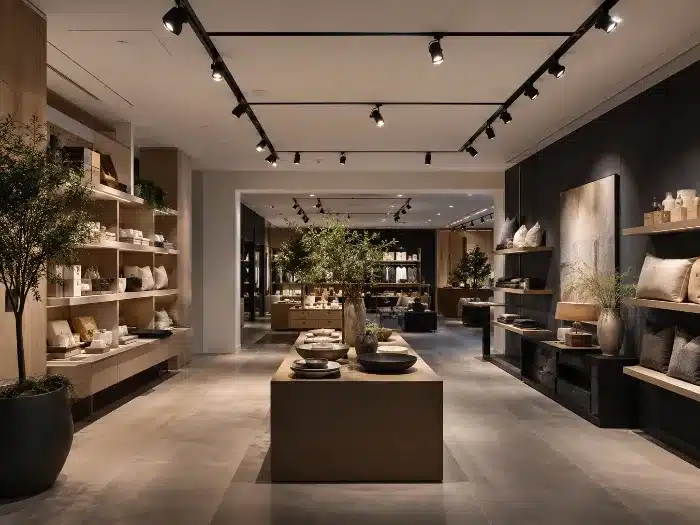
Controlled beam angles help LED track spotlights create clear visual focus in retail displays.
What Is a Track Lighting System?
現場 / 商業的現実
In commercial fit-outs, track lighting is often chosen because display layouts rarely remain fixed. Retail shelving changes, gallery exhibits rotate, and hospitality spaces may be re-styled seasonally. A fixed downlight layout can become inefficient when focal points move, while a well-planned track system allows luminaires to be repositioned and re-aimed with less ceiling rework.
詳細分析とエンジニアリングソリューション
A track lighting system is a linear electrified mounting rail that supplies power to compatible luminaires. Track spotlights can be installed, relocated, and aimed along the track as display or task requirements change.
For commercial lighting, the value of a track system lies in three core capabilities:
Positional flexibility
Luminaires can be moved along the track to align with merchandise, artwork, tables, counters, or architectural features.Directional adjustability
The spotlight head can usually rotate and tilt, allowing controlled accent lighting instead of broad general illumination.Beam selection at fixture level
Different beam angles can be used within the same project, which is useful when one space includes wall displays, feature tables, reception counters, decorative surfaces, and circulation areas.
Track systems are most effective when the lighting strategy requires adaptable emphasis, visual hierarchy, and future-proof positioning.
工場注記
From a manufacturing perspective, track lighting should not be treated as a purely decorative category. In commercial projects, the mechanical stability of the adapter, the consistency of electrical contact, and the aiming friction of the spotlight head all affect long-term service performance. A fixture that drifts after aiming or loses contact intermittently creates immediate maintenance issues on site.
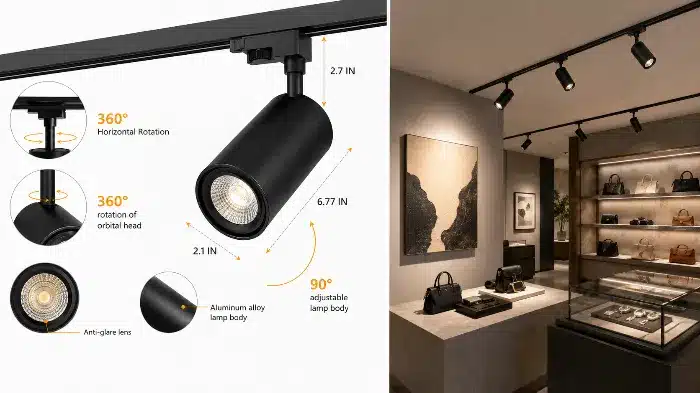
Track lighting system design influences aiming stability and long-term reliability.
How LED Track Spotlights Work
現場 / 商業的現実
Installers and specifiers often focus first on wattage and color temperature, but commissioning problems usually come from optical and directional performance. A track spotlight may deliver enough lumens on paper but still fail to highlight a product wall if beam spread, center intensity, distribution, or aiming angle is wrong.
This is why LED track spotlights should not be selected only by lumen output. In real projects, two luminaires with similar lumens can create very different visual results because their beam control, center beam intensity, spill light, color consistency, and glare shielding are different.2
詳細分析とエンジニアリングソリューション
LED track spotlights combine a directional LED source with a reflector, lens, or hybrid optical assembly to control beam shape and luminous intensity distribution. The fixture is mounted on an electrified track adapter and can usually rotate horizontally and tilt vertically.
Their lighting performance depends on four linked factors:
ビーム角
Beam angle describes the angular spread of the main beam. It affects the size of the illuminated area and the concentration of light on the target.3Luminous intensity distribution
This describes how light is delivered in different directions. A fixture with tighter optical control can create stronger emphasis even when total lumen output is similar.Aiming adjustability
Rotation and tilt determine whether the light reaches the target cleanly or produces spill light, reflected glare, or uneven emphasis.Glare control and accessories
Louvers, snoots, baffles, lenses, and well-designed fixture shielding can reduce direct view of the LED source and improve visual comfort.
In practice, designers evaluate how much useful light reaches the display plane, vertical surface, or focal object at the actual mounting distance.
| 特徴 | Broad Beam Track Spotlight | Narrow Beam Track Spotlight | Project Impact |
|---|---|---|---|
| Coverage area | 大きい | より小型 | Broad beams cover wider zones, while narrow beams concentrate light on focal targets |
| Center beam intensity | 低い | より高い | Higher intensity helps maintain accent effect at longer throw distances |
| Display contrast | 中程度 | 強い | 良好なコントラストは商品販売とプレゼンテーション品質を向上させます |
| 照準許容誤差 | より許容範囲が広い | より重要です | 狭いビームはより精密な調整が必要です |
| 漏れ光リスク | より高い | 正しく照準を合わせた場合は低減 | 漏れ光の制御が向上し、視覚的快適性が高まり、無駄な光が減ります |
| グレアリスク | 遮光と照準に依存 | 照準の設定に強く依存します | グレアは実際の視点位置から評価する必要があります |
工場注記
ホテル、ギャラリー、小売店の調整において、ルーメン出力と実用的なアクセント効果の差は非常に明白になります。公称出力が適切なスポットライトでも、光学制御が弱すぎると性能が低下することがあります。受付カウンター、美術品、商品ディスプレイ、装飾的な壁面テクスチャーでは、中心ビームの制御が公称ワット数よりも重要な場合が多いです。.
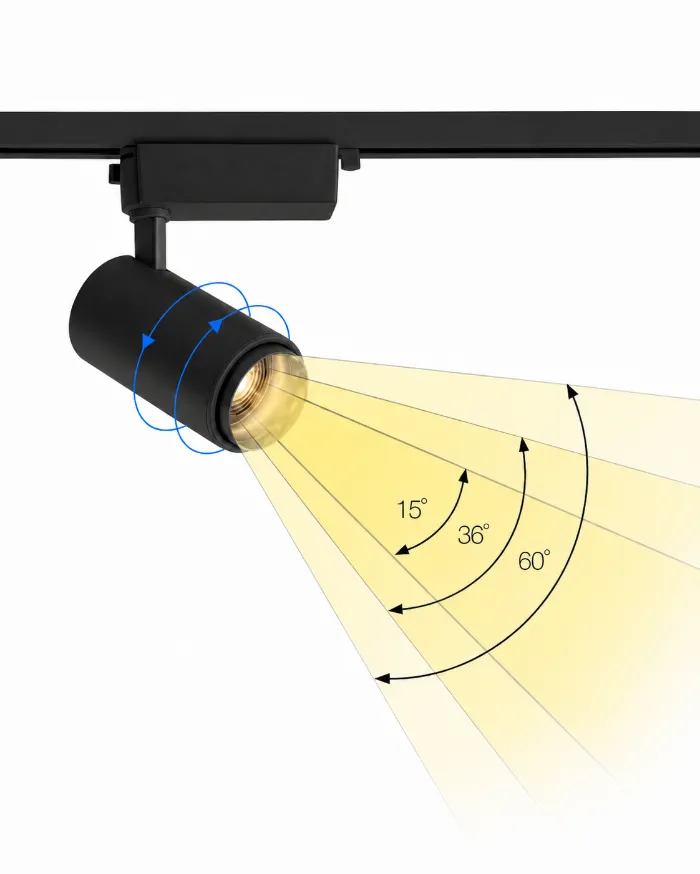
光学設計はビームの広がり、中心強度、漏れ光、グレア制御に影響します。.
トラックスポットライトの適切なビーム角の選定
現場 / 商業的現実
ビーム角の選択は、トラック照明プロジェクトで最も一般的な手直しの原因の一つです。狭すぎるビームは商品やディスプレイを部分的にしか照らさない可能性があり、広すぎるビームはアクセント効果を弱め、隣接エリアに光が漏れることがあります。店舗、ギャラリー、レストラン全体に間違ったビーム角が設置されると、修正には通常、器具の交換、光学系の変更、または全面的な再調整が必要となります。.
詳細分析とエンジニアリングソリューション
ビーム角は次の3つの実用的な入力に基づいて選択する必要があります:
ターゲット面からの取り付け高さ
対象物または展示エリアのサイズと反射率
重点照明と環境照明の間に必要なコントラスト
商業照明の実践において、ビーム分布はしばしば狭角、中角、広角に分類されます。これらは普遍的な固定基準ではなく、実用的な仕様カテゴリーです。.1
| ビームタイプ | 一般的な実用的用途 | 典型的なプロジェクトロジック |
|---|---|---|
| 狭角ビーム | 美術品、マネキン、小物、特設テーブル、高い天井 | 光を集中させ、強いアクセントをサポートし、長い投射距離でも強度を維持するのに役立ちます |
| ミディアムビーム | 棚、カウンター、小売店の壁面、複合商業ディスプレイ | 照射範囲、照度、および調整許容度のバランスを取ります |
| ワイドビーム | 広いテーブル、動線サポート、ソフトな強調、広い展示ゾーン | より広い表面をカバーしますが、過度に使用すると焦点のコントラストが低下する可能性があります |
設置高さが高くなるほど、ビームの照射範囲は広がり、中心照度がより重要になります。同じスポットライトでも、2.8m、4m、6mでは性能が大きく異なるため、設計者は目標距離における照射直径、有効垂直照度、ビームエッジの品質、漏れ光を評価します。.
小売ディスプレイ照明では、アクセント照明を使用して周囲光レベルよりも視覚的優先度を高めることがよくあります。店舗の種類や展示戦略に応じて、アクセント照明は単一の固定ルクス値ではなく、周囲光レベルの数倍で設計される場合があります。.4 美術館や博物館では、照度、スペクトル、露光時間、グレア、保存要件を総合的に制御する必要があるため、プロセスはより保守的になります。.5
| 選択係数 | 狭角ビーム | ミディアムビーム | ワイドビーム | Project Impact |
|---|---|---|---|---|
| 天井高 | 高い天井や長い投射距離に適しています | 標準的な商業用天井に適しています | 低い天井や広いターゲットにより適しています | 適切なマッチングは照明器具の交換リスクを低減します |
| 表示サイズ | 小物、美術品、マネキン | 棚、フィーチャーウォール、カウンター | 大型テーブル、広い表面 | 適切な適合により、現場での再調整が減ります |
| アクセントコントラスト | 高い | バランス型 | 低~中程度 | 適切なコントラストは視覚的階層を向上させます |
| Aiming sensitivity | 高い | 中程度 | 低い | Wider beams are easier to commission but may weaken focus |
| Spill light control | Strong when aimed correctly | バランス型 | More spill risk | Better spill control improves comfort and visual discipline |
工場注記
In large hospitality and retail projects, beam angle is sometimes specified too broadly because teams want to avoid sharp hot spots. The result is often flat lighting with poor visual hierarchy. A better approach is to use controlled narrow or medium beams for focal elements and let ambient lighting handle background brightness.
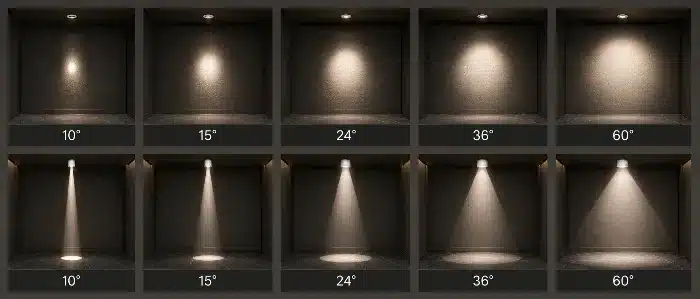
Different beam angles change the illuminated area, accent contrast, and aiming tolerance.
Common Applications of Track Lighting
現場 / 商業的現実
Commercial spaces rarely need uniform lighting everywhere. Products must stand out, artwork must be framed by light, tables must feel inviting, and brand zones must read clearly from circulation paths. Track spotlights can create this hierarchy without locking the project into a rigid ceiling plan, but the same strategy should not be copied directly from a gallery to a fashion store or from a cafe to a hotel lobby.
詳細分析とエンジニアリングソリューション
LED track spotlights are widely used in the following commercial applications:
小売店
Used for mannequins, shelving, promotional walls, feature tables, and shopfront presentation. Here, contrast, color quality, vertical display visibility, and merchandise modeling are critical.6Galleries and museums
Used to highlight artwork, sculptures, and temporary exhibitions with precise aiming and controlled beam spread. In these spaces, mock-up testing, spectrum evaluation, glare control, and conservation requirements are especially important.5Hospitality spaces
Used in lobbies, restaurants, lounges, bars, and reception areas to reinforce atmosphere, focal points, and material texture.Commercial interiors
Used in showrooms, sales offices, brand experience centers, and circulation zones where flexibility and visual emphasis are needed.
The key difference is the target surface and viewing condition. Vertical displays often need controlled front light, table or object displays rely more on concentrated beam placement, and architectural features may require grazing, accenting, or layered composition with ambient lighting.
工場注記
During hotel and retail commissioning, track spotlights are often adjusted several times after furniture, signage, merchandise, and decorative elements are fully in place. This is normal. The most reliable specifications are the ones that allow some aiming margin on site rather than depending on an exact theoretical position only.
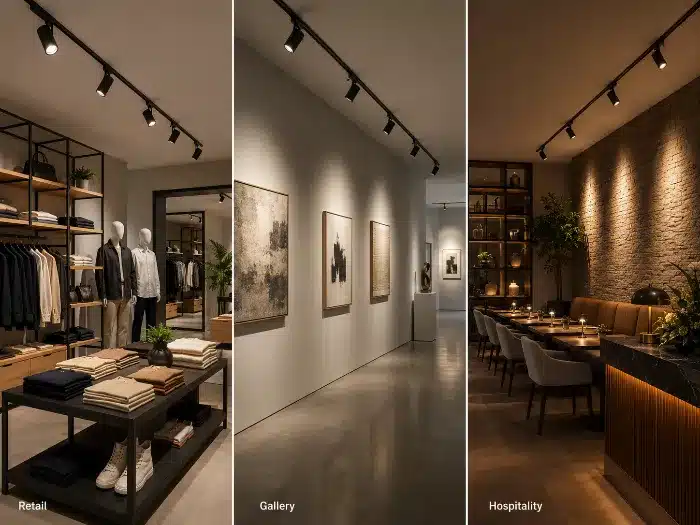
Track spotlights create flexible accent lighting for retail, gallery, and hospitality spaces.
Advantages of LED Track Spotlights in Commercial Lighting
現場 / 商業的現実
For B2B buyers, the value of track spotlights is not just appearance. In leased retail units, evolving product displays, and hospitality refurbishments, a flexible lighting platform can reduce repeated ceiling work and shorten update cycles, especially where maintenance access is difficult or business interruption has a direct cost.
詳細分析とエンジニアリングソリューション
LED track spotlights offer several practical advantages in commercial lighting:
Flexible fixture positioning
Luminaires can be relocated without major rewiring, making them suitable for changing layouts.Accurate accent lighting
Controlled optics and adjustable aiming improve focal emphasis and support visual merchandising.Layered lighting integration
Track spotlights work effectively with downlights, linear lighting, and decorative luminaires to build contrast and hierarchy.Better adaptation to display changes
When products, artwork, furniture, or seasonal layouts move, the lighting can move with them.Efficient use of output
Directional lighting places light where it is needed, which is more effective than relying on uniform ambient lighting to create emphasis.Lower long-term operating cost when correctly specified
LED systems can reduce energy use and maintenance cost, but rated life, thermal conditions, dimming compatibility, optical stability, and actual operating hours should be verified from product data and project conditions.7
From a project standpoint, these advantages improve lighting quality and operational flexibility in spaces that require regular updates rather than static layouts.
工場注記
From a manufacturing perspective, the best commercial track spotlight is not the one with the most aggressive specification sheet. It is the one that keeps optical consistency, mechanical aiming stability, electrical contact reliability, thermal performance, and color consistency across batches. In multi-store rollouts, batch-to-batch beam and color consistency are often more important than headline efficacy alone.
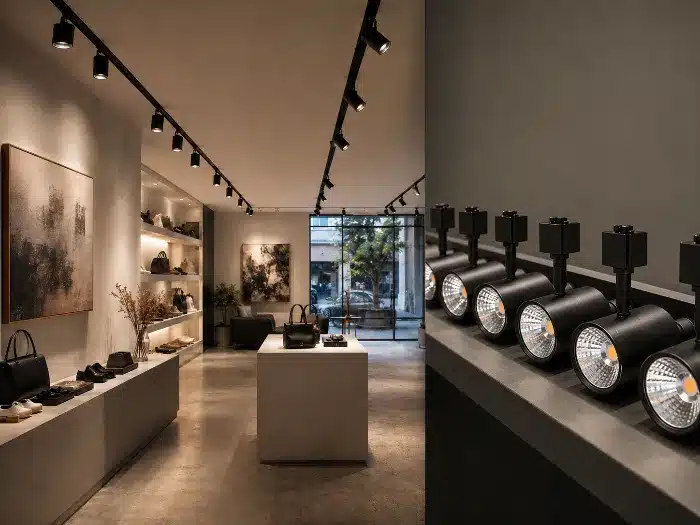
LED track spotlights support flexible accent lighting and long-term layout adaptation.
Track Lighting Layout Tips for Commercial Spaces
現場 / 商業的現実
A good fixture can still produce poor results if the layout ignores sightlines, target positions, ceiling geometry, or reflective surfaces. Common late-stage problems include uneven accent rhythm, shadow interference from shelving or signage, and glare caused by aiming directly into customer or guest view.
詳細分析とエンジニアリングソリューション
Effective track lighting layout starts with the target, not the ceiling. The design process should evaluate:
What needs emphasis
From where it will be viewed
At what mounting height the fixtures will operate
How much ambient light already exists
Whether the target is horizontal, vertical, glossy, matte, flat, or textured
How often the layout is expected to change
Practical layout principles include:
Align tracks with display logic
In retail, tracks are often placed parallel to shelving runs, feature walls, or circulation routes. In galleries, they are aligned for flexible artwork aiming. In hospitality, they may define focal islands or layered zones.Match spacing to beam spread and throw distance
Fixture spacing should reflect the actual beam footprint at the target plane, not just the ceiling grid.Avoid direct glare angles
Spotlights should be aimed to highlight the target while limiting direct visual intrusion into guest or shopper sightlines.Check reflected glare
Glass shelves, polished counters, glossy artwork protection, metal finishes, and dark reflective surfaces can all create reflected glare even when the fixture itself appears well shielded.Plan for adjustability margin
Leave enough aiming range and track capacity for future changes. A layout that is too tight on paper becomes difficult to adapt later.Balance accent and ambient lighting
Track spotlights should support a layered lighting scheme, not replace all general lighting unless the concept specifically requires it.
For commercial projects, mock-up testing is highly recommended, especially when display reflectance, ceiling height, and target lux levels are critical. Photometric data should be checked against real mounting conditions before final rollout.89
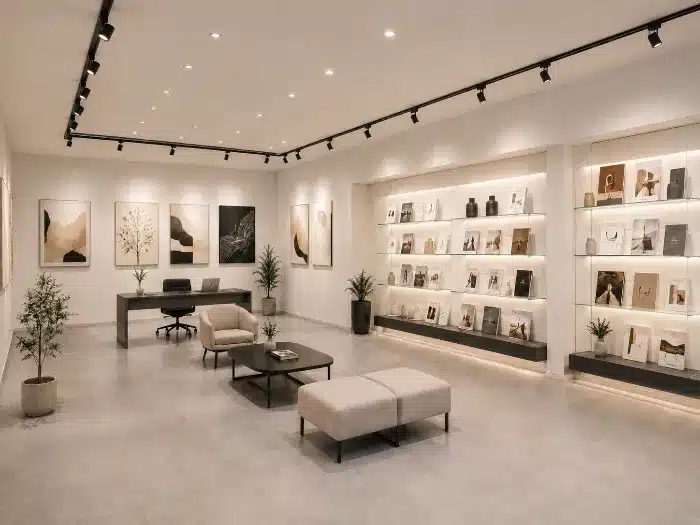
Track lighting layout should follow target positions, viewing direction, and beam spread.
How to Choose LED Track Spotlights for Commercial Projects?
| Project Requirement | Recommended Specification Focus |
|---|---|
| Retail shelf display | Medium beam, high CRI, stable color consistency, adjustable aiming |
| Mannequin or feature table | Narrow to medium beam, higher center intensity, controlled spill light |
| Gallery artwork | Precise beam control, low glare, suitable spectrum, mock-up testing |
| Hotel lobby or lounge | Warm CCT, low glare, stable dimming, refined material rendering |
| High ceiling application | Narrower beam, higher center beam intensity, verified photometric data |
| Frequently changing layout | Reliable track adapter, stable aiming friction, flexible beam options |
| Multi-store rollout | Batch color consistency, optical consistency, thermal reliability, clear QC control |
| Glossy display surfaces | Careful aiming, shielding accessories, reflected glare review |
よくあるご質問
What beam angle is best for LED track spotlights?
There is no single best beam angle for all projects. Narrow beams are useful for artwork, mannequins, feature tables, and higher ceilings where stronger focus is required. Medium beams are more versatile for retail shelving, counters, and wall displays. Wide beams are better for broader targets, softer emphasis, or supplementary ambient support.
Are LED track spotlights suitable for retail stores?
Yes. LED track spotlights are widely used in retail stores because they support flexible accent lighting for shelves, mannequins, promotional displays, shopfront areas, and seasonal layout changes. For retail projects, the key is to match beam angle, color quality, glare control, and aiming flexibility to the merchandise and customer viewing path.
How far apart should track spotlights be placed?
Spacing depends on ceiling height, beam angle, target size, aiming angle, and required illuminance. Fixture spacing should be based on the actual beam footprint at the target plane rather than only the ceiling grid. For important commercial projects, a mock-up or photometric simulation is recommended before final rollout.
What is the difference between narrow beam and wide beam track spotlights?
A narrow beam concentrates light into a smaller area and creates stronger visual focus. A wide beam covers a larger surface but produces softer contrast and may create more spill light if overused. Medium beams usually provide a balanced option for many commercial interiors.
How can glare from LED track spotlights be reduced?
Glare can be reduced by correct aiming, suitable beam angle selection, proper fixture shielding, accessories such as louvers or snoots, and careful review of reflective surfaces. Viewing direction is also important because a spotlight that looks comfortable from one angle may create direct or reflected glare from another position.
Should LED track spotlights be selected only by wattage or lumens?
No. Wattage and lumen output are only part of the specification. Beam distribution, center beam intensity, color consistency, dimming behavior, thermal design, glare control, and mechanical aiming stability all affect the final lighting result in commercial projects.
Conclusion: Business Value
LED track spotlights remain one of the most effective tools for commercial accent lighting because they combine directional control, layout flexibility, and application-specific beam selection. When properly specified, they improve visual hierarchy, reduce unnecessary spill light, and adapt more easily to future display changes.
From a business perspective, correct track spotlight selection supports three practical outcomes: better delivered lighting performance, lower maintenance effort during layout changes, and reduced lifetime system cost by avoiding repeated ceiling modification or fixture replacement.
B2B Engineering Recommendation
For commercial track spotlight projects, request beam angle samples, photometric files, mounting height details, target lux requirements, dimming requirements, and project layout information before final specification. Buyers can review TECO’s 照明器具 互換性のある器具オプションの出発点として、次に TECOエンジニアリングチームに連絡する ビーム選択、光学比較、調光検証、量産前のプロジェクトベースサンプル試験に関する図面とプロジェクト要件を含む。.
脚注
狭角、中角、広角ビームは、固定された普遍的な範囲ではなく、実用的な商業照明選択用語です。実際のビームカテゴリの命名はメーカーによって異なり、製品の測光データとサンプルで確認する必要があります。 出典: PNNL / DOE スミソニアン報告書. ↩ ↩
LED交換ランプおよび指向性照明器具は、ビーム特性、光度、色、配光が大きく異なる可能性があるため、ワット数またはルーメンのみに基づいて一対一の同等品として扱うべきではありません。 出典:PNNL / DOE GATEWAY, スミソニアン米国美術館でのLEDリフォームランプの実証. ↩
ビーム角は、照明学会によって、光度が最大光度の50%に低下する2方向間の角度として定義されます。 出典: IES、「ビーム角」“. ↩
小売アクセント照明は、1つの固定ルクス値ではなく、周囲レベルの数倍で設計されることが多いです。Waypoint Lightingのクイックリファレンス表は、小売の周囲/周辺レベルをリストし、ディスプレイアクセント照明は周囲レベルの3〜10倍になり得ると注記しています。 出典:Waypoint Lighting, IES推奨照度レベルクイックリファレンスガイド. ↩
博物館およびギャラリー照明には、制御されたビーム広がり、精密な照準、グレア制御、照度制限、スペクトルレビュー、露出管理、およびモックアップテストが必要です。 出典: IES推奨プラクティス:博物館照明. ↩ ↩
小売照明の品質、商品の視認性、ディスプレイコントラスト、アクセント照明、グレア、垂直面照度はANSI/IES RP-2-20で規定されています。, 推奨実践:小売スペースの照明. 出典: IES RP-2-20. ↩
LEDシステムはエネルギー使用量とメンテナンスコストを削減できますが、定格寿命と節約効果は製品設計、熱条件、試験方法、調光互換性、動作環境に依存します。出典: DOE、「LED照明」“; PNNL / DOE スミソニアン報告書. ↩
ビーム品質、色品質、光学性能、視覚的結果は、視覚品質が重要な場合、サンプル、モックアップ、またはプロジェクト試験で検証する必要があります。出典: PNNL/DOE GATEWAYスミソニアン報告書. ↩
DOE/PNNL GATEWAY博物館報告書は、特に博物館、ギャラリー、高視覚品質の商業インテリアにおける実際のプロジェクト条件下での検証を支援します。出典: DOE GATEWAY屋内プロジェクトアーカイブ; PNNLスミソニアン報告書. ↩