Iluminación Circadiana Explicada: ¿Una Guía Práctica para Proyectos Residenciales y de Hostelería?
Circadian lighting is often promoted as a wellness upgrade, yet many residential and hotel projects fail to deliver real biological benefit. The problem is not the idea. It is how circadian lighting is understood and applied.
Circadian lighting is not about special lamps or slogans. It is about using light, time, and behavior together to support how people actually live, sleep, and recover.
This practical guide explains what circadian lighting really means in homes and hotels, which biological principles truly matter, how applications differ between residential and hospitality settings, and how buyers can judge whether a circadian lighting project works in real life.
What Circadian Lighting Really Means in Residential and Hospitality Contexts?

Circadian lighting is often described in technical language that does not match daily living or hotel operation.
In residential and hospitality projects, circadian lighting means reducing biological stress from artificial light while reinforcing natural day–night signals.
Circadian lighting is not decorative lighting
Circadian lighting is frequently confused with:
- tunable white lighting
- warm ambient lighting
- smart lighting scenes
These tools can support circadian lighting, but they are not the goal.
The goal is biological alignment.
The practical definition
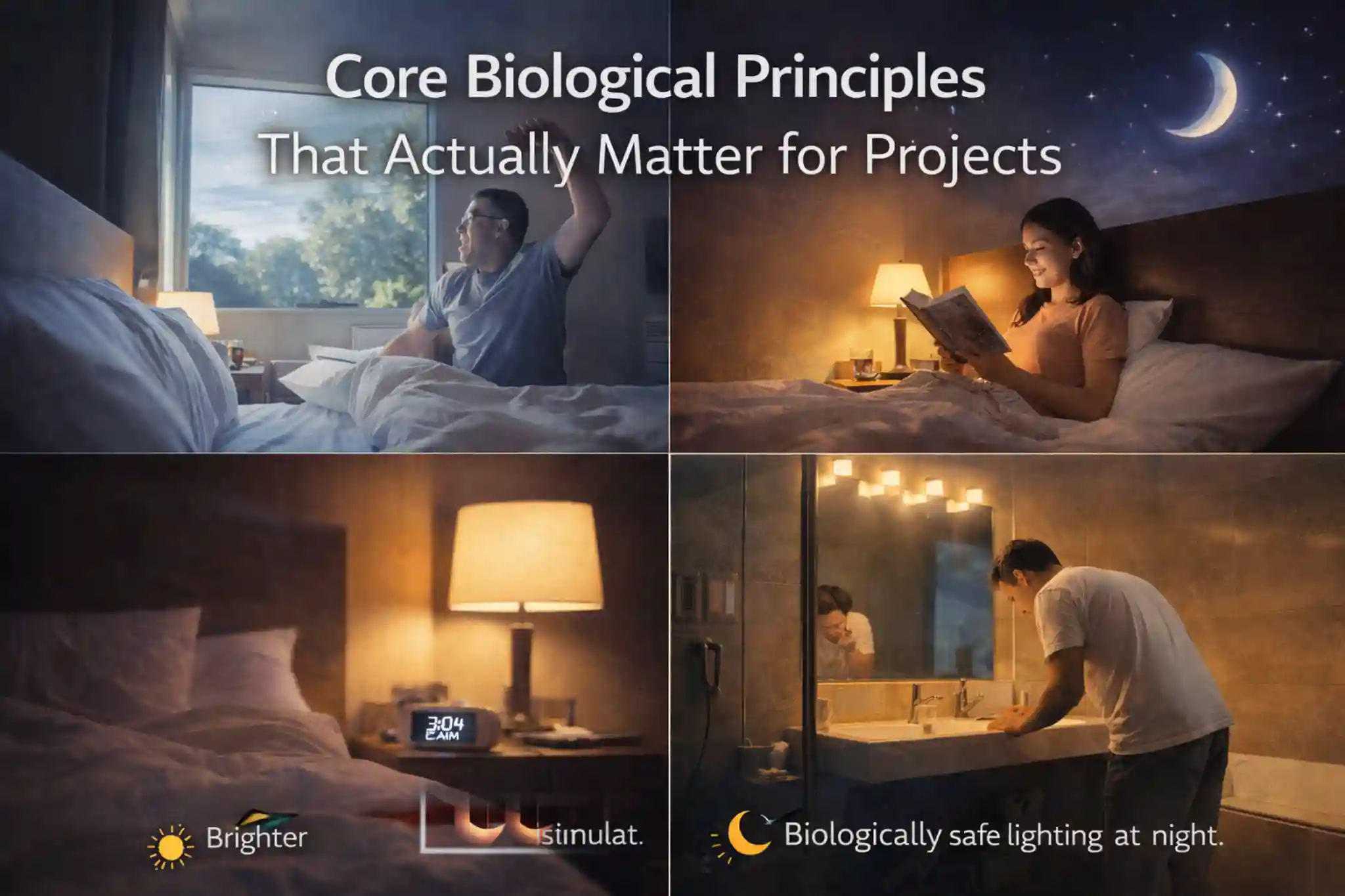
In real projects, circadian lighting means:
- brighter, biologically stimulating light during the day
- calmer, warmer, and lower-stimulation light in the evening
- biologically safe lighting at night
This applies to both circadian lighting for homes y circadian lighting for hotels, but the execution differs.
Why residential and hospitality projects struggle
Homes and hotels share challenges:
- people do not think about biology
- behavior overrides design
- lighting is often left on too long
Circadian lighting must work even when people are tired, distracted, or unfamiliar with the space.
That requirement shapes every design decision.
Circadian lighting as risk reduction
In practice, circadian lighting is less about optimization and more about harm reduction.
It aims to:
- reduce sleep disruption
- lower evening overstimulation
- avoid night-time biological shock
When evaluated this way, circadian lighting becomes practical instead of theoretical.
Core Biological Principles That Actually Matter for Projects?
Circadian science is complex, but projects do not need complexity. They need clarity.
Only a few biological principles truly matter when applying circadian lighting in residential and hospitality projects.
Principle 1: Light is a biological signal
Light does more than allow vision.
It affects:
- alertness
- hormone release
- sleep timing
This is driven largely by melanopsin-sensitive retinal cells, not by brightness alone.
This principle underpins all circadian lighting strategies.
Principle 2: Time matters more than color labels
The same light can help or harm depending on when it is used.
- morning light should stimulate
- evening light should calm
- night light should avoid stimulation
No spectrum is universally good or bad. Time defines meaning.
Principle 3: Duration and repetition matter
Circadian response depends on:
- repeated daily exposure
- consistent timing
One “perfect” lighting scene does little if behavior is random.
This is why circadian lighting often fails without control logic.
Principle 4: Night protection is critical
Most circadian damage occurs at night, not during the day.
White light at night, even warm white, can:
- suprimir la melatonina
- delay sleep onset
- fragment rest
For residential circadian lighting design and hospitality circadian lighting systems, night strategy matters more than daytime optimization.
Principle 5: Vertical exposure beats floor brightness
Biological response depends on light reaching the eyes.
Bright floors with dark walls deliver weak circadian signals.
This affects fixture choice and placement in real projects.
What does not matter as much as people think
In practical projects, circadian success does not depend on:
- perfect spectral curves
- complex metrics
- high-end research-grade systems
It depends on consistent, appropriate use.
How Circadian Lighting Should Be Applied Differently in Homes vs Hotels?
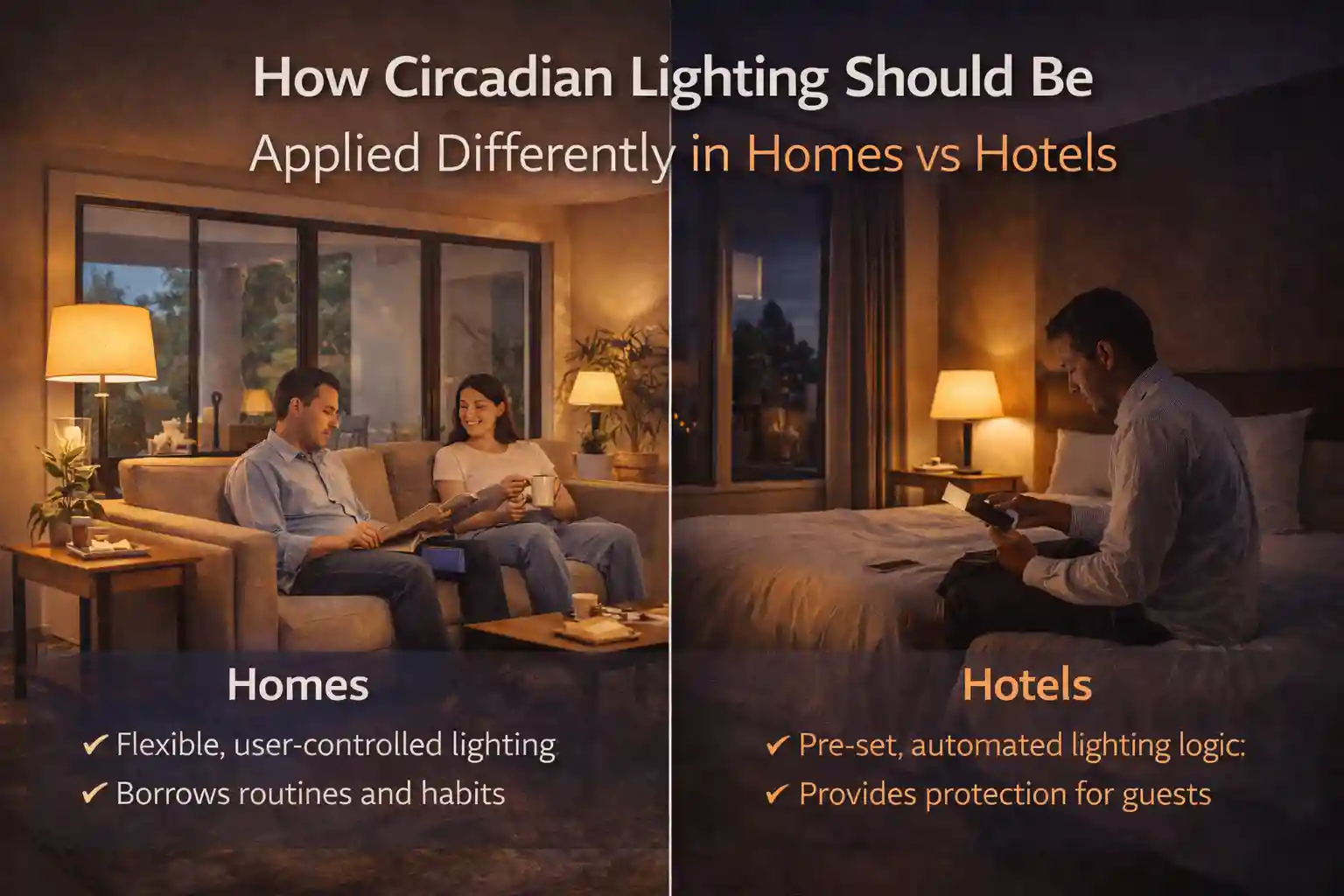
Homes and hotels share biological needs, but human behavior differs.
Circadian lighting for homes and circadian lighting for hotels require different design priorities because control, occupancy, and responsibility are not the same.
Residential circadian lighting design
In homes, circadian lighting must respect personal habits.
Key characteristics:
- stable occupants
- personal control
- long-term routines
Design priorities include:
- simple day–night transitions
- intuitive controls
- night-safe defaults
Residential circadian lighting design should guide behavior gently, not enforce it aggressively.
Typical residential strategies
Common residential approaches include:
- brighter neutral light in kitchens and work areas during the day
- warm, dimmable lighting in living areas at night
- red or very low amber light for night navigation
These strategies reduce biological disruption without requiring lifestyle changes.
Circadian lighting for hotels
Hotels operate under completely different constraints.
Characteristics include:
- constantly changing occupants
- no user education
- short stays
Guests do not adapt to the building. The building must protect the guest.
Hospitality circadian lighting systems priorities
Hotels must focus on:
- default-safe lighting behavior
- minimal reliance on guest action
- prevention of night-time overstimulation
This often means:
- limiting bright white light availability at night
- using automated schedules
- providing biologically safe night guidance lighting
Why hotels need stronger control logic
In hotels, manual control fails because:
- guests explore switches
- curiosity overrides intention
- habits vary widely
For hospitality circadian lighting systems, automation and restriction are often necessary, not optional.
Key difference summary
| Aspecto | Hogares | Hoteles |
|---|---|---|
| User control | Alta | Unpredictable |
| Education | Possible | Ninguno |
| Automation need | Opcional | Often essential |
| Night protection | Shared responsibility | Building responsibility |
Design must follow behavior reality.
The Role of Smart Lighting in Practical Circadian Projects?

Smart lighting is often misunderstood in circadian discussions.
Smart lighting supports circadian lighting by enforcing timing and consistency, not by improving spectrum quality.
What smart lighting actually does
In circadian projects, smart lighting helps with:
- scheduled transitions
- gradual dimming
- night-time lockouts
- centralized control
These functions improve reliability.
This is especially relevant for human-centric lighting practical guide discussions, where behavior consistency matters.
What smart lighting does not fix
Smart systems do not automatically provide:
- biologically safe spectrum
- correct fixture placement
- appropriate intensity
Automating the wrong light still produces the wrong biological effect.
Where smart lighting adds the most value
Smart lighting is most valuable when:
- many users share a space
- behavior is unpredictable
- circadian failure has real cost
This is why hospitality circadian lighting systems benefit more from automation than private homes.
When smart lighting is optional
In small residential projects, smart lighting may be optional if:
- occupants understand circadian needs
- habits are stable
- night lighting is already safe
Over-automation can increase complexity without adding benefit.
Practical view
Smart lighting should be treated as:
- a consistency tool
- a behavior buffer
Not as a circadian solution by itself.
Common Mistakes That Undermine Circadian Lighting Effectiveness?
Most circadian lighting failures follow the same patterns.
Circadian lighting fails when design focuses on features instead of behavior and biology.
Mistake 1: Treating circadian lighting as a product
Circadian lighting is often specified as:
- special lamps
- tunable fixtures
- marketing packages
Without time logic and behavior control, these products do little.
Mistake 2: Ignoring night-time lighting
Many projects optimize daytime lighting and forget night use.
Night-time mistakes include:
- bright bathroom lighting
- white corridor lights
- uncontrolled bedside lamps
These undermine circadian benefits completely.
Mistake 3: Assuming guests or residents will “use it correctly”
Designs that depend on perfect user behavior fail.
Circadian lighting must survive misuse.
Mistake 4: Overcomplicated scenes
Too many scenes confuse users.
Confusion leads to overrides.
Overrides break circadian logic.
Mistake 5: No evaluation after installation
Many projects declare success at handover.
Real circadian success shows up in:
- sleep quality
- comfort feedback
- reduced complaints
If no one checks, problems persist silently.
Mistake 6: Copying office circadian concepts into homes or hotels
Office-focused circadian strategies do not translate directly.
Homes and hotels require gentler, safer approaches.
Practical Design and Specification Guidelines for Real Projects?
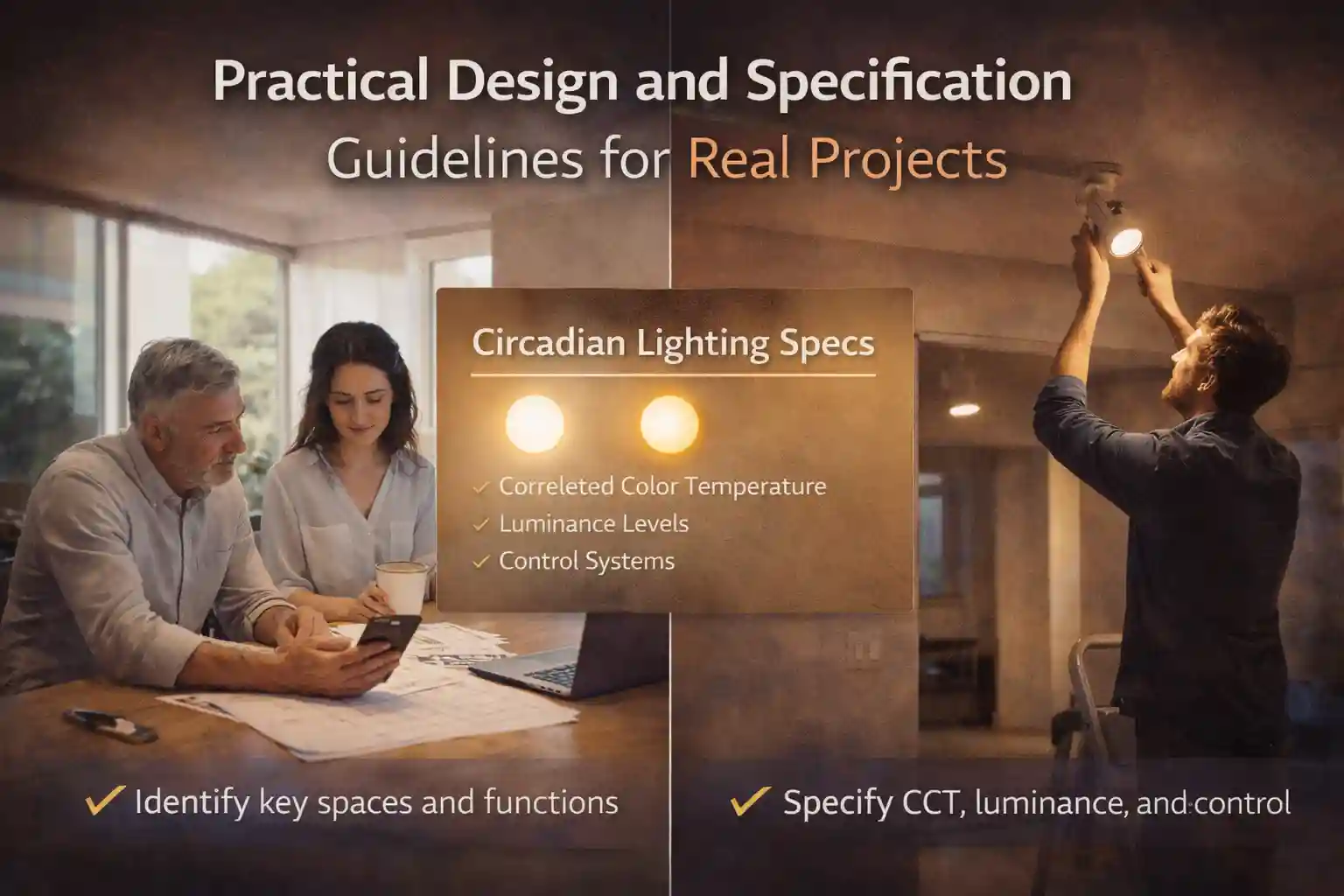
Circadian lighting becomes practical when guidelines are simple and enforceable.
Effective circadian lighting design focuses on clear phase roles, safe defaults, and minimal user effort.
Guideline 1: Define day, evening, and night clearly
Every project should define:
- when day lighting ends
- when evening transition begins
- when night protection starts
Ambiguity weakens circadian signaling.
Guideline 2: Assign fixture roles
Do not let one fixture serve all phases.
Typical role assignment:
| Fase | Fixture Role |
|---|---|
| Day | General illumination |
| Noche | Warm accent and ambient |
| Noche | Orientation only |
This simplifies behavior.
Guideline 3: Reduce white light availability at night
Night-time safety lighting should:
- avoid white spectrum
- remain low in intensity
- be shielded from direct view
This applies strongly to hospitality projects.
Guideline 4: Prefer defaults over instructions
Good circadian lighting works without explanation.
If a guest needs instructions, the design is fragile.
Guideline 5: Balance cost and impact
Circadian lighting does not require premium products everywhere.
Target investment where biological risk is highest:
- bedrooms
- bathrooms at night
- corridors
Guideline 6: Test behavior, not just light output
Walk the space at night.
Use it like a guest.
If light feels alerting, the design needs adjustment.
How Buyers and Project Owners Should Evaluate Circadian Lighting Success?
Success is not defined by specifications. It is defined by outcomes.
Circadian lighting success should be evaluated through behavior stability, night-time protection, and user comfort, not marketing claims.
Ask outcome-based questions
En lugar de preguntar:
- Does this system meet circadian standards?
Ask:
- Are guests exposed to bright white light at night?
- Is evening lighting calming by default?
- Does morning lighting support wakefulness?
These questions reveal real performance.
Evaluate consistency, not perfection
Circadian lighting does not need to be perfect.
It needs to be:
- consistently better than conventional lighting
- reliable across users
- robust against misuse
Monitor complaints and feedback
In hospitality projects, watch for:
- sleep complaints
- eye discomfort
- night-time disturbance reports
Lighting often plays a hidden role.
Think long term
Circadian lighting success shows over time, not at opening.
Designs that reduce complaints quietly are often the most successful.
Buyer mindset shift
Buyers should view circadian lighting as:
- a health-supporting infrastructure
- not a marketing feature
This shift leads to better decisions.
Conclusión
Circadian lighting in residential and hospitality projects succeeds when biology, timing, and human behavior are aligned through simple, consistent, and night-safe design rather than complex technology.
Teco supports B2B buyers and project owners developing circadian lighting solutions for homes and hotels that work in real life, not just on drawings.
We help with:
- circadian lighting for homes and hospitality
- residential circadian lighting design strategies
- practical fixture and spectrum selection
- avoiding over-designed but ineffective systems
Our focus is on stability, clarity, and biological safety across Europe, the Middle East, and Asia.
Correo electrónico: [email protected]
Sitio web: www.tecolite.com
Tell me your project type and user profile.
I will help you decide how circadian lighting should actually be applied.