Iluminação Circadiana Explicada: Um Guia Prático para Projetos Residenciais e de Hotelaria?
A iluminação circadiana é frequentemente promovida como uma melhoria de bem-estar, mas muitos projetos residenciais e hoteleiros não conseguem proporcionar um benefício biológico real. O problema não é a ideia. É como a iluminação circadiana é compreendida e aplicada.
A iluminação circadiana não é sobre lâmpadas especiais ou slogans. Trata-se de usar a luz, o tempo e o comportamento em conjunto para apoiar a forma como as pessoas realmente vivem, dormem e recuperam.
Este guia prático explica o que a iluminação circadiana realmente significa em casas e hotéis, quais os princípios biológicos que realmente importam, como as aplicações diferem entre ambientes residenciais e hoteleiros, e como os compradores podem avaliar se um projeto de iluminação circadiana funciona na vida real.
O que Significa Realmente a Iluminação Circadiana em Contextos Residenciais e Hoteleiros?

A iluminação circadiana é frequentemente descrita em linguagem técnica que não corresponde à vida diária ou à operação hoteleira.
Em projetos residenciais e hoteleiros, a iluminação circadiana significa reduzir o stress biológico da luz artificial enquanto reforça os sinais naturais de dia-noite.
A iluminação circadiana não é iluminação decorativa
A iluminação circadiana é frequentemente confundida com:
- iluminação branca ajustável
- iluminação ambiente quente
- cenas de iluminação inteligente
Estas ferramentas podem apoiar a iluminação circadiana, mas não são o objetivo.
O objetivo é o alinhamento biológico.
A definição prática
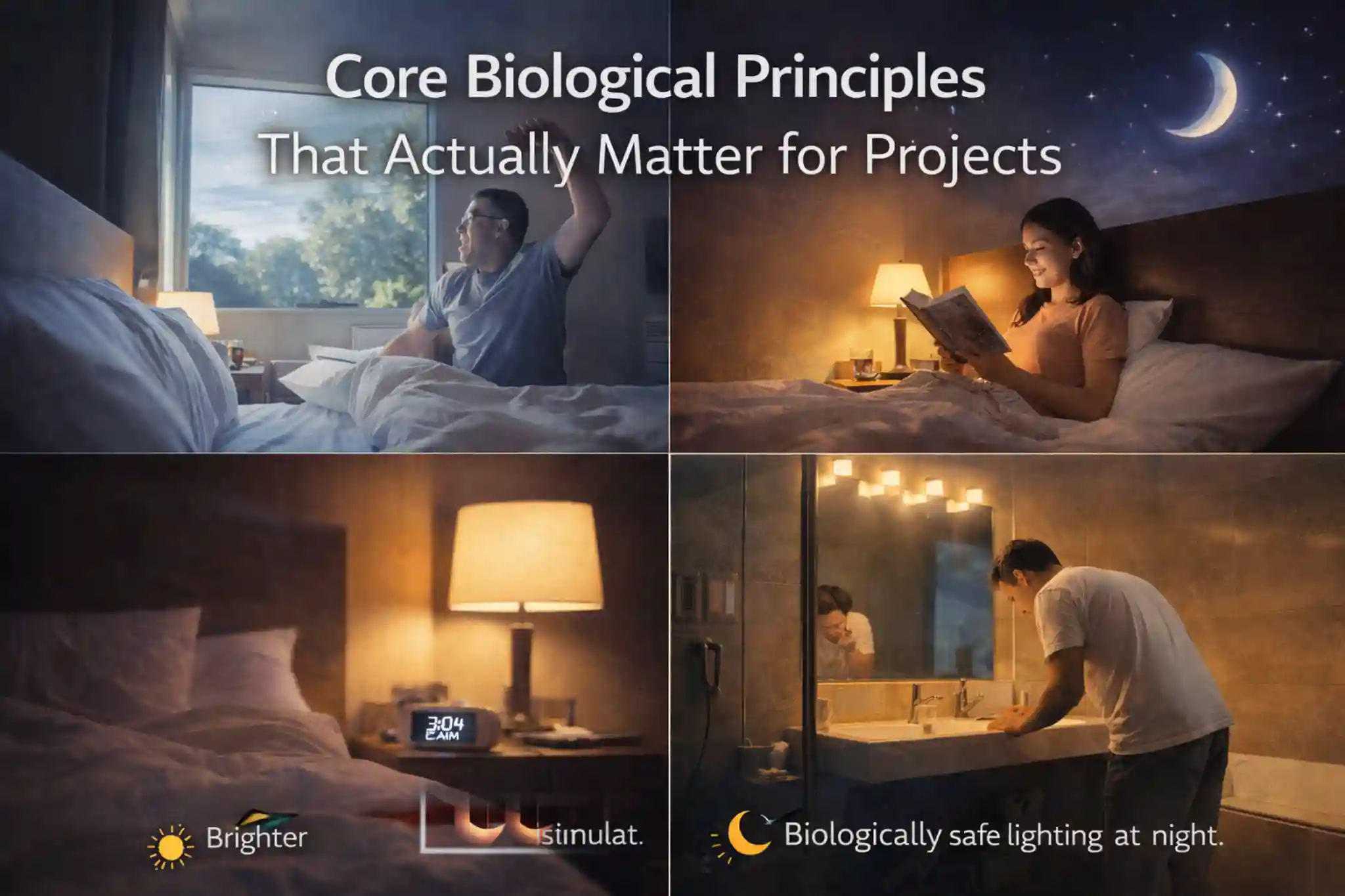
Em projetos reais, a iluminação circadiana significa:
- luz mais brilhante e biologicamente estimulante durante o dia
- luz mais calma, mais quente e de menor estimulação à noite
- iluminação biologicamente segura à noite
Isto aplica-se a ambos iluminação circadiana para casas e iluminação circadiana para hotéis, mas a execução difere.
Porque é que os projetos residenciais e de hotelaria têm dificuldades
Casas e hotéis partilham desafios:
- as pessoas não pensam na biologia
- o comportamento sobrepõe-se ao design
- a iluminação é frequentemente deixada ligada por demasiado tempo
A iluminação circadiana deve funcionar mesmo quando as pessoas estão cansadas, distraídas ou não estão familiarizadas com o espaço.
Esse requisito molda todas as decisões de design.
Iluminação circadiana como redução de risco
Na prática, a iluminação circadiana é menos sobre otimização e mais sobre redução de danos.
Tem como objetivo:
- reduzir a perturbação do sono
- menor sobrestimulação à noite
- evitar choque biológico noturno
Quando avaliada desta forma, a iluminação circadiana torna-se prática em vez de teórica.
Princípios Biológicos Fundamentais Que Realmente Importam para os Projetos?
A ciência circadiana é complexa, mas os projetos não precisam de complexidade. Eles precisam de clareza.
Apenas alguns princípios biológicos realmente importam ao aplicar a iluminação circadiana em projetos residenciais e hoteleiros.
Princípio 1: A luz é um sinal biológico
A luz faz mais do que permitir a visão.
Afeta:
- estado de alerta
- libertação de hormonas
- horário do sono
Isto é impulsionado principalmente por células da retina sensíveis à melanopsina, não apenas pelo brilho.
Este princípio sustenta todos iluminação circadiana estratégias.
Princípio 2: O tempo importa mais do que os rótulos de cor
A mesma luz pode ajudar ou prejudicar, dependendo de quando é utilizada.
- a luz da manhã deve estimular
- a luz da noite deve acalmar
- a luz noturna deve evitar estimulação
Nenhum espetro é universalmente bom ou mau. O tempo define o significado.
Princípio 3: A duração e a repetição são importantes
A resposta circadiana depende de:
- exposição diária repetida
- timing consistente
Uma cena de iluminação “perfeita” faz pouco se o comportamento for aleatório.
É por isso que a iluminação circadiana frequentemente falha sem lógica de controlo.
Princípio 4: A proteção noturna é crítica
A maior parte do dano circadiano ocorre à noite, não durante o dia.
A luz branca à noite, mesmo a branca quente, pode:
- suprimir a melatonina
- atrasar o início do sono
- fragmentar o descanso
Para o design de iluminação circadiana residencial e sistemas de iluminação circadiana na hotelaria, a estratégia noturna importa mais do que a otimização diurna.
Princípio 5: A exposição vertical supera o brilho do chão
A resposta biológica depende da luz que atinge os olhos.
Pisos claros com paredes escuras transmitem sinais circadianos fracos.
Isto afeta a escolha e colocação dos dispositivos em projetos reais.
O que não importa tanto quanto as pessoas pensam
Em projetos práticos, o sucesso circadiano não depende de:
- curvas espectrais perfeitas
- métricas complexas
- sistemas de alta gama para investigação
Depende de um uso consistente e apropriado.
Como a Iluminação Circadiana Deve Ser Aplicada de Forma Diferente em Casas vs Hotéis?
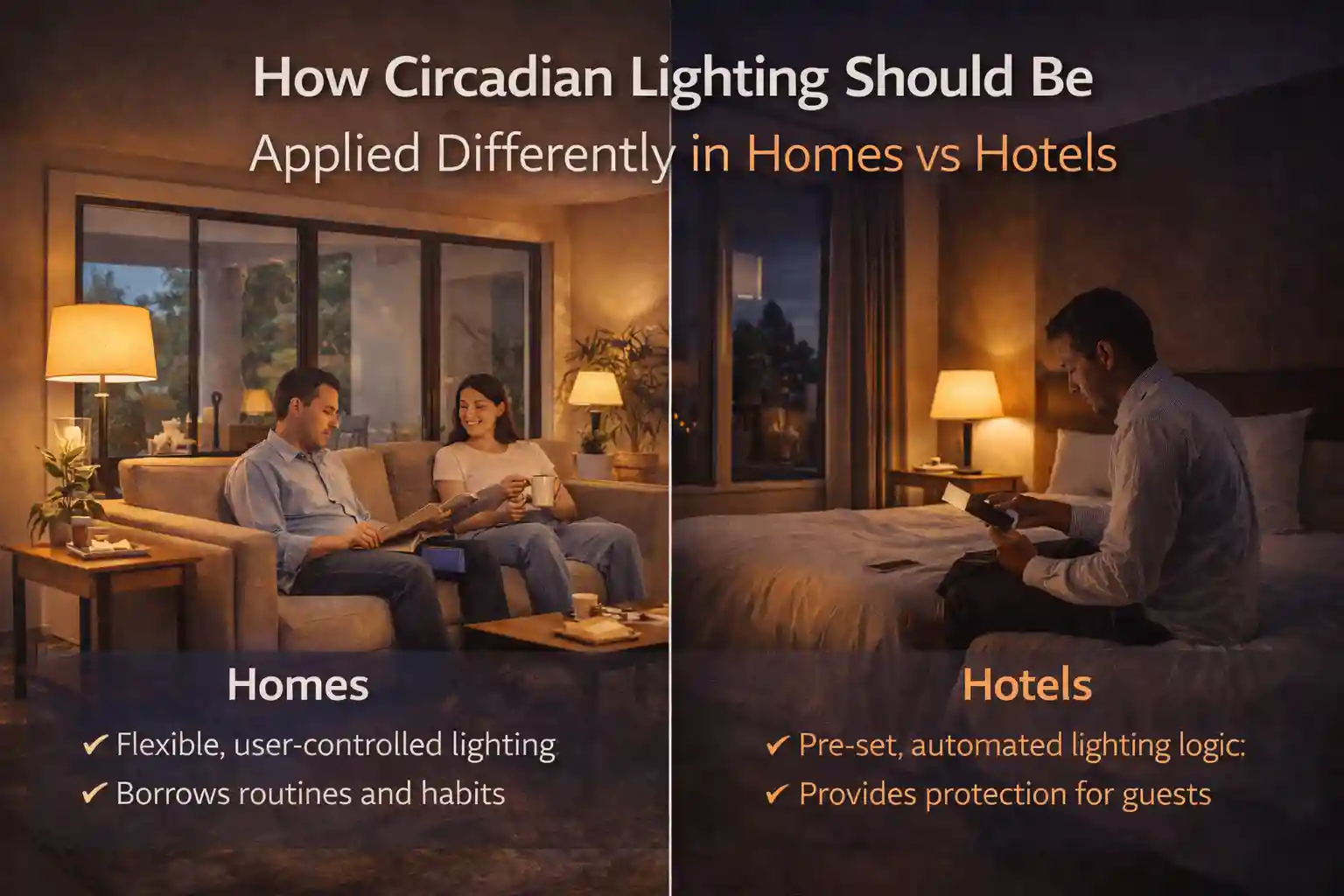
Casas e hotéis partilham necessidades biológicas, mas o comportamento humano difere.
A iluminação circadiana para casas e a iluminação circadiana para hotéis requerem prioridades de design diferentes porque o controlo, a ocupação e a responsabilidade não são os mesmos.
Design de iluminação circadiana residencial
Em casa, a iluminação circadiana deve respeitar os hábitos pessoais.
Características-chave:
- ocupantes estáveis
- controlo pessoal
- rotinas de longo prazo
As prioridades de design incluem:
- transições simples dia–noite
- controlos intuitivos
- predefinições seguras para a noite
O design de iluminação circadiana residencial deve orientar o comportamento suavemente, não impô-lo agressivamente.
Estratégias residenciais típicas
As abordagens residenciais comuns incluem:
- luz neutra mais brilhante em cozinhas e áreas de trabalho durante o dia
- iluminação quente e regulável nas áreas de estar à noite
- luz vermelha ou âmbar muito baixa para navegação noturna
These strategies reduce biological disruption without requiring lifestyle changes.
Circadian lighting for hotels
Hotels operate under completely different constraints.
Characteristics include:
- constantly changing occupants
- no user education
- short stays
Guests do not adapt to the building. The building must protect the guest.
Hospitality circadian lighting systems priorities
Hotels must focus on:
- default-safe lighting behavior
- minimal reliance on guest action
- prevention of night-time overstimulation
This often means:
- limiting bright white light availability at night
- using automated schedules
- providing biologically safe night guidance lighting
Why hotels need stronger control logic
In hotels, manual control fails because:
- guests explore switches
- curiosity overrides intention
- habits vary widely
For hospitality circadian lighting systems, automation and restriction are often necessary, not optional.
Key difference summary
| Aspect | Homes | Hotels |
|---|---|---|
| User control | Alta | Unpredictable |
| Education | Possible | Nenhum |
| Automation need | Opcional | Often essential |
| Night protection | Shared responsibility | Building responsibility |
Design must follow behavior reality.
The Role of Smart Lighting in Practical Circadian Projects?

Smart lighting is often misunderstood in circadian discussions.
Smart lighting supports circadian lighting by enforcing timing and consistency, not by improving spectrum quality.
What smart lighting actually does
In circadian projects, smart lighting helps with:
- scheduled transitions
- gradual dimming
- night-time lockouts
- centralized control
These functions improve reliability.
This is especially relevant for human-centric lighting practical guide discussions, where behavior consistency matters.
What smart lighting does not fix
Smart systems do not automatically provide:
- biologically safe spectrum
- correct fixture placement
- appropriate intensity
Automating the wrong light still produces the wrong biological effect.
Where smart lighting adds the most value
Smart lighting is most valuable when:
- many users share a space
- behavior is unpredictable
- circadian failure has real cost
This is why hospitality circadian lighting systems benefit more from automation than private homes.
When smart lighting is optional
In small residential projects, smart lighting may be optional if:
- occupants understand circadian needs
- habits are stable
- night lighting is already safe
Over-automation can increase complexity without adding benefit.
Practical view
Smart lighting should be treated as:
- a consistency tool
- a behavior buffer
Not as a circadian solution by itself.
Common Mistakes That Undermine Circadian Lighting Effectiveness?
Most circadian lighting failures follow the same patterns.
Circadian lighting fails when design focuses on features instead of behavior and biology.
Mistake 1: Treating circadian lighting as a product
Circadian lighting is often specified as:
- special lamps
- tunable fixtures
- marketing packages
Without time logic and behavior control, these products do little.
Mistake 2: Ignoring night-time lighting
Many projects optimize daytime lighting and forget night use.
Night-time mistakes include:
- bright bathroom lighting
- white corridor lights
- uncontrolled bedside lamps
These undermine circadian benefits completely.
Mistake 3: Assuming guests or residents will “use it correctly”
Designs that depend on perfect user behavior fail.
Circadian lighting must survive misuse.
Mistake 4: Overcomplicated scenes
Too many scenes confuse users.
Confusion leads to overrides.
Overrides break circadian logic.
Mistake 5: No evaluation after installation
Many projects declare success at handover.
Real circadian success shows up in:
- sleep quality
- comfort feedback
- reduced complaints
If no one checks, problems persist silently.
Mistake 6: Copying office circadian concepts into homes or hotels
Office-focused circadian strategies do not translate directly.
Homes and hotels require gentler, safer approaches.
Practical Design and Specification Guidelines for Real Projects?
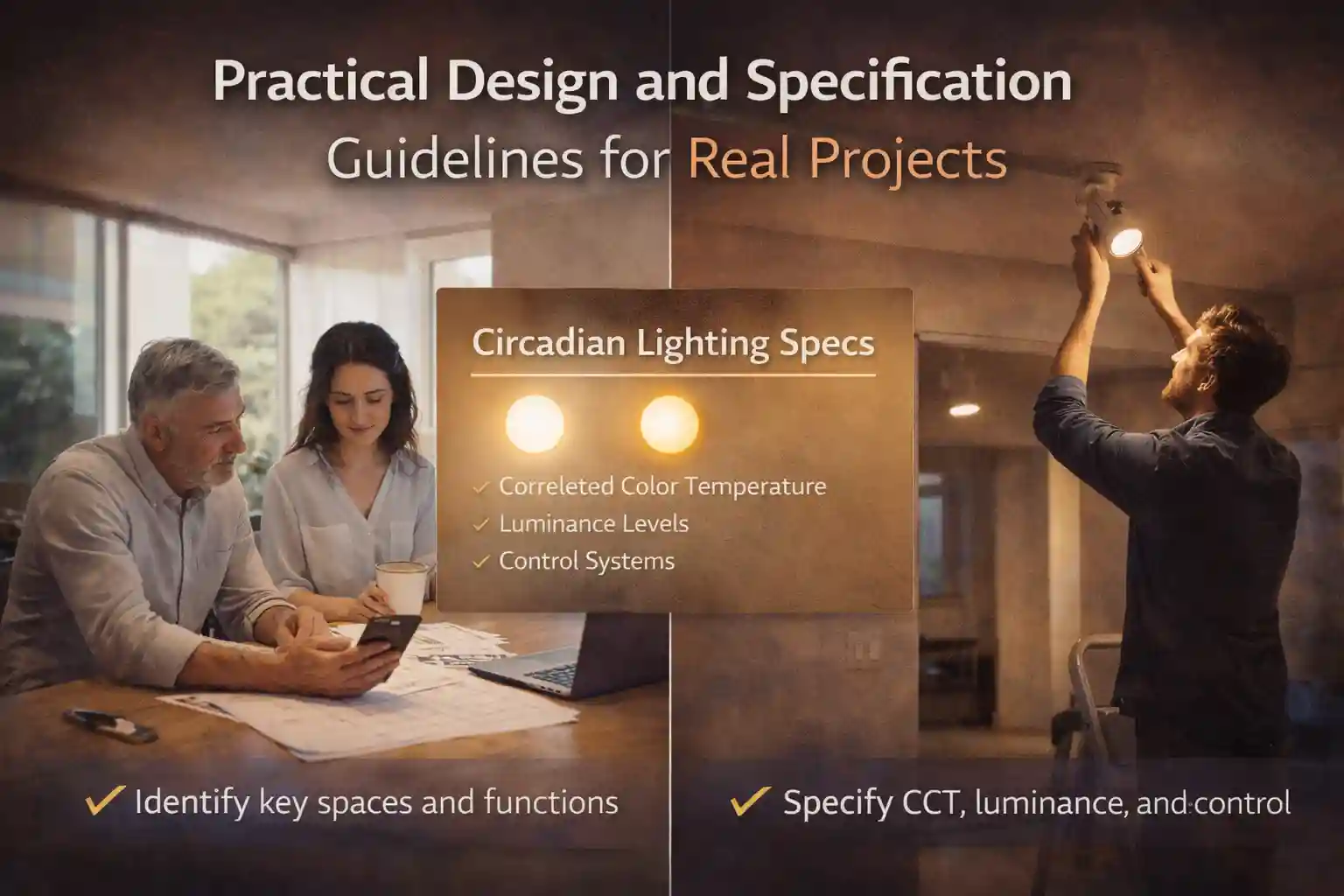
Circadian lighting becomes practical when guidelines are simple and enforceable.
Effective circadian lighting design focuses on clear phase roles, safe defaults, and minimal user effort.
Guideline 1: Define day, evening, and night clearly
Every project should define:
- when day lighting ends
- when evening transition begins
- when night protection starts
Ambiguity weakens circadian signaling.
Guideline 2: Assign fixture roles
Do not let one fixture serve all phases.
Typical role assignment:
| Fase | Fixture Role |
|---|---|
| Day | General illumination |
| Noite | Warm accent and ambient |
| Noite | Orientation only |
This simplifies behavior.
Guideline 3: Reduce white light availability at night
Night-time safety lighting should:
- avoid white spectrum
- remain low in intensity
- be shielded from direct view
This applies strongly to hospitality projects.
Guideline 4: Prefer defaults over instructions
Good circadian lighting works without explanation.
If a guest needs instructions, the design is fragile.
Guideline 5: Balance cost and impact
Circadian lighting does not require premium products everywhere.
Target investment where biological risk is highest:
- quartos
- bathrooms at night
- corridors
Guideline 6: Test behavior, not just light output
Walk the space at night.
Use it like a guest.
If light feels alerting, the design needs adjustment.
How Buyers and Project Owners Should Evaluate Circadian Lighting Success?
Success is not defined by specifications. It is defined by outcomes.
Circadian lighting success should be evaluated through behavior stability, night-time protection, and user comfort, not marketing claims.
Ask outcome-based questions
Instead of asking:
- Does this system meet circadian standards?
Ask:
- Are guests exposed to bright white light at night?
- Is evening lighting calming by default?
- Does morning lighting support wakefulness?
These questions reveal real performance.
Evaluate consistency, not perfection
Circadian lighting does not need to be perfect.
It needs to be:
- consistently better than conventional lighting
- reliable across users
- robust against misuse
Monitor complaints and feedback
In hospitality projects, watch for:
- sleep complaints
- eye discomfort
- night-time disturbance reports
Lighting often plays a hidden role.
Think long term
Circadian lighting success shows over time, not at opening.
Designs that reduce complaints quietly are often the most successful.
Buyer mindset shift
Buyers should view circadian lighting as:
- a health-supporting infrastructure
- not a marketing feature
This shift leads to better decisions.
Conclusão
Circadian lighting in residential and hospitality projects succeeds when biology, timing, and human behavior are aligned through simple, consistent, and night-safe design rather than complex technology.
Teco supports B2B buyers and project owners developing iluminação circadiana solutions for homes and hotels that work in real life, not just on drawings.
We help with:
- circadian lighting for homes and hospitality
- residential circadian lighting design strategies
- practical fixture and spectrum selection
- avoiding over-designed but ineffective systems
Our focus is on stability, clarity, and biological safety across Europe, the Middle East, and Asia.
Email: [email protected]
Site: www.tecolite.com
Tell me your project type and user profile.
I will help you decide how circadian lighting should actually be applied.