CRI98 vs GU10 de Alto Lúmen: Qualidade de Cor ou Brilho?
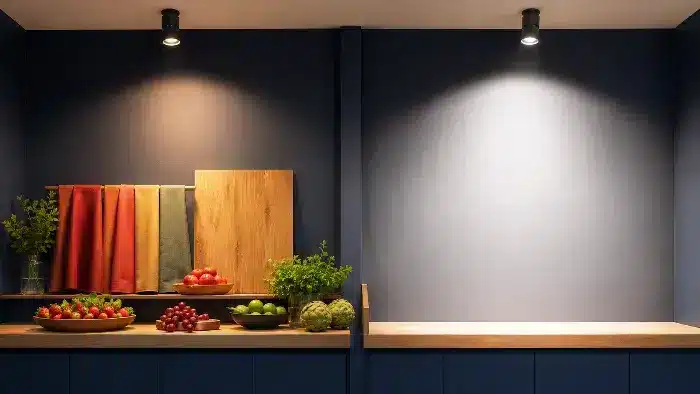
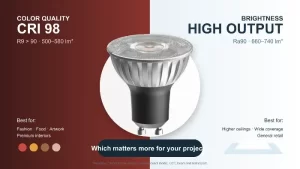
The same TECO GU10 product shown between two lighting priorities: richer color presentation and higher perceived brightness. The product itself uses the original TECO-supplied photograph.
Resposta Rápida
Choose a CRI98 GU10 when accurate color appearance directly affects the value of what is being illuminated, such as clothing, artwork, food, furniture, cosmetics, skin tones, or premium interior finishes.
Choose a high-lumen GU10 when the first priority is achieving sufficient illumination at the target surface, especially in higher ceilings, wider beam applications, general commercial spaces, or projects replacing bright halogen lamps.
However, the best GU10 is not automatically the lamp with the highest CRI or the highest lumen value. A successful choice must balance:
- Color quality
- Useful light on the target
- Ângulo do feixe
- Altura de montagem
- Dimming performance
- Heat management
- Lifetime
- Project budget
A 500-lumen CRI98 GU10 with a controlled 24° beam may illuminate a small display more effectively than a 700-lumen lamp with a wide 60° beam. Conversely, even perfect color rendering cannot compensate for inadequate illuminance in a large or high-ceilinged space.
The right question is therefore not simply “color quality or brightness?” It is:
How much light does the project need, where does that light need to go, and how accurately must the illuminated objects appear?
What Do CRI and Lumens Actually Measure?
Lumens measure the total quantity of visible light emitted by a lamp. More lumens generally mean more total light, but lumens do not tell you where that light goes or how objects will look beneath it.
CRI, or Color Rendering Index, evaluates how faithfully a light source renders colors compared with a reference source of the same color temperature. The commonly published Ra value is an average based on the first eight test colors, R1–R8. It does not include R9, the saturated red test color that is especially important for skin, food, wood, fabrics, flowers, and many retail products. EU regulations define CRI as the average of R1–R8 and treat R9 as a separate product parameter.
This distinction explains why two lamps carrying a similar “CRI 90” label can look noticeably different. One may render pastel colors reasonably well while leaving red materials flat or brownish. Another may have stronger red content and produce more natural skin tones, food, and warm finishes.
CRI and lumens answer different questions:
| Métrica | Question it answers | What it does not tell you |
|---|---|---|
| Lúmens | How much total visible light does the lamp emit? | Color accuracy, beam quality or target illuminance |
| CRI / Ra | How faithfully are a set of colors rendered? | Brightness, R9 performance or dimming quality |
| R9 | How well is saturated red rendered? | Overall color fidelity |
| Ângulo do feixe | How widely is the light distributed? | Total output or beam uniformity |
| Candela | How intense is the light in a particular direction? | Total light output |
| Lux | How much light reaches a surface? | Color quality |
Professional selection requires several of these values together.
Why Can a CRI98 GU10 Produce Fewer Lumens?
White LEDs usually create light by combining a blue or violet LED source with phosphor materials. To improve color rendering—particularly saturated red—a manufacturer must distribute more energy across parts of the spectrum that contribute less efficiently to the photopic lumen calculation.
As a result, a very-high-CRI version of the same lamp platform will often produce fewer lumens than a version optimized for maximum luminous efficacy. The size of this difference is not fixed. It depends on the LED package, phosphor system, color temperature, drive current, optical design, thermal conditions, and the way the manufacturer balances quality against efficiency.
For TECO’s current GU10 range, the supplied product matrix includes examples such as:
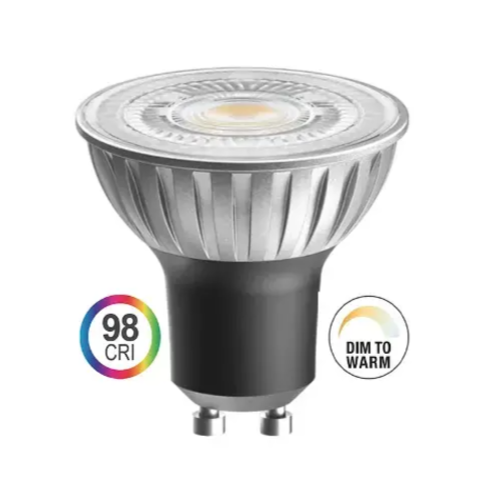
Actual TECO GU10 product photograph supplied by TECO.
| GU10 option | Color rendering | Declared luminous flux* | Main priority |
|---|---|---|---|
| High-CRI version | Ra98, R9 >90 | 500–580 lm | Accurate colors |
| High-output version | Ra90, R9 >90 | 660–740 lm | More light with good color quality |
| General high-output version | Ra80 | 670–710 lm | Brightness and efficiency |
| Narrow-beam version | Ra95 | 440 lm | Precision accent lighting |
*Output varies by product version and optical configuration. Confirm the exact model, CCT, beam angle and test report before specifying or ordering.
Buyers can review the currently published TECO Premium GU10 Pro 8W Ra98 specifications and browse the complete GU10 LED bulb range before requesting matched samples.
These figures show why wattage alone is a weak selection method. Two GU10 lamps rated at approximately 7.5–8 W may deliver very different lumen output and color quality. The difference comes from the complete optical and electrical design—not merely a 0.5 W change in nominal power.
High Lumens Do Not Always Mean a Brighter Display
Lumens measure total light, but a spotlight is designed to direct light. For GU10 applications, beam angle and center-beam intensity are often as important as total lumens.
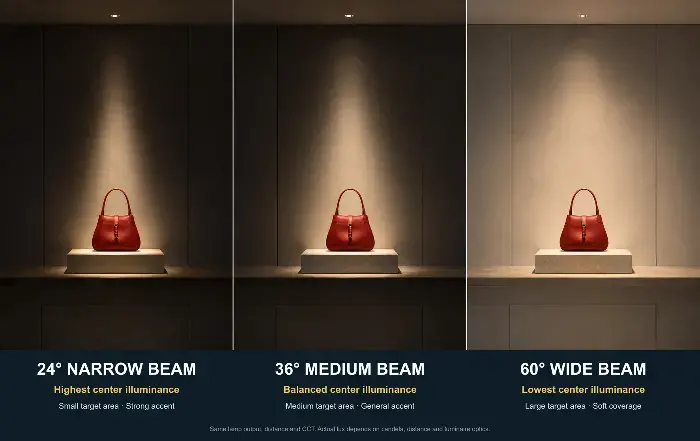
Illustrative narrow, medium and wide beam comparison. Use measured IES/LDT files and project distances for final calculations.
Consider two simplified examples:
- Lamp A: 500 lm with a 24° beam
- Lamp B: 540 lm with a 60° beam
Lamp B produces more total light, but spreads it across a much larger area. Lamp A may create substantially higher illuminance on a small painting, mannequin, table, or merchandise display. Lamp B may be better for broad ambient coverage.
Mounting height changes the result again. As the distance from the target increases, the beam becomes wider and illuminance falls. A product page that gives only lumens, with no beam angle, candela, beam diagram or test distance, does not provide enough information for a professional decision.
When comparing GU10 products, ask for:
- Ângulo do feixe
- Center-beam candlepower
- Beam diameter at typical installation distances
- Lux at one, two and three meters
- IES or LDT photometric files
- Photographs of the actual beam
- Information about hot spots, rings and color separation
A clean, uniform 500-lumen beam may be more useful than an uneven 700-lumen beam with glare, shadows or poorly controlled edges.
For projects that need optical flexibility after installation, compare fixed-beam products with the TECO GU10 Zoomable 7.5W Ra98 spotlight. For precision accent lighting, see the TECO 10° narrow-beam GU10.
Is CRI98 Visibly Better Than CRI90?
Sometimes yes, but not in every application.
Illustrative comparison of how spectral quality can affect reds, food, flowers, fabrics and natural materials. Final product approval should use measured data and real samples.
The difference is most likely to be visible when:
- The illuminated objects contain rich reds, natural skin tones or subtle color differences
- Customers compare products by color
- Artwork, textiles, wood, food or cosmetics are displayed
- Several materials with similar shades must remain distinguishable
- The existing lighting has a greenish, grey or washed-out appearance
- The project is positioned as premium
The difference may be less commercially important in:
- Corridors
- Storage areas
- Utility rooms
- General circulation spaces
- Locations where color discrimination is not important
- Projects where current illumination is already insufficient
Also remember that the Ra number is not the complete story. A lamp marked Ra98 should ideally be supported by its R9 value, spectral power distribution, color consistency and—where available—TM-30 results. The U.S. Department of Energy describes TM-30 as a system of related measures and graphics that provides broader information for evaluating color rendition and its trade-offs than a single-number approach.
For a serious commercial project, request:
- Ra
- R9
- TM-30 Rf and Rg, if available
- Spectral power distribution
- CCT and Duv
- SDCM or MacAdam ellipse
- Initial and maintained color data
These values help distinguish genuinely balanced color quality from a strong headline CRI number.
Application Guide: Which GU10 Should You Choose?

Fashion and Textile Retail
Prioritize CRI98 or another very-high-CRI option with strong R9 performance. Accurate rendering helps customers distinguish fabric colors, textures and finishes. Sufficient illuminance remains necessary, but increasing light quantity cannot correct a distorted spectrum.
For a deeper retail-specific specification process, read High CRI GU10 LED for Retail Lighting.
Recommended starting point:
- Ra: 95–98
- R9: >80, preferably >90 for premium applications
- Beam: 24° or 36°, depending on display size
- CCT: commonly 3000K or 4000K
- Always test with actual merchandise
Restaurants, Bakeries and Food Displays
High R9 is particularly important for meat, fruit, baked goods, tomatoes, wood and skin tones. A high-lumen lamp with weak saturated-red rendering may make food look dull even when the table is brightly illuminated.
For atmospheric areas, consider high-CRI dim-to-warm lighting. For food preparation or brighter service areas, a fixed-CCT high-CRI option may provide a better balance between visibility and appearance.
Galleries and Museums
Color accuracy, beam control and consistency usually take priority over maximum lumens. A narrow 10° or controlled 24° beam can place light precisely while limiting spill. The specification should also consider conservation requirements, glare, UV/IR exposure, dimming and scene control.
CRI98 alone is not enough: review R9, TM-30, spectrum, beam uniformity and color consistency.
Hotels and Premium Residential Projects
Guest rooms, restaurants, reception areas and decorative interiors benefit from natural skin tones, warm materials and smooth dimming. A high-CRI GU10 often delivers more perceived quality than a modest increase in total lumens.
Test the lamp with the actual wall dimmer. Color quality does not guarantee quiet, flicker-free or stable low-end dimming.
General Commercial Lighting
For corridors, general circulation, basic retail and locations with higher mounting heights, a high-output Ra90 option may offer the best balance. Ra90 with strong R9 is already suitable for many demanding applications and may provide significantly more light than an Ra98 version.
High Ceilings and Wide Beams
Prioritize the required target illuminance first. If the Ra98 option cannot achieve the design lux level without increasing lamp quantity, a high-output Ra90 version may be more practical. Alternatively, use a narrower beam or change the fixture layout rather than selecting only by total lumens.
Dimming and Flicker Can Matter More Than Either Number
A lamp can have excellent CRI and high lumen output but still create a poor user experience if it flickers, buzzes or drops out at low dimming levels.
For dimmable GU10 projects, check:
- Leading-edge and trailing-edge compatibility
- Minimum and maximum dimmer load
- Number of lamps on each circuit
- Minimum stable dimming level
- Pop-on and dropout behavior
- Audible noise
- Synchronization between lamps
- Flicker at full output and during dimming
- PstLM and SVM values
EU ecodesign requirements include full-load limits for PstLM and SVM for covered LED light sources, but a compliant full-load result does not automatically prove perfect performance across every dimmer and every low-level setting. Project-specific compatibility testing remains important.
For samples, test the exact lamp model with the intended dimmer, voltage, lamp quantity and fixture. Do not rely on a general statement such as “TRIAC compatible.”
TECO has also published a practical explanation of what 0–100% dimmable GU10 really means and why the lamp, dimmer and circuit load must be evaluated together.
The Thermal Limit of a High-Output GU10
GU10 is a compact format. The LED package, driver electronics, optics and heat-dissipation structure must all fit within a small housing. Increasing drive current may increase initial lumen output, but it also increases heat.
Poor thermal management can lead to:
- Reduced lumen maintenance
- Color shift
- Shorter driver life
- Unstable dimming
- Premature failure
- Lower reliability in enclosed fixtures
This is why the highest initial lumen figure is not always the best commercial choice. For hotels, restaurants and retail stores where lamps operate for long hours, maintained performance and replacement labor can matter more than a small advantage on the first-day datasheet.
Ask the supplier for:
- Operating temperature range
- Thermal test report
- LED board and driver temperature data
- L70 or lumen-maintenance information
- Aging-test conditions
- Enclosed-fixture limitations
- Warranty conditions
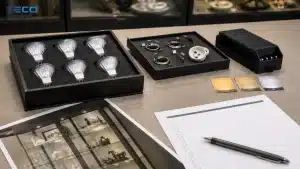
How to Run a Useful Sample Comparison
The most reliable decision comes from testing both versions in the real application.
Before approving a bulk order, use the broader LED sample and quality inspection checklist to verify the approved sample, written specification, certificates, packaging and production standard.
Step 1: Confirm Comparable Samples
Use the same:
- CCT
- Ângulo do feixe
- Input voltage
- Fixture
- Mounting position
- Dimmer
- Test distance
Comparing a 2700K, 60° high-output lamp with a 4000K, 24° CRI98 lamp will not isolate the effect of color quality.
Step 2: Measure the Target
Record:
- Center lux
- Average lux across the target
- Beam diameter
- Uniformity
- Glare
- Visual brightness
Step 3: Review Real Materials
Test the products, finishes or artwork used in the project. Include red, skin-tone, wood, fabric and neutral grey samples. Photographs can support the comparison, but camera settings must be locked because automatic white balance can hide differences.
Step 4: Test Dimming
Check full output, medium output and the lowest required level. Listen for noise and observe whether several lamps dim together.
Step 5: Run the Lamps at Temperature
Do not judge only during the first five minutes. Operate samples in the intended fixture and environment, then recheck output, color, noise and stability.
Step 6: Compare Total Project Cost
Consider:
- Lamp quantity
- Energy use
- Fixture and dimmer compatibility
- Expected replacement labor
- Warranty
- Customer complaints
- Value of better merchandise presentation
The lower-priced or higher-lumen lamp is not automatically the lower-cost solution.
Final Decision Matrix
| Project requirement | Recommended priority |
|---|---|
| Accurate merchandise colors | CRI98 with strong R9 |
| Food, skin and warm materials | High CRI plus high R9 |
| Maximum general brightness | High-output GU10 |
| High ceiling | Target lux, beam intensity and high output |
| Small accent target | Controlled narrow beam, not just more lumens |
| Premium hotel atmosphere | High CRI and verified smooth dimming |
| Gallery or artwork | CRI98, spectrum and precise beam control |
| Corridors and utility areas | Adequate lumens and efficiency |
| Long operating hours | Thermal reliability and maintained output |
| Existing wall dimmers | Tested compatibility and low-end stability |
Conclusão
CRI98 and high lumen output are not competing measures of the same thing. One describes color fidelity; the other describes total visible light. Both can be valuable, and both can be misleading when considered alone.
Choose CRI98 when the appearance of products, people, artwork, food or interior materials affects the success of the space. Choose a high-output GU10 when the project first needs more usable illumination, especially across wide beams or longer distances. In many commercial applications, a high-output Ra90 lamp with strong R9 provides an excellent middle ground.
Most importantly, evaluate the complete lighting result:
- Is the target bright enough?
- Are colors accurate and appealing?
- Is the beam clean and correctly sized?
- Does the lamp dim smoothly?
- Can it manage heat over long operating hours?
- Are the published values supported by test data?
The best GU10 is not the one with the largest number on the box. It is the one that delivers the required color quality and target illuminance under the real beam, fixture, dimmer and thermal conditions of the project.
Perguntas Frequentes
Does CRI98 always mean fewer lumens?
Not always, but a very-high-CRI version of the same lamp platform often has lower luminous efficacy because more energy is distributed across the spectrum to improve color fidelity. Compare products with the same CCT, wattage, beam angle and thermal conditions.
Is CRI98 visibly better than CRI90?
It can be, especially for artwork, textiles, food, skin tones and premium materials. The practical difference also depends on R9, spectrum, Duv, CCT and the objects being illuminated.
Is R9 included in the published CRI value?
No. The commonly published Ra value averages R1–R8. R9 is a separate saturated-red rendering value and should be reviewed independently.
Can a 500-lumen GU10 look brighter than a 700-lumen GU10?
Yes, on a small target. A narrower, well-controlled beam can create higher target illuminance than a wider beam with more total lumens. Compare candela, beam angle and measured lux—not only lumens.
Does high CRI guarantee flicker-free dimming?
No. Color rendering and dimming performance are separate. Verify driver design, dimmer compatibility, circuit load, PstLM/SVM and low-end behavior.
Which option is better for retail lighting?
For fashion, cosmetics, food or other color-sensitive displays, CRI98 or Ra95+ with strong R9 is usually the better starting point. For general retail illumination or high mounting positions, a high-output Ra90 option may provide a better balance.
Not Sure Which GU10 Version Fits Your Project?
Send us your application, mounting height, target beam angle, required CCT, dimmer model and estimated quantity. TECO can recommend a high-CRI or high-output GU10 configuration and prepare samples for side-by-side testing.
Primary button: Request GU10 Samples
Secondary button: Compare GU10 Models
Text link: Check Dimmer Compatibility