CRI98 против High-Lumen GU10: Качество цвета или яркость?
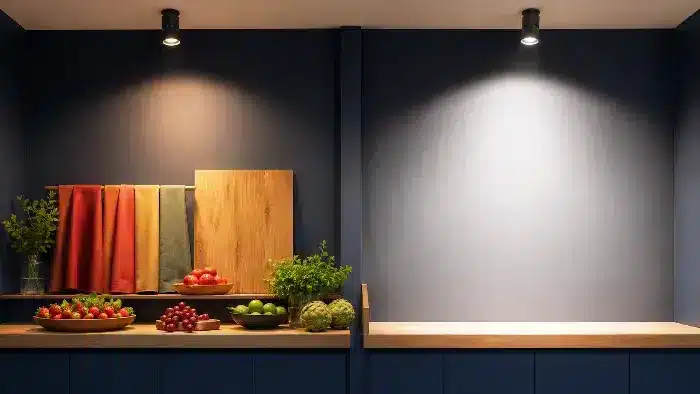
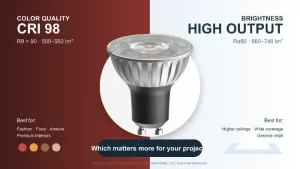
Тот же продукт TECO GU10 показан между двумя приоритетами освещения: более насыщенная цветопередача и более высокая воспринимаемая яркость. Сам продукт использует оригинальную фотографию, предоставленную TECO.
Краткий ответ
Выберите CRI98 GU10, когда точная цветопередача напрямую влияет на ценность освещаемых объектов, таких как одежда, произведения искусства, еда, мебель, косметика, оттенки кожи или премиальная отделка интерьера.
Выбирайте GU10 с высоким световым потоком, когда главный приоритет — достижение достаточной освещённости на целевой поверхности, особенно при высоких потолках, широких лучах, в общих коммерческих помещениях или при замене ярких галогенных ламп.
Однако лучшая лампа GU10 — не обязательно та, у которой самый высокий индекс цветопередачи или самое большое значение люменов. Удачный выбор должен балансировать:
- Качество цвета
- Полезный свет на цели
- Угол луча
- Высота монтажа
- Работа с диммированием
- Управление теплом
- Пожизненная
- Бюджет проекта
500-люменная CRI98 GU10 с узким лучом 24° может освещать небольшую витрину эффективнее, чем 700-люменная лампа с широким лучом 60°. И наоборот, даже идеальная цветопередача не компенсирует недостаточную освещённость в большом помещении или помещении с высокими потолками.
Поэтому правильный вопрос не просто “качество цвета или яркость?”, а:
Сколько света требуется проекту, куда должен попадать этот свет и насколько точно должны выглядеть освещаемые объекты?
Что на самом деле измеряют CRI и люмены?
Люмены измеряют общее количество видимого света, излучаемого лампой. Больше люменов обычно означает больше общего света, но люмены не показывают, куда направлен этот свет или как объекты будут выглядеть под ним.
CRI, или индекс цветопередачи, оценивает, насколько точно источник света передаёт цвета по сравнению с эталонным источником той же цветовой температуры. Обычно публикуемое значение Ra — это среднее значение на основе первых восьми тестовых цветов, R1–R8. Оно не включает R9 — тестовый насыщенный красный цвет, который особенно важен для кожи, еды, дерева, тканей, цветов и многих розничных товаров. Нормативы ЕС определяют CRI как среднее значение R1–R8 и рассматривают R9 как отдельный параметр продукта.
Это различие объясняет, почему две лампы с похожей маркировкой “CRI 90” могут выглядеть заметно по-разному. Одна может достаточно хорошо передавать пастельные цвета, но делать красные материалы тусклыми или коричневатыми. Другая может иметь более насыщенный красный спектр и давать более естественные оттенки кожи, пищи и тёплой отделки.
CRI и люмены отвечают на разные вопросы:
| Метрика | Вопрос, на который он отвечает | Что он не сообщает |
|---|---|---|
| Люмены | Сколько всего видимого света излучает лампа? | Точность цветопередачи, качество луча или требуемая освещённость |
| CRI / Ra | Насколько точно воспроизводятся наборы цветов? | Яркость, производительность R9 или качество диммирования |
| R9 | Насколько хорошо передаётся насыщенный красный цвет? | Общая точность цветопередачи |
| Угол луча | Насколько широко распределён свет? | Общая светоотдача или равномерность луча |
| Кандела | Какова интенсивность света в определённом направлении? | Общий световой поток |
| Люкс | Сколько света достигает поверхности? | Качество цвета |
Профессиональный подбор требует совместного учёта нескольких из этих значений.
Почему CRI98 GU10 может производить меньше люменов?
Белые светодиоды обычно создают свет, комбинируя синий или фиолетовый светодиодный источник с люминофорными материалами. Для улучшения цветопередачи — особенно насыщенного красного — производитель должен распределить больше энергии по частям спектра, которые менее эффективно влияют на расчёт фотопических люменов.
В результате версия той же лампы с очень высоким индексом цветопередачи часто будет производить меньше люменов, чем версия, оптимизированная для максимальной световой отдачи. Размер этого различия не фиксирован. Он зависит от светодиодного модуля, люминофорной системы, цветовой температуры, тока питания, оптической конструкции, тепловых условий и того, как производитель балансирует качество и эффективность.
Для текущего ассортимента GU10 от TECO в предоставляемой матрице продуктов приведены примеры, такие как:
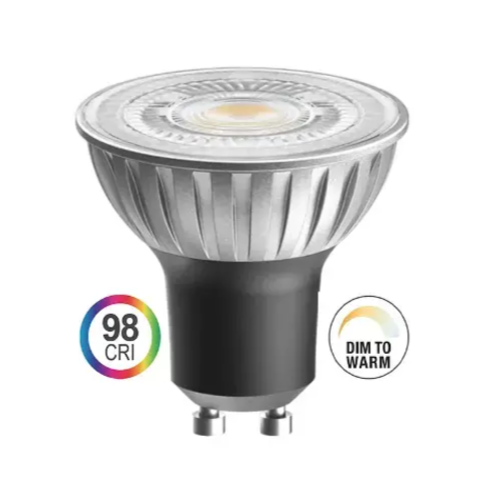
Фотография реального продукта TECO GU10 предоставлена компанией TECO.
| Вариант GU10 | Цветопередача | Заявленный световой поток* | Основной приоритет |
|---|---|---|---|
| Версия с высоким CRI | Ra98, R9 >90 | 500–580 лм | Точные цвета |
| Высокопроизводительная версия | Ra90, R9 >90 | 660–740 лм | Больше света с хорошим качеством цвета |
| Общая версия с высокой светоотдачей | Ra80 | 670–710 лм | Яркость и эффективность |
| Версия с узким лучом | Ra95 | 440 лм | Точечное акцентное освещение |
*Выходная мощность зависит от версии продукта и оптической конфигурации. Перед спецификацией или заказом уточните точную модель, CCT, угол луча и тестовый отчёт.
Покупатели могут ознакомиться с опубликованными в настоящее время Характеристики TECO Premium GU10 Pro 8W Ra98 и просмотрите полный ассортимент светодиодных ламп GU10 перед запросом согласованных образцов.
Эти цифры показывают, почему выбор только по мощности — ненадёжный метод. Две лампы GU10 номиналом примерно 7,5–8 Вт могут иметь совершенно разный световой поток и качество цвета. Разница обусловлена полной оптической и электрической конструкцией, а не просто изменением номинальной мощности на 0,5 Вт.
Высокие люмены не всегда означают более яркий дисплей
Люмены измеряют общий свет, но прожектор предназначен для направленного освещения. Для применений GU10 угол луча и интенсивность в центре луча часто так же важны, как и общие люмены.
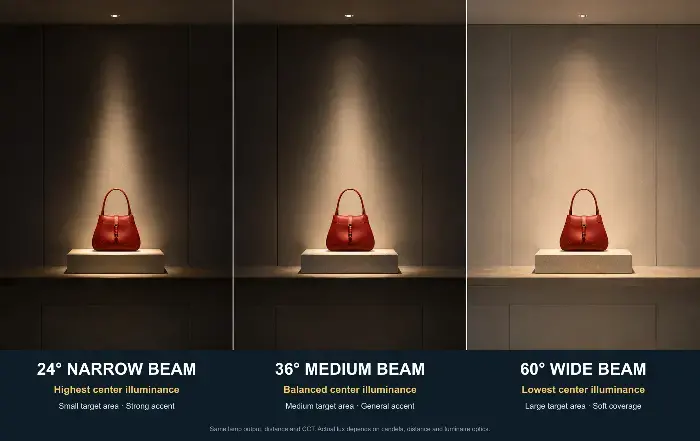
Иллюстративное сравнение узкого, среднего и широкого луча. Используйте измеренные файлы IES/LDT и расстояния до объекта для окончательных расчётов.
Рассмотрим два упрощённых примера:
- Лампа A: 500 лм с углом луча 24°
- Лампа Б: 540 лм с углом луча 60°
Лампа B производит больше общего света, но распределяет его по гораздо большей площади. Лампа A может создавать значительно более высокую освещённость на небольшой картине, манекене, столе или витрине. Лампа B может быть лучше для широкого общего освещения.
Высота монтажа снова меняет результат. По мере увеличения расстояния до цели луч становится шире, а освещённость падает. Страница продукта, которая указывает только люмены без угла луча, кандел, диаграммы луча или тестового расстояния, не предоставляет достаточной информации для профессионального решения.
При сравнении продуктов GU10 запрашивайте:
- Угол луча
- Световой поток центрального луча
- Диаметр луча на типичных расстояниях установки
- Люкс на расстоянии одного, двух и трёх метров
- Файлы фотометрии IES или LDT
- Фотографии реального луча
- Информация о горячих точках, кольцах и цветовом разделении
Чистый, равномерный луч в 500 люмен может быть полезнее, чем неравномерный луч в 700 люмен с бликами, тенями или плохо контролируемыми краями.
Для проектов, требующих оптической гибкости после установки, сравните продукты с фиксированным лучом с Настраиваемый прожектор TECO GU10 7.5Вт Ra98. Для точного акцентного освещения см. TECO 10° узколучевой GU10.
CRI98 заметно лучше, чем CRI90?
Иногда да, но не в каждом применении.
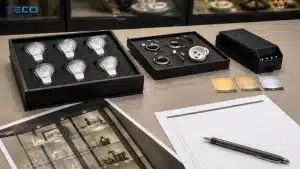
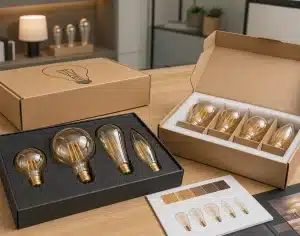
Наглядное сравнение того, как качество спектра может влиять на красные тона, пищу, цветы, ткани и натуральные материалы. Для окончательного одобрения продукта следует использовать измеренные данные и реальные образцы.
Разница, скорее всего, будет заметна, когда:
- Освещаемые объекты содержат насыщенные красные тона, естественные оттенки кожи или тонкие цветовые различия
- Клиенты сравнивают продукты по цвету
- Демонстрируются произведения искусства, текстиль, дерево, продукты питания или косметика
- Несколько материалов с похожими оттенками должны оставаться различимыми
- Существующее освещение имеет зеленоватый, серый или выцветший вид
- Проект позиционируется как премиальный
Разница может быть менее важной с коммерческой точки зрения в:
- Corridors
- Storage areas
- Utility rooms
- General circulation spaces
- Locations where color discrimination is not important
- Projects where current illumination is already insufficient
Also remember that the Ra number is not the complete story. A lamp marked Ra98 should ideally be supported by its R9 value, spectral power distribution, color consistency and—where available—TM-30 results. The U.S. Department of Energy describes TM-30 as a system of related measures and graphics that provides broader information for evaluating color rendition and its trade-offs than a single-number approach.
For a serious commercial project, request:
- Ra
- R9
- TM-30 Rf and Rg, if available
- Spectral power distribution
- CCT and Duv
- SDCM or MacAdam ellipse
- Initial and maintained color data
These values help distinguish genuinely balanced color quality from a strong headline CRI number.
Application Guide: Which GU10 Should You Choose?
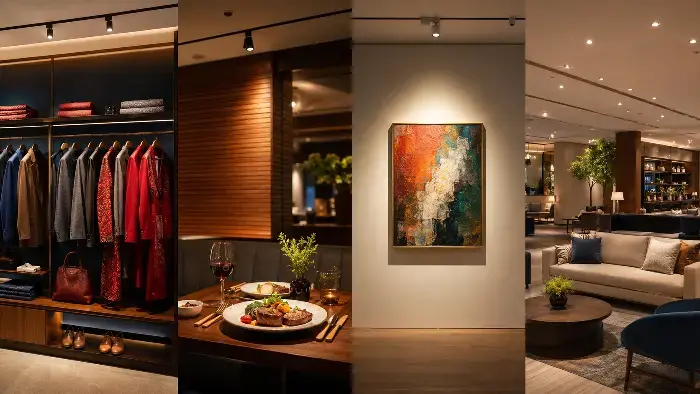
Fashion and Textile Retail
Prioritize CRI98 or another very-high-CRI option with strong R9 performance. Accurate rendering helps customers distinguish fabric colors, textures and finishes. Sufficient illuminance remains necessary, but increasing light quantity cannot correct a distorted spectrum.
For a deeper retail-specific specification process, read High CRI GU10 LED for Retail Lighting.
Recommended starting point:
- Ra: 95–98
- R9: >80, preferably >90 for premium applications
- Beam: 24° or 36°, depending on display size
- CCT: commonly 3000K or 4000K
- Always test with actual merchandise
Restaurants, Bakeries and Food Displays
High R9 is particularly important for meat, fruit, baked goods, tomatoes, wood and skin tones. A high-lumen lamp with weak saturated-red rendering may make food look dull even when the table is brightly illuminated.
For atmospheric areas, consider high-CRI dim-to-warm lighting. For food preparation or brighter service areas, a fixed-CCT high-CRI option may provide a better balance between visibility and appearance.
Galleries and Museums
Color accuracy, beam control and consistency usually take priority over maximum lumens. A narrow 10° or controlled 24° beam can place light precisely while limiting spill. The specification should also consider conservation requirements, glare, UV/IR exposure, dimming and scene control.
CRI98 alone is not enough: review R9, TM-30, spectrum, beam uniformity and color consistency.
Hotels and Premium Residential Projects
Guest rooms, restaurants, reception areas and decorative interiors benefit from natural skin tones, warm materials and smooth dimming. A high-CRI GU10 often delivers more perceived quality than a modest increase in total lumens.
Test the lamp with the actual wall dimmer. Color quality does not guarantee quiet, flicker-free or stable low-end dimming.
General Commercial Lighting
For corridors, general circulation, basic retail and locations with higher mounting heights, a high-output Ra90 option may offer the best balance. Ra90 with strong R9 is already suitable for many demanding applications and may provide significantly more light than an Ra98 version.
High Ceilings and Wide Beams
Prioritize the required target illuminance first. If the Ra98 option cannot achieve the design lux level without increasing lamp quantity, a high-output Ra90 version may be more practical. Alternatively, use a narrower beam or change the fixture layout rather than selecting only by total lumens.
Dimming and Flicker Can Matter More Than Either Number
A lamp can have excellent CRI and high lumen output but still create a poor user experience if it flickers, buzzes or drops out at low dimming levels.
For dimmable GU10 projects, check:
- Leading-edge and trailing-edge compatibility
- Minimum and maximum dimmer load
- Number of lamps on each circuit
- Minimum stable dimming level
- Pop-on and dropout behavior
- Audible noise
- Synchronization between lamps
- Flicker at full output and during dimming
- PstLM and SVM values
EU ecodesign requirements include full-load limits for PstLM and SVM for covered LED light sources, but a compliant full-load result does not automatically prove perfect performance across every dimmer and every low-level setting. Project-specific compatibility testing remains important.
For samples, test the exact lamp model with the intended dimmer, voltage, lamp quantity and fixture. Do not rely on a general statement such as “TRIAC compatible.”
TECO has also published a practical explanation of what 0–100% dimmable GU10 really means and why the lamp, dimmer and circuit load must be evaluated together.
The Thermal Limit of a High-Output GU10
GU10 is a compact format. The LED package, driver electronics, optics and heat-dissipation structure must all fit within a small housing. Increasing drive current may increase initial lumen output, but it also increases heat.
Poor thermal management can lead to:
- Reduced lumen maintenance
- Сдвиг цвета
- Shorter driver life
- Unstable dimming
- Premature failure
- Lower reliability in enclosed fixtures
This is why the highest initial lumen figure is not always the best commercial choice. For hotels, restaurants and retail stores where lamps operate for long hours, maintained performance and replacement labor can matter more than a small advantage on the first-day datasheet.
Ask the supplier for:
- Operating temperature range
- Thermal test report
- LED board and driver temperature data
- L70 or lumen-maintenance information
- Aging-test conditions
- Enclosed-fixture limitations
- Warranty conditions
How to Run a Useful Sample Comparison
The most reliable decision comes from testing both versions in the real application.
Before approving a bulk order, use the broader LED sample and quality inspection checklist to verify the approved sample, written specification, certificates, packaging and production standard.
Step 1: Confirm Comparable Samples
Use the same:
- CCT
- Угол луча
- Input voltage
- Fixture
- Mounting position
- Dimmer
- Test distance
Comparing a 2700K, 60° high-output lamp with a 4000K, 24° CRI98 lamp will not isolate the effect of color quality.
Step 2: Measure the Target
Record:
- Center lux
- Average lux across the target
- Beam diameter
- Однородность
- Glare
- Visual brightness
Step 3: Review Real Materials
Test the products, finishes or artwork used in the project. Include red, skin-tone, wood, fabric and neutral grey samples. Photographs can support the comparison, but camera settings must be locked because automatic white balance can hide differences.
Step 4: Test Dimming
Check full output, medium output and the lowest required level. Listen for noise and observe whether several lamps dim together.
Step 5: Run the Lamps at Temperature
Do not judge only during the first five minutes. Operate samples in the intended fixture and environment, then recheck output, color, noise and stability.
Step 6: Compare Total Project Cost
Consider:
- Lamp quantity
- Energy use
- Fixture and dimmer compatibility
- Expected replacement labor
- Warranty
- Customer complaints
- Value of better merchandise presentation
The lower-priced or higher-lumen lamp is not automatically the lower-cost solution.
Final Decision Matrix
| Project requirement | Recommended priority |
|---|---|
| Accurate merchandise colors | CRI98 with strong R9 |
| Food, skin and warm materials | High CRI plus high R9 |
| Maximum general brightness | High-output GU10 |
| High ceiling | Target lux, beam intensity and high output |
| Small accent target | Controlled narrow beam, not just more lumens |
| Premium hotel atmosphere | High CRI and verified smooth dimming |
| Gallery or artwork | CRI98, spectrum and precise beam control |
| Corridors and utility areas | Adequate lumens and efficiency |
| Long operating hours | Thermal reliability and maintained output |
| Existing wall dimmers | Tested compatibility and low-end stability |
Заключение
CRI98 and high lumen output are not competing measures of the same thing. One describes color fidelity; the other describes total visible light. Both can be valuable, and both can be misleading when considered alone.
Choose CRI98 when the appearance of products, people, artwork, food or interior materials affects the success of the space. Choose a high-output GU10 when the project first needs more usable illumination, especially across wide beams or longer distances. In many commercial applications, a high-output Ra90 lamp with strong R9 provides an excellent middle ground.
Most importantly, evaluate the complete lighting result:
- Is the target bright enough?
- Are colors accurate and appealing?
- Is the beam clean and correctly sized?
- Does the lamp dim smoothly?
- Can it manage heat over long operating hours?
- Are the published values supported by test data?
The best GU10 is not the one with the largest number on the box. It is the one that delivers the required color quality and target illuminance under the real beam, fixture, dimmer and thermal conditions of the project.
Часто задаваемые вопросы
Does CRI98 always mean fewer lumens?
Not always, but a very-high-CRI version of the same lamp platform often has lower luminous efficacy because more energy is distributed across the spectrum to improve color fidelity. Compare products with the same CCT, wattage, beam angle and thermal conditions.
Is CRI98 visibly better than CRI90?
It can be, especially for artwork, textiles, food, skin tones and premium materials. The practical difference also depends on R9, spectrum, Duv, CCT and the objects being illuminated.
Is R9 included in the published CRI value?
No. The commonly published Ra value averages R1–R8. R9 is a separate saturated-red rendering value and should be reviewed independently.
Can a 500-lumen GU10 look brighter than a 700-lumen GU10?
Yes, on a small target. A narrower, well-controlled beam can create higher target illuminance than a wider beam with more total lumens. Compare candela, beam angle and measured lux—not only lumens.
Does high CRI guarantee flicker-free dimming?
No. Color rendering and dimming performance are separate. Verify driver design, dimmer compatibility, circuit load, PstLM/SVM and low-end behavior.
Which option is better for retail lighting?
For fashion, cosmetics, food or other color-sensitive displays, CRI98 or Ra95+ with strong R9 is usually the better starting point. For general retail illumination or high mounting positions, a high-output Ra90 option may provide a better balance.
Not Sure Which GU10 Version Fits Your Project?
Send us your application, mounting height, target beam angle, required CCT, dimmer model and estimated quantity. TECO can recommend a high-CRI or high-output GU10 configuration and prepare samples for side-by-side testing.
Primary button: Request GU10 Samples
Secondary button: Compare GU10 Models
Text link: Check Dimmer Compatibility