24V LED Bulbs for Landscape, Cabin and Under-Cabinet Lighting: What to Check Before You Wire
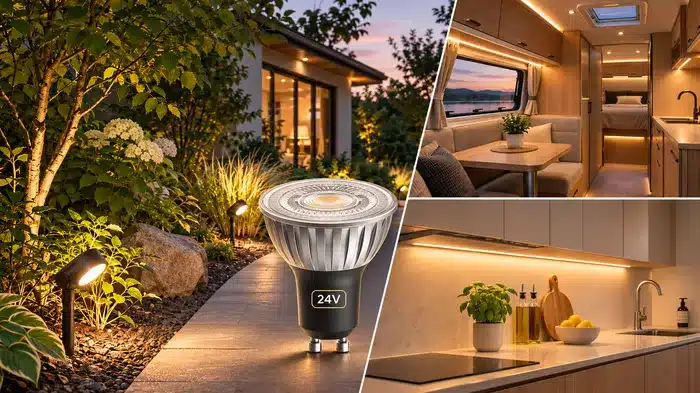
24V lighting is common in gardens, camper vans, boats and under kitchen cabinets. It’s a practical choice when you need low-voltage lighting without running mains power to every fitting.
But the same 24V LED bulb won’t necessarily suit every installation.
A garden spotlight has to cope with rain and damp connections. A boat’s electrical system may reach nearly 29V while charging. And a long row of cabinet lights can lose voltage along the cable, even when the power supply is working perfectly.
Most of these problems are easier to prevent before installation than to fix afterward.
24V Is Safer Than Mains Voltage, but Wiring Still Matters
One advantage of 24V lighting is the reduced electric shock risk compared with mains-voltage circuits. With a properly designed SELV supply, it can be a good choice for many low-voltage lighting applications.
But don’t confuse low voltage with a system that needs no electrical protection.
A 24V power supply can deliver considerable current. If a cable is too thin, a connector is loose or a circuit shorts, the wiring can still overheat.
Use a suitable power supply, correctly rated cables and appropriate fuses or circuit protection. For outdoor lighting, keep the mains side of the power supply properly enclosed and protected from the weather.
The same applies to camper vans and boats. Where lighting is connected to a battery system, the branch circuits need suitable protection, not just a switch.
Check What’s Actually Supplying the Bulbs
Before choosing a 24V LED bulb, find out whether the installation uses regulated 24V DC, an AC transformer or a battery system.
Some older landscape installations run on 24V AC. A bulb marked 24V DC isn’t a direct replacement for those systems unless the manufacturer explicitly allows AC input.
For a new DC installation, a regulated 24V supply is usually straightforward. The main things to check are the bulb’s input voltage range, the total load and whether the supply is suitable for the intended environment.
Camper vans and boats need a closer look.
A nominal 24V battery system doesn’t stay at exactly 24V. For example, some 24V battery chargers reach around 28.8V during charging. That voltage can be too high for a bulb designed only for a tightly regulated 24V supply.
If the bulbs will run directly from a battery, check the full operating voltage range. You may need a wider-input LED bulb or a suitable DC-DC regulator.
For marine installations, also consider vibration, moisture, corrosion and any applicable vessel electrical requirements.
A bulb that works well on a regulated 24V bench supply isn’t automatically suitable for every boat or vehicle.
Outdoor Lighting: The Cable Joint Matters as Much as the IP Rating
For landscape lighting, people often look for IP65 or IP67 on the product specification. That’s a reasonable starting point, but don’t stop there.
IP65 on a bulb doesn’t help much if the cable joint behind the fitting lets water in.
A garden spotlight may be exposed to rain, irrigation spray, soil moisture and condensation. The complete fitting, cable entries and electrical connections need to be suitable for those conditions.
If you’re using a replaceable 24V bulb inside an outdoor luminaire, check the protection rating of the complete assembly. The bulb itself doesn’t necessarily need the same IP rating when the enclosure provides the required protection.
IP67 is also not a blanket promise that a product can stay underwater indefinitely. Choose the protection level according to the actual installation conditions.
For boats, salt spray and corrosion add another problem. A fitting suitable for a sheltered cabin may not survive on an exposed deck.
Kitchen cabinet lighting is different. A lamp fitted under a dry cabinet may need little moisture protection, while one close to a sink or a wet work area needs more attention.
Choose the fitting for where it’s installed, not just for how the product is described in a catalogue.
Long Cable Runs: Check the Last Light First
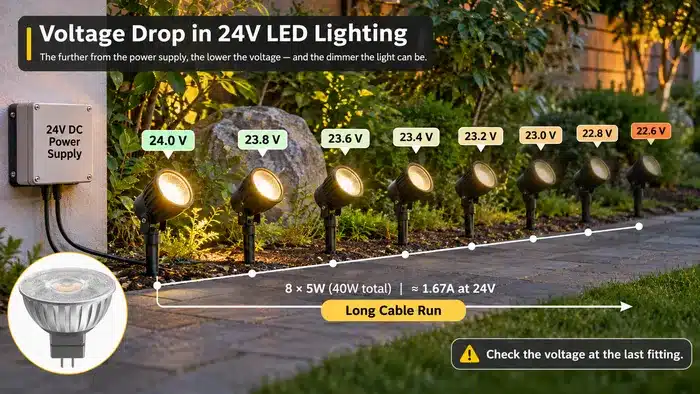
Say you’re installing eight 5W garden spotlights along a pathway.
That’s 40W in total, drawing roughly 1.67A from a 24V supply at nominal voltage.
If the power supply is near the first light and the cable runs a long distance to the last one, the voltage at the far end may be lower.
We see this on garden lighting jobs all the time: the first two lights near the transformer are bright, and the last two on the path are dimmer. It’s almost never the bulbs — it’s the cable.
Before replacing the bulbs or buying a larger power supply, measure the voltage at the furthest fitting under load. Then check the cable length, conductor size and connections.
Voltage drop is a common problem on long low-voltage runs, but a loose or corroded connection can produce similar symptoms.
A thicker cable, shorter run or separate power feed may solve the problem.
For a landscape project with several lighting zones, it can be better to split the installation into shorter circuits rather than running everything from one long cable.
The important thing is to keep the voltage at each bulb within its specified operating range.
Parallel Wiring: Count the Total Current
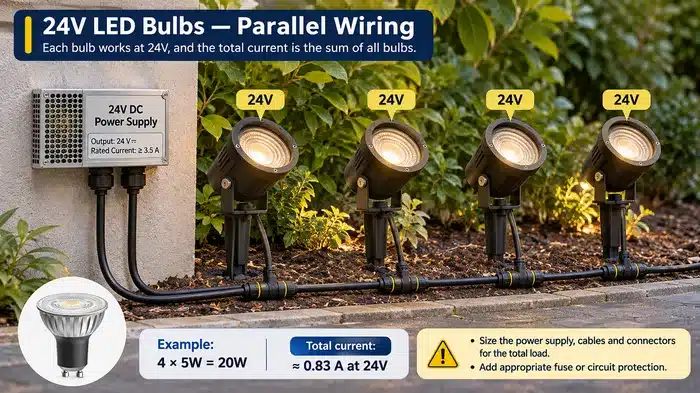
Most 24V constant-voltage LED bulbs are connected in parallel. Each bulb receives power from the same nominal 24V supply.
But adding more bulbs increases the total current.
Eight 5W lamps draw about 1.67A at nominal 24V. Sixteen draw about 3.33A. Size the main cable for the combined load, and make sure the power supply, controller and connectors can handle it.
If you’re using a PWM dimmer, its output channels must also be rated for the connected load. Don’t assume a controller can handle more bulbs just because the power supply has plenty of capacity.
And don’t connect the outputs of separate 24V power supplies together unless they’re specifically designed for that arrangement.
Under-Cabinet Lighting Has Its Own Problems
Under-cabinet lighting usually doesn’t involve long outdoor cable runs, but space and heat can become an issue.
Check the dimensions of the bulb and fitting before ordering. Some LED lamps have larger heat sinks than the halogen bulbs they replace.
The fitting also needs enough space for the lamp to operate within its permitted temperature range.
If the lights are dimmed, check the controller and bulb combination. A 24V bulb described as dimmable may require a particular PWM controller or other specified dimming method.
For kitchen worktops, beam angle matters too. A narrow spotlight can leave dark gaps between fittings, while a wider beam may give more even coverage.
For under-cabinet lights near a sink or hob, check the IP rating of the fitting — not just the bulb.
Test the light on the actual work surface rather than choosing by wattage alone.
What About CE and WEEE?
For EU projects, ask the supplier for the relevant EU Declaration of Conformity, supporting compliance documents and WEEE marking information before placing a bulk order.
A 24V DC bulb is generally outside the EU Low Voltage Directive’s voltage range, but other requirements, including RoHS and potentially EMC, may apply depending on the product.
Confirm which requirements apply to the exact product model and what documentation the supplier can provide.
Test the Setup Before Placing a Bulk Order
For a small installation, checking one bulb with the intended power supply may be enough for an initial assessment.
For a landscape project, camper conversion or larger under-cabinet installation, test a representative circuit before ordering the full quantity.
Use the actual power supply and dimmer where possible. Check that the lamps start reliably, remain stable and produce the expected brightness.
For long cable runs, measure the voltage at the furthest fitting. For boats and vehicles, check how the lighting behaves across the expected battery-voltage range.
And if the project involves outdoor lighting, make sure the complete fitting and connections are suitable for the conditions.
A sample test can reveal compatibility problems before the installation is repeated across dozens of fittings.
Planning a 24V LED Lighting Project?
If you’re sourcing 24V LED bulbs for landscape lighting, camper vans, boats or under-cabinet installations, send Tecolite the bulb type, power-supply details, installation environment and estimated quantity.
For longer runs, include the approximate cable length and number of bulbs per circuit. If dimming is required, let us know which controller you’re using.
We can help review the product requirements, discuss sample options and prepare a quotation for bulk orders.
For more on control systems, see our article on using 24V LED bulbs with DALI, KNX and Loxone. If you’re upgrading older low-voltage lighting, our MR16 replacement guide covers transformer and dimmer compatibility.