Высокий индекс цветопередачи GU10 LED для розничного освещения: стандарты точности цвета и соображения по проекту
Введение
In retail lighting, color accuracy is not a cosmetic detail. It directly affects how merchandise is perceived, how consistent a brand environment feels across locations, and how reliably a lighting scheme performs after installation. When a lamp makes apparel look dull, cosmetics appear inaccurate, or food displays lose freshness, the issue quickly becomes commercial rather than aesthetic.
For distributors, contractors, and project buyers, this becomes a system-level risk. A GU10 lamp that looks acceptable on paper but delivers unstable color, weak red rendering, or inconsistent beam appearance can lead to mock-up rejection, store refits, repeat site visits, and unnecessary stock replacement. In multi-store rollouts, even small color deviations between batches can create visible inconsistency and damage brand presentation.
High CRI GU10 LED selection for retail projects therefore needs to go beyond a single headline specification. The real engineering question is whether the lamp can reproduce merchandise colors faithfully, maintain batch consistency, and integrate into the intended lighting layout without creating commissioning problems later.
Executive Summary
High CRI GU10 LEDs improve retail presentation only when CRI, R9, color consistency1, beam angle, and color temperature2 are evaluated together. For commercial projects, stable batch performance and application-specific selection matter more than claiming the highest CRI number alone.
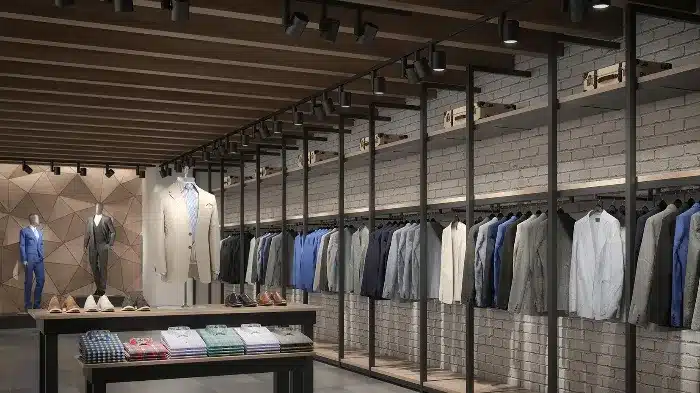
high cri gu10 led retail lighting color accuracy
Why Color Rendering Is Critical in Retail Lighting
On-Site / Commercial Reality
Retail lighting is judged at eye level, at close distance, and often beside competing products and neighboring displays. If product color appears flat or shifted under the spotlight, store staff notice it immediately, and customers often react before they understand why. For contractors, this means lighting complaints are difficult to dismiss because the problem is visually obvious under real merchandise.
In apparel chains, jewelry counters, cosmetic displays, and premium food retail, poor color rendering can trigger expensive adjustment work after opening. Re-lamping focused ceiling spots is not always simple, especially where access equipment, after-hours work, and visual re-aiming are required. In rollout programs, repeating that process across multiple stores is a direct cost issue.
Deep Dive & Engineering Solution
Color rendering describes how accurately a light source reveals object colors compared with a reference source. In retail settings, this affects more than visual comfort. It influences product appeal, price perception, and the perceived quality of the retail environment.
A high CRI GU10 spotlight is particularly relevant because accent lighting is usually the layer that defines merchandise. General ambient lighting may set the background, but GU10 spots often create the final visual impression on displayed products. If the spotlight has weak spectral output in key regions, the merchandise may appear less saturated, skin tones may look unnatural, and branded materials may lose intended color identity.
For retail applications, color rendering should be evaluated as part of a broader visual package:
| Характеристика | Standard CRI Lamp | High CRI Retail Lamp | Impact on Maintenance / ROI |
|---|---|---|---|
| Merchandise appearance | Acceptable for general use | More faithful color presentation | Fewer complaints during store handover |
| Brand consistency | May vary between batches | Better controlled visual identity | Lower risk in chain-store rollouts |
| Customer perception | Functional lighting only | Stronger product presentation | Better support for premium merchandising |
| Refit risk | Higher if mock-up fails | Lower when tested against actual products | Reduced labor and replacement cost |
A well-selected high CRI GU10 lamp helps retail spaces present products closer to their intended appearance, but it must still be paired with the correct beam spread, aiming, and color temperature to produce useful results.
Factory Note
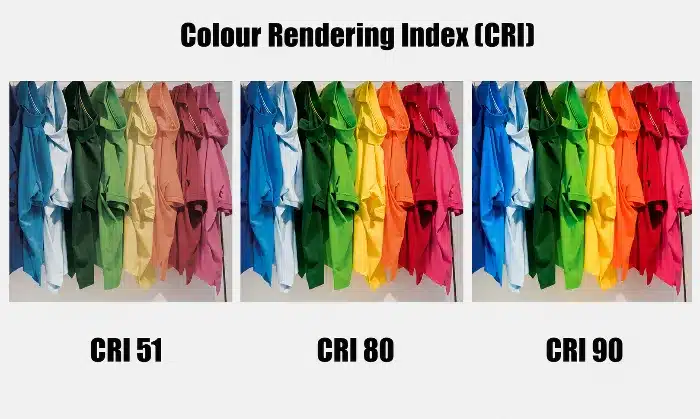
In apparel and cosmetics mock-ups, complaints often appear even when lumen output is acceptable. One common pattern is that a lamp passes a basic CRI 90 datasheet check, but fabrics with red, brown, beige, or skin-tone references still look weak because the spectrum and R9 performance are not strong enough. For retail supply, sample approval should therefore use real merchandise, not only a white wall or empty showroom.
retail gu10 spotlight color rendering standards
Understanding CRI, R9, and Color Accuracy Metrics
On-Site / Commercial Reality
During project review, many buyers ask for “CRI 90” as a minimum requirement. That is a useful starting point, but on site it is often not enough. Two lamps with the same nominal CRI can produce noticeably different results on apparel, leather goods, cosmetics, meat displays, or branded packaging. This becomes a problem when sample approval is based only on the catalog value.
If the specification ignores R93 and color consistency, installers may complete the full fit-out only to discover that reds look weak, skin tones look lifeless, or lamp-to-lamp variation becomes visible across the ceiling. Correcting that after opening is far more expensive than screening the lamps properly before ordering.
Deep Dive & Engineering Solution
CRI measures how accurately a light source renders a set of standard test colors. However, the commonly quoted general CRI value, often called Ra, does not fully represent difficult saturated colors. In retail lighting, that limitation matters.
R9 specifically refers to saturated red rendering. This is one of the most important supplemental indicators for retail because many commercially sensitive items depend on red content for visual appeal: skin tones, fashion fabrics, cosmetics, food, wood finishes, and premium packaging. A lamp can have a respectable Ra value while still delivering weak R9 performance.
Color accuracy in retail projects should therefore be reviewed through several layers:
| Метрика | What It Indicates | Why It Matters in Retail | Impact on Maintenance / ROI |
|---|---|---|---|
| CRI (Ra) | General color rendering performance | Baseline screening for commercial quality | Helps avoid underperforming low-end lamps |
| R9 | Saturated red rendering | Critical for apparel, cosmetics, food, and skin tones | Reduces mock-up rejection and relamping risk |
| Color consistency | Lamp-to-lamp chromaticity control | Prevents visible ceiling inconsistency | Important for chain-store visual standards |
| CCT | Apparent warmth or coolness of light | Affects product mood and material perception | Reduces redesign work if matched correctly |
For retail GU10 lamps, evaluating CRI without R9 is incomplete. Likewise, evaluating both without checking batch chromaticity control can still lead to visible inconsistency in the final installation. In practice, project approval should combine datasheet review, sample comparison, and mock-up validation under the actual merchandise mix.
Factory Note
During retail mock-ups, it is common to see two “CRI 90” lamps behave very differently. In one apparel review, two samples met the same headline requirement, but one produced visibly weaker red and beige tones under side-by-side fabric testing. The difference was not lumen output; it was spectral distribution, R9 performance, and bin control. For commercial supply, batch verification is just as important as the nominal color rendering specification.
CRI 90 vs CRI 98: Do Retail Stores Need Ultra-High CRI?
On-Site / Commercial Reality
Project teams often assume that the highest CRI value is always the safest specification. In practice, that approach can increase cost without delivering proportional benefit in every retail category. It may also narrow sourcing options, affect efficacy4, and create unnecessary pressure on lead time and batch consistency.
For commercial buyers, the real question is not whether CRI 98 is technically better in isolation. It is whether the application actually benefits enough to justify the trade-offs in cost, output, and procurement flexibility.
Deep Dive & Engineering Solution
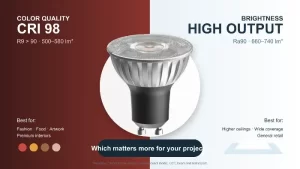
CRI 90 is already a strong threshold for many retail environments. It usually provides a clear improvement over standard commercial lamps and can support apparel, lifestyle retail, premium fixtures, and general product display when paired with a suitable R9 and stable color control.
CRI 98 moves closer to reference-source rendering and can be beneficial where exact color discrimination is central to the sales process. This may include luxury fashion, cosmetics, jewelry support lighting, galleries inside retail spaces, or premium branded environments where materials and finishes must appear highly refined.
However, ultra-high CRI should be specified selectively. In many projects, the visible improvement from CRI 90 to CRI 98 is meaningful only when other conditions are also optimized, such as display contrast, beam control, merchandise reflectance, and observer distance.
| Характеристика | CRI 90 GU10 | CRI 98 GU10 | Impact on Maintenance / ROI |
|---|---|---|---|
| General retail suitability | Strong | Excellent | CRI 90 often sufficient for broader rollouts |
| Red and subtle tone rendering | Good to very good | Typically stronger | Useful for premium product presentation |
| Световая отдача | Usually higher | Often reduced | May affect fixture count or energy target |
| Procurement flexibility | Broader | More limited | Influences lead time and replacement planning |
| Cost position | More balanced | Выше | Best reserved for value-critical zones |
A practical specification strategy is to define CRI 90 with verified R9 minimums for most retail areas, then reserve CRI 95 to 98 products for feature zones, premium displays, or brands with strict visual identity requirements. In many apparel projects, CRI 90+ with R9 above 50 is sufficient when CCT and beam control are correct. CRI 95+ or CRI 98 is more often justified for luxury fashion, high-end cosmetics, premium jewelry displays, or brand environments where subtle color differences affect buying decisions.
For these value-critical zones, a high-CRI option such as the TECO Premium GU10 Pro 8W Ra98 Dimmable LED Bulb is more relevant than a standard commodity GU10, because the selection conversation shifts from basic brightness to color accuracy, bin consistency, beam quality, and project approval risk.
Factory Note
From a manufacturing perspective, pushing CRI higher is not just a matter of changing one number. Spectral tuning can reduce efficacy and tighten component selection windows. For volume projects, a controlled CRI 90+ solution with strong R9 and stable bins often delivers better commercial results than an ultra-high CRI product with inconsistent supply.
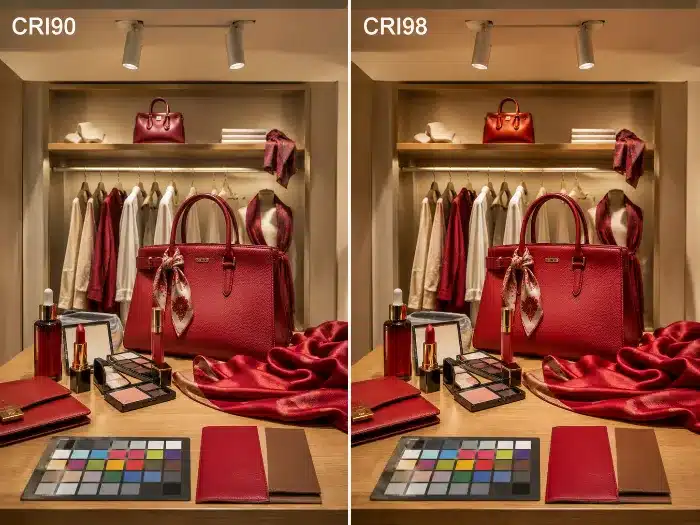
cri 90 vs cri 98 gu10 retail lighting
Why GU10 Spotlights Are Common in Retail Lighting
On-Site / Commercial Reality
Retail projects favor solutions that are familiar to installers, easy to replace, and compatible with compact ceiling formats. GU10 spotlights remain common because they support directional accent lighting without requiring a fully integrated luminaire change for every maintenance event. That matters in stores where access windows are limited and downtime must be controlled.
For contractors and facility teams, GU10 platforms also simplify service stock planning. A failed lamp can be replaced faster than a complete fitting, provided the lamp form factor, thermal behavior, and beam performance remain consistent with the original specification.
Deep Dive & Engineering Solution
The GU10 format is widely used in retail because it suits the functional role of accent lighting. Retail environments depend heavily on controlled beams to highlight merchandise, create focal hierarchy, and shape customer attention. GU10 LED products fit that need while remaining practical for track heads, recessed spot fittings, and small-format directional luminaires.
Their commercial popularity comes from several factors:
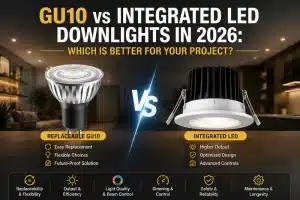
| Характеристика | GU10 Spotlight | Integrated Fixed Module | Impact on Maintenance / ROI |
|---|---|---|---|
| Replacement method | Lamp replacement | Often full fitting or module service | Lower maintenance disruption with GU10 |
| Beam options | Broad market availability | Depends on luminaire platform | Easier adaptation to display layouts |
| Installer familiarity | Высокий | Varies by system | Faster fit-out and lower service error risk |
| Stock management | Simpler for standard projects | More system-specific | Better for multi-site maintenance |
That said, not all GU10 LED lamps are equal in retail use. Optical control, thermal design, driver stability, and front-face consistency all affect real project performance. A lamp that physically fits the holder but produces inconsistent beam edges, excessive glare, or color shift under temperature rise can still create project failure.
Factory Note
In large hospitality projects and retail chains, GU10 remains attractive because maintenance teams understand it and replacement logistics are straightforward. The risk comes when procurement treats all GU10 lamps as interchangeable. In reality, optical quality, thermal margin, and dimmer compatibility can vary substantially between suppliers.
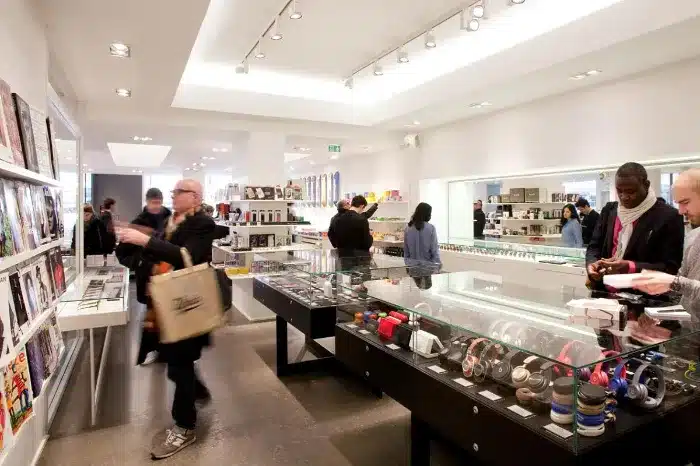
gu10 spotlight retail commercial project lighting
Beam Angle and Color Temperature Selection for Retail Projects
On-Site / Commercial Reality
Even a high CRI lamp will underperform if the beam angle is wrong for the display geometry. Narrow beams can create dramatic focus but may produce harsh contrast or hot spots on shallow shelves. Wide beams can improve uniformity but reduce emphasis and spill onto circulation areas. Once the ceiling is installed and aiming points are set, correcting poor beam selection can become labor-intensive.
Color temperature errors create a different but equally expensive problem. A lamp that is too warm may flatten clean white packaging or modern interiors, while a lamp that is too cool can make premium materials feel sterile. In retail, these issues show up immediately during brand review and visual merchandising setup.
Deep Dive & Engineering Solution
Beam angle and color temperature should be selected according to merchandise type, mounting height, display depth, and brand atmosphere. High CRI does not override these fundamentals.
For stores where shelf layouts, promotional tables, or display distances change often, an adjustable-beam product such as the TECO Premium GU10 Zoomable LED 7.5W Spot Light can be easier to evaluate during mock-up because the beam can be tuned without changing the lamp family.
A practical framework for GU10 retail spotlights:
| Project Factor | Узкий луч | Medium Beam | Wide Beam | Impact on Maintenance / ROI |
|---|---|---|---|---|
| Accent emphasis | Strong | Сбалансированный | Softer | Wrong selection leads to re-aiming and relamping |
| Shelf coverage | Ограничено | Умеренный | Broad | Affects fitting quantity and display uniformity |
| Visual drama | Высокий | Средний | Ниже | Important for premium merchandising |
| Spill light control | Лучше | Умеренный | Less controlled | Influences glare and wasted light |
For color temperature:
| Retail Application | Typical CCT Range | Commercial Effect | Impact on Maintenance / ROI |
|---|---|---|---|
| Fashion / boutique | 2700K to 3000K | Warm, premium, textured materials | Supports premium atmosphere |
| General lifestyle retail | 3000K to 3500K | Balanced warmth and clarity | Flexible across mixed merchandise |
| Cosmetics / clean product displays | 3500K to 4000K | Clearer presentation, cleaner whites | Useful where precision is important |
| Food and specialty zones | Application-specific | Must suit product category and freshness perception | Avoids poor product appearance and customer complaints |
Selection should always be validated against actual sample displays. Beam angle affects illuminance pattern, but it also changes how texture, gloss, and color saturation are perceived. Similarly, the right CCT depends on both merchandise and interior material palette.
Factory Note
During hotel commissioning and retail fit-outs, many “lamp problems” are actually beam or CCT mismatches. When a project team evaluates only lumen output and CRI, they often miss the optical distribution issue until aiming begins on site.
Lighting Design Considerations for Different Retail Categories
On-Site / Commercial Reality
Different retail categories respond very differently to the same lamp. A GU10 that works well in a footwear store may be unsuitable for cosmetics, and a lamp that flatters bakery products may distort white textiles. Standardizing one lamp across all zones may simplify procurement, but it can create visual compromise that becomes costly after opening.
For contractors and specifiers, this means category-based planning is essential before final ordering. Otherwise, the project may pass electrical installation but fail visual acceptance.
Deep Dive & Engineering Solution
Retail lighting should be tailored to merchandise characteristics, customer dwell behavior, and brand positioning.
| Retail Category | Key Visual Requirement | Recommended Focus | Impact on Maintenance / ROI |
|---|---|---|---|
| Одежда | Fabric tone, texture, skin tone support | High CRI, good R9, controlled accent beams | Reduces fitting changes after mock-up |
| Косметика | Accurate skin-related color perception | Strong R9, stable CCT, low variation | Critical for customer confidence and brand trust |
| Jewelry / luxury | Sparkle plus material fidelity | Tight beams, high color quality, controlled glare | Supports premium presentation |
| Food retail | Freshness and natural appearance | Category-specific spectrum and CCT | Poor choice quickly triggers complaints |
| General merchandise | Balanced clarity and efficiency | CRI 90+, moderate beam spread, stable bins | Good for scalable multi-site rollouts |
The article’s central point is that high CRI GU10 selection should be linked to product presentation, customer perception, and brand image, not treated as a single numeric upgrade. A successful retail lighting specification combines color metrics with practical design factors so that the lamp supports the actual sales environment rather than only satisfying a procurement checklist.
Factory Note
In large retail programs, the best results usually come from zoning rather than overspecifying every fitting. It is often more effective to use stronger color rendering in key presentation areas and a more balanced specification in general zones, provided visual transitions are controlled.
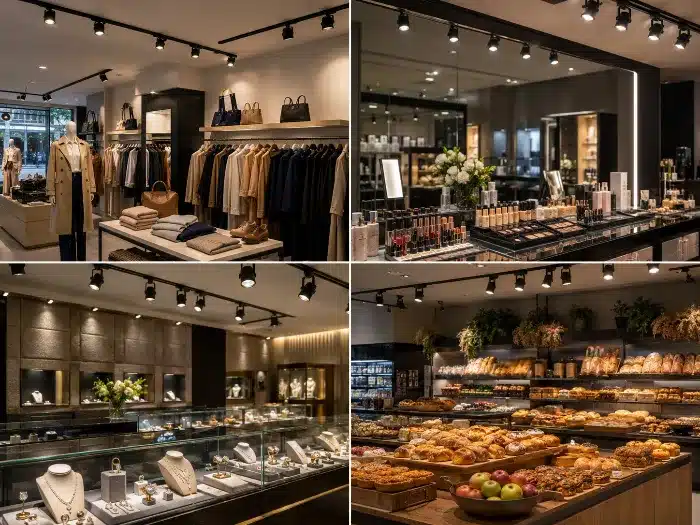
retail category lighting high cri gu10 selection
How to Select High CRI GU10 LEDs for Commercial Projects
TECO Product Specification References
The examples below are not generic placeholders. They are based on published TECO product page specifications and can help buyers connect the article’s selection criteria with real lamp families.
| Product Example | Verified Page Data | Best-Fit Retail Use |
|---|---|---|
| TECO Premium GU10 Pro 8W Ra98 Dimmable LED Bulb | 8W, Ra98, 2700K / 3000K / 4000K, up to 660 lm, 24° / 36° / 60°, Triac dimming, SDCM 3, 40,000-hour rated lifespan | High-end retail, galleries, museums, premium display zones |
| Диммируемая светодиодная лампа GU10 7,5 Вт CRI98, спот с высокой светоотдачей | 7.5W, CRI 98, 2700K / 3000K / 4000K, 510 / 550 / 570 lm, 24° / 36° / 60°, Triac dimming, flicker-free, SDCM 3 | Apparel stores, cosmetics counters, premium general retail |
| TECO Premium GU10 Zoomable LED 7.5W Spot Light | 7.5W, CRI 98, 2700K / 3000K / 4000K, 520 / 540 / 590 lm, adjustable 24° / 36° / 55°, Triac dimming, flicker-free, SDCM 3 | Retail layouts where beam angle may change between displays |
| TECO Premium MR16 GU5.3 Adjustable Beam Spotlight | MR16 / GU5.3, adjustable 24° / 36° / 55° beam, high CRI LED MR16 bulb positioning, dimmable driver, commercial 24-hour working design | 12V MR16 retail or display projects where transformer compatibility is confirmed |
R9 is still a project approval item rather than something to assume from the product title alone. If a retail specification requires R9 > 50 or stronger red rendering, the value should be confirmed through datasheet review, sample testing, or project-specific measurement before mass purchase.
On-Site / Commercial Reality
Commercial selection failures usually happen because the lamp is chosen from a datasheet without considering dimming behavior, batch control, thermal performance, and actual merchandise response. That may be manageable in a small site, but in chain retail or large-format fit-outs it creates a multiplied risk across every location.
The cost of choosing the wrong GU10 lamp is rarely limited to product replacement. It includes labor access, after-hours service, visual re-approval, and disruption to the opening schedule.
Deep Dive & Engineering Solution
A practical selection process for commercial high CRI GU10 projects should include the following checks:
- Confirm minimum CRI and R9 targets based on merchandise category.
- Define acceptable color consistency limits between lamps and between batches.
- Match beam angle to mounting height, shelf depth, and display intent.
- Select CCT according to brand atmosphere and product type.
- Verify dimmer compatibility if the project includes phase-cut control5.
- Review thermal conditions inside the actual luminaire housing.
- Approve samples using real merchandise, not white-board inspection only.
- Validate batch performance before full deployment.
Typical retail GU10 specification examples can be used as an early project filter before final sample approval:
| Retail Use Case | Typical CRI / R9 Target | CCT Direction | Beam Angle Direction | Заметки |
|---|---|---|---|---|
| Apparel store | CRI 90+, R9 > 50 | 3000K or 3500K | 36° or 60° | Balanced fabric tone and store warmth |
| Cosmetics counter | CRI 95+, strong R9 | 3500K to 4000K | 36° | Better skin-tone and product color accuracy |
| Jewelry display | CRI 95+ or CRI 98 | 3000K to 4000K by material | 24° or 36° | Narrower beams for sparkle and focus |
| General merchandise | CRI 90+ | 3000K to 4000K | 36° or 60° | Scalable for broader rollouts |
A common commercial baseline for premium retail GU10 review is CRI 90+, R9 > 50, 3000K or 4000K, 36° or 60° beam options, 25,000-hour class lifetime, and optional phase-cut dimming where the project requires it. Final values should still be confirmed against the actual dimmer, luminaire housing, ceiling height, and merchandise mock-up.
For apparel stores, cosmetics counters, and premium general retail zones, a product such as the Диммируемая светодиодная лампа GU10 7,5 Вт CRI98, спот с высокой светоотдачей fits this type of review because the published page data includes CRI 98, multiple CCT options, 24° / 36° / 60° beam options, Triac dimming, flicker-free operation, and SDCM 3. If the project uses 12V GU5.3 holders rather than mains-voltage GU10 holders, the TECO Premium MR16 GU5.3 Adjustable Beam Spotlight should be treated as a separate retrofit path with transformer and driver compatibility checked before approval.
| Selection Item | What to Verify | Why It Matters | Impact on Maintenance / ROI |
|---|---|---|---|
| CRI / R9 | Measured color rendering data | Ensures product color fidelity | Avoids visual rejection |
| Color consistency | Bin control and batch repeatability | Prevents visible ceiling mismatch | Reduces replacement sorting |
| Угол луча | Optical suitability for display | Avoids hot spots and poor coverage | Less site adjustment |
| CCT | Match to retail concept | Supports brand identity | Prevents relighting requests |
| Dimming behavior | Compatibility and smoothness | Important in mood-based retail scenes | Reduces flicker and instability complaints |
| Thermal reliability | Performance in enclosed fittings | Protects life and color stability | Lowers failure rate and RMA exposure |
The right commercial decision is not simply “choose the highest CRI available.” It is to select a lamp whose full performance profile has been verified against the project’s visual, electrical, and maintenance conditions.
Factory Note
From a manufacturing perspective, batch verification is essential for retail programs. Sample approval alone is not enough. For a chain-store rollout, the approved sample may look excellent, but later production lots still need checks for color point stability, R9 consistency, aging performance, and dimmer behavior. This is especially important when the same GU10 lamp will be installed across apparel walls, cashier zones, window displays, and promotional areas.
ЧАСТО ЗАДАВАЕМЫЕ ВОПРОСЫ
What CRI is recommended for retail lighting?
For many retail applications, CRI 90+ is a strong starting point. Premium displays, cosmetics, jewelry, galleries, and luxury retail may require CRI 95+ or CRI 98 depending on how critical color accuracy is to the buying decision.
Is CRI 90 enough for apparel stores?
CRI 90+ can be enough for many apparel stores when R9, CCT, beam angle, and batch color consistency are properly controlled. For high-end fashion or color-critical fabrics, sample testing with actual merchandise is still recommended.
Why is R9 important in retail lighting?
R9 measures saturated red rendering, which affects skin tones, cosmetics, warm fabrics, food, leather, and some branded packaging. Two lamps can both claim CRI 90 while showing different R9 performance in real displays.
Does high CRI reduce LED efficiency?
High CRI can reduce luminous efficacy because spectral tuning often requires trade-offs in output. This is why CRI 98 should be used where the visual benefit justifies the cost, output, and procurement impact.
What beam angle is best for retail GU10 spotlights?
There is no single best beam angle. Narrow beams such as 24° are useful for focused highlights, while 36° and 60° are often used for broader displays, apparel walls, and general accent lighting. The choice should match ceiling height, shelf depth, and display intent.
Conclusion: Business Value
For retail projects, high CRI GU10 LEDs create value when they improve merchandise appearance consistently and predictably across the full installation, not when they only offer an impressive catalog number. The most reliable commercial result comes from evaluating CRI, R9, beam control, CCT, dimming behavior, and batch consistency together.
That approach reduces maintenance effort, lowers relighting risk after commissioning, and helps protect long-term system cost by avoiding repeated site intervention.
Инженерная рекомендация для B2B
For retail projects, the most useful specification is not a single CRI number but a complete visual and electrical profile:
| Retail Zone | Recommended Starting Point |
|---|---|
| Fashion store | CRI 90+, R9 > 50, 3000K or 3500K, 36° or 60° |
| Косметика | CRI 95+, strong R9, 3500K to 4000K, controlled glare |
| Jewelry / luxury display | CRI 95+ or CRI 98, narrow-to-medium beam, high consistency |
| General retail rollout | CRI 90+, stable bin control, verified dimming compatibility |
For large retail projects, share the store layout, ceiling height, target CCT, beam angle plan, dimming method, approved merchandise samples, and rollout quantity before mass production. The Teco engineering team can review GU10 specification fit, check dimmer compatibility, verify batch color consistency, and support sample testing before full deployment.
Сноски
Color consistency refers to how closely the emitted light color matches between lamps and across production batches. ↩
CCT, or correlated color temperature, describes whether light appears warmer or cooler in tone, typically expressed in Kelvin. ↩
R9 is a color rendering index sample value representing saturated red performance, which is important in merchandise presentation. ↩
Luminous efficacy is the amount of visible light output produced per unit of electrical power consumed. ↩
Phase-cut control is a common dimming method that adjusts lamp power by trimming parts of the AC waveform. ↩